
There is a particular kind of conversation I have learned to recognise after twenty-four years in this trade. It usually begins with an international buyer or analyst who has just discovered that Nigeria sits on serious deposits of the very minerals their industry is desperate for, and it almost always carries the same note of surprise. “We did not realise Nigeria was even in this conversation,” they say. And I understand the surprise, because for most of the last two decades we genuinely were not. But anyone trying to understand Nigeria’s Position in the Global Battery Minerals Market today by looking at where we stood ten years ago is reading an old map. The terrain has shifted, and it is worth taking the time to describe what it actually looks like now from someone standing on the ground.
The battery minerals story is, at its heart, the story of the entire global energy transition. The metals that go into a lithium-ion cell, lithium, nickel, cobalt, manganese, and graphite, are no longer obscure industrial commodities. They are the strategic raw materials of the twenty-first century, and the world is scrambling to secure them. The question I want to address honestly is where Nigeria fits in that scramble, what we genuinely have to offer, and where the gap between potential and performance still lies.

A Market That Will Not Stop Growing
To understand our position, you first have to grasp the sheer scale and momentum of the market we are talking about. Global lithium-ion battery demand rose by twenty-nine percent in a single recent year, reaching well over one and a half terawatt-hours, driven by electric vehicles and the explosive growth of battery energy storage systems. The total lithium-ion battery market has expanded more than sixfold in the space of five years, and it is still climbing. The global battery raw materials market is now valued in the tens of billions of dollars and is forecast to roughly double over the coming decade.
After a brutal price slump, battery metals came roaring back into 2026. Lithium nearly doubled, nickel surged, and a closely watched battery metals index hit a multi-year high. The raw material bill for the lithium, graphite, nickel, cobalt, and manganese contained in the electric vehicles sold in a single recent year climbed into the tens of billions of dollars. This is not a market with a ceiling in sight. Demand for lithium alone is widely expected to triple before the end of this decade.
But there is a second, quieter fact about this market that matters even more for Nigeria, and it is this: the value is concentrated not in digging the minerals out of the ground, but in refining them. Refining and processing capacity for the key battery minerals is extraordinarily concentrated, with the top three nations controlling the overwhelming majority of global refining, and almost all recent supply growth flowing to a single dominant supplier. That concentration is exactly the vulnerability the rest of the world is now trying to correct, and it is exactly the opening through which a country like Nigeria can step.
What Nigeria Actually Brings to the Table
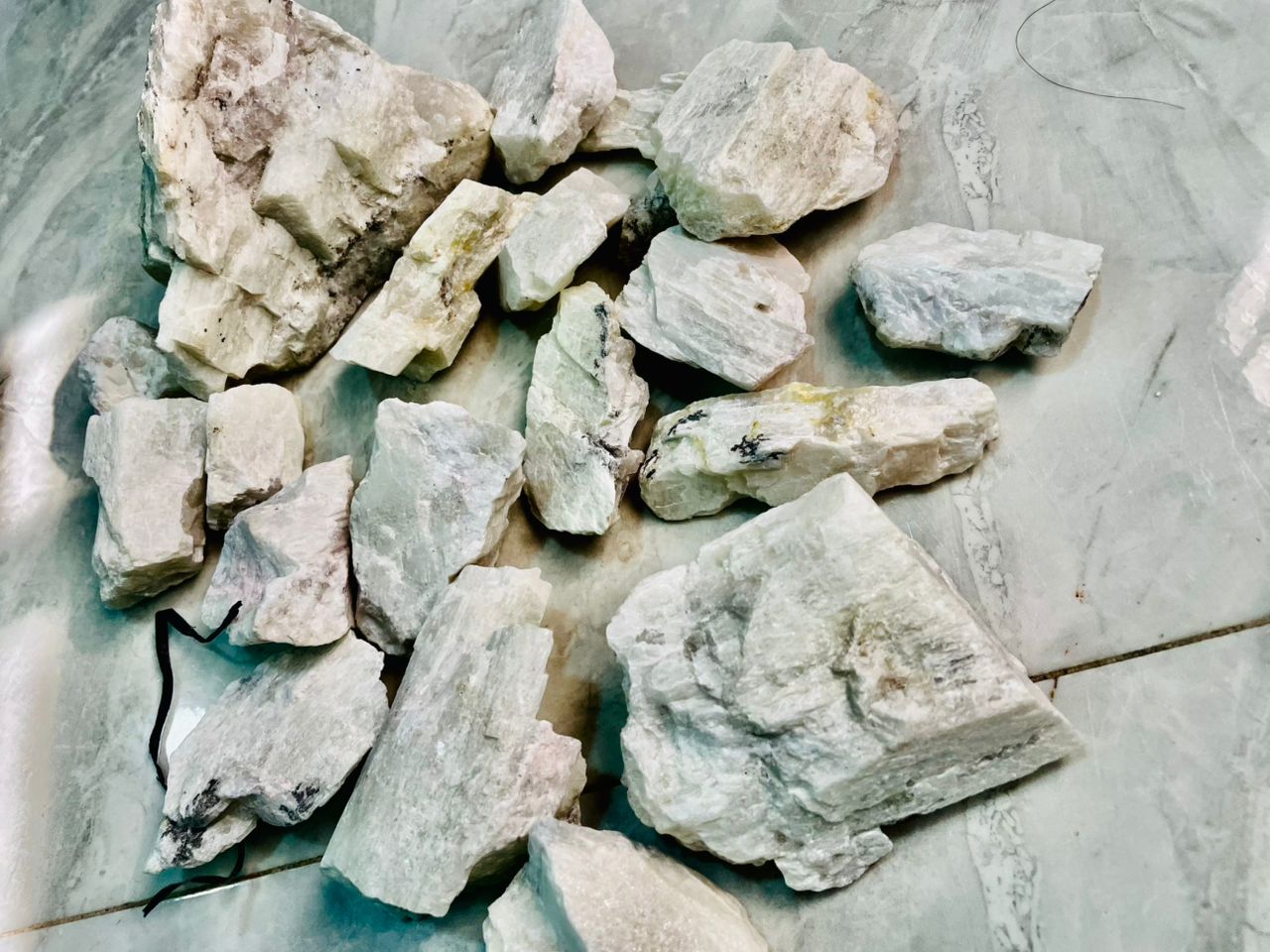
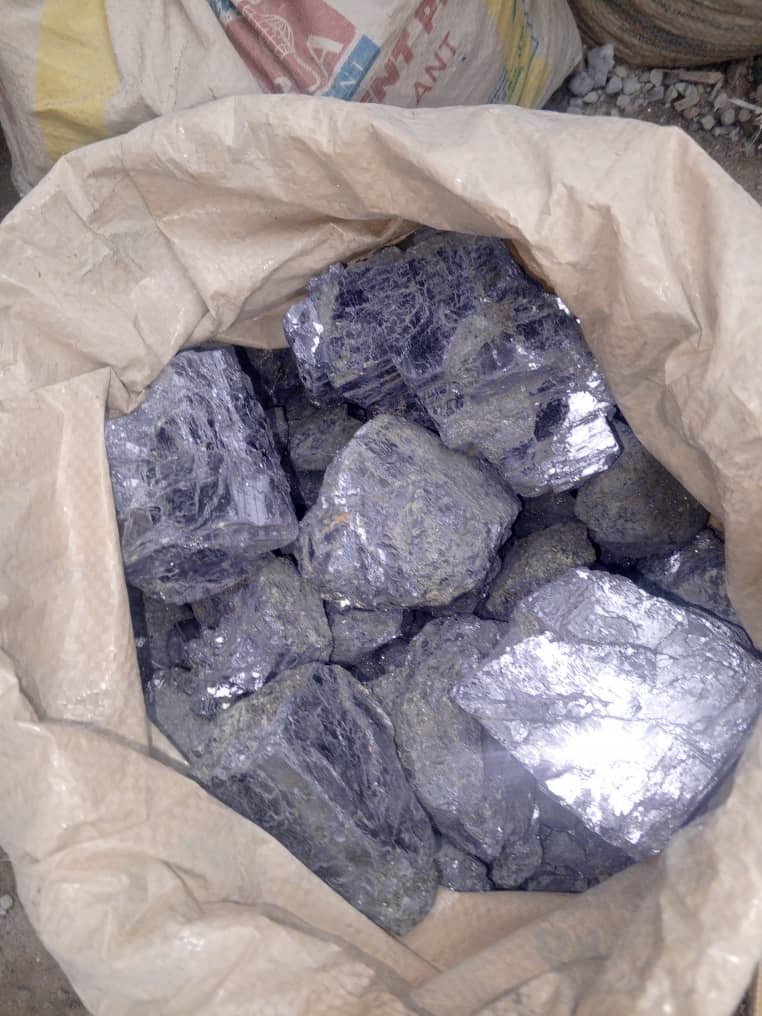
So what do we have? More than the world generally credits us with. Nigeria is estimated to hold one of the largest lithium endowments on the African continent, with significant spodumene and lepidolite-bearing pegmatites concentrated across the North-Central belt, particularly in Nasarawa, Plateau, and Kaduna. Beyond lithium, the country holds documented resources of cobalt, manganese, graphite, nickel, copper, zinc, and rare earth elements distributed across multiple states. These are not minor accompaniments. Graphite is the dominant anode material by weight in virtually every lithium-ion battery made today, and manganese and nickel are among the fastest-growing battery minerals by demand. Nigeria has all of them in the same national portfolio.
This is the point that I think is genuinely under-appreciated, both abroad and at home. The battery is not made from a single mineral. A finished cell brings together a cathode built from lithium combined with nickel, cobalt, and manganese in various ratios, and an anode built predominantly from graphite. Very few countries hold meaningful reserves across that entire basket. Nigeria does. Our unexplored critical mineral wealth has been valued by the government at figures running into the hundreds of billions of dollars. That breadth gives Nigeria a structurally interesting position: not as a one-mineral supplier vulnerable to the price swings of a single commodity, but as a potential multi-mineral contributor to the battery supply chain.
From Raw Exporter to Value Builder
For most of our history, the trouble has not been the geology. It has been what we did with it. Africa as a whole holds roughly thirty percent of global mineral reserves yet captures only about ten percent of the value generated from its mineral exports, precisely because the continent was structured as a raw-material supplier and the profitable work of processing happened elsewhere. Nigeria fit that pattern exactly. For years, lithium left the country as raw ore, often through informal channels, with sellers who did not even know the true value of what they were shipping.
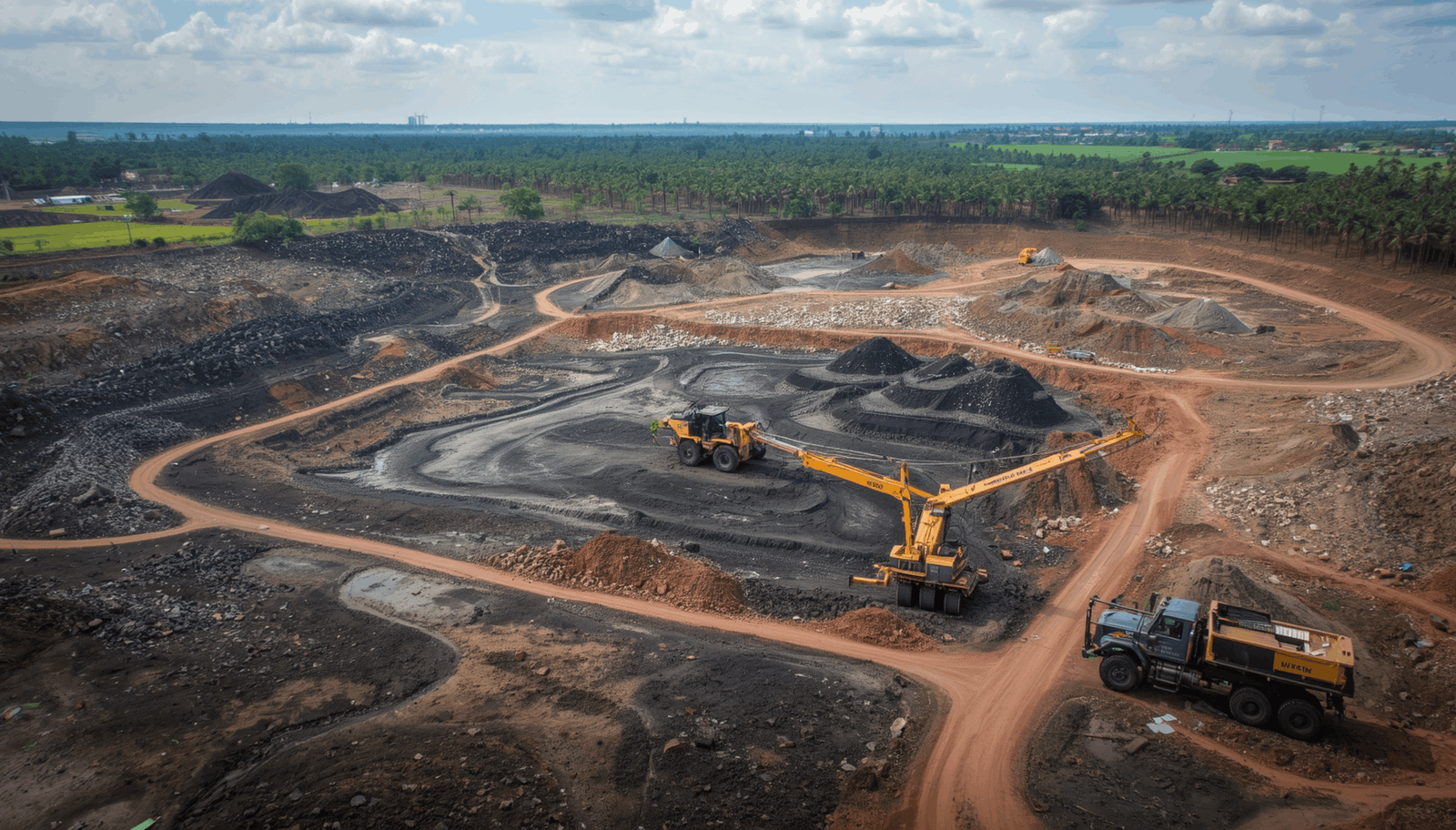
That is the part of the map that has genuinely changed. The federal government, through the Ministry of Solid Minerals Development under Minister Dele Alake, has set an explicit policy of local beneficiation, discouraging raw-ore export and demanding that minerals be processed before they leave. Billions of dollars in lithium and rare earth processing capacity are being committed and constructed, with the stated ambition of processing a meaningful share of our minerals domestically and lifting mining’s contribution to GDP. The intent is to move Nigeria up the value chain, from selling rock to selling concentrate, and eventually toward the battery-grade chemicals and components that command the real margins. Whether we achieve the full ambition is a separate question, but the direction of national policy has decisively turned, and that matters enormously for where we sit in the global market.
The Honest Challenges
I have never believed in selling a story that does not survive contact with reality, so let me be candid about what stands between Nigeria and the position it aspires to.
The first constraint is power. Refining battery minerals to battery-grade purity is costly and intensely energy-hungry, and Nigeria’s electricity supply remains inadequate for industrial-scale processing without dedicated captive generation. Every serious project must solve its own energy problem before it solves anything else.
The second is the informal nature of much of our mining. A great deal of production remains artisanal, undocumented, and irregular in both volume and grade. Industrial processing plants and international buyers need predictable, well-characterised supply, and bridging the distance between scattered small-scale miners and reliable industrial intake is a real, ongoing challenge of organisation and trust.
The third is the familiar cluster of infrastructure, transparent licensing, sustained capital, and the cyclicality of mineral prices. Battery metals are volatile; fortunes are made by those who understand this is a structural decade-long shift and lost by those who flee at the first downturn. And the fourth, which I refuse to treat as an afterthought, is the need for credible environmental and community stewardship, because a supply chain that the world increasingly judges on ESG standards will not reward operators who cut those corners.
None of this cancels the opportunity. It defines who is serious enough to capture it.
Where Augustina Impex Fits In
I did not write this as an academic exercise. This is the market my company lives in every day. At Augustina Impex Limited, we have spent more than two decades trading and facilitating the export of Nigeria’s solid minerals, including the very battery-relevant materials at the centre of this story, alongside our broader portfolio of monazite, ilmenite, zircon, columbite, tantalite, tin, fluorite, and garnet. We know the distance between a heap of ore at the mine gate and a quality-controlled consignment that an international processor or buyer will pay a premium for, because closing that distance is the work we do.
For investors and processors looking at Nigeria’s battery minerals, we offer on-the-ground sourcing intelligence, reliable aggregation, and the export facilitation that turns ambition into shipped tonnes. For miners and aggregators, we provide a credible and disciplined route to serious international markets. As Nigeria steadily climbs from raw exporter toward value builder, the firms that can dependably connect feedstock to processor and consignment to buyer will be the indispensable links in that chain, and that is precisely the role we are built to play.
If you are weighing Nigeria’s Position in the Global Battery Minerals Market, whether as an investor seeking entry, a processor needing trustworthy feedstock, or a buyer wanting a dependable Nigerian partner, I would welcome a conversation. The map has changed. The opportunity belongs to those who read it correctly and move.
Kolawole King Chief Executive Officer, Augustina Impex Limited #288 Diye Ward, Zarmaganda, Jos South, Plateau State, Nigeria Email: augustinaimpex@gmail.com WhatsApp: +234 906 090 4274 Website: https://augustinaimpex.com Blog: https://augustinaimpexng.blogspot.com/ Advert Video: https://www.youtube.com/watch?v=Izg0t7By6co
#BatteryMinerals #NigeriaCriticalMinerals #Lithium #Graphite #Manganese #Cobalt #EVBatteries #BatteryMetals #GlobalSupplyChain #EnergyTransition #CriticalMineralsAfrica #MineralBeneficiation #SolidMineralsNigeria #NigeriaMining #LithiumIonBatteries #BatteryRawMaterials #MineralExportNigeria #ValueAddition #AugustinaImpex #GreenEnergyMinerals #EVSupplyChain #Spodumene
Post a comment
Related Posts
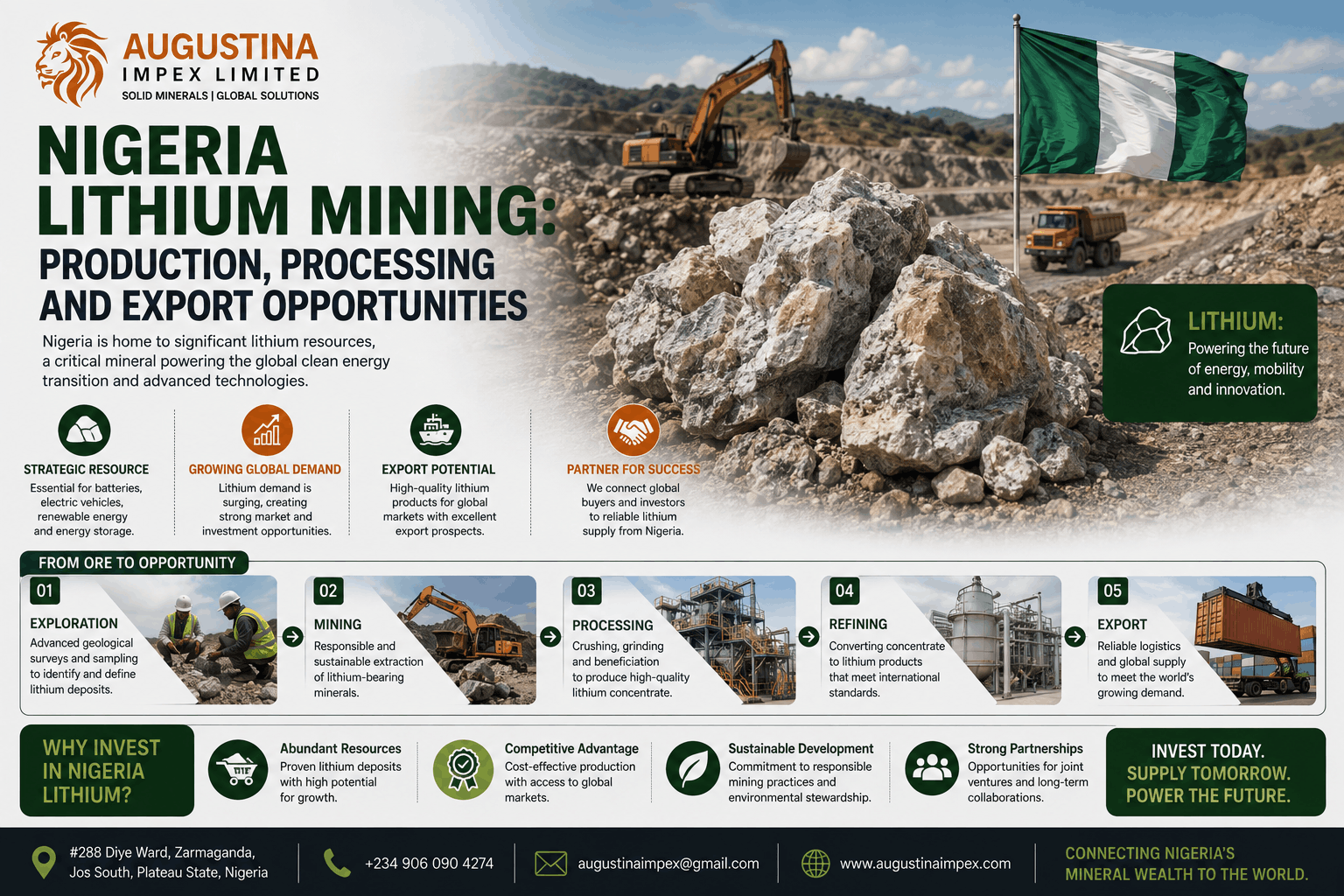
Nigeria Lithium Mining: Production, Processing & Export
Nigeria Lithium Mining: Production, Processing and Export Opportunities By Kolawole King, CEO — Augustina Impex…
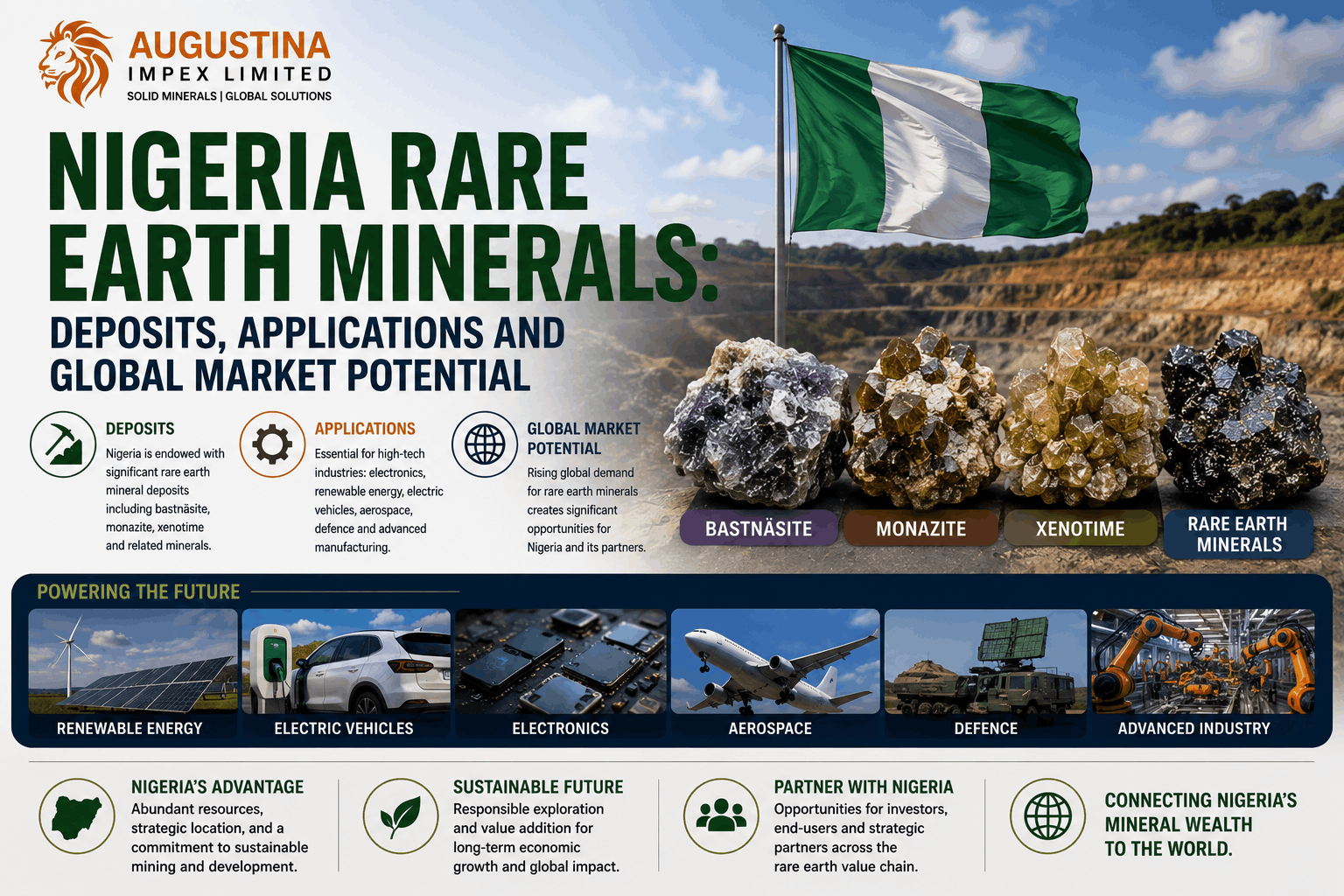
Nigeria Rare Earth Minerals: Deposits & Market Potential
Nigeria Rare Earth Minerals: Deposits, Applications and Global Market Potential By Kolawole King, CEO —…
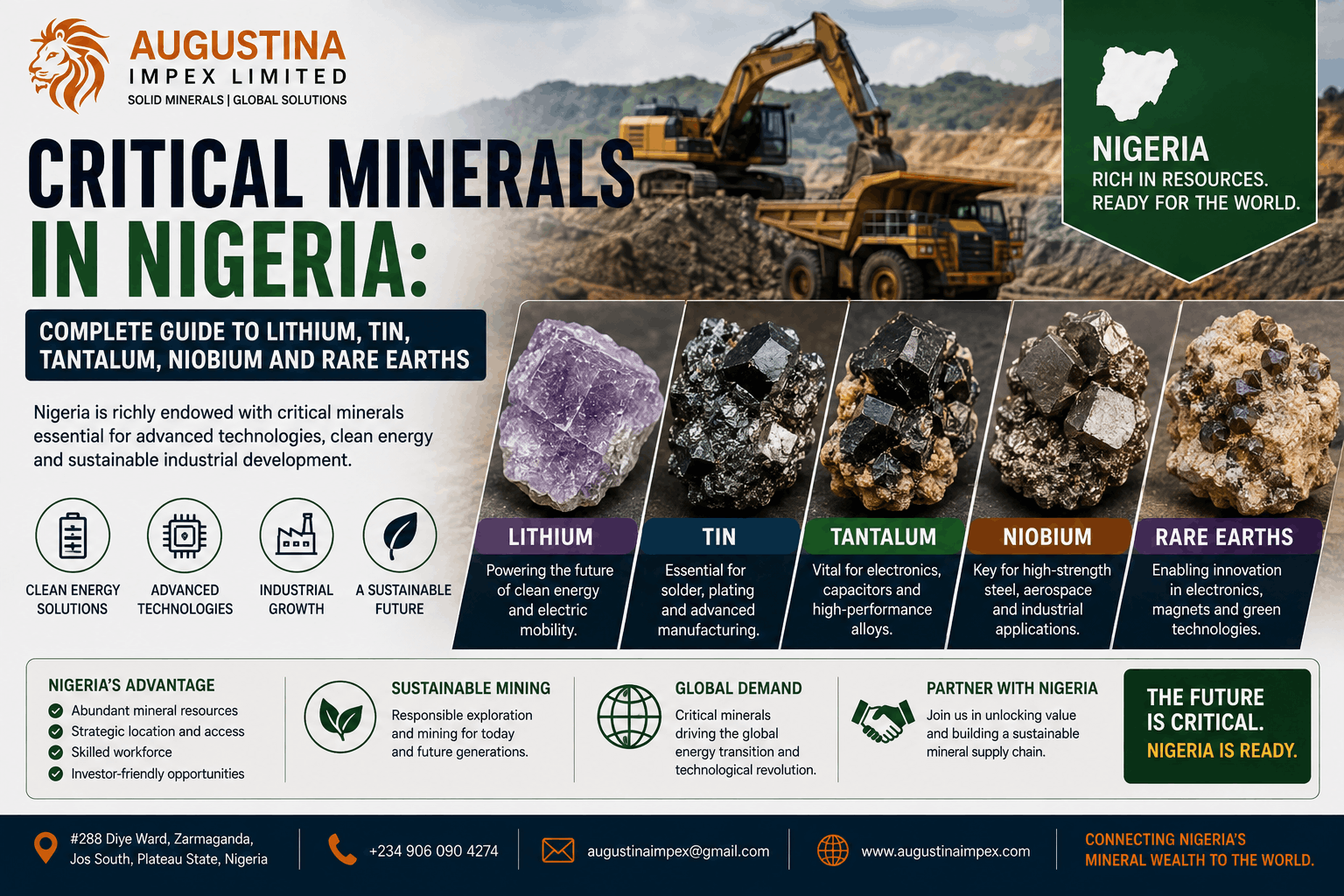
Nigeria Critical Minerals Guide: Lithium, Tin & Rare Earths
Critical Minerals in Nigeria: Complete Guide to Lithium, Tin, Tantalum, Niobium and Rare Earths By…
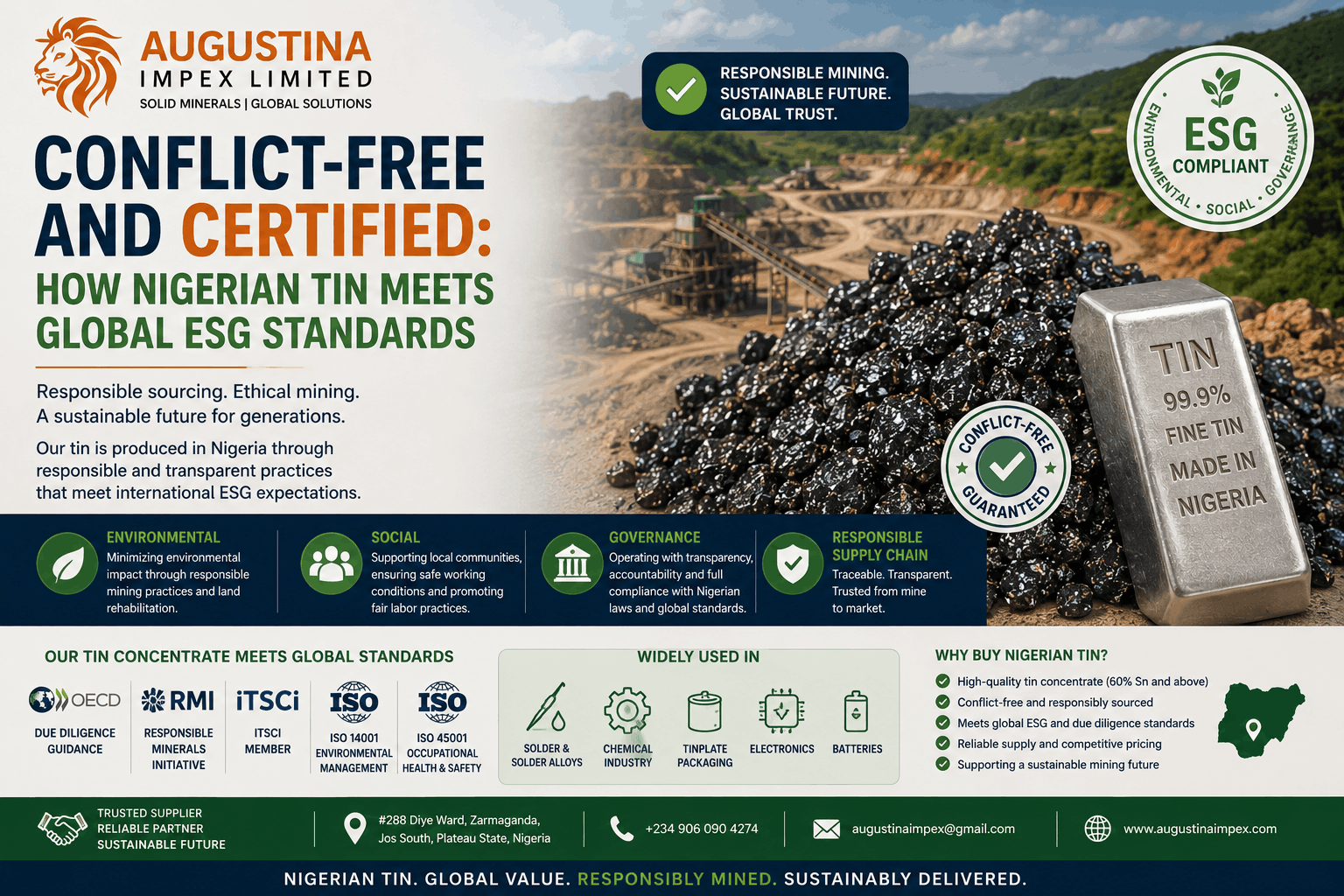
Conflict-Free Nigerian Tin Meets Global ESG Standards
Conflict-Free and Certified: How Nigerian Tin Meets Global ESG Standards By Kolawole King, CEO —…