
The global race for lithium is intensifying, and a growing number of international buyers — procurement teams at battery manufacturers, commodity traders, chemical converters, and supply chain strategists — are looking beyond the traditional lithium powerhouses of Australia, Chile, and increasingly China-influenced Zimbabwe. They are looking at Nigeria.
Nigerian lithium ore is not a new discovery. Nigeria’s pegmatite belt has been documented by geologists since the colonial era. What is new is the urgency with which the world needs non-Chinese lithium supply, and the growing recognition that Nigeria’s spodumene and lepidolite deposits are not only real and accessible — they are commercially competitive and strategically significant.
This article explains, in full, why international buyers are choosing Nigerian lithium ore in 2026 and beyond. We examine the geological reality, the geopolitical drivers, the commercial logic, the supply chain mechanics, and what working with a verified Nigerian lithium ore exporter actually looks like in practice.

The Global Lithium Supply Crisis: Why Origin Matters More Than Ever
For most of the past decade, the conversation around lithium supply was relatively simple: Australia mined and concentrated spodumene, China processed it into lithium hydroxide and lithium carbonate, and battery makers around the world consumed those chemicals. This integrated supply chain was efficient and cost-effective — but it created a structural vulnerability that 2025 exposed with brutal clarity.
China’s export controls on critical minerals, implemented in phases from 2023 onward, sent shockwaves through the battery supply chains of South Korea, Japan, the European Union, and the United States. While spodumene itself was not directly embargoed, processed lithium chemicals and associated rare earth compounds faced increasing scrutiny, licensing requirements, and in some cases outright export restrictions. The message to global manufacturers was unmistakable: if your lithium supply chain runs through China, you are exposed.
Simultaneously, the International Energy Agency and major investment banks revised upward their forecasts for lithium demand. The EV transition is not slowing — it is accelerating. Global EV sales set new records in both 2024 and 2025. Grid-scale battery storage deployment doubled year-on-year. Consumer electronics demand remained robust. Every battery in every one of these applications needs lithium, and the world does not have enough diversified, non-Chinese-controlled supply to meet the trajectory.
This is the context in which international buyers are looking at Nigeria. Not because Nigeria is the easiest or most familiar origin — but because the world urgently needs more sources of lithium mineral raw material that are not embedded in China’s supply chain architecture. Nigeria offers exactly that.
Nigeria’s Lithium Geology: What the Rocks Actually Say
Understanding why international buyers choose Nigerian lithium ore starts with understanding what is actually in the ground. Nigeria’s lithium endowment is geological fact, not marketing narrative, and the numbers are compelling.
Nigeria sits on a vast expanse of Precambrian basement complex geology — ancient crystalline rocks, primarily granites and gneisses, that have remained geologically stable for hundreds of millions of years. Associated with this basement complex are extensive zones of granitic pegmatites: coarse-grained igneous rocks that crystallised slowly from magma rich in water and volatiles, concentrating incompatible elements — including lithium — to extraordinary levels.
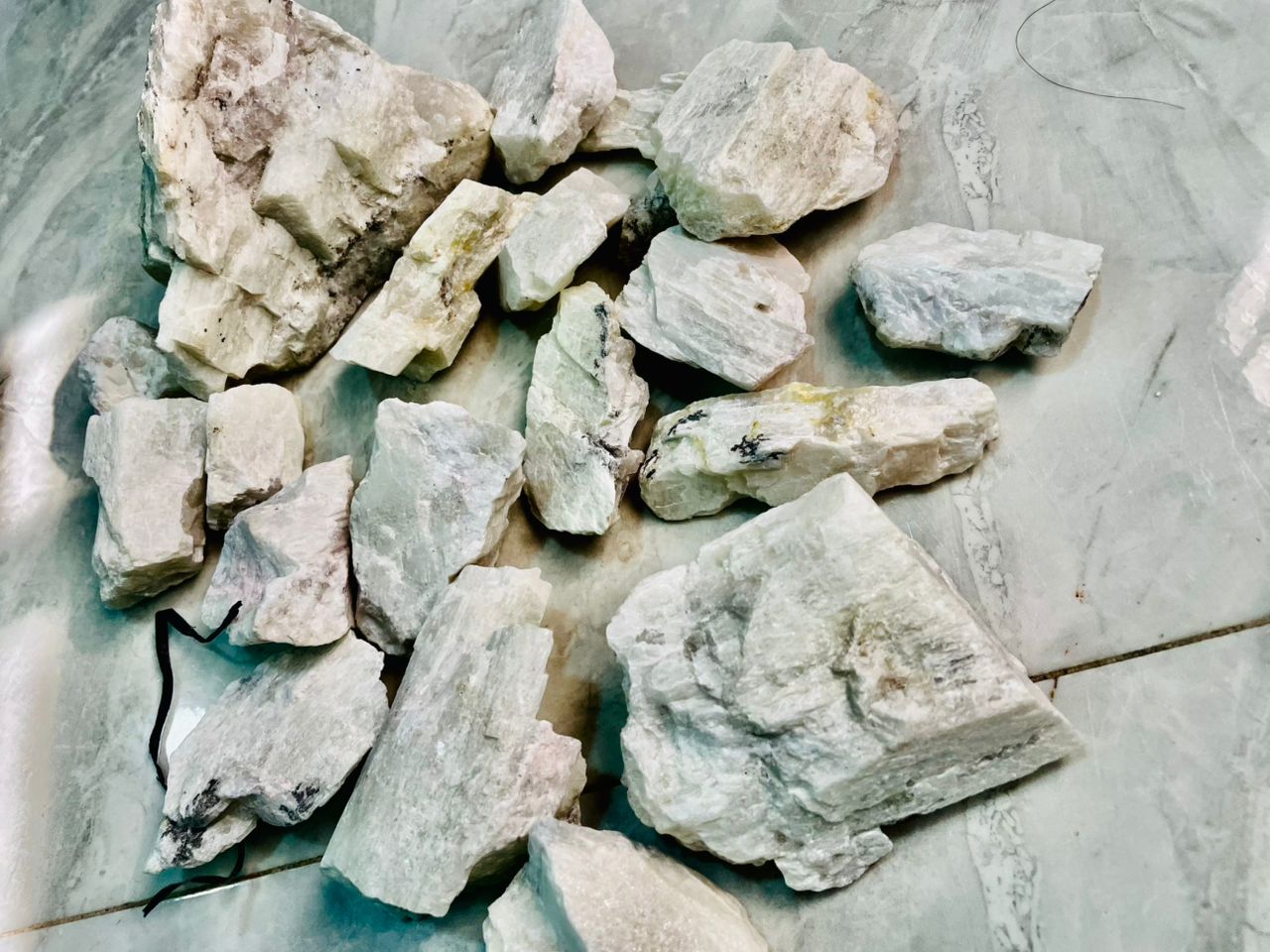
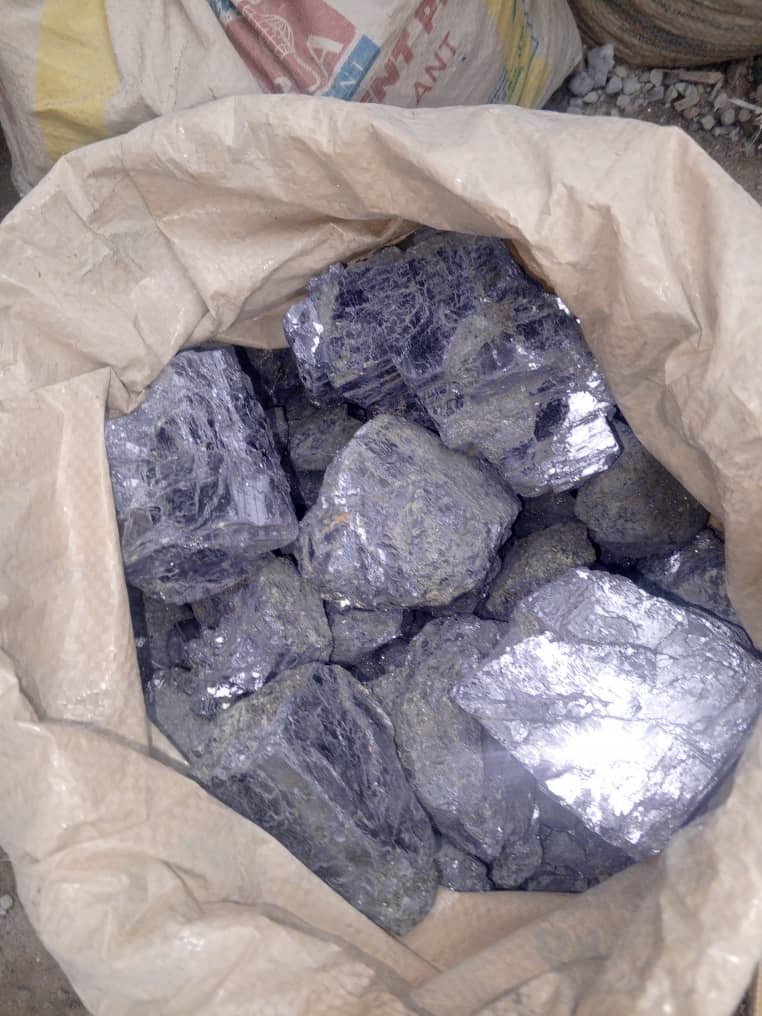
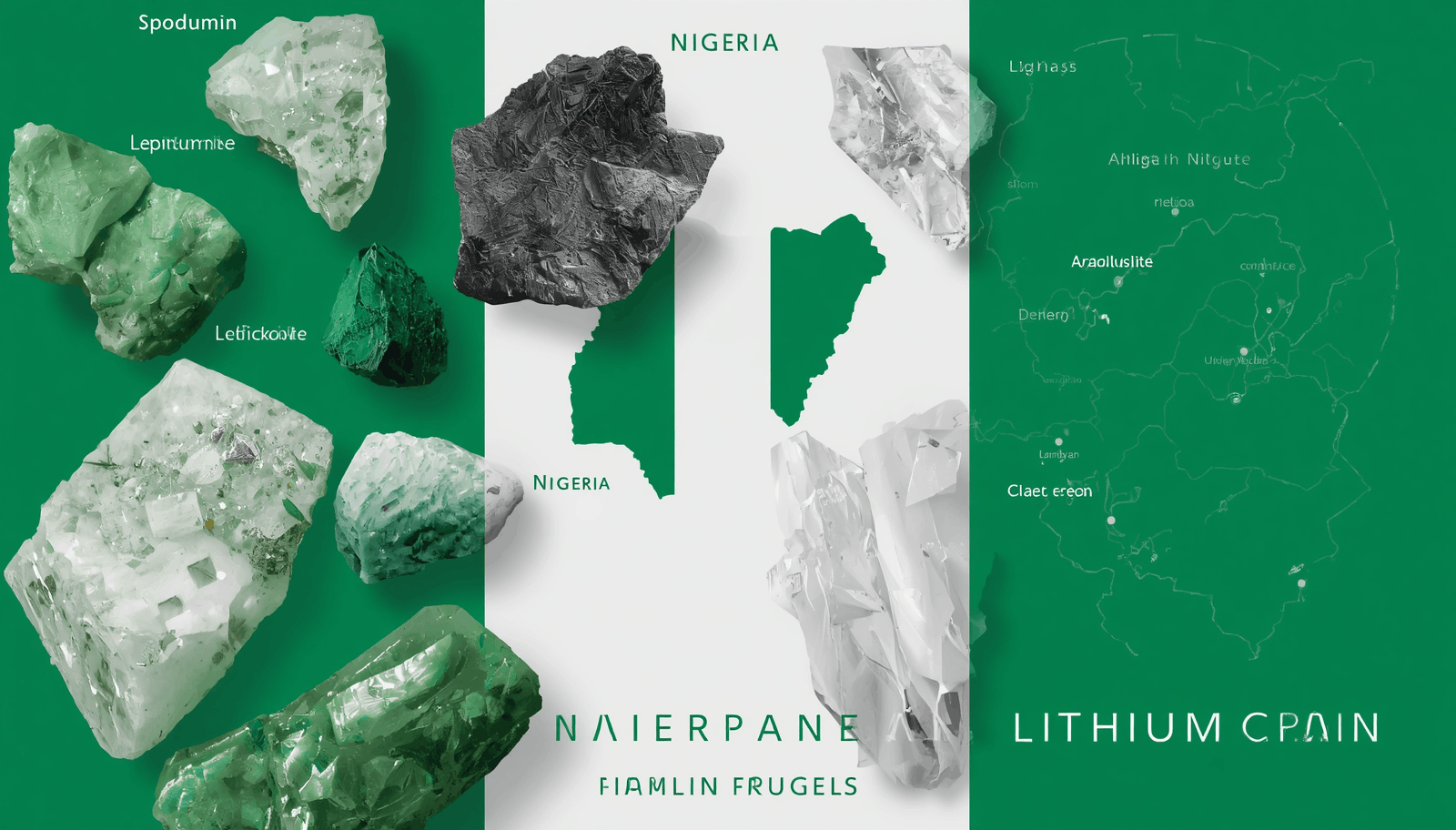
The lithium-bearing minerals found in Nigerian pegmatites include primarily spodumene (LiAlSi₂O₆) and lepidolite (K(Li,Al)₃(Al,Si)₄O₁₀(OH,F)₂), alongside amblygonite and petalite in some formations. Spodumene — the same mineral that drives Australia’s world-leading lithium production at Greenbushes, Wodgina, and Pilgangoora — has been confirmed in multiple states with lithium oxide (Li₂O) grades of up to 8–9% in the richest Nigerian pegmatites. This is above the global commercial threshold by a significant margin.
The primary lithium-bearing states in Nigeria are:
| Nasarawa State | Recognised as Nigeria’s “Lithium Hub.” The state hosts the country’s densest concentration of documented lithium pegmatites, with deposits confirmed in Kokona, Karu, Nasarawa, Agwada, and Keffi LGAs. Li₂O grades of 5–9% have been recorded in field assays. |
| Kwara State | Oke Ode and Shagbe are among the notable spodumene occurrences. The Kwara State government has been proactive in aligning with NEPC on solid minerals export governance, enhancing credibility for sourcing from this region. |
| Kaduna State | Significant pegmatite formations hosting spodumene alongside columbite-tantalite. Kaduna has a well-established artisanal and small-scale mining sector and growing institutional investment. |
| Plateau State | Nigeria’s historic mining heartland. Plateau hosts spodumene alongside tin, columbite, and rare earth minerals. The established mining and export infrastructure in Jos gives Plateau State an operational advantage. |
| Cross River State | An emerging lithium prospecting zone with confirmed spodumene presence in Eastern Nigerian basement complex pegmatites. Largely underexplored — a frontier opportunity for buyers seeking early-mover positioning. |
Critically, Nigeria’s lithium resource base is substantially underexplored by international mining standards. The absence of systematic, large-scale geological surveys means that the deposits that have been identified — and are already being commercially mined and exported — almost certainly represent only a fraction of what exists in the country. Buyers entering the Nigerian lithium market now are accessing supply before the full scale of the resource is understood, and before global capital arrives in force and prices in the true scarcity premium.
Reason 1: Supply Chain Diversification Away from Chinese Control
If you ask procurement managers at South Korean battery makers, European automotive OEMs, or US Department of Defense-aligned material suppliers why they are looking at Nigerian lithium ore, the first answer — almost universally — is diversification. They need lithium sources that are not controlled by, processed through, or commercially dependent on Chinese entities.
Nigeria meets this criterion definitively. Nigerian lithium ore is mined by Nigerian operators, concentrated by Nigerian processing facilities, exported by NEPC-registered Nigerian companies, and shipped from Nigerian ports directly to buyers worldwide. The supply chain from mine to vessel does not pass through China, does not involve Chinese processing, and is not subject to Chinese export licensing.
For buyers operating under the EU’s Critical Raw Materials Act, the US Inflation Reduction Act’s domestic content provisions for battery supply chains, or Japan’s Strategic Energy Plan supply security requirements, Nigerian origin lithium can contribute to non-Chinese-origin sourcing quotas that are becoming increasingly mandatory — not merely aspirational.
This supply chain independence from China is, for many international buyers, the single most powerful commercial argument for Nigerian lithium ore, entirely independent of price or grade considerations. The geopolitical risk premium attached to Chinese-origin lithium supply is now large enough to justify sourcing from emerging origins like Nigeria even if prices were comparable — and, as we discuss below, Nigerian prices are in fact competitive.
Reason 2: Zimbabwe’s Export Restrictions Are Redirecting African Lithium Trade
Africa’s role in global lithium supply was transformed by Zimbabwe’s extraordinary rise: from negligible production in 2020 to one of the world’s top five spodumene producers by 2024. Chinese companies invested heavily in Zimbabwean lithium mines — Bikita Minerals, Prospect Lithium Zimbabwe, Zhedar Resources — and Zimbabwe rapidly became one of the most important feedstock sources for Chinese lithium converters.
But Zimbabwe then moved to capture more of the downstream value by mandating domestic processing. The policy, prohibiting the export of unprocessed lithium concentrate and taking full effect from 2027, is already disrupting offtake relationships and creating supply gaps for buyers who relied on Zimbabwean material. The implicit message is clear: if you want Zimbabwean lithium, you need to process it in Zimbabwe — which requires investment in Zimbabwean infrastructure, compliance with Zimbabwean regulations, and alignment with Zimbabwean political priorities that many international buyers are not positioned or willing to undertake.
This policy-driven supply gap from Zimbabwe is creating a tangible market opportunity for Nigeria. Nigerian spodumene does not carry export processing mandates. Nigerian mineral exports are governed by the NEPC permit framework — which requires licensing and compliance, but does not require buyers to process in Nigeria. You can import Nigerian lithium ore as a raw concentrate, process it at your facility, and capture the downstream value in your own jurisdiction.
For buyers who built sourcing models around Zimbabwean material, Nigeria is the most logistically comparable replacement in Africa — similar geological product, similar shipping routes to Asian markets, similar FOB export structure. The transition is not seamless, but it is practical.
Reason 3: Grade and Quality That Competes with Global Benchmarks
International buyers are commercially sophisticated. They do not choose an origin based on geopolitics alone — they need the lithium mineral they are buying to meet the grade and quality specifications that their converters and downstream processes require. Nigerian lithium ore passes this test.
The commercial standard for spodumene concentrate in global trade is SC6 — material containing a minimum of 6.0% Li₂O. This is the specification that lithium hydroxide and lithium carbonate converters in China, South Korea, and Japan require as feedstock for battery-grade chemical production. Nigerian spodumene, sourced from quality-controlled production with proper processing and beneficiation, meets and in some cases exceeds SC6 specification.
The following grade characteristics define commercially available Nigerian lithium ore:
- Grade Range: Li₂O content: 5.0% to 9.0% in raw pegmatite; 6.0% to 7.5% achievable in concentrated product after flotation processing
- Iron Oxide: Fe₂O₃ content: ≤1.0% in quality-processed material — important for battery-grade converter economics
- Moisture: Moisture: ≤8% on a wet basis; contracts settled on dry-weight basis
- Physical Form: Physical form: granular concentrate suitable for direct feeding into calcination kilns for lithium hydroxide or carbonate production
- Chemical Panel: Full elemental oxide panel: Al₂O₃, SiO₂, CaO, MnO, P₂O₅, Na₂O, K₂O confirmed via ISO/IEC 17025 accredited laboratory analysis
Every commercial consignment of Nigerian lithium ore offered by reputable exporters is supported by laboratory analysis from accredited testing facilities — Zirconex Mining & Metal Laboratory (ISO/IEC 17025), SGS Nigeria, or equivalent — confirming the specific grade and chemical composition of the identified batch. This is not aspirational specification: it is verifiable, documented material quality.
Reason 4: Competitive Pricing in a Tightening Market
Global spodumene SC6 prices recovered strongly through 2025 and into 2026, climbing above USD 2,000 per metric tonne CIF China as structural supply deficits reasserted themselves after the brief demand lull of 2024. In this pricing environment, Nigerian spodumene concentrate — offered on FOB Lagos terms — represents a compelling commercial option for buyers who have freight-cost efficiency through established vessel scheduling to Asian ports.
Nigerian lithium ore pricing reflects the reality of an emerging supply origin: there is a discount to the Australian benchmark that reflects logistical unfamiliarity, the additional due diligence requirements of working with a newer source, and the absence of the long-term offtake relationships that anchor Australian pricing. This discount will narrow as Nigeria’s supply credentials become more widely established — which means buyers entering the market now capture a price advantage that will not be available indefinitely.
Key pricing dynamics for Nigerian lithium ore in 2026 include:
| SC6 vs SC5 Premium | SC6 (≥6.0% Li₂O) commands a 15–25% premium over SC5 (≥5.0% Li₂O). Premium Nigerian material meeting SC6 spec should be priced on SC6 terms. Always confirm grade with independent laboratory analysis before agreeing a price. |
| Volume Discount | Quarterly or annual offtake commitments unlock better unit pricing than spot purchases. If you can offer volume certainty, negotiate accordingly — Nigerian exporters value reliability and will price it into the contract. |
| Payment Terms Effect | Letter of Credit (LC) at sight terms generally yield a better quoted price than T/T, because the seller’s financing risk is lower. For commercial orders, LC at sight is both the safer and the more economical instrument. |
| Western Buyer Premium | Market data consistently shows European and North American buyers pay a premium for Nigerian minerals relative to comparable Asian buyer offers. Use Asian market reference pricing as your negotiation anchor. |
| FOB vs CIF | Nigerian exporters offer FOB Lagos, Lekki, or Onne. CIF China prices need to add ocean freight (approx. USD 50–90/t) and marine insurance to the FOB price. Control your own freight — it gives you more price transparency and negotiating leverage. |
Nigeria vs Other Global Lithium Origins: A Direct Comparison
How does Nigerian lithium ore stack up against the established global supply sources? This comparison is important for buyers who need to justify the sourcing decision internally, against colleagues or stakeholders who may be more familiar with Australian or Chilean supply chains.
| Factor | Australia | Zimbabwe | Chile | Nigeria |
| Primary Mineral | Spodumene SC6 | Spodumene SC6 | Lithium brine | Spodumene / Lepidolite |
| Li₂O Grade (hard-rock) | 6.0 – 7.5% | 6.0 – 7.0% | N/A (brine) | Up to 8–9% in pegmatites |
| Chinese Influence | Moderate | Very High | High | Low |
| Export Restrictions | None | Processing mandate (2027) | None | None (permit-based) |
| FOB to China (est. days) | 18 – 24 | 20 – 28 | 30 – 40 (Pacific) | 25 – 35 |
| Regulatory Maturity | High | Moderate | High | Developing, NEPC-governed |
| Price Competitiveness | Benchmark | Similar to AUS | Brine economics differ | Competitive / emerging discount |
The key takeaway from this comparison is that Nigeria offers a genuinely differentiated value proposition — not simply a lower-cost version of what Australia already provides, but a strategically distinct origin with its own advantages: low Chinese influence, no export processing mandates, competitive hard-rock grades, and an emerging discount that early movers can capture. The disadvantages are real — regulatory maturity is developing, and due diligence requirements are higher — but they are manageable with the right local partner.
Reason 5: A Supportive Regulatory Framework Built for Export
One concern international buyers sometimes raise about emerging mineral origins is regulatory uncertainty — the worry that licences may be invalid, export documentation may be fraudulent, or that the Nigerian government may introduce export restrictions that disrupt supply. Understanding the actual Nigerian regulatory framework dispels much of this concern.
Nigerian lithium mineral export operates under a well-defined statutory framework, administered by credible government agencies:
- MMSD: The Ministry of Mines and Steel Development (MMSD) issues mining leases and mineral titles. All legitimate Nigerian lithium miners hold MMSD-issued mining licences that are publicly verifiable through the ministry’s records.
- NEPC: The Nigerian Export Promotion Council (NEPC) issues Registered Exporter (RE) certificates and Mineral Export Permits — mandatory for all solid minerals export from Nigeria. Only formally registered limited liability companies can hold NEPC registration, creating a meaningful barrier to entry for fraudulent operators.
- CAC: The Corporate Affairs Commission (CAC) governs company registration. A valid CAC registration certificate is a basic compliance requirement for any credible Nigerian exporter.
- CBN: The Central Bank of Nigeria (CBN) oversees the e-Form M regime governing foreign exchange flows from mineral exports — ensuring that export proceeds are properly repatriated and documented.
Critically, Nigeria has not imposed — and currently has no policy mandate for — domestic processing requirements for lithium minerals. Spodumene concentrate can be exported as a raw mineral product under the standard NEPC permit framework. This contrasts directly with Zimbabwe’s increasingly restrictive approach and makes Nigeria a significantly more accessible origin for buyers who need to import raw concentrate for processing at their own facilities.
The Nigerian government has, if anything, been actively working to increase, not restrict, legitimate solid mineral exports as part of its economic diversification strategy away from petroleum dependence. The Solid Minerals Development Fund and ongoing mining sector reform initiatives reflect a government posture that is favourable to international buyers and exporters.
Reason 6: Accessible Incoterms and Established Shipping Routes
Practically speaking, getting Nigerian lithium ore from mine to your facility is achievable through well-established logistics channels. Nigeria has three major export ports that serve the solid minerals trade, each with regular vessel calls from major international shipping lines:
| Lekki Deep Seaport, Lagos | Nigeria’s newest and most modern deep-water port, with significantly improved throughput capacity and faster vessel turnaround than legacy facilities. Increasingly preferred by mineral exporters. Regular calls from COSCO, MSC, CMA CGM, Evergreen, and other major carriers. |
| Apapa Port, Lagos | Nigeria’s largest port by throughput. High volume but historically subject to congestion — factor into delivery timelines. Well-connected to global routes for both container and bulk vessel movements. |
| Onne Port, Rivers State | Located in Nigeria’s Niger Delta industrial zone. Significant cargo-handling capability. Used for bulk mineral exports to both Asian and European markets. |
Transit times from Nigerian ports to major destination markets: China (major ports) 25–35 days; South Korea (Busan) 28–38 days; Japan (major ports) 30–40 days; India (Mumbai/Nhava Sheva) 15–22 days; Europe (Rotterdam/Hamburg) 18–25 days.
Nigerian lithium ore is exported FOB (Free On Board), which means the seller’s responsibility ends once the cargo is loaded on board the vessel at the named Nigerian port. From that point, the buyer’s freight forwarder handles ocean carriage and insurance. This structure is familiar to any international commodity buyer and creates a clean separation of responsibility between seller and buyer. Buyers with established vessel-booking relationships can minimise freight costs and maximise scheduling flexibility.
What Due Diligence Looks Like for Nigerian Lithium Ore
Buying Nigerian lithium ore safely requires structured due diligence. This is not unique to Nigeria — any mineral sourcing from an emerging origin requires it. But the specific steps for Nigerian lithium are well-defined, practical, and ultimately not a barrier to trade for prepared buyers.
Verify the Supplier’s Licences
Request and verify the mining lease number through MMSD, the NEPC Registered Exporter certificate and RE number, and the CAC registration certificate. Cross-check that the company name, registration number, and bank account details are internally consistent. A legitimate Nigerian lithium exporter will provide all of these without hesitation.
Commission Third-Party Independent Inspection
Before any payment, commission an internationally recognised inspection agency — SGS, Bureau Veritas, Intertek, or CCIC — to physically inspect the stockpile at the mine or warehouse. Your inspector will verify the physical existence and approximate quantity of the material, collect representative samples, and submit them to an accredited laboratory for independent grade analysis. This is non-negotiable for your first transaction with any new Nigerian supplier.
Request a Physical Sample
For converter buyers, a 1–5 kg physical sample is standard practice before committing to a commercial purchase order. A reputable Nigerian exporter will dispatch samples via DHL or FedEx International Priority upon written request, drawn from the specific identified stockpile, not from a separate batch.
Use a Letter of Credit at Sight
For commercial orders, insist on payment via irrevocable Letter of Credit (LC) at sight — 95% against shipping documents at sight, 5% against discharge port survey. This protects both parties, creates documentary accountability, and is the international standard for commodity mineral trade. Do not send large T/T advance payments to a new Nigerian supplier without prior third-party inspection.
Understand the Documentation Package
A compliant Nigerian lithium ore export generates: Commercial Invoice, Packing List, NEPC Certificate of Origin, NEPC Mineral Export Permit, Bill of Lading, ISO/IEC 17025 Certificate of Analysis, Weighbridge Certificate, Clean Certificate of Inspection (CCI), and CBN e-Form M. If any of these are missing or inconsistent, do not proceed to payment.
The Nigeria Advantage: A Summary for Procurement Decision-Makers
For procurement managers and supply chain strategists building a board-level brief for Nigerian lithium ore sourcing, the case can be summarised as follows. Nigerian lithium ore offers geological grades competitive with the best global sources, freedom from Chinese supply chain integration, no export processing mandates unlike Zimbabwe, active government support for mineral exports, FOB export from established ports with global shipping connections, and a due diligence framework that — while demanding — is transparent, structured, and deliverable.
The risks are real and should be stated honestly: regulatory maturity is still developing; due diligence requirements are higher than for an established origin like Australia; and the supplier landscape includes both credible operators and bad-faith actors who must be screened out. Managing these risks requires working with a verified, licensed, experienced Nigerian mineral export partner — one who knows the regulatory landscape, has documented production, and has a commercial reputation to protect.
| Quick-Reference: Why Nigerian Lithium Ore? ✔ Non-Chinese origin — satisfies IRA, CRMA, and allied-nation sourcing requirements ✔ SC6-grade spodumene available — battery-grade feedstock, not industrial-grade material ✔ No domestic processing mandate — import raw concentrate for your own downstream ✔ Competitive FOB pricing — captures emerging-origin discount before the market fully prices in Nigeria’s potential ✔ Established export framework — NEPC, MMSD, CAC, CBN — not a regulatory vacuum ✔ Direct ship from Lagos / Lekki / Onne — 25–35 days to China, 18–25 days to Europe |
Why Source Nigerian Lithium Ore Through Augustina Impex Limited
Augustina Impex Limited is a licensed Nigerian solid minerals export company headquartered in Jos, Plateau State — Nigeria’s historic mining capital. We exist to bridge the gap between Nigeria’s extraordinary mineral wealth and the international buyers who need it, through a commercial process that is transparent, compliant, and professionally managed at every stage.
We do not offer material we have not verified. We do not make delivery commitments we cannot support with documentation. We do not take shortcuts on regulatory compliance because shortcuts create problems at customs, at the port, and ultimately in your processing facility. Our reputation is built on delivering exactly what we say we will deliver, supported by the documentation that international mineral trade requires.
For Nigerian lithium ore buyers, we provide:
- Direct connections to verified, MMSD-licensed Nigerian lithium producers with active mining operations and documented stockpiles
- ISO/IEC 17025 accredited laboratory analysis reports for every commercial consignment — independent of the supplier, verifiable by you
- Third-party inspection facilitation through SGS, Bureau Veritas, Intertek, or CCIC — your choice of inspector, arranged transparently
- Physical sample dispatch for converter testing — DHL/FedEx tracked, from the specific identified stockpile
- Competitive FOB pricing on a clear, documented basis — no hidden intermediary fees or undisclosed markups
- Full NEPC/MMSD/CAC/CBN export documentation compliance — every document, correctly executed, first time
- 2% Performance Bond capability for qualified buyers operating with a non-operative Letter of Credit in place
- Responsive, English-speaking team based in Nigeria with direct access to the mine-level relationships that determine whether a transaction delivers or fails
| Start Your Sourcing Conversation Today Whether you are exploring Nigerian lithium ore for the first time or looking to establish a long-term offtake relationship, Augustina Impex Limited is ready to assist. Respond within 24 hours to all serious buyer enquiries. Kolawole King — Chief Executive Officer Email: augustinaimpex@gmail.com | WhatsApp: +234 906 090 4274 Website: www.augustinaimpex.com | Blog: augustinaimpexng.blogspot.com #288 Diye Ward, Zarmaganda, Jos South, Plateau State, Nigeria |
Frequently Asked Questions: Nigerian Lithium Ore
What type of lithium mineral is available from Nigeria?
The primary lithium mineral available for export from Nigeria is spodumene concentrate (LiAlSi₂O₆), the same mineral that drives Australia’s world-leading lithium production. Lepidolite, amblygonite, and petalite are also found in Nigerian pegmatites. Spodumene is the most commercially significant for battery-grade lithium production.
What Li₂O grade can I expect from Nigerian spodumene?
Commercial Nigerian spodumene concentrate is available at SC5 (≥5.0% Li₂O) and SC6 (≥6.0% Li₂O) grades. The richest Nigerian pegmatites host raw mineralisation with Li₂O up to 8–9%, and beneficiation processing can achieve SC6 and SC6+ concentrate from this material. Always insist on an ISO/IEC 17025 accredited laboratory report confirming the specific grade of your batch.
Is Nigerian lithium ore free from Chinese supply chain involvement?
Yes. Nigerian lithium ore is mined, processed, and exported entirely within Nigeria by Nigerian operators using NEPC-registered Nigerian export companies. The supply chain from mine to vessel does not involve Chinese ownership, processing, or export licensing. This makes Nigerian origin lithium compatible with allied-nation sourcing requirements under the US IRA and EU Critical Raw Materials Act.
Does Nigeria require lithium ore to be processed in-country before export?
No. Unlike Zimbabwe, Nigeria does not currently impose domestic processing mandates on lithium mineral exports. Spodumene concentrate can be exported as raw mineral material under the standard NEPC Mineral Export Permit framework. You import the concentrate and process it at your own facility.
What is the standard payment instrument for Nigerian lithium purchases?
The standard instrument for commercial orders is an irrevocable Letter of Credit (LC) at sight — 95% of the invoice value payable against shipping documents at sight, with 5% released against discharge port survey confirmation. For trial shipments, Telegraphic Transfer (T/T) — 30% advance and 70% against bill of lading — is also used with established partners.
How long does ocean freight take from Nigeria to China?
Transit time from Lagos (Lekki or Apapa) to major Chinese ports — including Shanghai, Tianjin, Qingdao, and Guangzhou — is approximately 25 to 35 days, depending on the shipping line, routing, and vessel schedule.
How do I verify that a Nigerian lithium ore supplier is legitimate?
Request and verify: (1) MMSD mining lease number; (2) NEPC Registered Exporter certificate and RE number; (3) CAC company registration certificate; (4) ISO/IEC 17025 accredited laboratory analysis reports for the specific batch; (5) third-party inspection by SGS, Bureau Veritas, Intertek, or CCIC before any payment. A legitimate Nigerian exporter will welcome all of these steps without resistance.
Can I get a physical sample before placing a commercial order?
Yes. Physical samples of 1–5 kg are available for dispatch via DHL or FedEx International Priority upon written request. The sample should be drawn from the specific stockpile identified for your commercial purchase — not from a separate batch. This is standard practice and any credible Nigerian lithium exporter should accommodate it readily.
Conclusion: Nigeria’s Time in the Lithium Supply Chain Has Arrived
The question is no longer whether Nigeria has commercially significant lithium ore. That question was answered by the geological surveys, the mine-level laboratory reports, and the growing volume of Nigerian lithium mineral that is already flowing into international trade. The question now is whether your organisation is going to engage with the Nigerian lithium market early enough to build real commercial relationships and capture the sourcing advantage — or whether you are going to wait until the crowd arrives and the early-mover premium has been priced away.
International buyers who are already choosing Nigerian lithium ore are doing so with clear eyes about both the opportunity and the due diligence requirements. They are diversifying away from Chinese supply chain dependency. They are accessing material that is not subject to Zimbabwean processing mandates. They are capturing a pricing advantage that exists precisely because Nigeria is not yet fully on the radar of the broader market. And they are doing all of this through structured, verified, documentation-supported transactions that protect their commercial interests at every step.
Nigeria’s lithium moment has arrived. The geological resources are real. The regulatory framework is functional. The logistics are accessible. The pricing is competitive. The supply chain independence is genuine. What has been missing — until now — is the transparent, professional, buyer-focused export capability that turns geological potential into delivered commercial value.
That is what Augustina Impex Limited provides. We look forward to starting a conversation about your requirements.
Kolawole King | Chief Executive Officer — Augustina Impex Limited
#288 Diye Ward, Zarmaganda, Jos South, Plateau State, Nigeria
augustinaimpex@gmail.com | WhatsApp: +234 906 090 4274 | www.augustinaimpex.com
Post a comment
Related Posts
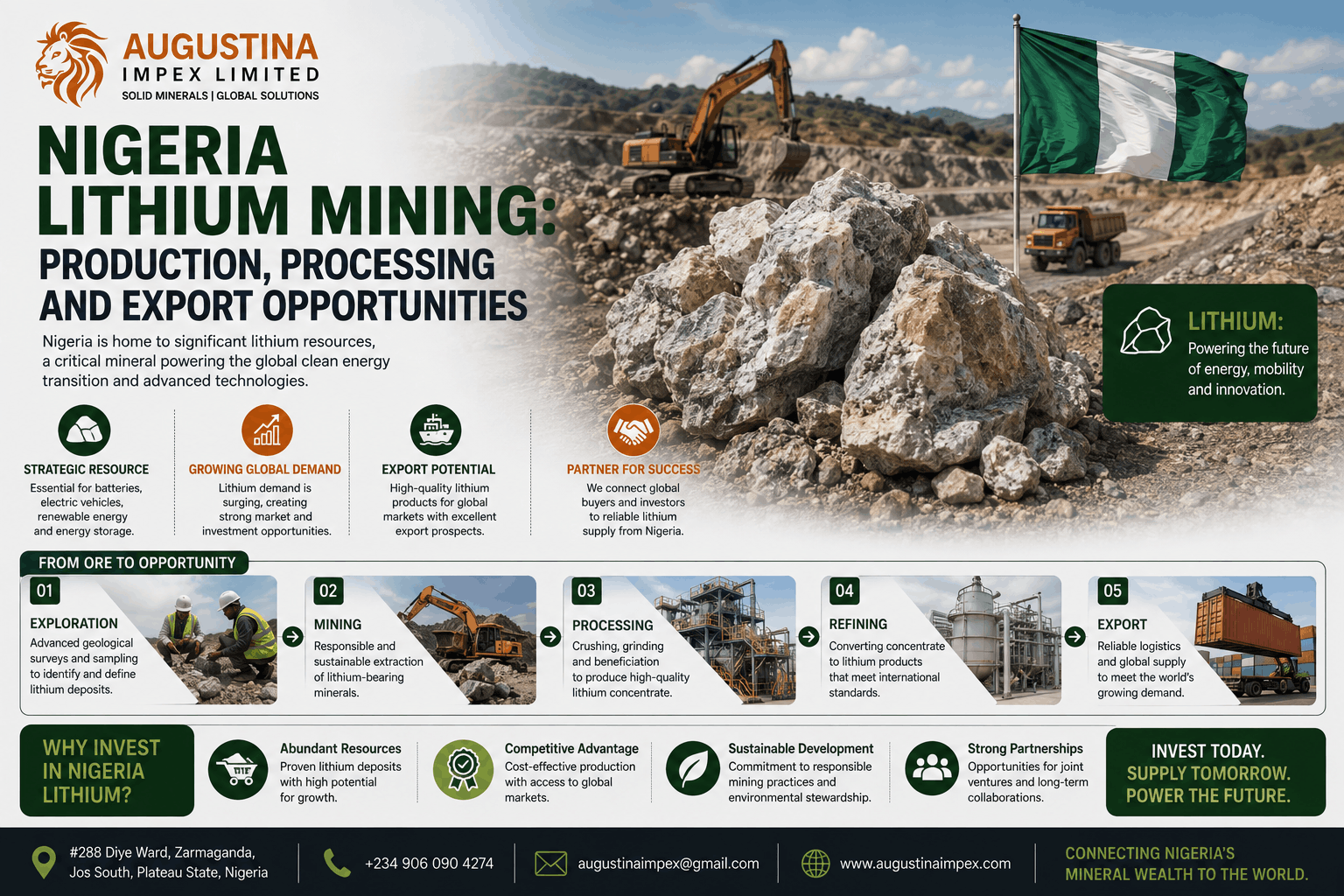
Nigeria Lithium Mining: Production, Processing & Export
Nigeria Lithium Mining: Production, Processing and Export Opportunities By Kolawole King, CEO — Augustina Impex…
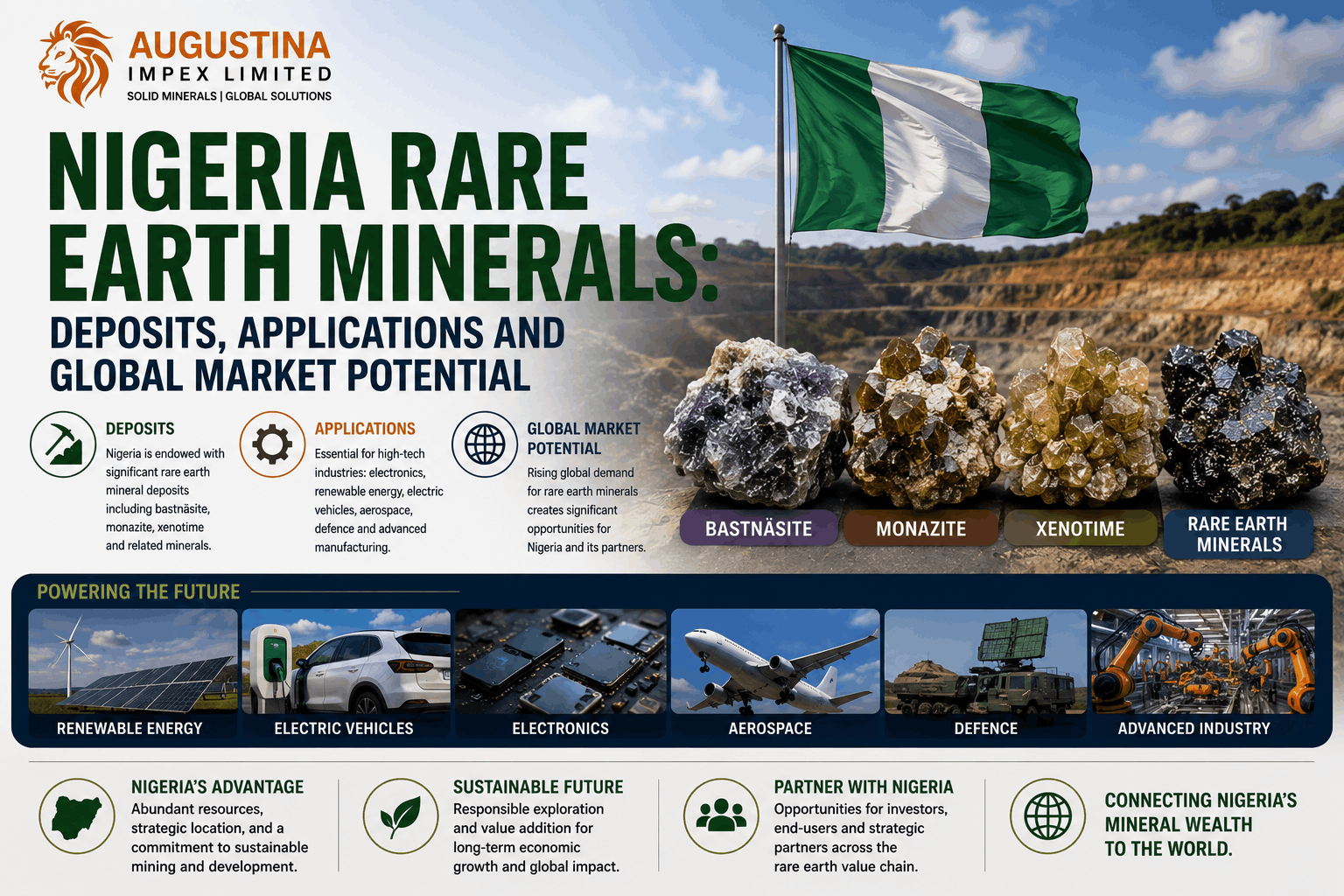
Nigeria Rare Earth Minerals: Deposits & Market Potential
Nigeria Rare Earth Minerals: Deposits, Applications and Global Market Potential By Kolawole King, CEO —…
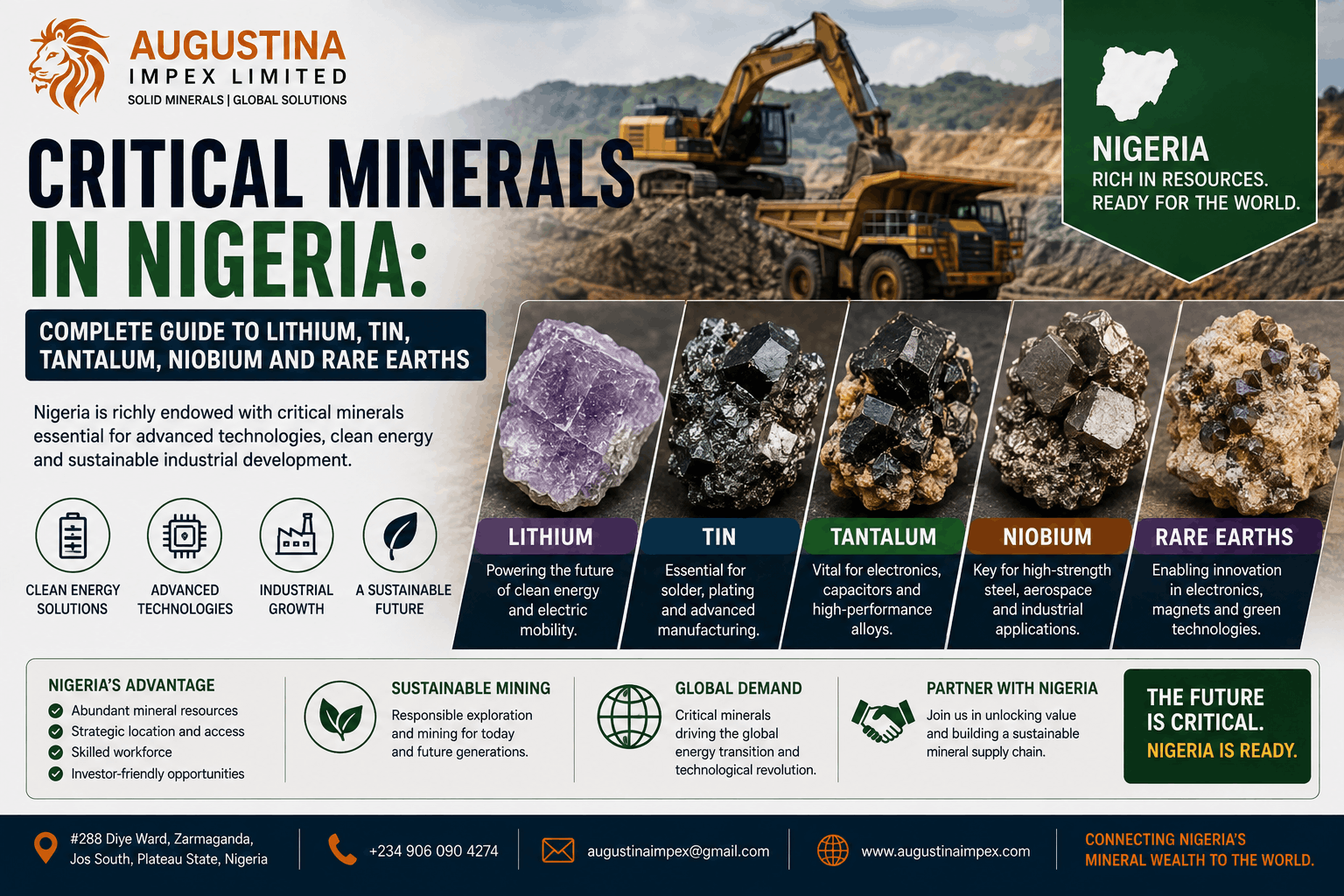
Nigeria Critical Minerals Guide: Lithium, Tin & Rare Earths
Critical Minerals in Nigeria: Complete Guide to Lithium, Tin, Tantalum, Niobium and Rare Earths By…
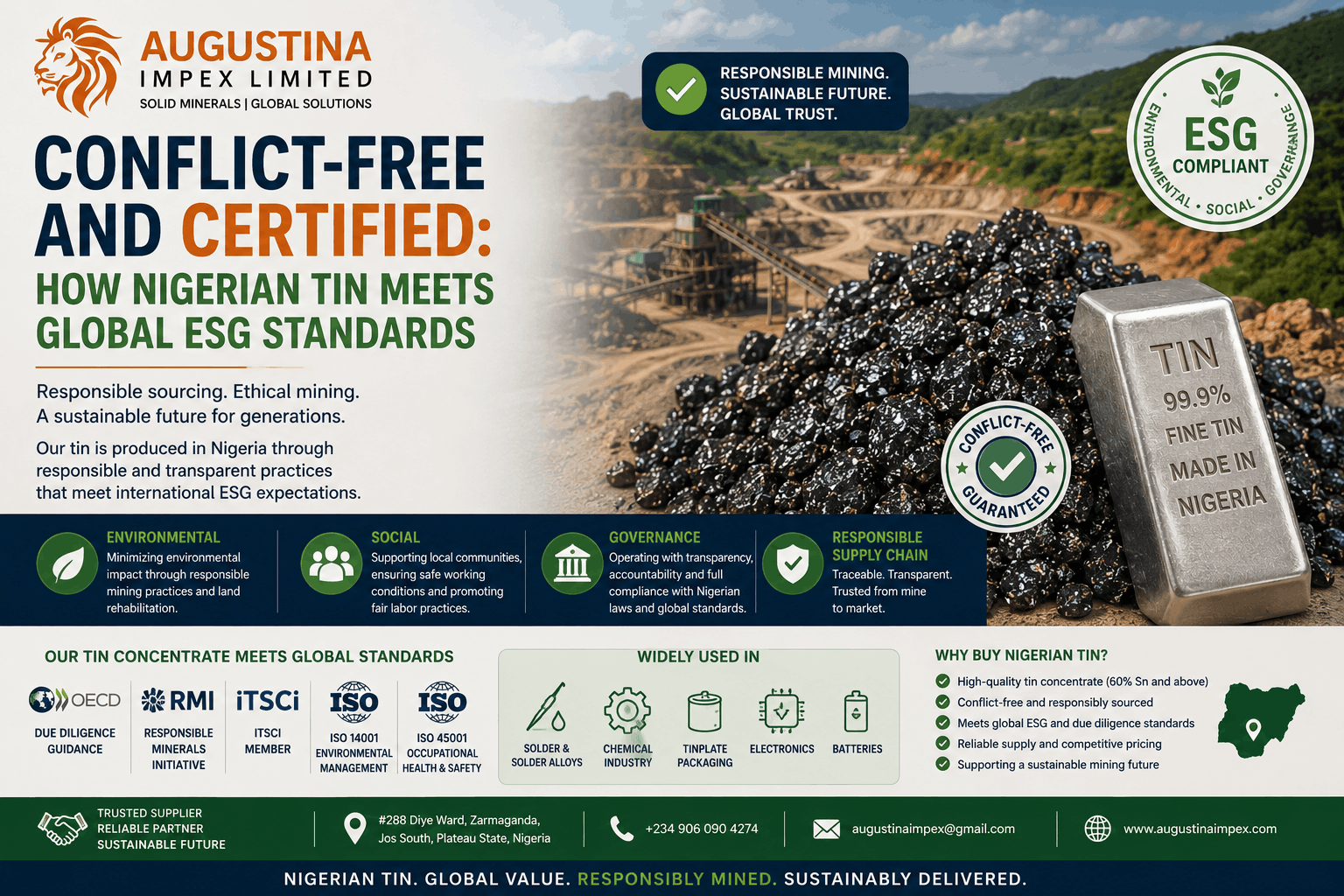
Conflict-Free Nigerian Tin Meets Global ESG Standards
Conflict-Free and Certified: How Nigerian Tin Meets Global ESG Standards By Kolawole King, CEO —…