
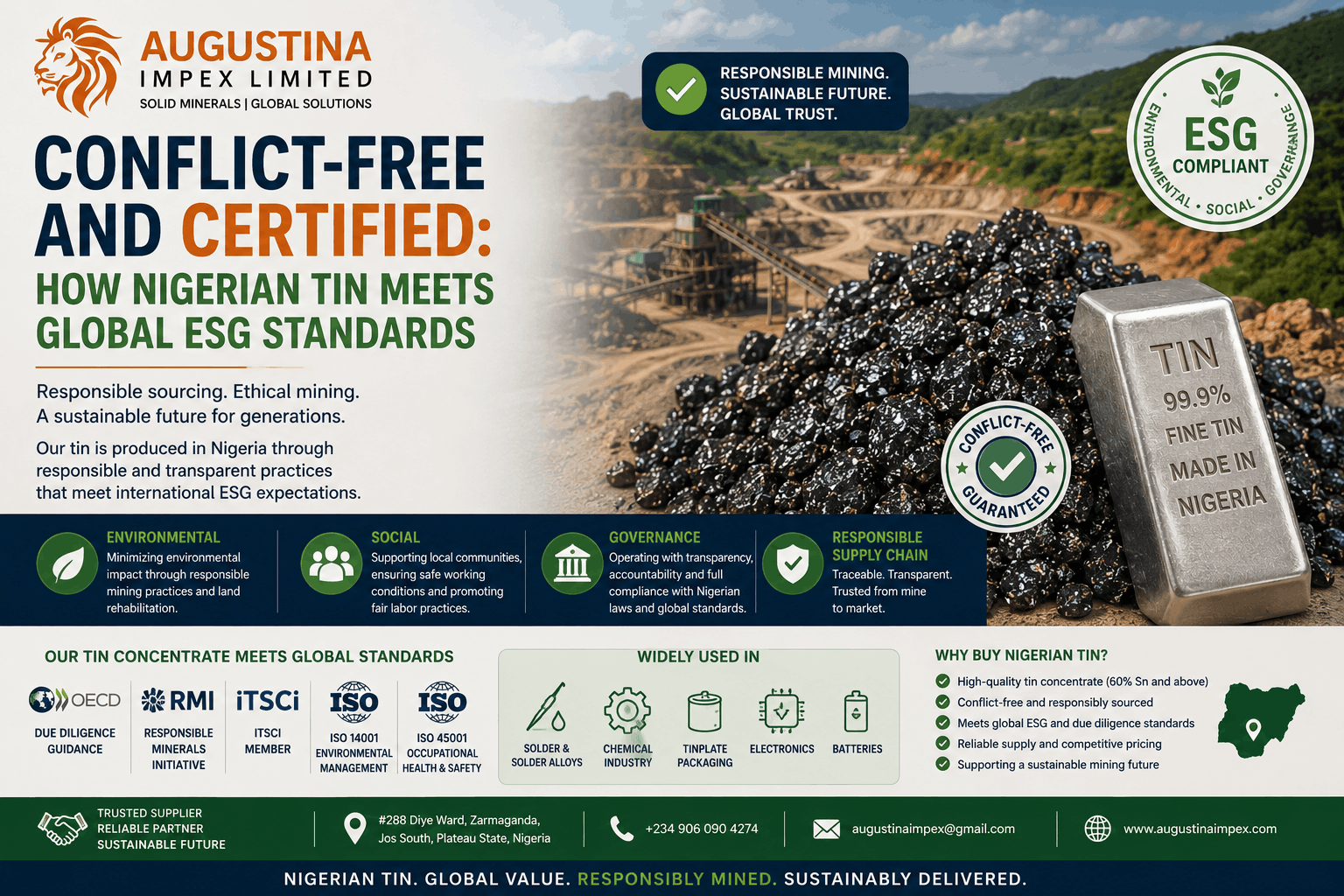
Conflict-Free and Certified: How Nigerian Tin Meets Global ESG Standards
By Kolawole King, CEO — Augustina Impex Limited | Published: August 2026 | 16 min read
In the boardrooms of global electronics manufacturers, automotive OEMs, and semiconductor companies, a quiet revolution has taken place over the past decade. The question is no longer only “what does this mineral cost?” — it is “where did this mineral come from, who mined it, under what conditions, and can we prove it?” Environmental, social, and governance (ESG) standards have moved from corporate social responsibility footnotes to front-and-centre procurement criteria. And nowhere is this shift felt more acutely than in the sourcing of tin — one of the four metals (alongside tantalum, tungsten, and gold) that are subject to the world’s most comprehensive conflict minerals due diligence regime.
For procurement managers who source tin for solder, tinplate, alloys, or chemical applications, the question of whether their cassiterite feedstock is conflict-free is not optional. It is a legal requirement under US federal law (Dodd-Frank Act Section 1502), a regulatory obligation under EU law (EU Conflict Minerals Regulation, effective 2021), and a supply chain transparency expectation embedded in the OECD Due Diligence Guidance for Responsible Supply Chains of Minerals from Conflict-Affected and High-Risk Areas.
Nigeria sits in a uniquely advantageous position within this regulatory landscape. As a country that is explicitly not designated as a conflict-affected or high-risk area (CAHRA) under the OECD framework and the applicable US and EU regulations, Nigeria’s tin cassiterite is inherently free of the compliance burden that shadows supply from the Democratic Republic of Congo (DRC) and its nine adjoining countries. In this article, we explain precisely what this means, how Nigerian tin documentation is structured to support buyer ESG reporting, and how Augustina Impex Limited provides the compliance infrastructure that procurement teams, sustainability officers, and legal departments need to source Nigerian tin with confidence.
Understanding ESG in Mineral Sourcing: What It Means for Tin Buyers
ESG — Environmental, Social, and Governance — is a framework for evaluating the non-financial impacts of a business and its supply chain. In the context of mineral sourcing, each dimension carries specific meaning:
① Environmental — How does mineral extraction affect the local ecosystem? Does the mining operation comply with national environmental law? Are tailings and process water managed responsibly? Is land rehabilitation conducted after mining? For tin from the Jos Plateau, environmental considerations focus on alluvial mining impacts on river systems, land disturbance at mining sites, and the mercury and chemical-free nature of gravity-based cassiterite separation.
② Social — Are workers (including artisanal miners) treated fairly, paid adequately, and protected from occupational health risks? Is child labour absent from the supply chain? Are local communities consulted and do they share in the economic benefits of mineral extraction? In Nigeria’s Jos Plateau, the social dimension is shaped by the large artisanal and small-scale mining (ASM) community — a community that the FMMSD’s formalisation programme is actively working to bring within a regulated framework.
③ Governance — Does the mining operation have legal licences? Is the export company registered with the appropriate regulatory authorities? Is the mineral supply chain traceable from mine to port? Is there independent third-party verification of claims? In Nigeria, the governance dimension is addressed by the FMMSD mining licence system, NEPC export registration, NESS certification, and CCIC/SGS/Bureau Veritas pre-shipment inspection — all of which Augustina Impex coordinates on behalf of its buyers.
The pressure on corporate supply chains to demonstrate ESG compliance has intensified significantly since 2020. The EU Corporate Sustainability Due Diligence Directive (CS3D), effective from 2024–2027 across company size tiers, requires large European companies to conduct due diligence on human rights and environmental risks throughout their global value chains — not just at the direct supplier level. The SEC’s climate disclosure rules and conflict minerals reporting requirements continue to bind US public companies. ESG ratings agencies (MSCI, Sustainalytics, S&P Global) are increasingly incorporating supply chain mineral sourcing into company ratings. And downstream customers — Apple, Samsung, Tesla, Volkswagen — are passing ESG verification requirements upstream to their Tier 1 and Tier 2 suppliers. For tin buyers in this environment, having a verifiable, documented, conflict-free supply source is not a differentiator — it is a basic requirement for commercial survival.
The Conflict Minerals Regulatory Landscape: Three Frameworks Every Tin Buyer Must Understand
① US Dodd-Frank Act Section 1502 — The Pioneering Conflict Minerals Law
The Dodd-Frank Wall Street Reform and Consumer Protection Act, signed into US law in 2010, contains Section 1502 — a provision that requires SEC-registered companies to disclose whether their products contain tin, tantalum, tungsten, or gold (collectively “3TG” or “conflict minerals”) that originated in the Democratic Republic of Congo (DRC) or one of its nine adjoining countries, and whether those minerals may have financed or benefited armed groups in those regions.
Companies subject to Section 1502 — which includes virtually all public companies listed on US exchanges that use 3TG minerals in their manufactured products — must file an annual Conflict Minerals Report (CMR) with the SEC and conduct a “reasonable country of origin inquiry” (RCOI) to determine where their 3TG minerals come from. If the RCOI indicates minerals originated outside the DRC and adjoining countries, no further due diligence is required for those minerals. Nigeria is not a covered country under Section 1502. Nigerian tin cassiterite sourced through a documented supply chain (with Certificate of Origin) requires only an RCOI — not the full OECD-standard supply chain audit that DRC-origin tin requires — to satisfy Section 1502 obligations.
② EU Conflict Minerals Regulation (EU 2017/821) — Effective January 2021
The EU Conflict Minerals Regulation (Regulation EU 2017/821) entered into force on 1 January 2021. It requires EU importers of tin, tantalum, tungsten, and gold above specified volume thresholds to implement OECD-aligned supply chain due diligence — including a management system, risk identification and assessment, risk management, third-party audit, and public reporting.
Critically, the EU Regulation applies to minerals from conflict-affected and high-risk areas (CAHRAs) — a designation based on a list maintained by the European Commission. As of 2026, Nigeria is not designated as a CAHRA under the EU Regulation. EU importers of Nigerian tin concentrate are therefore not subject to the enhanced due diligence obligations that apply to DRC-origin tin. They must still conduct a basic “reasonable inquiry” to confirm origin, but the burden is dramatically lighter. A well-documented Nigerian tin supply chain — with Certificate of Origin, NEPC/NESS certification, and CCIC/SGS inspection — satisfies this inquiry requirement comfortably.
③ OECD Due Diligence Guidance — The Global Standard for Responsible Mineral Sourcing
The OECD Due Diligence Guidance for Responsible Supply Chains of Minerals from Conflict-Affected and High-Risk Areas is the internationally recognised standard framework for responsible mineral sourcing — referenced in both the Dodd-Frank rules and the EU Conflict Minerals Regulation, and adopted by industry initiatives including the Responsible Minerals Initiative (RMI), the International Tin Association (ITA), and the Responsible Business Alliance (RBA).
The OECD Guidance’s five-step framework is designed primarily for minerals from CAHRAs. For minerals from countries not designated as CAHRAs — including Nigeria — the guidance still recommends baseline due diligence practices (supplier identification, basic checks on legal compliance, documentation of origin), but does not require the intensive smelter/refiner audit, third-party assessment, or public reporting obligations that apply to CAHRA-origin minerals. Nigerian tin, sourced through NEPC-licensed exporters with CCIC/SGS verification, naturally satisfies these baseline requirements.
| Regulatory Framework | Applies to Nigerian Tin? | Required Due Diligence Level | Key Nigerian Documentation Needed |
|---|---|---|---|
| US Dodd-Frank 1502 | Yes — disclosure required; NOT a covered country | RCOI only — no full audit required | Certificate of Origin; NEPC export documentation; CCIC/SGS inspection cert |
| EU CMR (2017/821) | Yes — importers must conduct reasonable inquiry; Nigeria NOT a CAHRA | Baseline reasonable inquiry — no enhanced audit | Certificate of Origin; supplier CAC/NEPC registration; NESS certificate |
| OECD DD Guidance | Baseline practices recommended; Nigeria not a CAHRA | Step 1–2 baseline (supplier ID, legal compliance check) | Supplier registration docs; COO; FMMSD/NEPC licence confirmation |
| CMRT (RMI Template) | Completed as part of buyer’s supplier due diligence package | Section A (company) + Section B (mineral origin) completed by supplier | Augustina Impex completes CMRT on request — origin: Nigeria (non-CAHRA) |
Why Nigeria Is Not a Conflict-Affected Country: The Legal and Factual Basis
The fundamental ESG advantage of Nigerian tin rests on a clear legal and factual foundation: Nigeria is not, and has never been, designated as a conflict-affected and high-risk area (CAHRA) under the OECD Due Diligence Guidance, the US Dodd-Frank Act’s implementing rules, or the EU Conflict Minerals Regulation. The Dodd-Frank Section 1502 “covered countries” are the DRC and its nine land-bordering neighbours: Angola, Burundi, Central African Republic, Republic of Congo, Rwanda, South Sudan, Tanzania, Uganda, and Zambia. Nigeria does not share a land border with the DRC and is not on this list.
The OECD’s list of CAHRAs, used as a reference under the EU Regulation, is broader and more dynamic — it is updated periodically and includes countries where armed conflict, fragile governance, or systematic human rights violations create conditions under which mineral revenues may fund armed groups or be extracted through coercive methods. As of 2026, Nigeria does not appear on this list for tin mining regions. The Jos Plateau — Nigeria’s primary tin-producing area — is administered by the Plateau State government and the Federal Government of Nigeria, operates under the Nigerian Minerals and Mining Act 2007, and its mining communities are not subject to control by armed non-state actors in the way that mining areas in the DRC’s North Kivu and Ituri provinces are.
A US-listed electronics manufacturer sourcing tin from the DRC must: (a) conduct RCOI; (b) if DRC origin is confirmed, implement a full OECD 5-step due diligence programme including independent third-party smelter audit; (c) file an annual Conflict Minerals Report with the SEC; and (d) potentially face “DRC conflict undeterminable” or “DRC conflict tin” disclosure — outcomes that can damage investor and customer relations. The same manufacturer sourcing identical-grade tin from Nigeria through Augustina Impex needs only: (a) conduct RCOI; (b) confirm Nigerian origin via Certificate of Origin; (c) disclose “DRC conflict free” status in annual CMR. The documentation burden difference is dramatic — and the reputational benefit is real.
Nigeria’s Export Compliance Framework: The Documentation Architecture
Nigeria’s mineral export sector is governed by one of Africa’s most structured regulatory frameworks for solid mineral exports — a fact that is often underestimated by international buyers who associate informal mining with absent documentation. Understanding this framework helps buyers appreciate the compliance architecture that underpins every Augustina Impex tin concentrate shipment.
① The Nigerian Minerals and Mining Act 2007
Nigeria’s primary mining legislation, the Nigerian Minerals and Mining Act (NMMA) 2007, establishes the legal framework for mineral title, mining licences, export rights, and royalty obligations. All commercial mining operations — including the artisanal and small-scale mining cooperatives that supply much of the Jos Plateau cassiterite — are required to hold appropriate licences from the Federal Ministry of Mines and Steel Development (FMMSD). The Small-Scale Mining Licence (SSML) is the most relevant instrument for artisanal tin producers. Augustina Impex sources only from licensed mining operations or through FMMSD-registered aggregation channels.
② NEPC Registration — The Export Licence
The Nigerian Export Promotion Council (NEPC) registers all solid mineral exporters and issues a Registration number (RE Number) that must appear on all export documentation. Augustina Impex’s export entity — Jase Odus Nigeria Limited (RC 2022462) — holds NEPC Registration Number RE 0039421, valid through July 2027. This registration is independently verifiable through NEPC and constitutes the primary governance document confirming that our export operations are licensed and compliant with Nigerian export law.
③ NESS Certificate — Shipment-Level Export Compliance
The Nigerian Export Supervision Scheme (NESS) issues a compliance certificate for each export shipment — confirming that the shipment meets Nigerian mineral export standards, has been weighed and sampled, and carries complete documentation. The NESS certificate is a mandatory document for all Nigerian solid mineral exports and is one of the key documents that buyers require for their supply chain due diligence records. It provides shipment-level traceability that links the specific export lot to the exporter’s NEPC registration.
④ Certificate of Origin — The Critical ESG Document
The Certificate of Origin (COO) is the single most important document for conflict minerals compliance purposes. Issued by the Nigerian Export Promotion Council or a chamber of commerce authorised by NEPC, the COO formally certifies that the mineral originated in Nigeria — establishing the non-CAHRA origin status that exempts the mineral from enhanced conflict minerals due diligence requirements. The COO includes: exporter details, product description, quantity and weight, HS code, country of origin (Nigeria), and the certifying authority’s signature and seal. This document is retained in the buyer’s compliance records and disclosed in conflict minerals reporting as evidence of DRC-conflict-free status.
Third-Party Verification: CCIC, SGS, and Bureau Veritas as ESG Assurance Providers
For buyers who need independent verification beyond Nigerian regulatory documentation, Augustina Impex coordinates pre-shipment inspection by internationally accredited inspection agencies — CCIC (China Certification and Inspection Group), SGS (Société Générale de Surveillance), and Bureau Veritas. These agencies are globally recognised by smelters, regulators, and auditors as credible third-party verifiers of mineral quantity, quality, and sourcing documentation.
The inspection process covers: physical sampling of the concentrate lot using internationally recognised sampling protocols; laboratory assay for Sn grade and penalty elements; net weight determination at a certified weighbridge; review of the exporter’s documentation for completeness; and container stuffing witness for larger shipments. The resulting inspection certificate — bearing the CCIC/SGS/BV letterhead and inspector’s credentials — provides the independent assurance that auditors and sustainability officers require when reviewing supply chain documentation.
For buyers subject to the EU’s CS3D human rights and environmental due diligence requirements, the CCIC/SGS/BV inspection also serves as a documented verification step in the value chain mapping that CS3D compliance requires — providing a timestamped, independent confirmation that the mineral was present at the specified location, in the specified quantity and quality, at the time of export from Nigeria.
The Social Dimension: ASM Communities and Responsible Tin Mining on the Jos Plateau
For buyers with strong social sustainability commitments — particularly those responding to UN Sustainable Development Goals, ILO labour standards, or customer codes of conduct — the social dimension of Nigerian tin sourcing is an important consideration. The artisanal and small-scale mining (ASM) communities of the Jos Plateau are the backbone of Nigeria’s tin production, and their working conditions, economic wellbeing, and labour practices are legitimate ESG factors that buyers should understand.
Nigerian ASM tin mining on the Jos Plateau is characterised by several features that are broadly positive from an ESG standpoint. First, child labour is not a systematic feature of Jos Plateau tin mining in the way it has been documented in some DRC mining areas — adult community members conduct the physical mining work, with family-based support activities that are consistent with ILO norms. Second, no armed group control exists over the Jos Plateau mining communities — miners are free agents within a civilian, government-administered framework. Third, economic benefit flows to local communities — ASM income from tin mining is a primary livelihood source for tens of thousands of Plateau State residents, directly reducing rural poverty.
The FMMSD’s ongoing ASM formalisation programme — including the issuance of Small-Scale Mining Licences (SSML) to cooperatives, the registration of mining communities in a national ASM database, and the provision of technical training through the Mining Cadastre Office — is progressively bringing the Jos Plateau mining community within a regulated, documented framework. Augustina Impex actively supports this formalisation process by sourcing preferentially from licensed operations and documented cooperative groups, and by providing the aggregation and export infrastructure that gives ASM miners access to international markets at fair prices.
Environmental Standards: Nigerian Tin Mining and Land Management
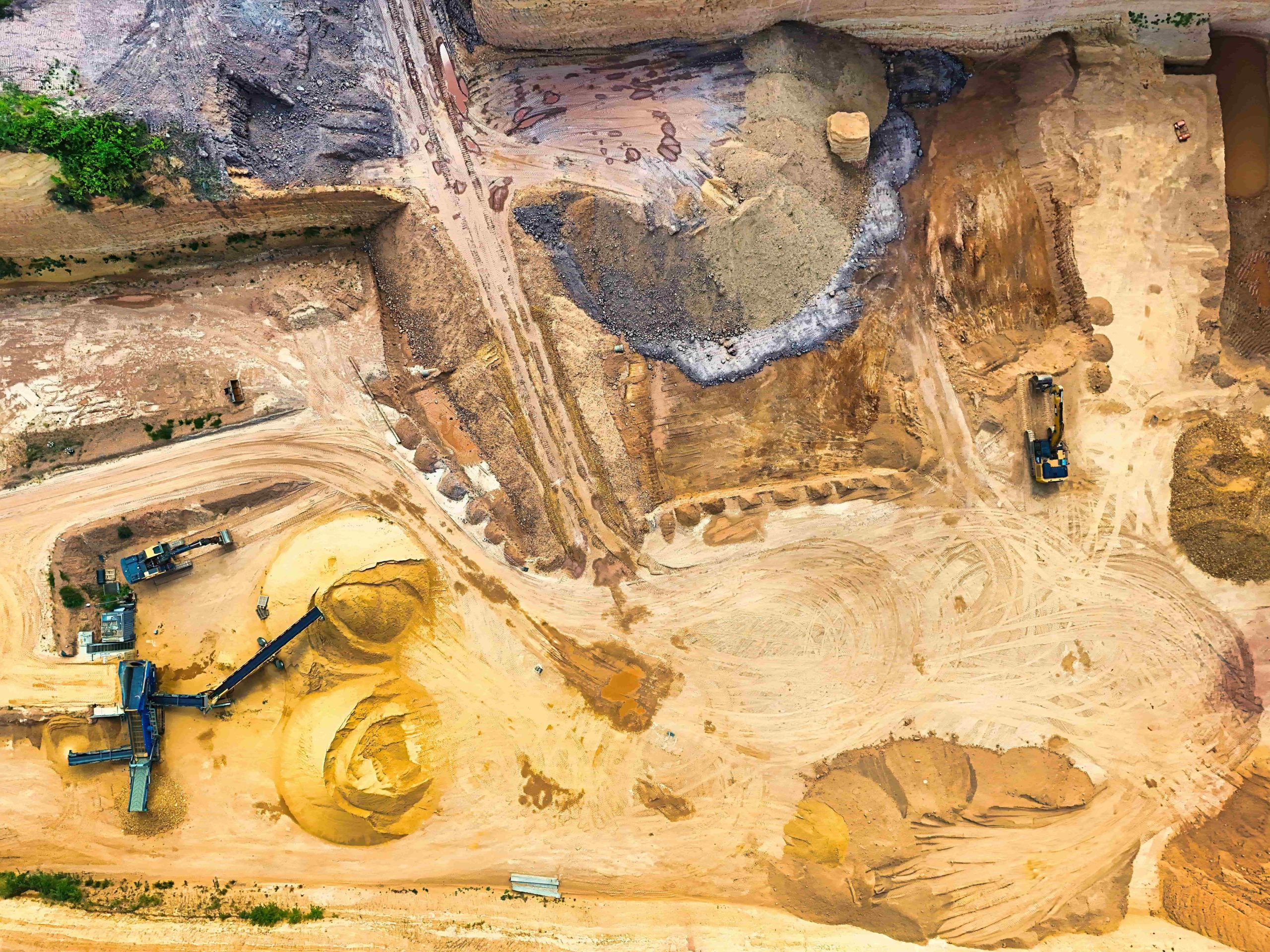
The environmental footprint of alluvial tin mining is an area where Nigerian cassiterite production has both genuine strengths and areas requiring ongoing improvement. On the positive side, gravity-based cassiterite separation is a completely chemical-free process — unlike gold mining, which often involves mercury amalgamation or cyanide leaching with severe environmental consequences, tin concentration by jigging, sluicing, and spiral concentrator uses only water and the natural density differential between minerals. There are no toxic reagents, no chemical tailings ponds, and no heavy metal contamination of the separation process itself.
Nigerian mining law requires licensed mining operations to submit environmental impact assessments (EIAs) to the Federal Ministry of Environment and the FMMSD before commencing operations, and to implement environmental management plans (EMPs) covering dust suppression, water management, and post-mining land rehabilitation. The Nigerian Environmental Standards and Regulations Enforcement Agency (NESREA) has oversight of these obligations. For larger operations and the Jos HMS plant, these requirements provide a baseline environmental management framework that buyers can reference in their supply chain sustainability disclosures.
The environmental challenge in the Jos Plateau context is the legacy of decades of pre-regulation open-cut alluvial mining — the “mining ponds” that characterise the landscape of Plateau State’s tin fields are historical features, not products of current operations. Contemporary mining operations are subject to current environmental law and are progressively improving their land management practices as the FMMSD’s compliance capacity develops.
Completing the CMRT: How Augustina Impex Supports Buyer Conflict Minerals Reporting
The Conflict Minerals Reporting Template (CMRT), maintained by the Responsible Minerals Initiative (RMI) and widely used by electronics manufacturers, automotive OEMs, and their suppliers, is the standardised questionnaire for disclosing conflict mineral sourcing information throughout the supply chain. Completing the CMRT accurately and completely is a requirement for suppliers to many large international manufacturers.
Augustina Impex can complete the CMRT on behalf of buyers who require it as part of their supplier due diligence process. The key CMRT entries for Nigerian tin sourced through Augustina Impex are:
| CMRT Field | Augustina Impex Entry |
|---|---|
| Company Name | Augustina Impex Limited / Jase Odus Nigeria Limited (export entity) |
| Declaration Scope | Tin (Cassiterite / SnO₂) |
| Conflict Minerals Status | DRC Conflict Free |
| Country of Origin | Nigeria (Federal Republic of Nigeria) |
| CAHRA Status | No — Nigeria is not a CAHRA under OECD, Dodd-Frank, or EU CMR |
| Smelter/Refiner | Disclosed upon request (Malaysia, Indonesia, or China — buyer dependent) |
| Supporting Documentation | COO, NEPC registration, NESS certificate, CCIC/SGS inspection cert available |
How Nigerian Tin Supports Your Corporate ESG and Sustainability Disclosures
For sustainability teams at manufacturing companies, sourcing tin from Nigeria through a documented, verified supply chain creates positive ESG disclosure content across multiple frameworks:
① SEC Conflict Minerals Report (CMR) — Nigerian tin allows a “DRC conflict free” disclosure, avoiding the reputational and investor relations exposure of “DRC conflict undeterminable” outcomes that commonly arise from DRC-origin supply chains.
② GRI Standards (Global Reporting Initiative) — GRI 408 (Child Labour) and GRI 409 (Forced or Compulsory Labour) disclosures are supported by the documented, civilian-administered nature of Nigerian tin production.
③ UN SDG Alignment — Sourcing from Nigerian ASM communities (SDG 8 — Decent Work and Economic Growth; SDG 10 — Reduced Inequalities) provides positive SDG contribution content for sustainability reports, supporting the narrative that your mineral sourcing creates development impact in one of Africa’s most economically important mining communities.
④ EU Corporate Sustainability Reporting Directive (CSRD) — Nigerian tin’s documentation package (NEPC, NESS, COO, CCIC/SGS) provides the supply chain traceability evidence that CSRD’s value chain due diligence disclosure requirements demand.
⑤ Supply Chain Diversification Narrative — As geopolitical risk management has become a boardroom priority, the ability to report a geographically diversified critical mineral supply chain — with West African sourcing as a complement to Southeast Asian and Chinese supply — is itself a governance positive that risk committees and ESG ratings agencies recognise.
The International Tin Association (ITA) operates a Responsible Sourcing programme for tin that provides a framework for miners, traders, and smelters to demonstrate responsible practices. ITA’s Standard for Responsible Supply, aligned with OECD guidance and RMI standards, is increasingly referenced by downstream tin users as a supply chain assurance mechanism. Nigerian tin exporters who implement documented, independently verified supply chains consistent with ITA Standard requirements are well-positioned to participate in this responsible sourcing ecosystem. Augustina Impex is committed to aligning its supply chain practices with internationally recognised responsible sourcing standards and welcomes buyer discussions on third-party assessment and certification pathways.
State-by-State ESG Profile: Nigerian Tin Production Regions
For buyers conducting supply chain mapping and CAHRA risk assessment, the following state-by-state guide provides the ESG context for Nigeria’s tin-producing regions — governance status, security environment, ASM formalisation level, and known ESG considerations for each area:
| State | CAHRA Status | Security Environment | ASM Formalisation | Key ESG Notes |
|---|---|---|---|---|
| Plateau State | Not CAHRA | Stable — government-administered; Jos city fully functional | High — most advanced ASM registration; SSML widely issued | HMS plant enables chemical-free gravity separation; adult workforce; civilian governance |
| Nasarawa State | Not CAHRA | Generally stable; localised security incidents do not affect mining areas significantly | Medium — SSML programme active; some unregistered cooperatives | Tin co-produced with coltan; civilian-administered; improving FMMSD presence |
| Bauchi State | Not CAHRA | Stable in mining LGAs; no conflict-mineral conditions | Medium — ASM active; formalisation in progress | Extension of Jos Plateau geological belt; similar ESG profile to Plateau State |
| Taraba State | Not CAHRA | Moderate — some communal conflict in non-mining LGAs; mining areas generally stable | Low-Medium — ASM present; formal licensing less developed | Buyer due diligence should confirm mine-of-origin documentation; supply processed through Jos |
| Kaduna State | Not CAHRA | Southern Kaduna has some communal tensions; mining areas in Birnin Gwari generally stable | Medium — growing formal sector aligned with lithium development | Minor cassiterite; primarily coltan/lithium context; SSML licensing framework applies |
| Zamfara State | Not CAHRA — but heightened vigilance recommended | Improving — government security operations have stabilised some LGAs; buyer should verify current status | Low — ASM formalisation early stage | Augustina Impex recommends enhanced documentation for Zamfara-origin material; Plateau State origin preferred for ESG-sensitive buyers |
For buyers with strict ESG criteria — particularly those responding to Tier 1 customer codes of conduct from Apple, Samsung, Intel, or automotive OEMs — Augustina Impex recommends sourcing Nigerian tin concentrate primarily from Plateau State and Nasarawa State, where the governance, formalisation, and documentation infrastructure is most developed. Material from these states, processed through the Jos HMS plant and exported through Jase Odus Nigeria Limited, carries the most complete and independently verifiable ESG documentation package. This is the supply chain we recommend for all buyers with formal conflict minerals reporting obligations.
Augustina Impex: Your ESG-Aligned Nigerian Tin Supply Partner
Augustina Impex Limited (RC 750691) is a NEPC-registered Nigerian solid mineral export company operating under Jase Odus Nigeria Limited (RC 2022462, NEPC RE 0039421 — valid July 2027). Every tin concentrate shipment carries: Certificate of Origin (Nigeria — non-CAHRA), NESS Certificate, NEPC Export Declaration, CCIC/SGS/Bureau Veritas pre-shipment inspection certificate, independent assay certificate, and commercial invoice/packing list. We can complete the RMI Conflict Minerals Reporting Template (CMRT) on request. We source from licensed mining operations in Plateau and Nasarawa states and process through the Jos HMS plant under the management of Eliezer Onah — ensuring a traceable, documented supply chain from mine to port.
We understand that ESG is not a checkbox exercise for serious buyers — it is an ongoing commitment that requires a supply partner who takes documentation, traceability, and compliance as seriously as grade and price. At Augustina Impex, we have built our supply chain around the needs of internationally compliant buyers, because we recognise that the future of Nigerian mineral exports depends on earning and maintaining the trust of the global manufacturing community.
Frequently Asked Questions: ESG and Conflict-Free Status of Nigerian Tin
Yes. Nigeria is not a “covered country” under the Dodd-Frank Act Section 1502 implementing rules. Provided your RCOI confirms Nigerian origin — which a Certificate of Origin from Augustina Impex/Jase Odus Nigeria Limited achieves — you may disclose the tin as “DRC Conflict Free” in your annual Conflict Minerals Report filed with the SEC. No further supply chain audit, independent third-party assessment, or smelter verification is required beyond the RCOI step for Nigerian-origin tin.
No. The EU Conflict Minerals Regulation (EU 2017/821) requires enhanced OECD-aligned due diligence — including independent third-party audit — only for minerals sourced from conflict-affected and high-risk areas (CAHRAs). As Nigeria is not designated as a CAHRA, you are required only to conduct a “reasonable inquiry” to confirm origin. A documented supply chain with Certificate of Origin, NEPC registration, NESS certificate, and CCIC/SGS inspection satisfies the reasonable inquiry standard for Nigerian tin.
Yes. Augustina Impex will complete the Responsible Minerals Initiative (RMI) Conflict Minerals Reporting Template (CMRT) on request for any buyer who requires it as part of their supplier qualification or annual conflict minerals due diligence process. The completed CMRT will declare Nigerian origin, DRC conflict-free status, and reference the supporting documentation package. We will also provide a completed Responsible Minerals Assurance Process (RMAP) supplier data sheet if required by your downstream customers.
For each tin concentrate shipment, Augustina Impex provides: Certificate of Origin (Nigeria); NEPC Export Declaration (Jase Odus Nigeria Limited, RE 0039421); NESS Certificate; CCIC/SGS/Bureau Veritas Pre-Shipment Inspection Certificate; Independent Laboratory Assay Certificate; CAC Certificate of Incorporation for Augustina Impex Limited and Jase Odus Nigeria Limited; and CMRT completion on request. Additional documentation — including mining licence details for source mines, GPS coordinates of production areas, and photographic evidence of processing — can be arranged for buyers with enhanced due diligence requirements.
CAHRA designation is based on assessment of armed conflict conditions, fragile governance, and systematic human rights violations in mineral-producing areas. Nigeria’s Jos Plateau tin-producing region does not exhibit the conditions that characterise CAHRA designations — there are no armed non-state groups controlling mining operations, no documented systematic use of forced or child labour in tin mining, and no evidence of mineral revenues funding armed conflict. While buyers should monitor OECD CAHRA list updates as part of their standard due diligence process, there is no basis in the current situation for concern about near-term CAHRA designation affecting Jos Plateau tin production.
Augustina Impex Limited provides DRC conflict-free Nigerian cassiterite with full CMRT support, Certificate of Origin, NEPC/NESS certification, and CCIC/SGS independent inspection — everything your ESG and legal teams need.
📧 augustinaimpex@gmail.com
📞 WhatsApp: +234 906 090 4274
Kolawole King is the Chief Executive Officer of Augustina Impex Limited (RC 750691), a NEPC-licensed Nigerian solid mineral export company headquartered in Jos, Plateau State. Kolawole has extensive experience navigating the ESG, conflict minerals compliance, and export documentation requirements of international tin, coltan, and lithium mineral buyers across Asia, Europe, and the Middle East. For ESG compliance discussions, CMRT completion requests, or conflict-free tin sourcing enquiries: augustinaimpex@gmail.com | WhatsApp: +234 906 090 4274 | www.augustinaimpex.com | Corporate Blog
Post a comment
Related Posts
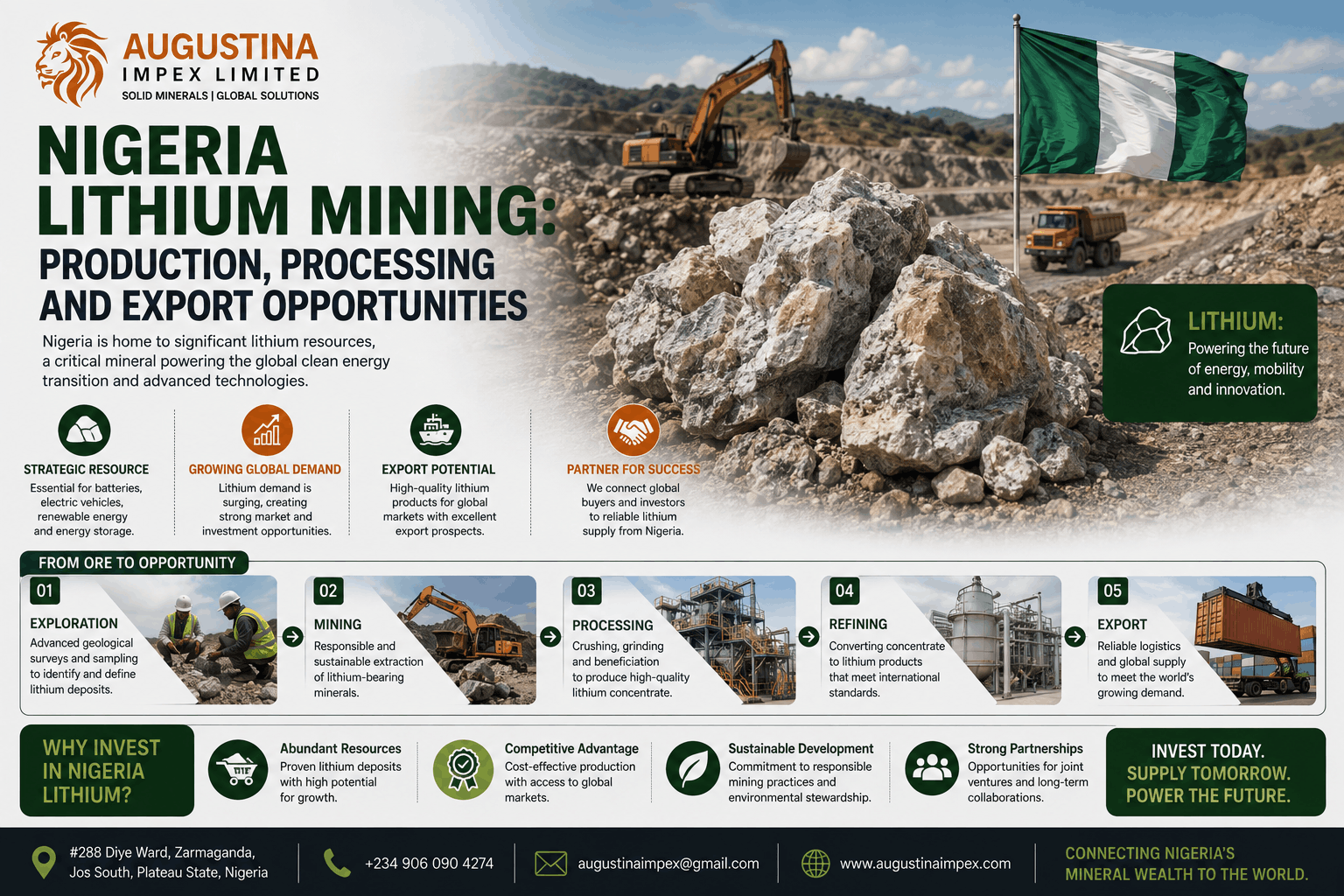
Nigeria Lithium Mining: Production, Processing & Export
Nigeria Lithium Mining: Production, Processing and Export Opportunities By Kolawole King, CEO — Augustina Impex…

Nigeria Rare Earth Minerals: Deposits & Market Potential
Nigeria Rare Earth Minerals: Deposits, Applications and Global Market Potential By Kolawole King, CEO —…
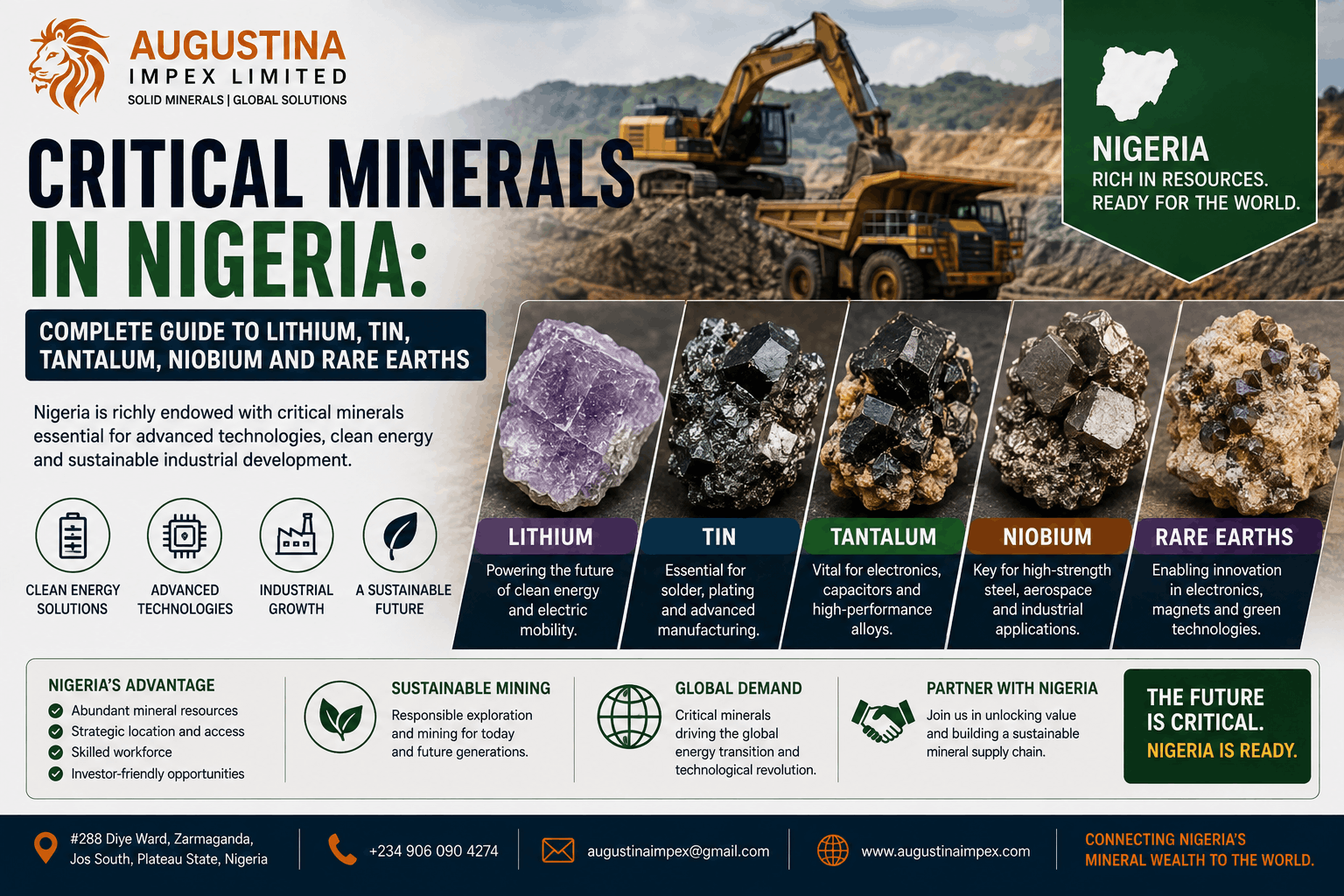
Nigeria Critical Minerals Guide: Lithium, Tin & Rare Earths
Critical Minerals in Nigeria: Complete Guide to Lithium, Tin, Tantalum, Niobium and Rare Earths By…
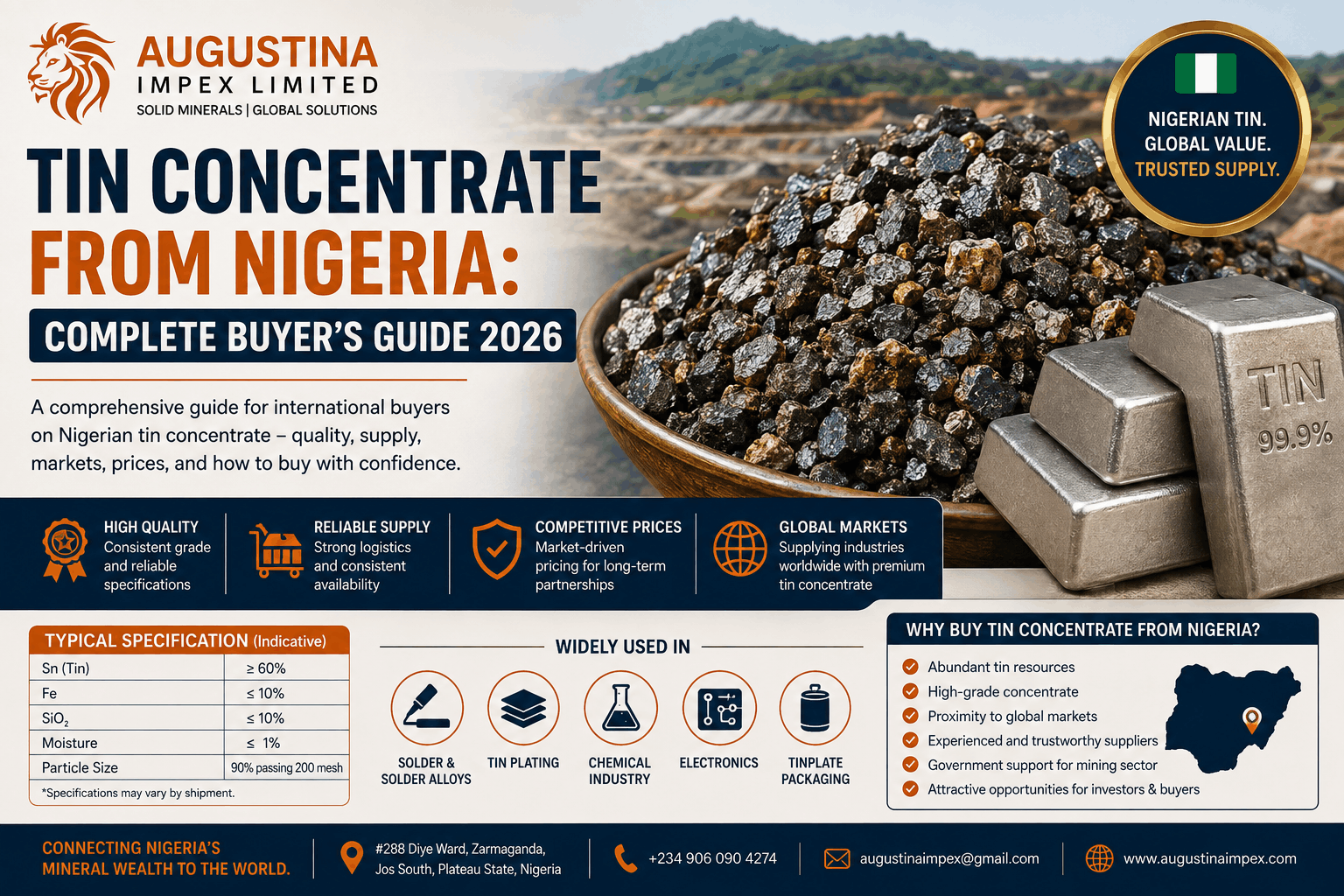
Tin Concentrate from Nigeria: Complete Buyer’s Guide 2026
Tin Concentrate from Nigeria: Complete Buyer’s Guide 2026 By Kolawole King, CEO — Augustina Impex…