

If you are buying minerals from Nigeria — whether you are sourcing spodumene concentrate, monazite sand, bastnasite, columbite-tantalite, or any other solid mineral — understanding the Nigerian mineral export process is essential. Not just as background knowledge, but as a practical due diligence tool that helps you distinguish between legitimate, compliant Nigerian exporters and the brokers, fraudsters, and legally non-compliant operators who unfortunately exist in the same market.
The Nigerian mineral export framework is more structured and more formal than many international buyers expect. There are specific government agencies with clearly defined roles, specific licences and permits that must be obtained before any mineral can legally leave the country, specific documents that must accompany every export consignment, and specific financial instrument and foreign exchange compliance requirements that govern how export proceeds are handled.
When all of these elements are properly in place, Nigerian mineral export is a reliable, documented, professionally manageable process. When they are not — when a supplier is operating without NEPC registration, without proper mining licences, or without genuine laboratory documentation — the result is compliance failures that create problems at Nigerian ports, at destination country customs, and ultimately in the commercial relationship between buyer and seller.
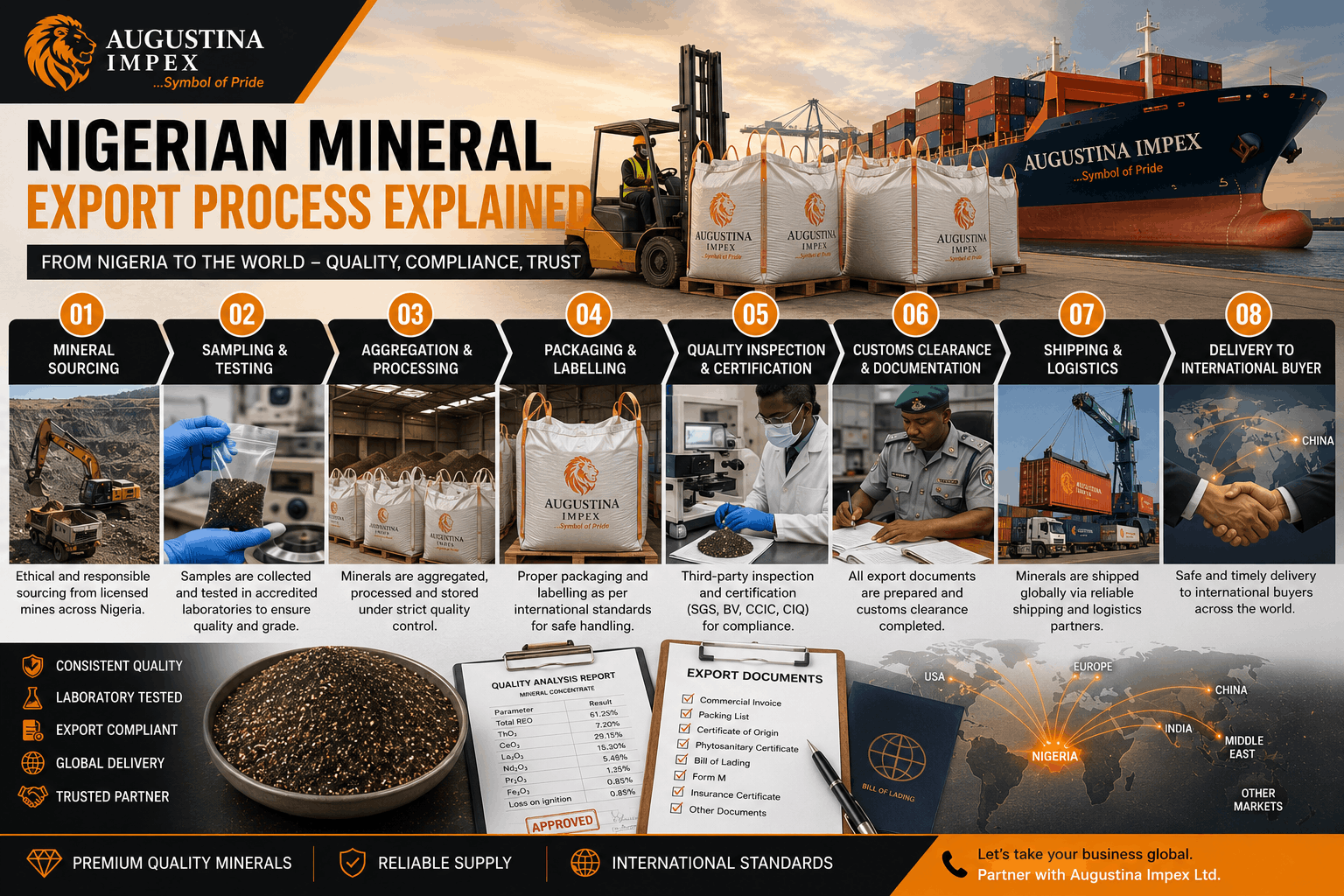
This guide, prepared by Augustina Impex Limited, walks through the complete Nigerian mineral export process from end to end. Whether you are a first-time buyer of Nigerian minerals or an experienced importer looking to verify that your supplier is operating correctly, this article gives you the understanding you need.
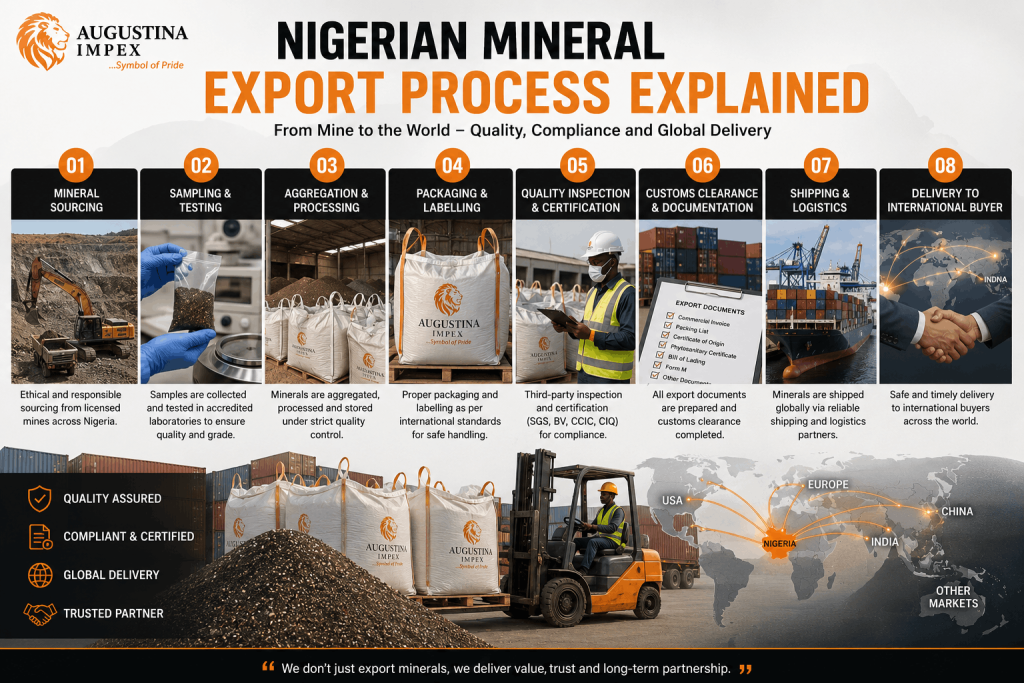
The Regulatory Landscape: Who Governs Nigerian Mineral Exports?
The Nigerian solid mineral export framework involves multiple government agencies, each with a distinct and non-overlapping role. Understanding who does what is the foundation of understanding the export process.
| Body / Agency | Abbreviation | Role in Mineral Export |
| Ministry of Mines and Steel Development | MMSD | Issues mining leases and mineral titles; oversees royalty collection; grants mineral export licences at ministerial level for certain categories |
| Nigerian Export Promotion Council | NEPC | Issues Registered Exporter (RE) certificates; processes Mineral Export Permits (MEP); issues Certificates of Origin; promotes Nigerian non-oil exports internationally |
| Nigerian Customs Service | NCS | Processes export declarations (Shipping Bills); verifies documentation at ports; collects applicable export duties; enforces export prohibition lists |
| Central Bank of Nigeria | CBN | Governs the e-Form M / Form NXP regime for export proceeds repatriation; monitors foreign exchange flows from mineral exports through designated commercial banks |
| Corporate Affairs Commission | CAC | Registers companies under Nigerian law; issues CAC registration certificates required for NEPC registration and all formal commercial activity |
| Nigerian Geological Survey Agency | NGSA | Provides geological mapping, mineral resource assessment, and technical advisory services; involved in mineral identification and certification in some contexts |
| Standards Organisation of Nigeria | SON | Sets and enforces product and process standards; may be involved in quality certification for certain mineral products depending on the importing country’s requirements |
Of these agencies, the NEPC and the MMSD are the most directly relevant to the day-to-day export process. The NEPC is the primary regulatory gateway for mineral exporters — without a valid NEPC Registered Exporter certificate, no company can legally process a mineral export. The MMSD governs the upstream mining activity that produces the minerals in the first place. The Nigerian Customs Service is the operational enforcement point at the port of exit.
For international buyers, the key compliance indicators to look for in a Nigerian mineral supplier are: valid NEPC Registered Exporter (RE) certificate, verifiable MMSD mining lease number (if the supplier is also a producer), valid CAC company registration, and a bank account registered in the company’s name at a recognised Nigerian bank. These four documents are the foundation of a legally compliant Nigerian mineral exporter.
Phase 1: Company Registration and Establishment of Export Standing
Before any Nigerian company can export minerals, it must establish its legal standing through a structured registration process. This phase happens before any specific export transaction — it is the foundation on which all future exports rest.
Company Registration with the Corporate Affairs Commission (CAC)
The first requirement is that the exporting entity is a properly registered company under Nigerian law. The Corporate Affairs Commission (CAC) is the body responsible for company registration in Nigeria. For solid mineral export purposes, the exporter must be registered as a limited liability company (either a private company limited by shares, or a public company). Registered business names and sole proprietorships are not eligible to register as NEPC exporters and cannot legally export minerals.
The CAC registration process requires: submission of proposed company name (subject to availability search), Memorandum and Articles of Association, details of directors and shareholders, registered office address, and payment of prescribed registration fees. Upon successful registration, the CAC issues a Certificate of Incorporation, which assigns the company its unique registration number (RC number) and provides the formal legal basis for all subsequent business activity.
The time frame for CAC registration is typically 1–5 working days for straightforward applications processed through the CAC’s online portal. More complex applications or those requiring manual processing may take longer. Every legitimate Nigerian mineral exporter should be able to produce their CAC Certificate of Incorporation instantly upon request — it is the first document an international buyer should ask for.
NEPC Exporter Registration
The Nigerian Export Promotion Council (NEPC) is the statutory body responsible for promoting and regulating Nigerian non-oil exports, including solid minerals. Registration with the NEPC as a Registered Exporter is mandatory for any company seeking to export minerals from Nigeria. This is not optional, not waivable, and not substitutable by any other licence or permit.
To register with the NEPC as a solid mineral exporter, a company must provide: CAC Certificate of Incorporation, CAC Form CAC2 (particulars of directors) and CAC Form CAC7 (statement of share capital), Tax Identification Number (TIN) and evidence of tax registration, bank verification and statement, evidence of the company’s export product and business activity, passport photographs of the company’s authorised signatory, and payment of the NEPC registration fee.
Upon successful registration, the NEPC issues a Registered Exporter (RE) certificate bearing the company’s unique RE number. This RE number is the single most important identifier of a legitimately registered Nigerian mineral exporter. It can be verified through the NEPC directly. RE certificates are renewable annually — a serious buyer should always confirm that the supplier’s RE certificate is current, not expired.
| Key Due Diligence Point for Buyers Always request a copy of the supplier’s NEPC Registered Exporter certificate and verify the RE number is current and not expired. A company without a valid NEPC RE certificate cannot legally export minerals from Nigeria. If a supplier claims to be “in the process of registering” or says they export through a third party’s licence, treat this as a serious risk indicator. |
Mining Licence — For Producers
If the Nigerian mineral supplier is also the mineral producer (as opposed to a licensed exporter buying from a third-party producer), they must also hold a valid mining licence from the Ministry of Mines and Steel Development (MMSD). The Nigerian Minerals and Mining Act 2007 (as amended) governs the issuance of mineral rights in Nigeria. The main categories of mineral right relevant to commercial export volumes are: Exploration Licence (for exploration only, not production), Small-Scale Mining Lease (for artisanal and small-scale operations), and Mining Lease (for full commercial production).
A valid mining lease specifies the mineral or minerals covered, the area of land covered (in coordinates), the leaseholder (the registered company), and the validity period. Mining leases are renewed periodically and their status can be cross-checked with MMSD records. Any supplier claiming to be a mine owner or producer should provide their mining lease number — verifiable with MMSD — as part of basic due diligence.
Phase 2: Pre-Export Preparation — Product, Laboratory, and Inspection
Once a company has its export standing in order, the preparation of a specific export consignment follows a defined sequence of steps that must be completed before the cargo can be presented to Nigerian Customs for export clearance.
Mineral Production and Stockpiling
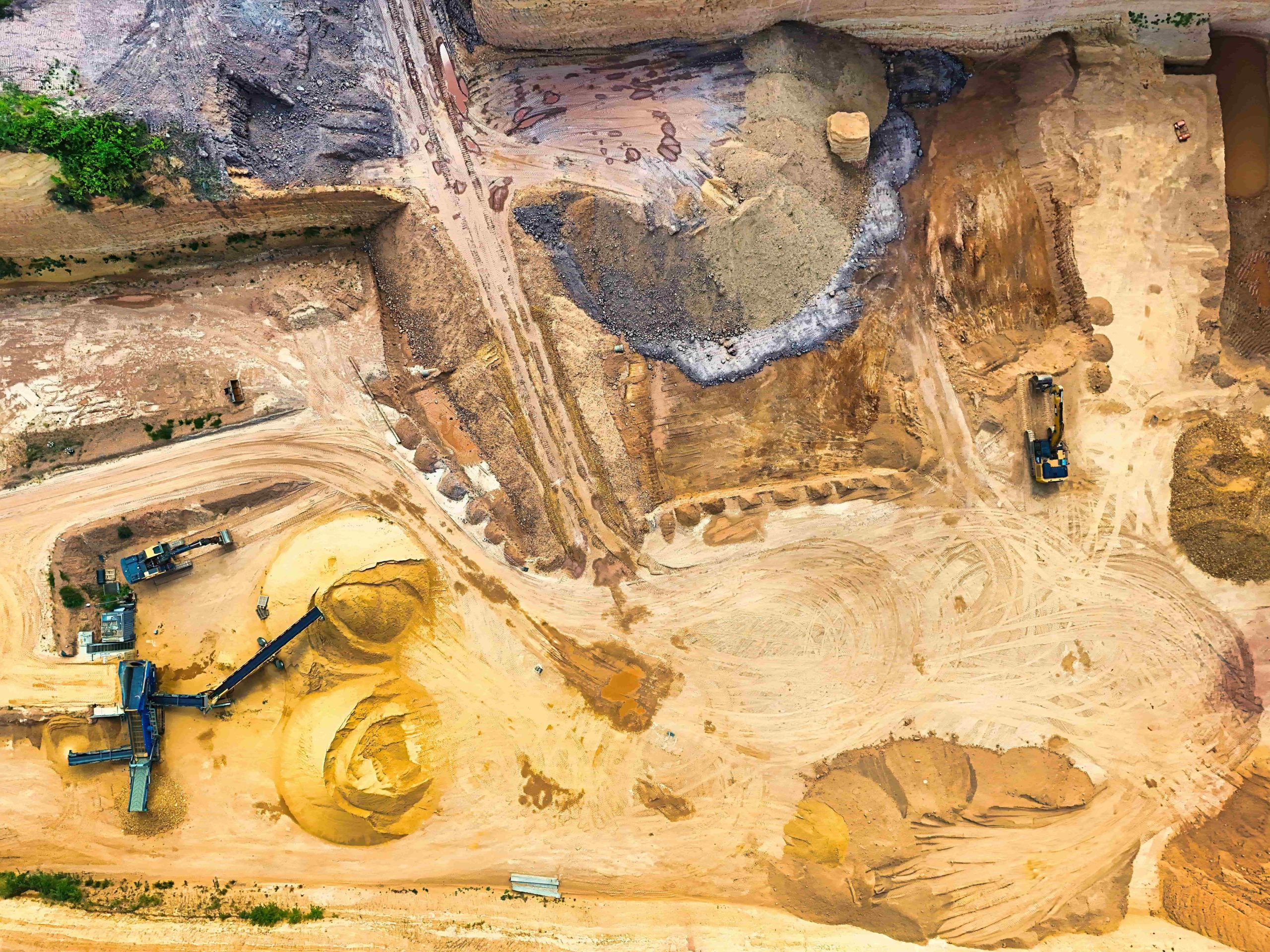
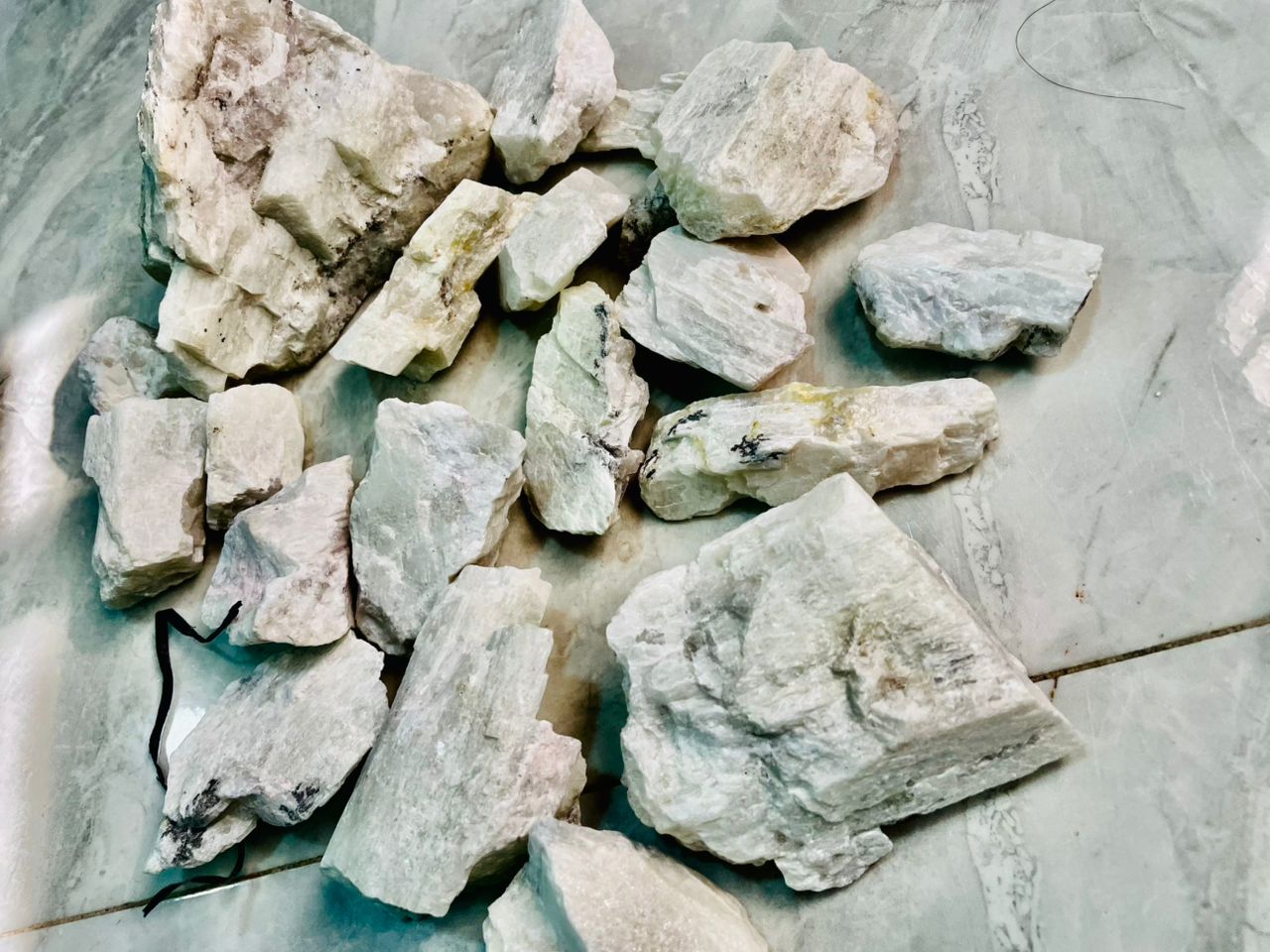
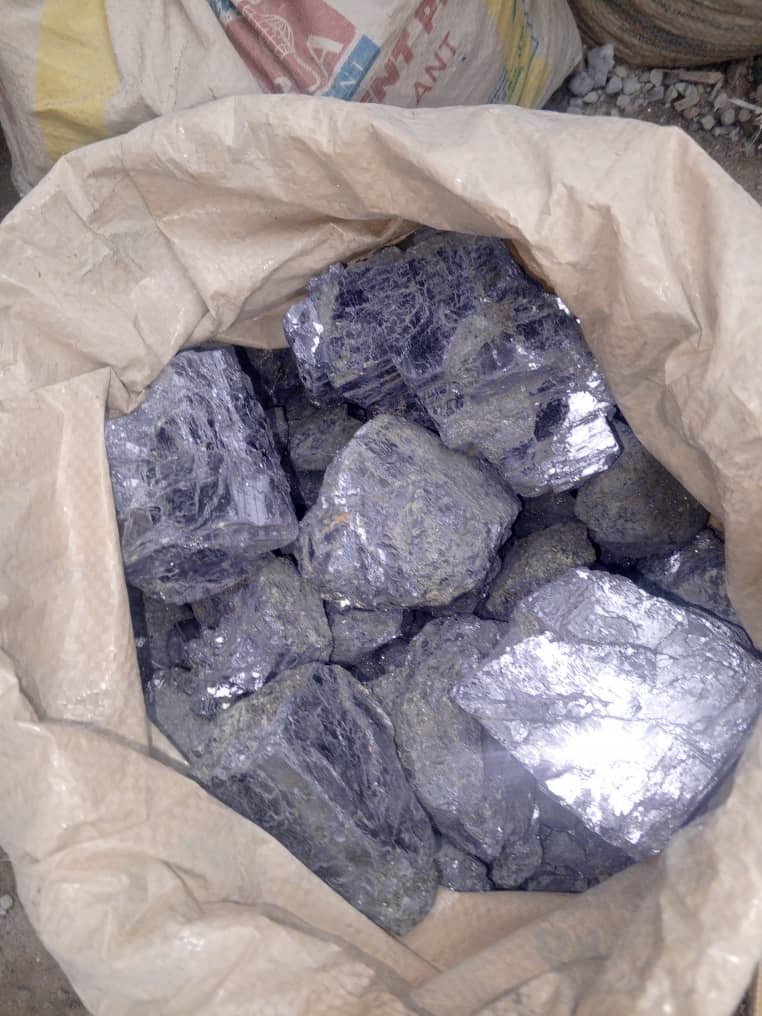
The physical mineral product — whether spodumene concentrate, monazite, bastnasite, columbite-tantalite, zircon, or another solid mineral — must be produced, processed to the agreed specification, and stockpiled at a location where it can be weighed, sampled, and inspected. For an exporter who is also a producer, this means operating the mine and processing facility. For an exporter who is buying from a producer, this means taking possession of the mineral at the mine or processing facility and transferring it to an accessible stockpile location.
The mineral must be in the form and at the grade specified in the commercial agreement with the buyer. For concentrate products like spodumene, this means that beneficiation processing — typically flotation — has been completed and the concentrate meets the minimum Li₂O grade committed in the Soft Corporate Offer. For monazite and bastnasite, the material must be in the physical form and at the TREO content confirmed in the laboratory analysis.
Independent Laboratory Analysis
Before any commercial export can be validated, the mineral must be tested by an independent, ISO/IEC 17025 accredited laboratory. This is non-negotiable for any credible Nigerian mineral export — both because international buyers require it and because the NEPC Mineral Export Permit process requires grade documentation. In Nigeria, recognised accredited facilities include Zirconex Mining & Metal Laboratory (ISO/IEC 17025 certified), SGS Nigeria, and other internationally accredited testing facilities.
The laboratory process involves collection of representative samples from the stockpile using defined sampling protocols, submission of the samples to the laboratory, multi-element XRF or ICP analysis to determine the mineral composition and grade, and issuance of a formal Certificate of Analysis bearing the laboratory’s accreditation seal, the sample identification number, the analytical methodology used, and the laboratory director’s signature. This certificate is a foundational document for the entire export transaction — it supports the NEPC permit application, the commercial invoice, the buyer’s import licence (where required), and the Letter of Credit presentation.
Weighbridge Certification
The mineral must be accurately weighed at a licensed weighbridge facility to generate the official weight certificate. Commercial contracts are settled on the basis of net dry weight, so moisture content must also be determined and recorded. The weighbridge certificate identifies the cargo, confirms the gross weight, tare weight, and net weight, and is signed by the weighbridge operator. This document accompanies the export documentation package and is used to reconcile the commercial invoice quantity with the bill of lading quantity.
Third-Party Pre-Shipment Inspection
For international transactions — particularly those involving a Letter of Credit as the payment instrument — a pre-shipment inspection by an internationally recognised inspection agency is standard practice and is typically mandated by the buyer. SGS, Bureau Veritas, Intertek, and CCIC are the most widely used agencies for Nigerian mineral export inspections.
The inspection agency’s inspector visits the stockpile, verifies the physical existence and approximate quantity of the mineral, collects representative samples using defined protocols, and submits those samples to the agency’s laboratory for independent grade analysis. The resulting Clean Certificate of Inspection (CCI) — issued only when the material passes the inspector’s checks — is one of the most important documents in the export package. It provides the buyer with independent, third-party confirmation that the material inspected matches the grade and quantity claimed. Without this document, the buyer has only the seller’s word and the seller’s own laboratory analysis — which is not an adequate basis for a commercial mineral transaction.
Phase 3: Obtaining the NEPC Mineral Export Permit
The Mineral Export Permit (MEP) is the central regulatory document that authorises a specific consignment of mineral to leave Nigeria. It is issued by the NEPC and is required for every export, regardless of how many previous exports the same company has completed. The MEP is transaction-specific — it identifies the specific exporter, the specific mineral, the quantity, the destination, and the buyer.
The application for a Mineral Export Permit requires submission of the following to the NEPC:
- RE Certificate: Valid NEPC Registered Exporter (RE) certificate — confirming the exporter’s legal standing
- Commercial Agreement: Proforma Invoice or Sales and Purchase Agreement — confirming the commercial terms of the specific transaction
- Laboratory Analysis: ISO/IEC 17025 accredited Certificate of Analysis — confirming the mineral grade and composition of the specific batch
- Weight Certificate: Weighbridge Certificate — confirming the net weight of the consignment
- Mineral Provenance: Evidence of mining title or purchase agreement with the producer — confirming the legal provenance of the mineral
- Tax Clearance: Tax clearance certificate — confirming the exporter’s tax compliance status
- Additional Documents: Any additional documentation specific to the mineral type — for example, radiation safety certificates for naturally occurring radioactive minerals such as monazite
The NEPC reviews the application and, if satisfied that all requirements are met and the export is legally compliant, issues the Mineral Export Permit. This permit authorises the export of the specific quantity of mineral identified in the application and has a defined validity period within which the export must be completed.
The processing time for a NEPC Mineral Export Permit varies depending on the completeness of the application and NEPC’s workload at the time of submission. Well-prepared applications with complete documentation are typically processed in 5–15 working days. Incomplete applications, discrepancies in the documentation, or applications for minerals that require additional regulatory clearance may take longer. Experienced Nigerian mineral exporters know how to prepare complete, accurate applications that minimise processing delays.
| Important for Buyers: What the Export Permit Tells You The existence of a valid NEPC Mineral Export Permit for your specific consignment is one of the strongest indicators that the export is legally compliant. A supplier who cannot produce a Mineral Export Permit for your specific transaction — or who tells you it is not required — is either uninformed or is operating outside the legal framework. Always request a copy of the MEP before issuing payment instructions. |
Phase 4: Commercial Terms, Financial Instruments, and CBN Compliance
Parallel to the physical and regulatory preparation of the export, the commercial and financial arrangements must be structured correctly. For international mineral transactions, this involves agreeing and implementing the right payment instrument and ensuring compliance with the Central Bank of Nigeria’s export proceeds monitoring framework.
Agreeing the Incoterms
Nigerian mineral exports are almost universally offered on FOB (Free On Board) terms — the most widely used Incoterm for bulk mineral exports worldwide. FOB means the seller is responsible for all costs and risks associated with getting the mineral to the ship’s rail at the named Nigerian port (Apapa, Lekki, or Onne). Once the cargo crosses the ship’s rail, responsibility passes to the buyer, who is responsible for ocean freight, marine insurance, and all costs at the destination.
FOB is preferred by Nigerian mineral exporters because it gives them control over the logistics process within Nigeria — where they have established relationships with freight forwarders, trucking companies, and port agents — while allowing buyers to arrange their own ocean freight through their preferred shipping lines. It also provides pricing clarity: the buyer’s total landed cost is the FOB price plus their freight and insurance costs, which they can determine independently.
CIF (Cost, Insurance, and Freight) terms — where the seller pays ocean freight and insurance — are less common for Nigerian mineral exports because Nigerian exporters generally do not have the established global freight relationships that make CIF competitive. Buyers who request CIF should expect a higher quoted price that incorporates the seller’s freight cost, which may not be as competitive as what the buyer can arrange directly through their own freight forwarder.
The Letter of Credit (LC) — Standard Payment Instrument
For commercial mineral transactions from Nigeria, the standard and most secure payment instrument is an irrevocable Letter of Credit (LC) at sight, issued by a first-class international bank acceptable to both parties. The LC structure for Nigerian mineral exports typically follows this pattern: the buyer’s bank issues the LC in favour of the seller’s Nigerian bank; the LC specifies the exact documents required for payment, the quantities, grades, and loading period; the seller ships the cargo and presents the required documents to their Nigerian bank; the Nigerian bank presents the documents to the buyer’s bank; and the buyer’s bank pays at sight upon verification that all documents are compliant.
The standard Nigerian mineral export LC requires presentation of: original Bill of Lading, commercial invoice, packing list, NEPC Certificate of Origin, ISO/IEC 17025 Certificate of Analysis, Weighbridge Certificate, and Clean Certificate of Inspection (CCI). The specific documents required should be agreed in the Sales and Purchase Agreement and reflected accurately in the LC terms. Discrepancies between the LC document requirements and the actual documents produced at presentation are one of the most common causes of payment delays in Nigerian mineral transactions — good exporters know how to structure LC terms to be achievable.
The 95/5 Payment Structure
A widely used variation of the LC at sight structure for Nigerian mineral exports is the 95/5 split: 95% of the invoice value is paid at sight against shipping documents, and the remaining 5% is paid against a discharge port survey certificate confirming that the mineral delivered at destination matches the grade and quantity specified in the shipping documents. This structure protects the buyer against quality or quantity shortfalls at the discharge port while giving the seller access to the vast majority of the payment upon shipment. It is considered balanced and professionally appropriate for commercial mineral trade.
T/T Payment — For Trial Shipments
For smaller trial shipments — particularly first transactions between a buyer and a new Nigerian supplier — Telegraphic Transfer (T/T) is sometimes used. The typical T/T structure for a Nigerian mineral trial shipment is 30% advance payment against the proforma invoice (paid before shipment preparation begins) and 70% against the Bill of Lading (paid after the vessel has loaded and the B/L has been issued). Buyers should not pay 100% T/T advance without prior third-party inspection — the advance payment provides the initial commercial trust needed to begin shipment preparation, while the 70% balance against B/L ensures that some commercial leverage is retained until documents are presented.
CBN e-Form M and Export Proceeds Repatriation
Nigeria’s Central Bank requires all export transactions above USD 10,000 to be registered through the electronic Form M (e-Form M) system — a foreign exchange monitoring mechanism administered through the exporter’s commercial bank. The e-Form M is filed before shipment and records the transaction details, the buyer’s bank, the payment terms, and the expected foreign exchange inflow. When export proceeds are received, the exporter’s bank reports the receipt to the CBN, completing the repatriation record.
The e-Form M is not a document that the buyer directly manages — it is a Nigerian regulatory requirement that the seller’s bank administers. However, buyers should be aware that any Nigerian mineral exporter operating without the e-Form M system is not in compliance with CBN foreign exchange regulations. Compliance with the e-Form M system is a mark of a legitimately operating Nigerian exporter who is managing their foreign exchange obligations properly.
Phase 5: Port Procedures, Customs Clearance, and Shipping
Once the mineral is ready at the export warehouse, the Mineral Export Permit is in hand, and the financial instrument is in place, the cargo moves to the port for export clearance and loading.
Engaging a Licensed Freight Forwarder and Customs Agent
The physical movement of mineral cargo from the warehouse to the vessel requires coordination by a licensed Nigerian freight forwarder and customs agent. This is not a process that an exporter manages personally at the port — it requires specialists who have established relationships with shipping lines, port terminal operators, trucking companies, and customs officers, and who understand the specific documentation requirements for solid mineral exports at each Nigerian port.
A good Nigerian freight forwarder handles: booking cargo space with the shipping line, arranging trucking from the export warehouse to the port terminal, submitting the export declaration (Shipping Bill) to the Nigerian Customs Service through the Nigeria Customs Service Integrated System (NICIS II), coordinating with the terminal operator for cargo receipt and loading, obtaining the Bill of Lading from the shipping line after cargo is loaded, and ensuring that all export documents are consistent and that the cargo description on the Shipping Bill matches the NEPC Mineral Export Permit.
Nigerian Ports for Mineral Export
The three primary Nigerian ports used for solid mineral exports are:
| Lekki Deep Seaport, Lagos | Nigeria’s newest major deep-water port, commissioned in 2023. Features modern cargo handling equipment, deeper draft berths, and significantly improved throughput capacity compared to Apapa. Increasingly preferred by mineral exporters for its operational efficiency and faster vessel turnaround. Regular calls from COSCO, MSC, CMA CGM, Evergreen, and other global carriers. |
| Apapa Port, Lagos | Nigeria’s historically largest port by throughput volume. Well-established shipping connections to all global routes. Has experienced chronic congestion in past years — improvement works and port management reforms have reduced but not eliminated delays. Work with an experienced freight forwarder who monitors Apapa conditions in real time. |
| Onne Port, Rivers State | Located in Nigeria’s oil and gas industrial hub in Rivers State. Significant bulk and general cargo handling capability. Used for mineral exports to both Asian and European destinations. Preferred for exports from the South-South geopolitical zone to reduce inland haulage distance. |
Export Customs Declaration and Clearance
The Nigerian Customs Service (NCS) governs the export clearance process at Nigerian ports. The export declaration — called the Shipping Bill — is filed electronically through the NICIS II system by the customs agent on behalf of the exporter. The Shipping Bill records: the exporter’s details, the commodity (using the appropriate HS code for the mineral), the quantity, the value, the destination country and port, the vessel name and voyage number, and references to the supporting export documents.
For solid minerals, the appropriate Harmonised System (HS) codes are important for correct classification and duty computation. Common HS codes for Nigerian mineral exports include codes within Chapter 26 (ores, slag, and ash) and Chapter 28 (inorganic chemicals) for processed mineral concentrates. Using the wrong HS code creates customs complications and can delay port clearance. Experienced freight forwarders and customs agents know the correct codes for each mineral product.
Nigerian Customs officers inspect the export documentation to verify that the Shipping Bill, NEPC Mineral Export Permit, laboratory analysis, and weighbridge certificate are internally consistent — that the commodity description, quantity, and grade on the Shipping Bill match the documents supporting the export permit. Any discrepancy triggers a query that must be resolved before clearance is granted. This is another reason why documentary consistency from the earliest stage of the export process is critical.
Loading and Bill of Lading Issuance
Once customs clearance is granted, the cargo is released for loading onto the vessel. The shipping line’s agent supervises the loading and confirms the weight of cargo loaded (typically through draft survey for bulk shipments or tally for containerised cargo). After loading is completed, the shipping line issues the Bill of Lading — the title document for the cargo that will be used to negotiate payment under the LC and to release the cargo at the destination port.
The Bill of Lading must accurately reflect: the shipper (exporter), the consignee (buyer or bank, depending on LC terms), the notify party, the vessel name, voyage number, and flag, the port of loading (e.g., Lekki, Lagos, Nigeria), the port of discharge (destination port), the commodity description and HS code, the gross and net weight (consistent with the weighbridge certificate), the number of packages or containers, the freight terms (FOB = freight prepaid by buyer), and the date of issue (the on-board date — this is the date that triggers LC payment timelines).
The Complete Nigerian Mineral Export Documentation Package
Every commercial Nigerian mineral export generates a specific set of documents that must be complete, accurate, and internally consistent. Any discrepancy between documents — a weight figure on the invoice that does not match the weighbridge certificate, a grade on the commercial invoice that does not match the laboratory analysis — will cause problems at both the Nigerian customs stage and the LC presentation stage.
| Document | Issued By | Purpose | Required For |
| Commercial Invoice | Exporter | States goods, quantity, price | Customs, LC presentation |
| Packing List | Exporter | Details packaging and weights | Customs, LC presentation |
| Certificate of Origin | NEPC / NACCIMA | Confirms Nigerian origin | Importing country customs |
| NEPC Mineral Export Permit | NEPC | Authorises the specific export | Nigerian Customs clearance |
| Bill of Lading (B/L) | Shipping Line | Title document for cargo | LC negotiation, import customs |
| ISO/IEC 17025 Certificate of Analysis | Accredited Laboratory | Confirms mineral grade/composition | Buyer’s converter / import licence |
| Weighbridge Certificate | Licensed Weighbridge | Confirms net and gross weight | Customs, LC, discharge survey |
| Clean Certificate of Inspection (CCI) | SGS / BV / Intertek / CCIC | Pre-shipment inspection confirmation | Buyer due diligence, LC terms |
| CBN e-Form M | Exporter via bank | FX monitoring, repatriation record | Central Bank of Nigeria compliance |
| Shipping Bill / Export Declaration | Nigerian Customs Service | Customs export clearance record | Port clearance, duty computation |
| Phytosanitary / NAFDAC (if applicable) | NAFDAC | Confirms no prohibited substances | Specific importing country requirements |
For buyers presenting documents under a Letter of Credit, every document listed in the LC’s terms must be presented in exactly the form specified. If the LC says “full set of original bills of lading” and you present only two of three originals, the presentation is discrepant. If the LC says “Certificate of Origin issued by NEPC” and you present one from NACCIMA, the presentation is discrepant — even if both are technically valid Certificates of Origin. Getting the LC document requirements right at the agreement stage — and then producing exactly those documents — is the key discipline of successful Nigerian mineral trade.
Common Mistakes in Nigerian Mineral Export — and How to Avoid Them
Understanding what goes wrong in Nigerian mineral exports is as important as understanding what the correct process looks like. The following are the most frequent failures in Nigerian mineral export transactions, and what both buyers and sellers can do to prevent them.
Mistake 1: Exporting Without a Valid NEPC Registration
Some operators in the Nigerian mineral market export without valid NEPC registration — either because they have never registered, because their registration has lapsed, or because they are using another company’s registration without authorisation. This creates severe compliance problems at the port, where customs officers check NEPC documentation, and at the destination, where an export without proper NEPC permit may be treated as an illegal export. For buyers, always verify the NEPC RE number before committing to a transaction.
Mistake 2: Inconsistent Documentation
The most common cause of LC document presentation failure is inconsistency between documents. The weight on the commercial invoice does not match the weighbridge certificate. The grade description on the B/L does not match the laboratory analysis. The consignee name on the B/L differs from the beneficiary name on the LC. These discrepancies arise when different parties prepare different documents without a central review. A competent Nigerian mineral exporter coordinates all document preparation to ensure consistency before presentation.
Mistake 3: Using Non-Accredited Laboratory Certificates
Presenting a laboratory certificate from a non-ISO/IEC 17025 accredited facility — or worse, a self-generated “analysis” document — as the basis for the export permit application and the LC presentation is a serious error. Banks may reject non-accredited lab certificates as LC documents. Importing country customs may reject them as supporting import documentation. And of course, they do not provide any genuine assurance of the mineral grade.
Mistake 4: Wrong HS Code Classification
Using an incorrect Harmonised System code on the Shipping Bill creates customs classification issues at both the Nigerian export stage and the destination import stage. Different HS codes attract different duty rates and may be subject to different import licensing requirements in the destination country. Always confirm the correct HS code for your specific mineral product with an experienced Nigerian customs agent before filing the export declaration.
Mistake 5: Inadequate Freight Forwarder
Using a freight forwarder without specific experience in Nigerian mineral exports — particularly one unfamiliar with port procedures at the specific export port — leads to preventable delays, documentation errors, and cargo handling problems. Mineral exports require forwarders who understand the NEPC permit process, the Nigerian Customs Service system, and the specific logistics of moving heavy mineral cargo from inland stockpile to port terminal. Do not use a generalist forwarder for your first Nigerian mineral export.
Mistake 6: Skipping Third-Party Inspection
Exporters who discourage third-party inspection — and buyers who agree to proceed without it — create transactions that lack the independent verification that protects both parties. For the exporter, a CCI from a reputable agency validates the quality claim and supports the LC presentation. For the buyer, the CCI is the strongest available assurance that the material loaded matches what was agreed. Skipping it to save time or cost is a false economy.
What International Buyers Should Look for in a Compliant Nigerian Mineral Exporter
Armed with an understanding of the Nigerian mineral export process, international buyers can now evaluate their Nigerian supplier against a specific compliance checklist. A fully compliant Nigerian mineral exporter will be able to confirm all of the following without hesitation:
- ✔ NEPC Registration: Valid, current NEPC Registered Exporter (RE) certificate with a verifiable RE number — not expired, not borrowed from another company
- ✔ CAC Registration: Valid CAC Certificate of Incorporation with a matching RC number — confirming the company is a properly registered Nigerian limited liability company
- ✔ Mining Licence (if applicable): Valid MMSD mining lease (if the supplier is also the producer) — with a verifiable lease number and area covered
- ✔ Independent Lab Analysis: ISO/IEC 17025 accredited Certificate of Analysis for the specific batch being offered — not a generic or undated laboratory document
- ✔ Third-Party Inspection: Willingness to facilitate pre-shipment inspection by SGS, Bureau Veritas, Intertek, CCIC, or equivalent — and a CCI from such an agency for the commercial consignment
- ✔ Bank Account in Company Name: Bank account registered in the company’s name at a recognised Nigerian bank — for LC routing and CBN e-Form M compliance
- ✔ Mineral Export Permit: NEPC Mineral Export Permit for the specific transaction — confirming the export is specifically authorised
- ✔ Documentary Consistency: Consistent documentation from start to finish — invoice, weighbridge, lab cert, packing list, and B/L all aligned with each other and with the LC terms
A supplier who cannot confirm every item on this list is not fully compliant with the Nigerian mineral export framework. Some gaps are more serious than others — the absence of NEPC registration is an absolute disqualifier; the absence of a CCI (while serious) is correctable. Use this checklist as a framework for your supplier evaluation, not as a binary pass/fail for individual items.
How Augustina Impex Limited Navigates the Nigerian Mineral Export Process
Augustina Impex Limited operates as a NEPC-registered Nigerian solid mineral exporter with deep experience in the complete export process — from mine-level sourcing and laboratory verification through NEPC permit applications, port logistics, and LC document presentation. Our operational base in Jos, Plateau State puts us at the centre of Nigeria’s historic solid mineral trading community, with the supplier relationships, regulatory knowledge, and logistics infrastructure that the process requires.
When we receive an enquiry from an international buyer — whether for spodumene concentrate, monazite, bastnasite, columbite-tantalite, or another solid mineral — we begin immediately with the documentation chain. We identify the specific producer stockpile, commission independent laboratory analysis, arrange third-party pre-shipment inspection by the buyer’s preferred agency, prepare the NEPC permit application with complete and consistent documentation, coordinate with our port freight forwarder for customs clearance and loading, and manage the LC document presentation through our banking channel.
Our buyers receive a complete, consistent, authentic documentation package for every transaction — not because we think documentation is bureaucratic box-ticking, but because we know that a single discrepant document can delay payment, create customs problems, and undermine the commercial relationship that both parties have invested in building. We treat documentary discipline as a core competency, not an afterthought.
| Export Process Support for International Buyers If you are a first-time buyer of Nigerian minerals and want guidance on what to expect from the export process, what documents to request, or how to structure your LC to minimise discrepancy risk, contact Augustina Impex Limited. We regularly advise buyers on the practical mechanics of Nigerian mineral import, including liaison with your freight forwarder, your importing country customs broker, and your bank’s trade finance team. Kolawole King | CEO, Augustina Impex Limited Email: augustinaimpex@gmail.com | WhatsApp: +234 906 090 4274 | www.augustinaimpex.com |
Frequently Asked Questions: Nigerian Mineral Export Process
Who can export minerals from Nigeria?
Only companies registered with the Nigerian Export Promotion Council (NEPC) as Registered Exporters can legally export minerals from Nigeria. NEPC registration is open only to properly registered Nigerian limited liability companies with a valid CAC Certificate of Incorporation. Individuals, sole traders, and registered business names cannot hold NEPC registration and cannot legally export minerals.
What is the NEPC Mineral Export Permit and is it required for every export?
The NEPC Mineral Export Permit (MEP) is a transaction-specific authorisation document issued by the NEPC for each individual export consignment. It is required for every export of solid minerals from Nigeria, regardless of how many previous exports the same company has completed. A valid NEPC Registered Exporter certificate does not by itself authorise any specific export — each shipment requires its own MEP.
What Incoterm do Nigerian mineral exporters use?
The overwhelming majority of Nigerian mineral exports are transacted on FOB (Free On Board) terms, with the named port being Apapa (Lagos), Lekki (Lagos), or Onne (Rivers State). CIF terms are less common because Nigerian exporters generally lack competitive freight relationships for international ocean carriage. FOB gives buyers the ability to control their own ocean freight costs and scheduling.
What is the standard payment instrument for Nigerian mineral exports?
The standard payment instrument is an irrevocable Letter of Credit (LC) at sight, typically structured on a 95/5 basis — 95% payable at sight against shipping documents, and 5% against discharge port survey confirmation. For trial shipments with trusted partners, T/T (30% advance / 70% against Bill of Lading) is also used. LC at sight provides the strongest protection for both parties and is preferred for commercial-scale transactions.
How long does the Nigerian mineral export process take from start to finish?
A well-prepared export by an experienced Nigerian mineral exporter, from stockpile identification to Bill of Lading issuance, typically takes 3–6 weeks. This includes laboratory analysis (5–10 working days), third-party inspection (3–7 working days), NEPC permit application (5–15 working days), and port logistics and customs clearance (1–2 weeks). Poorly prepared applications, incomplete documentation, or port congestion can extend this timeline significantly.
What HS codes are used for Nigerian mineral exports?
Nigerian mineral exports use Harmonised System (HS) codes primarily from Chapter 26 (ores, slag, and ash) and Chapter 28 (inorganic chemicals and associated compounds) of the HS tariff schedule. Specific codes depend on the mineral: spodumene concentrate falls under HS 2825.20 (lithium oxide and hydroxide) or 2612.20 (uranium/thorium ores) depending on form; monazite falls under HS 2612.20; columbite-tantalite under HS 2615.90. Always confirm the correct code with an experienced Nigerian customs agent, as misclassification creates compliance problems at both the export and import stages.
Can a buyer inspect the mineral before payment in Nigeria?
Yes — and this is strongly recommended for any first transaction with a new Nigerian mineral supplier. Buyers or their appointed inspection agents can visit the stockpile at the mine or warehouse to physically verify the material. Pre-shipment inspection by SGS, Bureau Veritas, Intertek, or CCIC is the most practical form of independent verification, combining physical stockpile inspection with independent laboratory sampling. A reputable Nigerian mineral exporter will facilitate and welcome this process.
What happens if there is a quality or quantity shortfall at the destination port?
Quality and quantity at the destination port are typically confirmed by a discharge port survey conducted by the buyer’s appointed inspector. If the discharge survey confirms a shortfall against the Bill of Lading quantity or the Certificate of Analysis grade, the commercial remedy depends on the terms of the Sales and Purchase Agreement. The 5% retention under a 95/5 LC structure provides an immediate mechanism for financial adjustment. Additional remedies may include price adjustment, replacement shipment, or arbitration under the agreed dispute resolution clause.
Conclusion: A Process That Rewards Preparation
The Nigerian mineral export process is structured, documented, and governed by a clear regulatory framework. It is not simple — it involves multiple government agencies, several sequential permit and documentation steps, rigorous financial instrument requirements, and port logistics that demand specialist knowledge. But it is manageable, repeatable, and ultimately reliable for buyers and sellers who approach it with the right preparation and the right partners.
The buyers who have the best experiences with Nigerian mineral exports are those who understand the process before they start, verify their supplier’s compliance credentials at the outset, insist on independent laboratory analysis and third-party inspection, use a properly structured LC as their payment instrument, and work with an experienced Nigerian mineral exporter who knows how to prepare consistent, complete documentation that presents without discrepancy.
The buyers who have the worst experiences are those who skip due diligence in pursuit of attractive pricing, accept a supplier’s word without documentary verification, send advance payments without inspection, and discover — too late — that the supplier they chose was either a non-compliant operator, a broker without real product, or simply unprepared for the documentary discipline that international mineral trade requires.
Augustina Impex Limited exists to be the partner that makes Nigerian mineral export work exactly as it should — with full documentation, independent verification, regulatory compliance, and commercial reliability. We look forward to walking you through this process, transaction by transaction, as we build a sourcing relationship that delivers real value for your business.
Kolawole King | Chief Executive Officer — Augustina Impex Limited
#288 Diye Ward, Zarmaganda, Jos South, Plateau State, Nigeria
augustinaimpex@gmail.com | WhatsApp: +234 906 090 4274 | www.augustinaimpex.com
-
Previous Post
Trusted Monazite Supplier for International Buyers
Post a comment
Related Posts
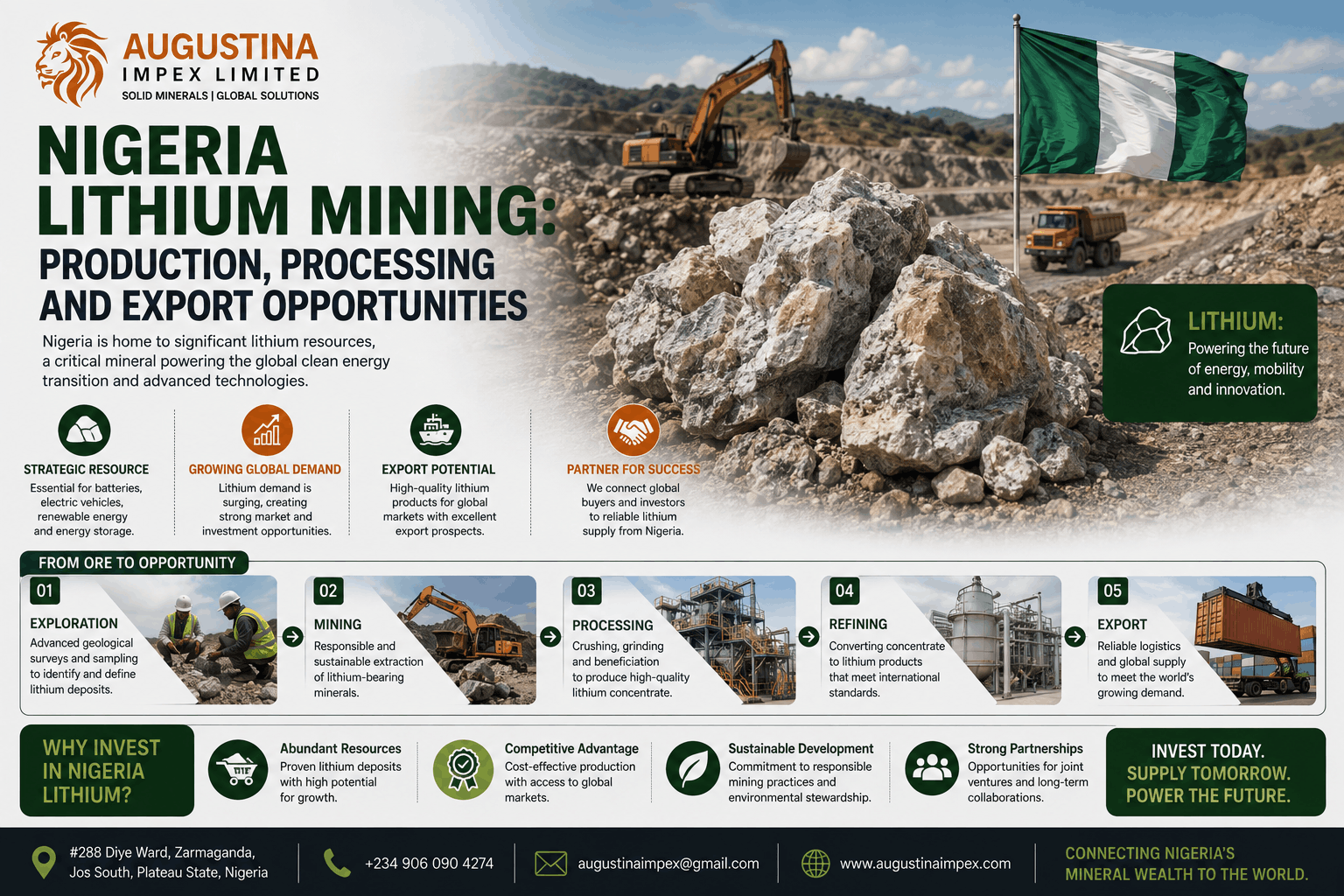
Nigeria Lithium Mining: Production, Processing & Export
Nigeria Lithium Mining: Production, Processing and Export Opportunities By Kolawole King, CEO — Augustina Impex…

Nigeria Rare Earth Minerals: Deposits & Market Potential
Nigeria Rare Earth Minerals: Deposits, Applications and Global Market Potential By Kolawole King, CEO —…

Nigeria Critical Minerals Guide: Lithium, Tin & Rare Earths
Critical Minerals in Nigeria: Complete Guide to Lithium, Tin, Tantalum, Niobium and Rare Earths By…
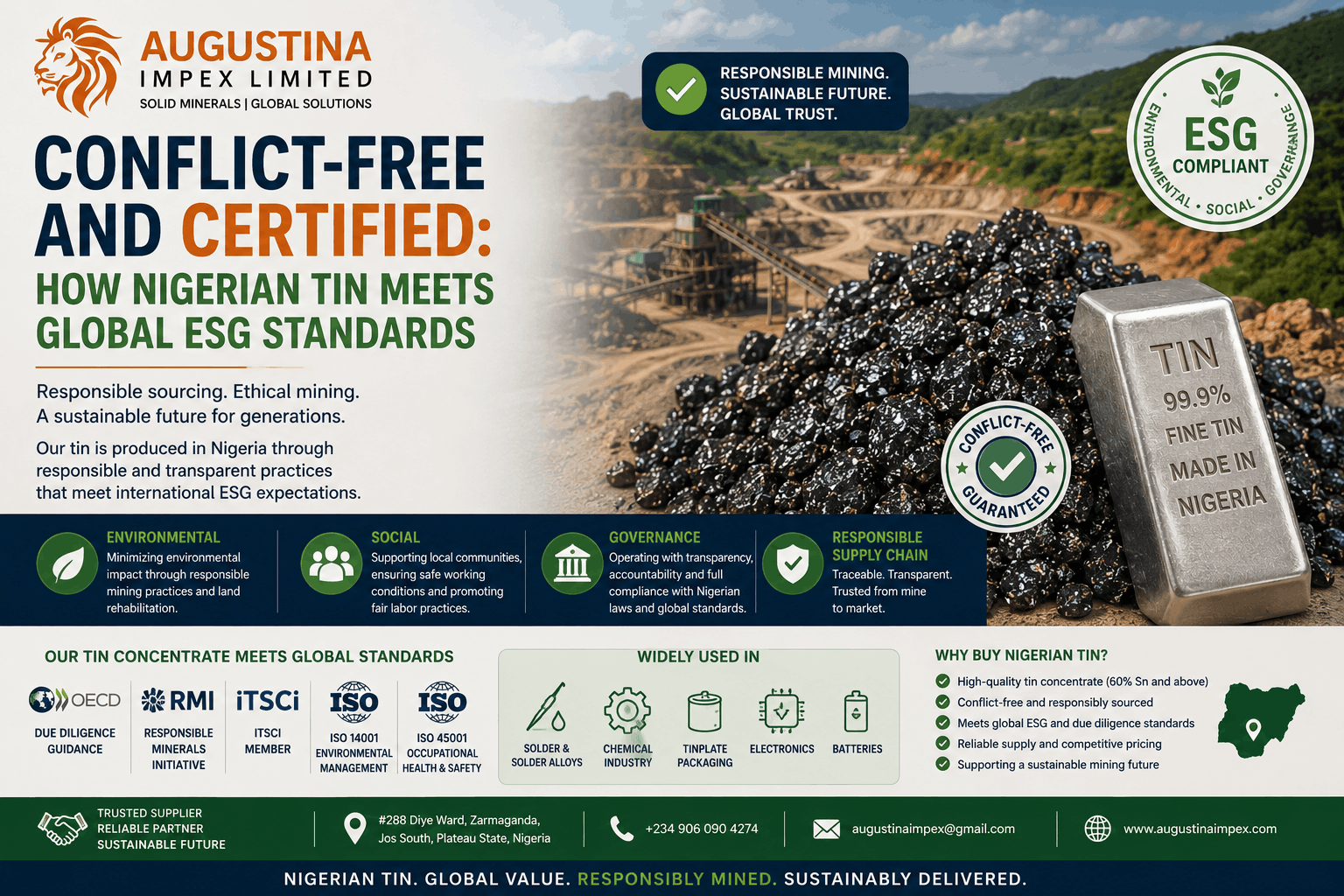
Conflict-Free Nigerian Tin Meets Global ESG Standards
Conflict-Free and Certified: How Nigerian Tin Meets Global ESG Standards By Kolawole King, CEO —…