

There was a time when every buyer who reached out to me asked the same question: what do you have available right now? The mineral business was a business of the present tense. You had a parcel of columbite or tin sitting at a buying station, a buyer wanted it, and the deal lived and died on that day’s price.
The questions I receive now are different, and the difference tells the whole story. Today buyers ask what I will have in 2030. They ask whether I can commit to volumes through 2035. They want to know about the future, because the future demand for strategic minerals has become the single most important variable in their planning. After 24 years on the Jos Plateau, I have learned to pay close attention when the questions change — and these have changed completely. This article is my attempt to explain why, to walk through what the serious forecasts actually project, and to be honest about what it means for those of us sitting at the African end of these supply chains.
It is a long read. The next two decades deserve it.
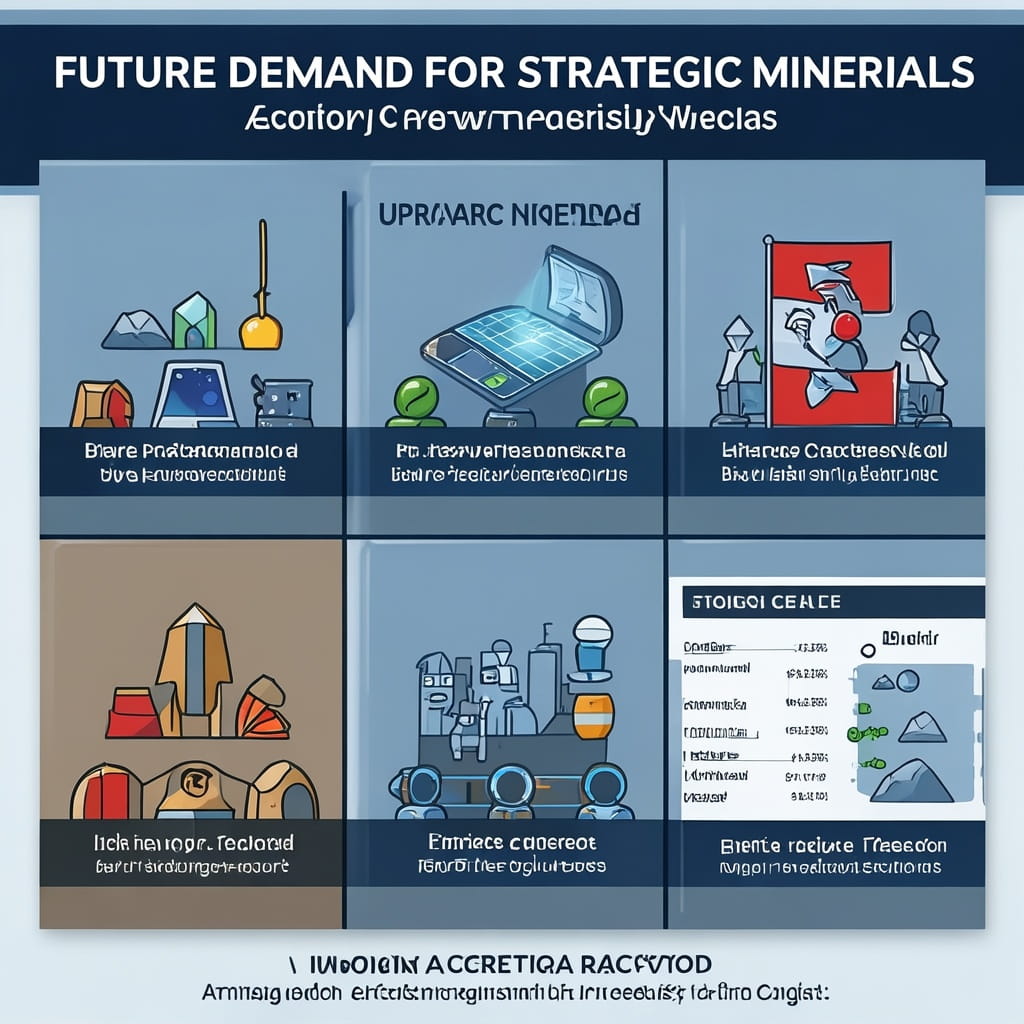
The Question Every Buyer Now Asks
The shift from the present tense to the future tense is not a quirk of my own customers. It reflects a global recalculation. Manufacturers, governments and investors have realised that the materials behind electrification, computing and defence are going to be needed in volumes the world has never produced, and that securing them is a multi-year project, not a spot purchase.
That is why demand forecasting — once a dry exercise for analysts — now sits at the centre of boardroom strategy. When you are building a battery gigafactory or a fleet of data centres that will run for decades, you cannot afford to assume the minerals will simply be there when you need them. You have to look down the road. And when serious institutions look down that road, what they see is a demand curve bending sharply upward for a whole family of minerals.
The Four Engines of Future Demand
When I try to explain to people why demand is set to surge, I point to four engines pulling in the same direction at once. It is the simultaneity that makes this moment unusual.
The first engine is electrification and the electric vehicle. Batteries devour lithium, nickel, cobalt and graphite, and the energy sector has accounted for the overwhelming share of recent demand growth in those metals — on the order of 85 percent. The second engine is renewable power and, above all, the electricity grid. Solar and wind need silica, copper and rare earth magnets, but it is the grid itself — the wires, transformers and substations connecting it all — that has quietly become one of the single largest drivers of copper demand on earth. The third engine is the newest and, to my mind, the most underappreciated: artificial intelligence and the data centres behind it. Those vast server farms are extraordinarily hungry for copper, gallium, silicon and rare earth magnets, and their electricity appetite — projected to climb toward 3 percent of all global power by 2030, up from around 1.5 percent in 2024 — translates directly into yet more grid copper. The fourth engine is defence and national security, as governments rebuild stockpiles and weapons systems that depend on rare earths and other strategic materials. Add the steady background pull of urbanisation across the developing world, and you have demand pressure arriving from every side at the same time.
What the Forecasts Actually Say
I am wary of throwing numbers around, but the projections from the most credible source in this space — the International Energy Agency’s Global Critical Minerals Outlook — are worth stating plainly, because they are striking.
Under the agency’s cleaner-energy scenarios, demand for lithium is projected to rise as much as sevenfold by 2035, with nickel and cobalt roughly tripling and copper roughly doubling. Even under today’s stated policies, the more conservative path, lithium demand grows close to fivefold by 2040 while graphite and nickel double. These are not distant fantasies; the trend is already visible in the actual figures. In 2024 alone, lithium demand jumped by nearly 30 percent — far above the 10 percent annual pace of the previous decade — while nickel, cobalt, graphite and rare earths each grew by 6 to 8 percent. To meet this trajectory, the IEA estimates that enormous sums of new investment are required, by some measures approaching 800 billion dollars across mining and refining by 2040. That is the scale of build-out the world is contemplating. When the most sober analysts in the field are using numbers like these, a producer should sit up and listen.
Future Demand for Strategic Minerals Meets a Supply That Cannot Keep Up
Here is the part that should concentrate every mind, because rising future demand for strategic minerals only matters commercially if supply struggles to follow — and the evidence says it will struggle badly.
The same IEA analysis projects, under current policies, a copper supply shortfall of around 30 percent by 2035 and a lithium shortfall of around 40 percent, measured against what announced projects can actually deliver. Copper is the clearest warning. Output may reach only about 29 million tonnes by 2035 against the roughly 35 million tonnes the world will need, and demand could push toward 37 million tonnes by 2050. The reasons are structural and stubborn: ore grades are declining, the richest deposits have already been found, new mines routinely take more than a decade to bring online, and exploration spending actually fell in 2024 as low prices discouraged investment. Layer the AI build-out on top — which alone could add something like a million tonnes of copper demand by 2030 — and the mismatch between what the world wants and what the ground can yield becomes the defining commercial fact of this era. Scarcity, when it is structural, is opportunity for those positioned to supply.
The Price Paradox
I have to address something that confuses many people and trips up a lot of would-be investors, because I have watched it happen. If demand is soaring and supply is short, why did mineral prices fall so hard recently?
In 2024, prices for many of these very minerals dropped sharply. Lithium fell more than 80 percent from its 2022 peak; cobalt, nickel and graphite slid by 10 to 20 percent. The reason was a short-term glut: producers in China, Indonesia and the Democratic Republic of Congo scaled up battery-metal output remarkably fast, faster than for traditional metals, and that wave of new supply temporarily overwhelmed even rapidly growing demand. This is the paradox every serious producer must understand. Short-term oversupply can mask a long-term deficit. The market can be awash one year and desperately tight a few years later. The investors who get burned are the ones who flee at the first price dip; the ones who prosper are those who keep their eyes on the structural trend and use the quiet periods to position. Volatility is not a bug in this market — it is a permanent feature, and learning to live with it is part of the craft.
The Wildcards: Substitution and Recycling
I would be selling you a fairy tale if I pretended every mineral is guaranteed to win. Two forces could temper the demand picture, and honesty requires naming them.
The first is substitution. Battery chemistry is evolving quickly. Lithium iron phosphate cells have already cut the cobalt and nickel needed per battery, and sodium-ion batteries — which sidestep lithium altogether for some uses — are advancing. Technology can erode demand for a specific mineral even as the overall trend rises. The second is recycling. As the first generations of batteries and electronics reach end of life, recycling could supply something like 10 to 15 percent of critical mineral needs by 2035, with cobalt recovery potentially reaching 30 percent under ambitious scenarios. Neither force reverses the demand wave — the growth is simply too large — but both reshape which minerals benefit most and by how much. The lesson I draw is to stay diversified and stay informed, rather than betting everything on a single commodity’s forecast.
What This Means for Africa and Nigeria
Step back from the detail and the conclusion for my continent is clear. We are looking at a demand wave that will run for decades, not a passing boom — and Africa holds something close to 30 percent of the world’s mineral reserves, including many of the materials these forecasts say the world will desperately need.
What moves me most is how directly this maps onto the ground I know. The lithium now being processed on Nigerian soil, the rare-earth-bearing monazite of the North-Central belt, the columbite and tantalite that have come out of the Jos Plateau for a century — these are precisely the minerals the demand curves are bending upward to meet. Nigeria is no longer peripheral to this story. The task for us is to position now, during the build-out years, so that we are ready when the structural deficits arrive: building reliable supply, adding value before material leaves our shores, and forming the kind of long-term relationships that the buyers asking about 2035 are actively seeking. A generational demand wave only rewards those who are standing in the right place when it breaks.
An Honest Look at the Risks
Demand forecasts are powerful, but they are not promises, and I would not respect my readers if I treated them as such.
The first risk is that scenarios diverge — the gap between the most aggressive clean-energy pathway and today’s stated policies is wide, and reality usually lands somewhere uncertain in between. The second is the price volatility I described: a producer who borrows heavily and builds for tomorrow’s deficit can be sunk by today’s glut if the timing is wrong. The third is substitution risk for any single mineral, which is why concentration is dangerous. The fourth is timing itself — demand that the models place in 2030 might genuinely arrive in 2034, and the interest on patient capital does not pause to wait. And beneath all of it sit the familiar African challenges: the need for value-adding capacity, the importance of social licence and good governance, and the gap between grand projections and delivered tonnes. None of this dims the opportunity. It simply means the opportunity belongs to the prepared, the patient and the well-partnered, not to the reckless.
Where Augustina Impex Fits In
This is the work my company exists to do. Augustina Impex Limited has traded across the Jos Plateau mineral belt since 2001, and our portfolio — monazite, ilmenite, zircon, columbite, tantalite, tin, lithium, fluorite, garnet and lead ore — sits squarely among the materials these demand forecasts point toward. We understand the full journey from a working minesite to an international buyer’s long-term contract, and in a market increasingly defined by the future tense, what we offer is exactly what forward-looking buyers need: verified local sourcing, quality assurance, proper export documentation, and the on-the-ground consultancy that turns a strategically important deposit into a dependable, repeatable supply relationship.
If you are a buyer trying to lock in supply for the demand you can see coming, an investor weighing a long-horizon entry into African minerals, or a partner who values reliability and straight dealing, that is the conversation I welcome. The world has finally started asking about the future of these minerals. For those of us who have worked them since before that future was fashionable, the opportunity now is to make sure we are ready to meet it — and that more of the value it creates stays where the minerals come from. I am glad to discuss how.
Kolawole King Chief Executive Officer, Augustina Impex Limited #288 Diye Ward, Zarmaganda, Jos South, Plateau State, Nigeria Email: augustinaimpex@gmail.com WhatsApp: +234 906 090 4274 Website: https://augustinaimpex.com Blog: https://augustinaimpexng.blogspot.com/ Advert Video: https://www.youtube.com/watch?v=Izg0t7By6co
#StrategicMinerals #CriticalMinerals #MineralDemand #Lithium #Copper #RareEarths #EnergyTransition #AIDataCenters #EVBatteries #SupplyGap #MineralSupercycle #IEAOutlook #AfricaMinerals #NigeriaMining #AugustinaImpex
-
Previous Post
The New Global Competition for Strategic Minerals
Post a comment
Related Posts
Nigeria Lithium Mining: Production, Processing & Export
Nigeria Lithium Mining: Production, Processing and Export Opportunities By Kolawole King, CEO — Augustina Impex…
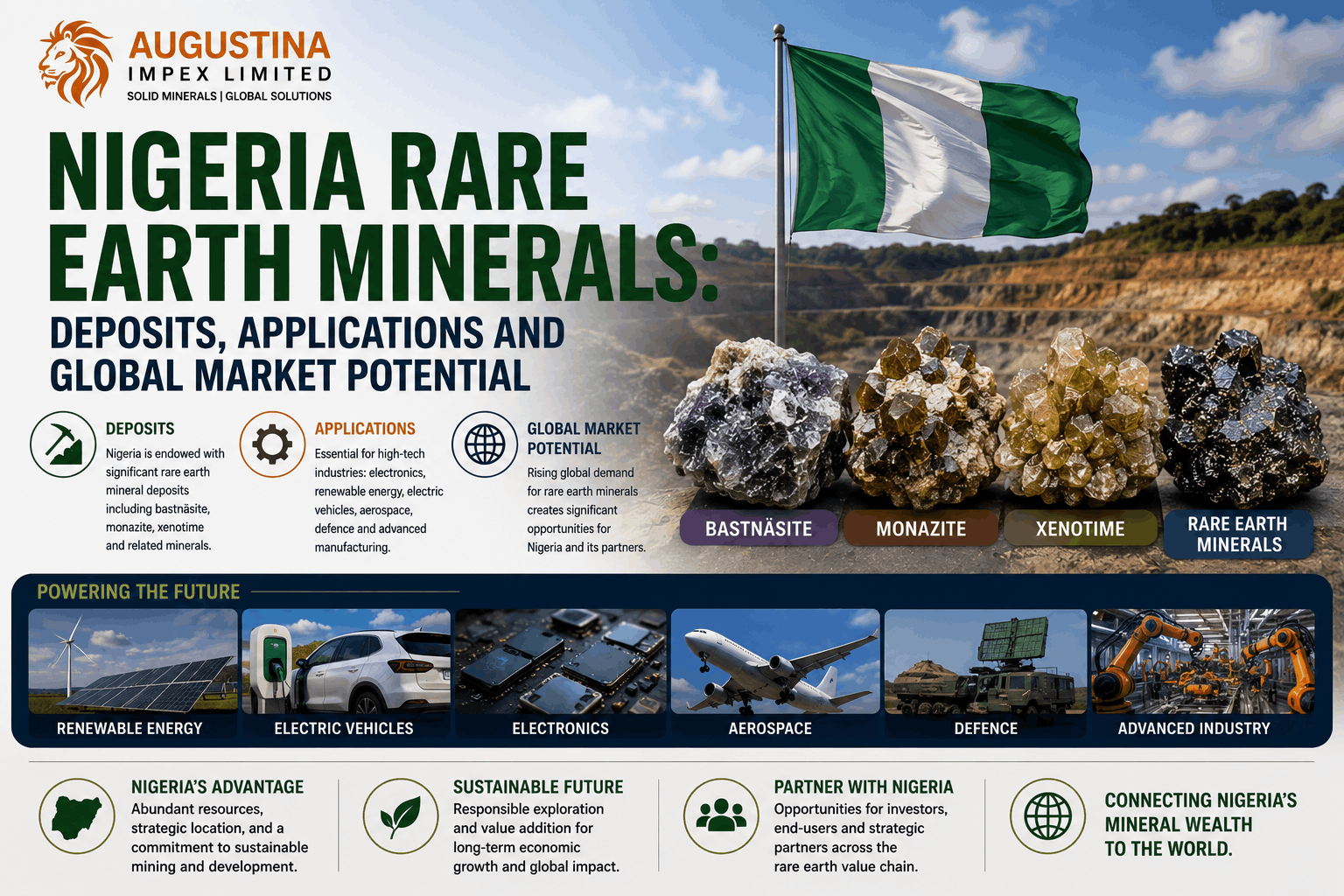
Nigeria Rare Earth Minerals: Deposits & Market Potential
Nigeria Rare Earth Minerals: Deposits, Applications and Global Market Potential By Kolawole King, CEO —…
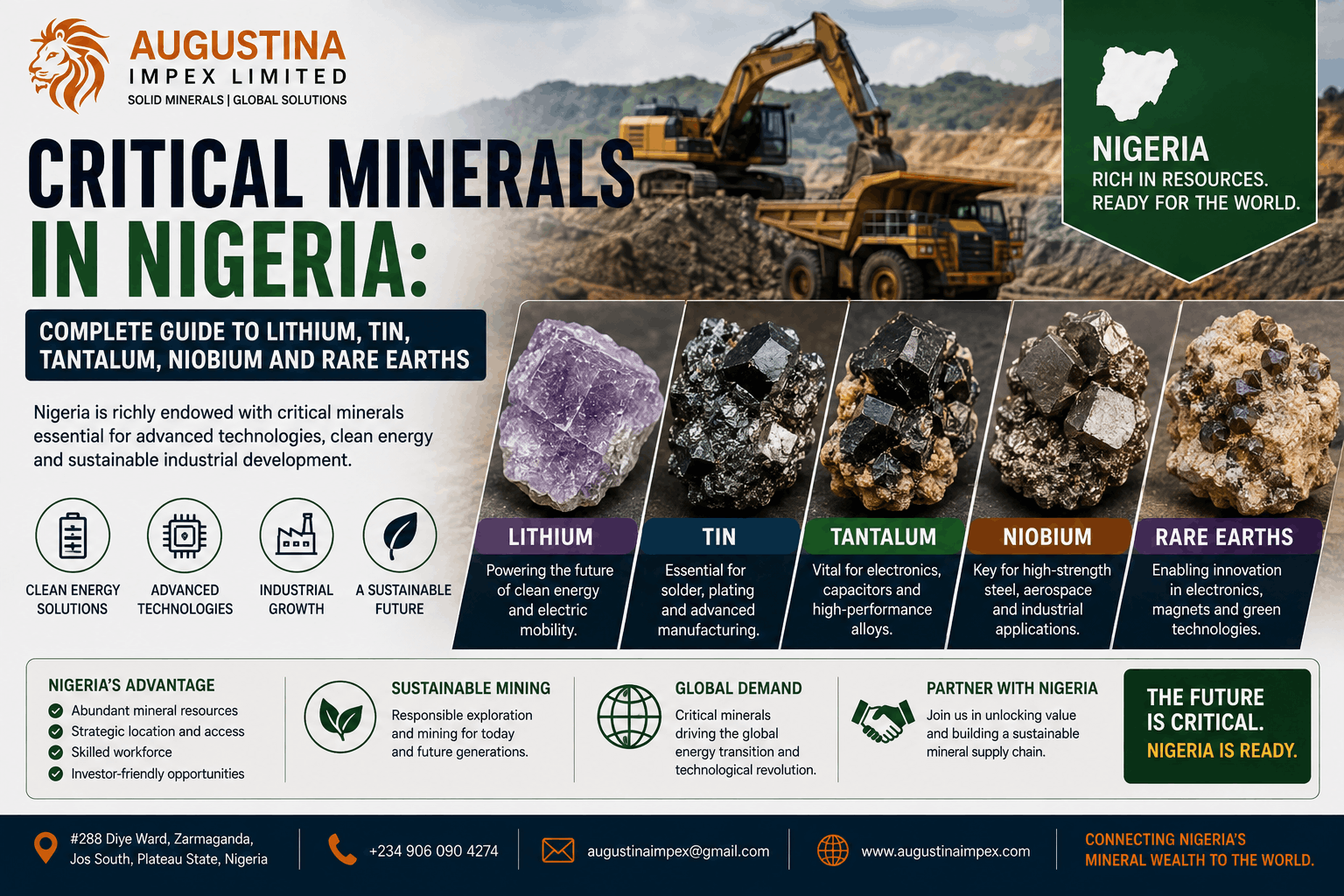
Nigeria Critical Minerals Guide: Lithium, Tin & Rare Earths
Critical Minerals in Nigeria: Complete Guide to Lithium, Tin, Tantalum, Niobium and Rare Earths By…
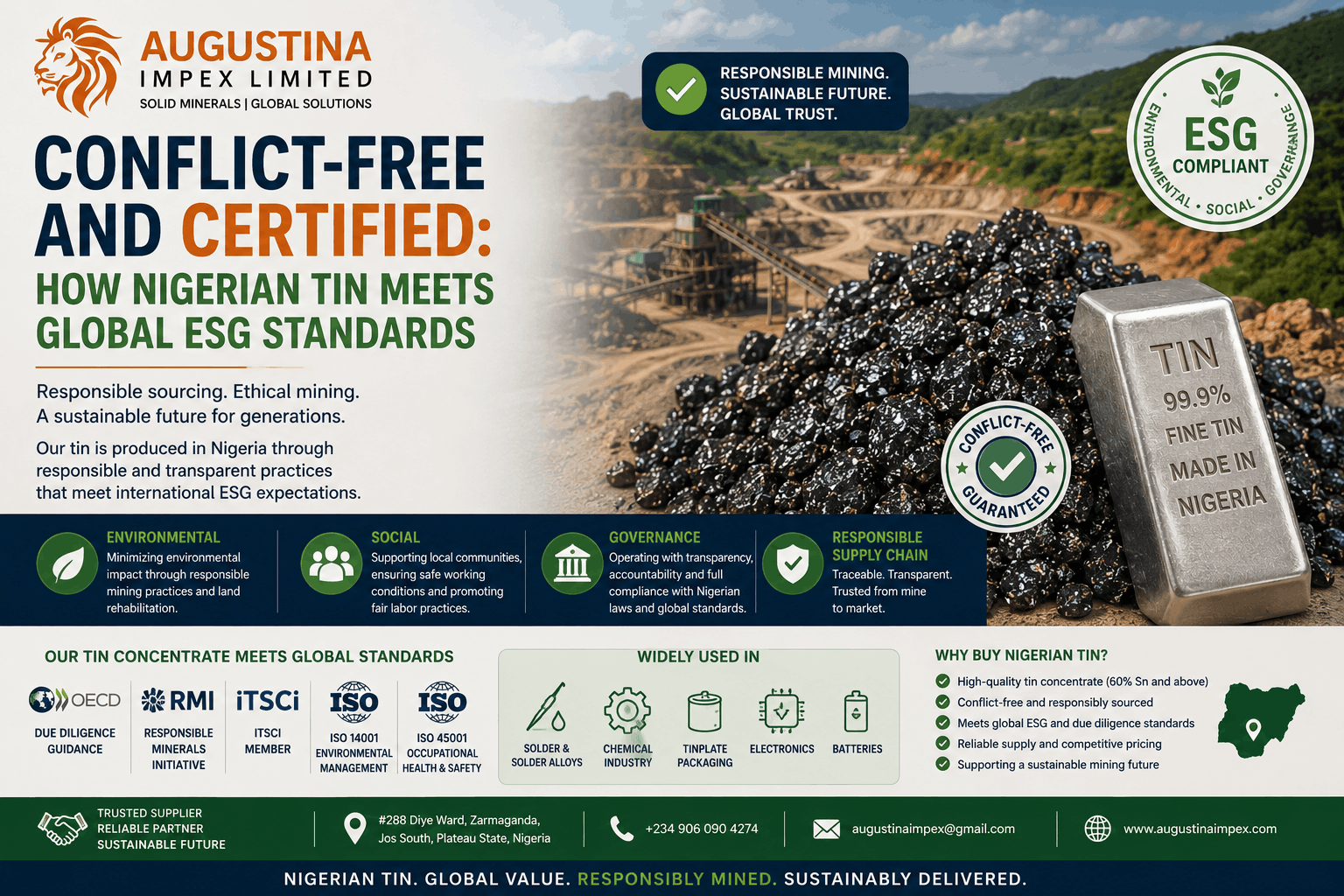
Conflict-Free Nigerian Tin Meets Global ESG Standards
Conflict-Free and Certified: How Nigerian Tin Meets Global ESG Standards By Kolawole King, CEO —…