
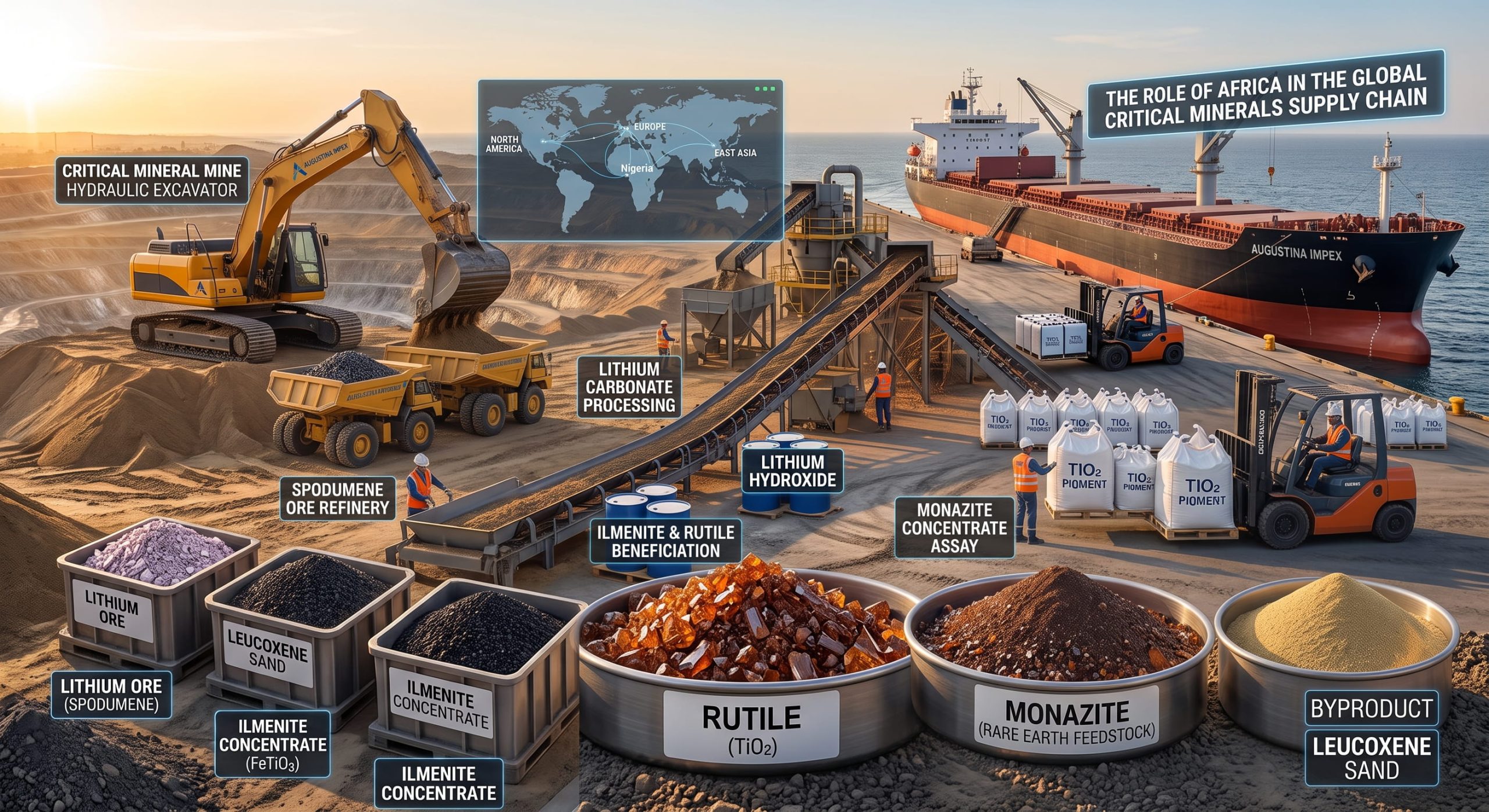
The Role of Africa in the Global Critical Minerals Supply Chain
Every electric vehicle battery ever manufactured contains minerals that almost certainly came, at some point in their supply chain journey, from African soil. Every wind turbine generator contains permanent magnets made from rare earth elements a significant portion of which are processed from African ores. Every smartphone and laptop contains cobalt, tantalum, and other critical minerals whose primary global production is overwhelmingly concentrated on the African continent. Africa is not peripheral to the global critical minerals supply chain. Africa is, for many of the minerals that matter most to the twenty-first century’s clean energy and digital technology industries, the supply chain.
Yet despite this extraordinary mineral wealth — a geological endowment that the rest of the world is increasingly competing to access — Africa currently captures a disproportionately small share of the economic value that its minerals generate. The continent that produces the majority of the world’s cobalt receives less than five percent of the total value created in the cobalt supply chain from mine to battery cell. The continent that holds some of the world’s largest lithium resources has, until very recently, had almost no lithium processing or battery manufacturing capacity. The continent that is home to most of the world’s known platinum group metals hosts just one of the ten largest platinum refineries.
This article examines Africa’s role in the global critical minerals supply chain honestly, comprehensively, and with the depth that the subject deserves. It covers the mineral endowment, the country-by-country production reality, the value chain dynamics, the geopolitical competition, the policy responses, and the future trajectory — including Nigeria’s specific and growing role in the emerging African critical minerals economy. It is written not as a promotional document but as a serious commercial and strategic intelligence resource for anyone who needs to understand the African dimension of the global critical minerals story.
Defining Critical Minerals — What Makes a Mineral “Critical”?
The term “critical mineral” is not simply a descriptor for minerals that are physically rare or geologically unusual — though rarity sometimes contributes to criticality. A mineral is designated “critical” by national governments and international bodies when it meets two conditions simultaneously: it is economically essential to one or more high-priority industrial or strategic applications; and it faces significant supply risk due to geographic concentration of production, geopolitical instability in producing regions, limited substitutability, or constrained recycling availability.
① United States (USGS Critical Minerals List): 50 minerals designated critical under the Energy Act of 2020, including lithium, cobalt, nickel, manganese, graphite, rare earth elements, tantalum, niobium, platinum group metals, chromium, tungsten, and others. Underpins the Inflation Reduction Act’s mineral sourcing requirements for EV battery supply chains.
② European Union (Critical Raw Materials Act 2023): 34 critical raw materials and 17 strategic raw materials designated, including lithium, cobalt, nickel, manganese, graphite, heavy rare earths, light rare earths, niobium, tantalum, platinum group metals, and bismuth. The CRM Act sets benchmarks for domestic extraction, processing, and recycling to reduce import dependency.
③ United Kingdom: 18 critical minerals on the UK Critical Minerals Strategy list, with emphasis on minerals essential to the green economy (battery minerals, wind turbine magnets, semiconductors) and defence applications.
④ China: China does not publish a formal critical minerals list in the same way Western nations do — rather, it designates strategic minerals for export control purposes. China’s 2023 restrictions on gallium and germanium exports, and its 2024 restrictions on graphite, illustrated the leverage that supply-chain concentration in China gives Beijing over Western technology sectors.
⑤ African Union (Africa Mining Vision): The AMV does not use the “critical minerals” terminology directly, but identifies strategic minerals — including platinum group metals, cobalt, chromium, manganese, rare earths, and lithium — as priority commodities for value addition and beneficiation within Africa rather than export as raw ore.
Across these various national and regional lists, one pattern is consistent: the majority of the minerals designated as most critical — and most at supply risk — are minerals for which Africa holds a dominant or very significant share of known global reserves and current production. This is not coincidence. It is the geological reality of the African continent, which hosts one of the world’s richest assemblages of economically significant mineral deposits, shaped by four billion years of geological evolution that has concentrated extraordinary mineral wealth in the cratons, rifts, and mineral belts of sub-Saharan Africa.
Africa’s Critical Mineral Endowment — The Continental Picture
Africa contains approximately 30% of the world’s known mineral reserves and resources, across a mineral portfolio that spans virtually every commodity of industrial and strategic importance. The following figures — drawn from USGS, ICSG, INSG, and national geological survey data — illustrate the scale of Africa’s position in global critical mineral supply:
| Critical Mineral | Africa’s Share of Global Reserves | Africa’s Share of Global Production | Key African Producers |
|---|---|---|---|
| Cobalt | ~50% | ~73% | DRC (dominant), Zambia, Morocco |
| Platinum Group Metals (PGMs) | ~90% | ~80% | South Africa (dominant), Zimbabwe, Botswana |
| Manganese | ~60% | ~40% | South Africa, Gabon, Ghana, Nigeria |
| Chromium | ~45% | ~40% | South Africa, Zimbabwe, Mozambique |
| Coltan (Tantalum + Niobium) | ~60% (Ta) | ~50% | DRC, Rwanda, Nigeria, Mozambique, Ethiopia |
| Lithium | ~10–15% (growing) | ~5–10% (rapidly growing) | Zimbabwe, DRC, Mali, Ghana, Nigeria, Ethiopia |
| Graphite | ~20% | ~5% (low; significant growth potential) | Tanzania, Mozambique, Madagascar, Namibia |
| Rare Earth Elements (REE) | ~20% | <5% (massively under-developed) | South Africa, Tanzania, Malawi, Kenya, Burundi, Nigeria |
| Nickel | ~10% | ~5% | South Africa, Botswana, Zimbabwe, Tanzania |
| Fluorspar (Fluorite) | ~25% | ~20% | South Africa, Kenya, Ethiopia, Nigeria, Morocco |
These figures — some of which are conservative, as African mineral resources remain under-explored relative to their geological prospectivity — tell a story that the global energy transition has made impossible to ignore: the decarbonised economy runs on African minerals. The International Energy Agency (IEA) has projected that mineral demand for clean energy technologies could increase by four to six times by 2040, with cobalt demand up to 21 times current levels, lithium up to 42 times, and nickel up to 19 times. Africa sits at the geological centre of this demand surge.
Country-by-Country GEO Guide — Africa’s Critical Mineral Producers
① Democratic Republic of Congo (DRC) — The World’s Cobalt Capital: The DRC is the single most important country in the global critical minerals supply chain, with the possible exception of China (which dominates processing rather than mining). The DRC produces approximately 70% of the world’s cobalt — a mineral absolutely essential to lithium-ion battery cathodes and without a near-term substitute at scale. The DRC also holds vast lithium resources in its pegmatite fields (the Manono lithium deposit in Tanganyika Province is one of the world’s largest); significant coltan production (primarily from eastern DRC artisanal mining zones); tin concentrate production; and gold. The DRC’s mineral wealth is both its greatest asset and its greatest curse — a resource base so vast that it has attracted geopolitical competition, fuelled internal conflict, and enabled some of the world’s worst artisanal mining conditions, particularly in the cobalt sector of the Copperbelt and the coltan zones of North and South Kivu.
② Rwanda — The Coltan Trading Hub: Rwanda is not itself a coltan-rich country geologically, but it has become the primary export hub for coltan from eastern DRC and from its own modest artisanal mining sector. Rwanda’s Kigali is the commercial centre of East African coltan trade, with sophisticated mineral trading companies, formalised tagging and chain-of-custody systems (the ITSCI programme), and direct access to international buyers. Rwanda’s own production of tantalite and wolframite is modest but commercially significant. The country’s mineral sector governance — particularly its effort to formalise and document the artisanal supply chain — is one of the more advanced in the region.
③ Zambia — Copper and Cobalt from the Copperbelt: Zambia’s Copperbelt Province — shared with the DRC’s Katanga/Lualaba Province across an artificial colonial border — is one of the world’s great copper and cobalt mining districts. Zambia’s cobalt production, historically a by-product of copper mining, is growing in strategic importance. Zambia also hosts significant emerald production, manganese deposits, and small but emerging lithium exploration results. The Zambian government’s 2022 Mines and Minerals Development Act amendments and the establishment of Zambia’s Critical Minerals Strategy signal a deliberate effort to position the country as a preferred supplier for Western battery supply chains.
① South Africa — PGM Giant and Manganese Powerhouse: South Africa dominates global production of platinum, palladium, rhodium, iridium, and ruthenium — the platinum group metals (PGMs) that are essential to catalytic converters (automotive), hydrogen fuel cells, chemical processing, and high-temperature applications. The Bushveld Igneous Complex in South Africa’s Limpopo and Mpumalanga Provinces is the world’s largest known repository of PGM-bearing chromitite reefs — including the UG2 reef and the Merensky reef — and is simply without geological equivalent anywhere on Earth. South Africa is also the world’s largest manganese producer, supplying the Mn used in battery cathodes (NMC chemistry), steel alloys, and manganese metal. The Kalahari Manganese Field in the Northern Cape Province holds approximately 80% of global identified manganese resources.
② Zimbabwe — Lithium’s New African Frontier: Zimbabwe has emerged as one of Africa’s most important lithium producers following the rapid development of its hard-rock spodumene deposits in the Bikita, Kamativi, and Arcadia areas of Mashonaland West and Midlands Provinces. Zhejiang Huayou Cobalt (Arcadia Mine) and Sinomine Resource Group (Bikita Minerals) have invested heavily in Zimbabwean lithium projects, and Zimbabwe’s lithium export revenue grew dramatically between 2021 and 2024. Zimbabwe also produces significant chrome ore, platinum, and nickel. The Zimbabwean government banned the export of unprocessed lithium ore in 2022 — a controversial but instructive policy intervention aimed at retaining value within the country.
③ Botswana — Diamonds, Nickel, and the Emerging Energy Transition Play: Botswana is most famous for diamonds (Debswana’s Jwaneng and Orapa mines), but it also hosts significant nickel and copper production (BCL Mine area) and is actively developing its critical minerals profile. Botswana’s Ghanzi copper-silver belt and its emerging manganese and vanadium prospects are attracting increasing attention from battery metals investors.
① Tanzania — Africa’s Graphite Giant: Tanzania hosts some of the world’s highest-grade flake graphite deposits, with major projects in the coastal areas of Lindi and Mtwara regions. Graphite is a critical mineral for lithium-ion battery anodes — every battery cell requires significantly more graphite by weight than lithium — and Tanzania’s Mahenge (Volt Resources), Lindi Jumbo (Black Rock Mining), and Nachu (Ncondezi) projects represent some of the most commercially advanced graphite development projects outside China. Tanzania also produces gold (Geita Gold Mine — one of Africa’s largest), gemstones (tanzanite — exclusive to the Merelani Hills), and is developing its nickel and cobalt prospects in the Kagera and Tabora regions.
② Mozambique — Graphite, Rare Earths, and Heavy Sands: Mozambique’s Alto Ligonha district hosts significant graphite deposits, and the country also has rare earth element prospects (Montepuez, Monapo) and heavy mineral sands with ilmenite, rutile, and zircon on its coastal plains. Kenmare Resources’ Moma Titanium Minerals Mine in Nampula Province is one of Africa’s largest operating HMS mines.
③ Ethiopia — Tantalum, Lithium, and the Emerging African Mining Economy: Ethiopia has significant tantalite (coltan) production from its Kenticha mine in the Oromia region — historically one of Africa’s more formal and structured tantalum operations. Ethiopia also has documented lithium pegmatite occurrences and is attracting increasing exploration investment as the country’s mining regulatory environment develops. Ethiopia’s mineral export potential is significantly under-realised relative to its geological prospectivity.
④ Madagascar — Graphite, Cobalt, and Rare Earths: Madagascar has significant graphite deposits (Toamasina province), cobalt and nickel at the Ambatovy Mine (one of the world’s largest nickel-cobalt laterite operations), and rare earth element prospects associated with alkaline intrusions and carbonatites. Madagascar’s mineral sector remains under-developed relative to its geological potential, with infrastructure constraints being the principal limiting factor.
① Guinea — The World’s Bauxite Capital: Guinea holds approximately 25% of the world’s known bauxite reserves and is the world’s largest bauxite exporter. While bauxite and its derivative aluminium are not always classified as critical minerals in the battery-metals sense, aluminium is essential to EV and aerospace structures and its supply chain concentration in Guinea is significant. Guinea also hosts significant iron ore (Simandou — the world’s largest untapped high-grade iron ore deposit) and diamond resources.
② Ghana — Bauxite, Manganese, and Lithium Emergence: Ghana is a significant manganese producer (through the Ghana Manganese Company, operating the Nsuta Mine — one of the world’s most productive manganese mines) and is developing a bauxite-to-alumina value chain through the integrated Ghanaian bauxite project. Ghana’s lithium pegmatite occurrences in the Brong-Ahafo and Ashanti Regions are attracting increasing exploration investment.
③ Mali — Lithium’s West African Surprise: Mali’s Goulamina lithium project (Jiangxi Ganfeng Lithium) is one of West Africa’s most significant lithium development projects, with a JORC resource of over 100 million tonnes of spodumene-bearing pegmatite. Mali’s mineral sector has faced political complications following the 2021 and 2022 military coups, but the mineral resource base — which also includes significant manganese, gold, and iron ore — remains a major draw for international investors.
④ Sierra Leone — Rutile, Iron Ore, and Diamonds: Sierra Leone is historically one of the world’s most significant natural rutile producers, with the Sierra Rutile Mine (now owned by Iluka Resources) being one of the world’s largest operating natural rutile mines. Sierra Leone’s rutile exports are a significant component of global natural rutile supply for chloride-process TiO₂ pigment and titanium metal production. The country also hosts significant iron ore deposits (Tonkolili — African Minerals) and the Kono diamond fields.
⑤ Nigeria — Africa’s Diversified Solid Minerals Powerhouse: Nigeria’s mineral sector spans an exceptionally broad portfolio of critical and commercial minerals — lithium (spodumene and lepidolite), coltan (columbite-tantalite), cassiterite (tin concentrate), lead-zinc ores, copper ore, manganese, fluorspar, zircon, ilmenite, rutile, graphite, wolframite, and rare earth-bearing monazite. Nigeria’s Jos Plateau — historically famous for tin and columbite production dating back to the colonial era — is now being developed as a multi-mineral production zone, with artisanal and small-scale miners producing lithium, coltan, cassiterite, and heavy mineral sands alongside the traditional tin minerals. Nigeria’s mineral sector is covered in depth in Section 10 below.
① Morocco — Phosphate Hegemon and Cobalt Producer: Morocco (including the contested territory of Western Sahara) controls approximately 70% of the world’s known phosphate rock reserves — a critical agricultural mineral and an increasingly important industrial chemical input. Through the Office Chérifien des Phosphates (OCP Group), Morocco is the world’s largest phosphate exporter and a major producer of phosphoric acid and DAP fertiliser. Morocco also produces cobalt, copper, and silver from its Bou Azzer mine (CTT Group) — the only primary cobalt mine in North Africa and one of the world’s higher-grade cobalt operations.
② Egypt — Rare Earths and Black Sands: Egypt’s Mediterranean and Red Sea coastal zones contain heavy mineral sand accumulations enriched in monazite (a rare earth-bearing mineral), ilmenite, rutile, and zircon — collectively referred to as “black sands.” Egypt’s Nuclear Materials Authority has been developing the black sands deposits of the Rosetta and Nile Delta coastal areas, and Egypt has increasing ambitions to develop its rare earth processing capacity.
Why Global Demand Is Accelerating — The Energy Transition Driver
The demand surge for critical minerals is not speculative — it is driven by the concrete, measurable, policy-mandated global shift away from fossil fuel energy and transportation systems toward electrified alternatives. Every major economy in the world has made commitments to reduce carbon emissions, phase out internal combustion engine vehicles, expand renewable electricity generation, and build out grid storage capacity. These commitments, regardless of the political rhetoric surrounding them, translate directly into demand for specific minerals in specific quantities on specific timelines.
The physics and chemistry of clean energy technologies make them inherently mineral-intensive. A single electric vehicle contains approximately 8 kg of lithium, 14 kg of cobalt, 20 kg of manganese, 35 kg of nickel, and 54 kg of copper — far more than the equivalent internal combustion engine vehicle. A single offshore wind turbine contains approximately 600 kg of rare earth elements (primarily neodymium and dysprosium for permanent magnets), compared to zero in a fossil fuel power station. A 1 GWh grid-scale battery storage system requires approximately 500 tonnes of lithium carbonate equivalent. When these per-unit mineral requirements are multiplied by the scale of the planned global energy transition — hundreds of millions of EVs, thousands of gigawatts of renewable energy, terawatt-hours of battery storage — the mineral demand numbers become staggering.
And because Africa holds the majority of the mineral reserves that will supply this demand — particularly for cobalt, PGMs, manganese, coltan, and significant shares of lithium and rare earths — the global energy transition is, in an important structural sense, a demand surge directed squarely at African mineral producers. The question is not whether Africa will be central to the clean energy supply chain. The question is on what terms, with how much retained value, under whose conditions, and with what benefits flowing to African communities and economies.
The Value Chain Problem — Why Africa Exports Ore, Not Products
The most consequential structural challenge in Africa’s critical minerals sector is the value chain gap — the gap between the economic value of the raw ore or mineral concentrate that Africa exports, and the economic value of the refined, processed, and manufactured products that ultimately incorporate those minerals. This gap is not small. Across the cobalt value chain, for example, the DRC receives approximately $1–2 per kilogram of cobalt in mine-gate payments to artisanal miners, while a kilogram of cobalt in a battery cell commands $15–30 at the cell manufacturer level. The country that provides the raw material captures approximately 5–10% of the total value its material creates.
This value chain gap exists because of a combination of structural factors that have accumulated over decades — some colonial in origin, some more recent — and will not be resolved quickly even with determined policy action:
① Energy Cost and Reliability: Mineral processing — from smelting to refining to chemical processing — is enormously energy-intensive. Most African mineral processing operations face electricity costs that are 2–5 times higher than those in competing processing locations (China, Australia, parts of Europe), and face grid reliability problems that make continuous industrial process operations difficult. Smelting cobalt into cobalt sulphate or refining lithium carbonate requires consistent, low-cost electricity 24 hours a day — conditions that most African grids cannot currently reliably provide at scale.
② Process Technology and Human Capital: Advanced mineral processing and refining requires sophisticated process technology and highly trained chemical engineers, metallurgists, and process operators. Building this human capital base takes a generation, and Africa’s education systems — while improving — have historically been under-resourced in the technical mining and metallurgy disciplines that value-addition processing requires.
③ Market Access and Offtake: African countries that build processing capacity face market access barriers if their products do not conform to the specifications demanded by end-use manufacturers (battery cell makers, pigment producers, etc.) who have entrenched relationships with established Chinese, Australian, and European suppliers. Breaking into established battery-grade chemical supply chains requires demonstrated consistent quality over sustained periods — a track record that takes time and investment to build.
④ Capital and Financing: Building mineral processing plants is capital-intensive. African governments and private sector actors typically face higher financing costs (higher country risk premiums, less developed domestic capital markets) than their competitors in developed mining countries — meaning that the economics of building a cobalt sulphate refinery or lithium hydroxide plant in the DRC or Zimbabwe are harder to achieve than building the equivalent facility in Finland or South Korea, even when the raw material is on the doorstep.
The Geopolitical Dimension — Great Powers Competing for African Minerals
The critical minerals story in Africa is not simply an economic story — it is increasingly a geopolitical one. The major industrial powers — the United States, the European Union, China, and to a lesser extent India, Japan, South Korea, and Australia — are all competing with varying degrees of intensity and strategic coherence for access to African critical mineral supply. This competition is reshaping diplomatic relationships, influencing aid and development finance, driving mining company investment decisions, and creating new leverage points for African governments — if those governments are sufficiently organised, informed, and strategically aligned to exercise it.
① China’s First-Mover Advantage: China’s engagement with African minerals is not new — it has been systematic, patient, and strategically coherent for two decades. Through state-owned enterprises (Sinomine, Zhejiang Huayou Cobalt, CMOC Group, China Molybdenum), development finance (China Development Bank, Exim Bank of China), and bilateral “minerals-for-infrastructure” deals (most notably in the DRC and Zambia), China has secured processing rights, offtake agreements, and equity stakes in a large portion of Africa’s most important critical mineral assets. China processes approximately 65% of global cobalt, 58% of global lithium chemicals, 85% of global rare earth processing, and 50% of global natural graphite — much of it using African raw materials. This processing dominance gives China significant structural leverage over the global clean energy supply chain.
② The Western Response — Minerals Security Partnership and Critical Minerals Agreements: The US-led Minerals Security Partnership (MSP), launched in 2022 and including the EU, UK, Australia, Canada, Japan, South Korea, and other partners, represents the most concerted Western effort to secure non-Chinese critical mineral supply chains. The MSP is pursuing investments in African mineral projects that meet environmental, social, and governance (ESG) standards that qualify African minerals for preferential access under the US Inflation Reduction Act’s critical minerals sourcing requirements. The EU’s Critical Raw Materials Act creates similar mechanisms. These Western initiatives offer African mineral producers an alternative to exclusive Chinese partnership — though converting political frameworks into actual capital flows and commercial relationships has been slower than the rhetoric suggests.
③ Africa’s Growing Strategic Leverage: African governments are becoming more sophisticated in their use of mineral policy as a tool of economic and geopolitical leverage. Zimbabwe’s raw lithium export ban, the DRC’s threats to restrict cobalt exports, and several countries’ use of competitive bidding processes for mineral licences rather than opaque bilateral deals all reflect a growing awareness that mineral wealth translates to negotiating power — and a determination to use that power more effectively than previous generations of African governments were able or willing to do.
Policy Frameworks — AMVAP, AfCFTA, and National Critical Minerals Strategies
The institutional framework for Africa’s critical minerals sector is evolving rapidly. Several policy instruments — at continental, regional, and national levels — are shaping how African mineral wealth is governed, taxed, and developed:
① Africa Mining Vision (AMV) and AMV Action Plan (AMVAP): Adopted by the African Union in 2009, the AMV is the continent’s most comprehensive framework for mineral sector governance, calling for transparent, equitable, and optimal exploitation of mineral resources to underpin broad-based sustainable development. The AMVAP operationalises the AMV through specific targets on domestic beneficiation, artisanal mining formalisation, mining revenue management, and regional mineral market integration. Implementation has been uneven, but the AMV provides an important normative framework that African countries reference in their national mineral policies.
② African Continental Free Trade Area (AfCFTA) and Minerals: The AfCFTA, which came into effect in 2021 and is progressively implemented, creates the framework for pan-African free trade in goods and services — including mineral products and processed mineral commodities. If fully implemented, AfCFTA could enable the development of intra-African mineral processing value chains, where raw ore from one country is processed in another and sold as a finished product into global markets under a continental African trade identity. This would be a structural shift from the current model in which most African mineral trade flows are oriented towards Asia and Europe rather than towards other African countries.
③ Lobito Corridor and Mineral Infrastructure Investment: The Lobito Corridor — a US, EU, and African Union-supported railway and transport infrastructure initiative linking the DRC and Zambia’s Copperbelt to Angola’s port of Lobito on the Atlantic coast — represents a concrete, capital-backed effort to reduce the logistics cost of African mineral exports to non-Chinese buyers. The corridor would give DRC cobalt and Zambian copper an efficient, non-Chinese-controlled export route to the Atlantic, reducing dependence on Chinese-controlled infrastructure in eastern and southern Africa.
Nigeria’s Specific Role in the African Critical Minerals Picture
Nigeria occupies a distinctive and increasingly important position in the African critical minerals landscape. Unlike countries whose mineral sectors are dominated by one or two flagship commodities (DRC: cobalt; South Africa: PGMs; Zimbabwe: lithium), Nigeria’s solid minerals sector is characterised by extraordinary diversification — a breadth of mineral commodities that spans virtually every major industrial and critical mineral category, distributed across multiple geological settings and producing states.
| State | Critical Minerals Present | Commercial Status |
|---|---|---|
| Plateau State | Lithium (spodumene), Coltan, Cassiterite, Zircon, Rutile, Ilmenite, Manganese | Active; Nigeria’s premier multi-mineral mining state |
| Nasarawa State | Lithium (spodumene), Copper, Coltan, Baryte, Tantalite | Growing; Akiri Mine copper JV area; lithium rapidly developing |
| Zamfara State | Gold, Copper, Lead-Zinc, Lithium (emerging) | Active gold ASM; Birnin Gwari lead-zinc; emerging lithium exploration |
| Taraba State | Lithium (Mambilla Plateau), Bauxite, Lead-Zinc, Coltan | Emerging; remote but geologically prospective lithium zone |
| Edo State | Lepidolite (lithium), Bentonite, Silica Sand | Active lepidolite supply from Auchi (Etsako West) |
| Cross River State | Rutile, Ilmenite, Baryte, Lead-Zinc | Emerging HMS; baryte active in Obudu area |
| Ondo State | Rutile (Ore area), Bitumen, Feldspar | Active rutile ASM; major bitumen deposits under development |
| Kwara / Ekiti States | Lithium (spodumene, lepidolite), Columbite, Cassiterite | Active small-scale mining; growing lithium output |
| Plateau / Kogi States | Lead-Zinc (Galena), Copper, Manganese | Dengi Mine (Kanam LGA, Plateau) — active Pb production |
Nigeria’s mineral sector has historically been overshadowed by the country’s petroleum industry, which dominated government revenue and foreign exchange earnings from the 1970s onwards and drew both public and private investment away from solid minerals development. The Nigeria Mineral and Mining Act 2007 and subsequent regulatory frameworks created the basis for a more commercially oriented solid minerals sector, but implementation and enforcement have been inconsistent, and the sector’s contribution to GDP and export revenue remains well below its geological potential.
The global critical minerals demand surge is changing this calculus. Nigeria’s lithium, coltan, cassiterite, and manganese are now commercially relevant at global prices that make the development of Nigeria’s mineral sector economically compelling in a way that was simply not true when commodity prices were lower. This creates both opportunity — a window for Nigeria to monetise its mineral wealth at premium prices — and risk, if that monetisation occurs on terms that primarily benefit foreign extractors rather than Nigerian communities and the Nigerian economy.
Challenges Facing African Critical Mineral Producers
The opportunity represented by the global critical minerals demand surge is real, but so are the challenges that African mineral producers face in realising it. An honest assessment of Africa’s position must acknowledge these challenges, because they are the real-world constraints within which any commercial strategy for African mineral development must operate.
① Infrastructure Deficit: Roads, railways, ports, and power infrastructure are inadequate in many of Africa’s most mineral-rich areas. The DRC’s artisanal mining zones in eastern Congo are served by dirt tracks; many of Nigeria’s mineral-producing areas in Plateau, Nasarawa, and Taraba States have poor road access that limits the volume and increases the cost of mineral transport to export points. Without infrastructure investment, high-quality mineral deposits remain commercially sub-optimal.
② Governance and Regulatory Risk: Mining is a long-term investment requiring legal and regulatory certainty over multi-decade periods. Several African mineral-producing countries have histories of retroactive tax changes, licence revocations, contract renegotiations, and political instability that increase the risk premium investors attach to African mineral projects — raising the cost of capital and reducing competitiveness relative to more stable jurisdictions like Australia and Canada.
③ ASM Formalisation Gap: The majority of Africa’s artisanal and small-scale miners — who produce a very significant proportion of critical minerals including cobalt, coltan, and lithium — operate informally, without mining licences, without formal commercial contracts, and outside the tax and export documentation systems that international buyers increasingly require for supply chain compliance. Formalising ASM is essential for building traceable, ESG-compliant African mineral supply chains, but progress has been slow across most of the continent.
④ Environmental and Social Legacy: African mining has a troubled legacy of environmental degradation, community displacement, and inadequate benefit sharing from large-scale mining operations. This legacy creates justified community-level resistance to new mining development and requires that new mineral projects demonstrate credibly different approaches — genuine community benefit sharing, meaningful environmental management, and local employment and procurement commitments — to secure the social licence they need to operate.
The Future — Africa’s Path to Critical Minerals Powerhouse Status
The trajectory of the global energy transition is clear. The demand for African critical minerals will increase substantially — not gradually but rapidly — over the next ten to twenty years. The question for Africa is not whether to be part of this story, but how to be part of it in a way that generates lasting economic transformation rather than a repeat of the colonial resource extraction pattern that characterised the twentieth century.
The positive scenario — the scenario that African policymakers, business communities, and civil society are working towards — is one in which Africa moves progressively up the critical mineral value chain: from raw ore export to concentrate production, from concentrate to refined metal and chemical products, from refined products to battery component manufacturing, and ultimately to battery cell and battery system manufacturing for both export and African domestic use. This trajectory is not a fantasy — it is the stated policy goal of multiple African governments and the commercial direction of multiple African and international companies. But it requires sustained policy consistency, infrastructure investment, human capital development, and access to patient long-term capital that are difficult to assemble and sustain.
In the nearer term, the most realistic and commercially actionable opportunity for African mineral producers — including Nigerian producers like those in Augustina Impex’s supply network — is to capture more value at the aggregation, beneficiation, and first-stage processing level: moving from raw ore to processed concentrate, from concentrate to PSI-inspected and documented export-grade product, from informal artisanal production to formalised, licensed, and commercially structured supply arrangements. These steps — individually modest compared to building a battery cell factory — collectively represent a significant increase in the value captured within Africa from its mineral resources. And they are achievable now, with existing technology, existing regulatory frameworks, and existing commercial relationships, by well-organised and commercially credible mining and export companies.
How Augustina Impex Positions Nigeria in the Global Critical Minerals Picture
Augustina Impex Limited is a NEPC-registered Nigerian solid minerals export company that operates at the intersection of Nigeria’s artisanal and small-scale mining sector and the international critical minerals market. Through a multi-state supply network spanning Plateau, Nasarawa, Taraba, Kwara, Ekiti, Zamfara, Edo, and Cross River States, and an HMS processing plant partnership in Jos, Augustina Impex aggregates, quality-assesses, and exports a portfolio of Nigerian critical minerals to qualified international buyers in Asia, Europe, and the Middle East.
Our commercial model is built on three principles that we believe are essential to realising the opportunity that the global critical minerals demand surge presents for Nigerian mining communities: transparency (honest grade reporting, PSI-verified assay, documented supply chains); reliability (consistent supply execution, well-organised logistics, proactive communication); and professionalism (commercially competent export management, full regulatory compliance, and treatment of every international buyer as a long-term partner rather than a one-off transaction).
We supply lithium ore (spodumene and lepidolite), coltan (columbite-tantalite), cassiterite (tin concentrate), copper ore, manganese ore, fluorspar, zircon, ilmenite, rutile, monazite, lead ore (galena), zinc ore, wolframite, graphite, and bastnasite — across the full spectrum of Nigeria’s critical and commercial mineral portfolio. International buyers who want verified access to Nigerian critical minerals, with pre-shipment inspection by CCIC, SGS, or Bureau Veritas and complete export documentation under NEPC RE No. 0039421, are invited to contact us to discuss their specific requirements.
Frequently Asked Questions — Africa’s Role in Critical Minerals
By export value, South Africa is consistently Africa’s largest mineral exporter, driven by platinum group metals, manganese, chrome, iron ore, and coal. By strategic importance to the clean energy transition, the Democratic Republic of Congo is arguably the single most critical African mineral producer, given its dominant position in cobalt supply and its growing lithium, coltan, and tin sectors. By mineral portfolio breadth — the widest range of different commercially significant minerals — Nigeria is among Africa’s most diversified mineral producers, with a portfolio spanning fifteen or more commercially significant commodities across multiple critical mineral categories.
China’s dominance of African mineral processing reflects a twenty-year lead in investment, relationship-building, and supply chain integration that will not be displaced quickly. However, the combination of Western government policy (IRA, EU CRMA), commercial incentives (ESG supply chain requirements, supply diversification mandates by battery and EV manufacturers), and African government policy (export bans on raw ore, beneficiation requirements, competitive licence bidding) is creating real pressure for diversification. The outcome over the next decade will depend on how effectively Western and African actors translate policy frameworks into actual capital flows, processing investments, and commercial relationships — a transition that is under way but far from complete.
The Africa Mining Vision (AMV), adopted by African heads of state in 2009, is a policy framework that calls for African mineral resources to be developed in a way that maximises broad-based sustainable development for African societies — rather than simply maximising volume of raw ore export. In practice, the AMV advocates for domestic beneficiation (processing minerals within Africa before export), transparent and competitive licensing, strong environmental and social standards, and effective sharing of mineral revenue with producing communities. The AMV directly influences the export policies of countries like Zimbabwe (raw lithium export ban) and the DRC (processing requirements), and provides the normative framework within which most African mineral sector reform discussions take place. For international buyers and investors, the AMV signal is clear: African governments are moving, at varying speeds, towards requiring more value addition before export — which means that sourcing strategies built exclusively around raw ore import from Africa face increasing policy headwinds.
The US Inflation Reduction Act (IRA) of 2022 provides tax credits for electric vehicles assembled in North America using battery materials sourced from the US or from countries with which the US has a free trade agreement (FTA) or a relevant critical minerals agreement (CMA). Most African countries do not have FTAs with the US, but the US has been negotiating CMAs with specific countries (including DRC and Zambia) to create qualifying supply chain status for their critical minerals. For African mineral producers who can demonstrate ESG-compliant supply chains and establish direct commercial relationships with US battery supply chain participants, the IRA creates real commercial incentives. The broader effect of the IRA is to increase the commercial value of ESG-documented, politically aligned African mineral supply — which rewards the kind of structured, formalised, and transparent mining and export operations that Augustina Impex and similar companies are building.
Ethical, efficient sourcing of African critical minerals requires engaging with commercially structured, well-documented, and regulatory-compliant mineral producers and export companies — rather than attempting to source directly from artisanal miners or informally through brokers without documentary accountability. Key requirements for buyers include: confirmation of mine licensing or export company regulatory registration; pre-shipment inspection by an internationally accredited inspector (CCIC, SGS, Bureau Veritas); assay documentation from an ISO/IEC 17025 accredited laboratory; chain-of-custody documentation tracing the mineral from mine origin to export point; and export documentation including NEPC (or equivalent) registration, NESS certificate, and customs declaration. Augustina Impex provides all of these elements for Nigerian critical mineral exports. Contact us directly to discuss your sourcing requirements and compliance documentation needs.
Augustina Impex Limited is your NEPC-registered gateway to Nigeria’s diverse and growing critical minerals supply. From lithium and coltan to rutile and manganese — we supply verified, PSI-inspected Nigerian minerals to international buyers with full export documentation and transparent commercial terms.
📧 augustinaimpex@gmail.com | 📞 WhatsApp: +234 906 090 4274
Kolawole King is the Chief Executive Officer of Augustina Impex Limited (RC 750691), a NEPC-registered Nigerian solid minerals export company headquartered in Jos, Plateau State, Nigeria. With a multi-state supply network and an HMS processing plant partnership in Jos, Augustina Impex connects Nigerian critical mineral producers with qualified international buyers across Asia, Europe, and the Middle East. Visit www.augustinaimpex.com or the corporate blog at augustinaimpexng.blogspot.com.
-
Previous Post
Ilmenite vs Rutile: Key Differences | Augustina Impex
Post a comment
Related Posts
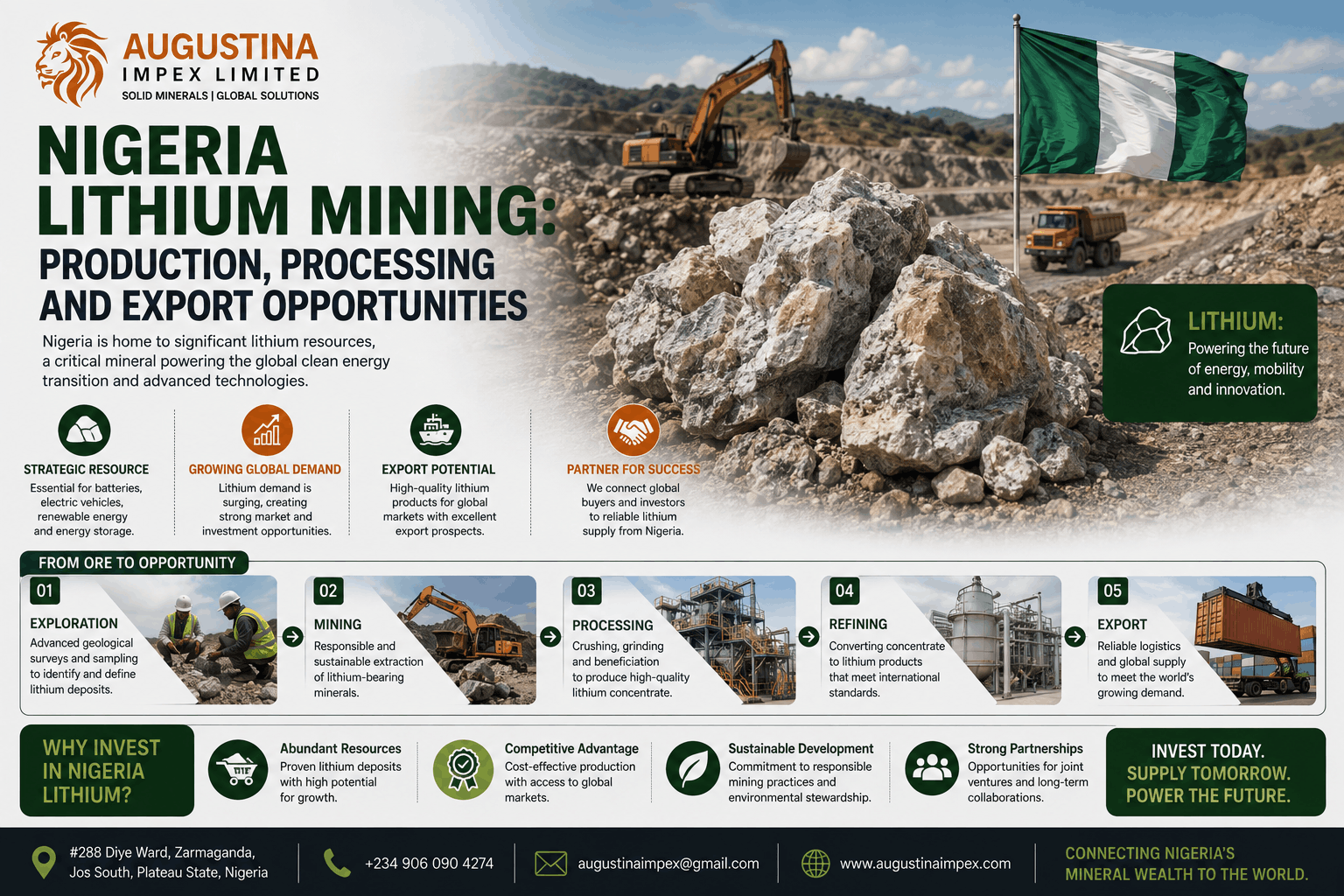
Nigeria Lithium Mining: Production, Processing & Export
Nigeria Lithium Mining: Production, Processing and Export Opportunities By Kolawole King, CEO — Augustina Impex…
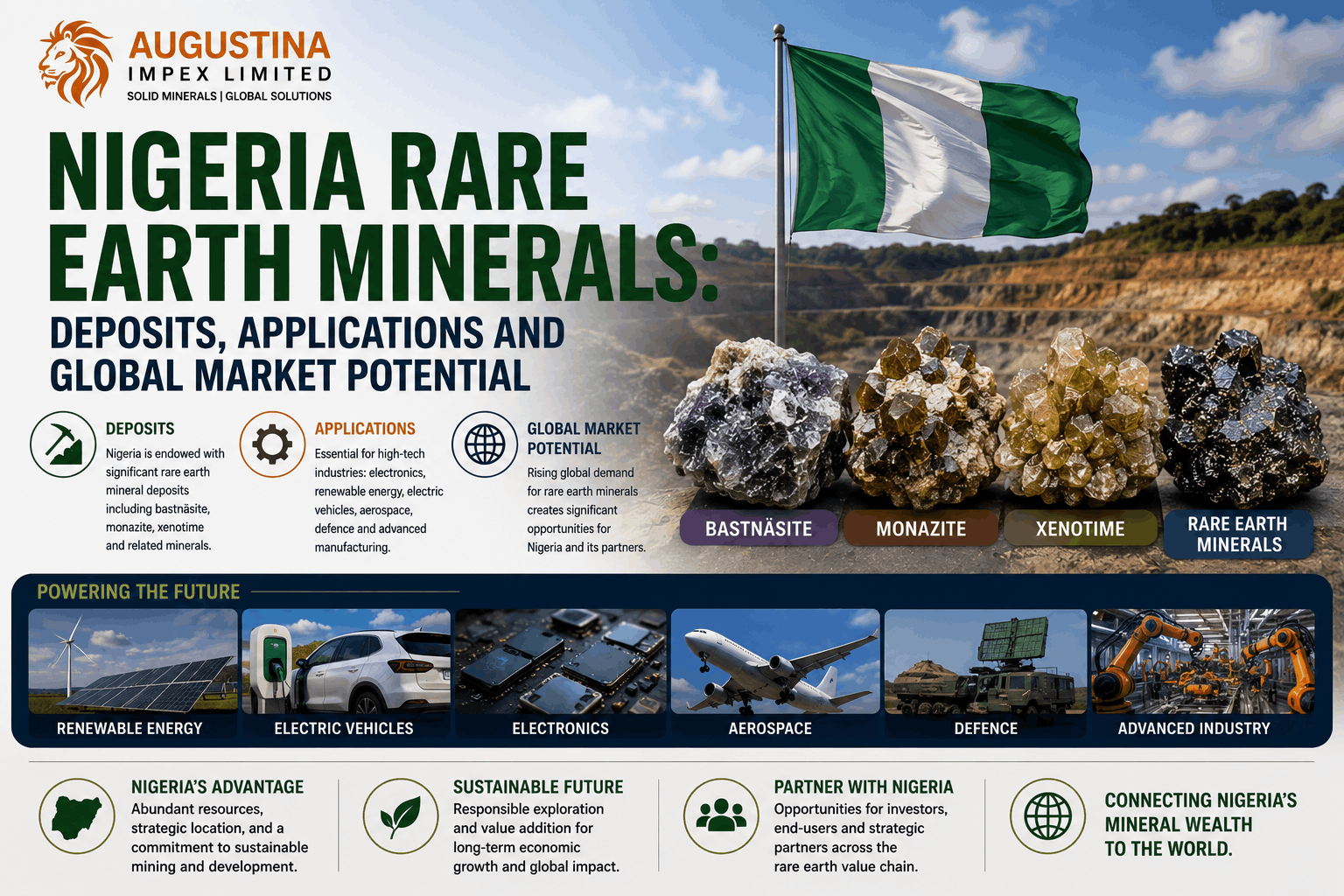
Nigeria Rare Earth Minerals: Deposits & Market Potential
Nigeria Rare Earth Minerals: Deposits, Applications and Global Market Potential By Kolawole King, CEO —…
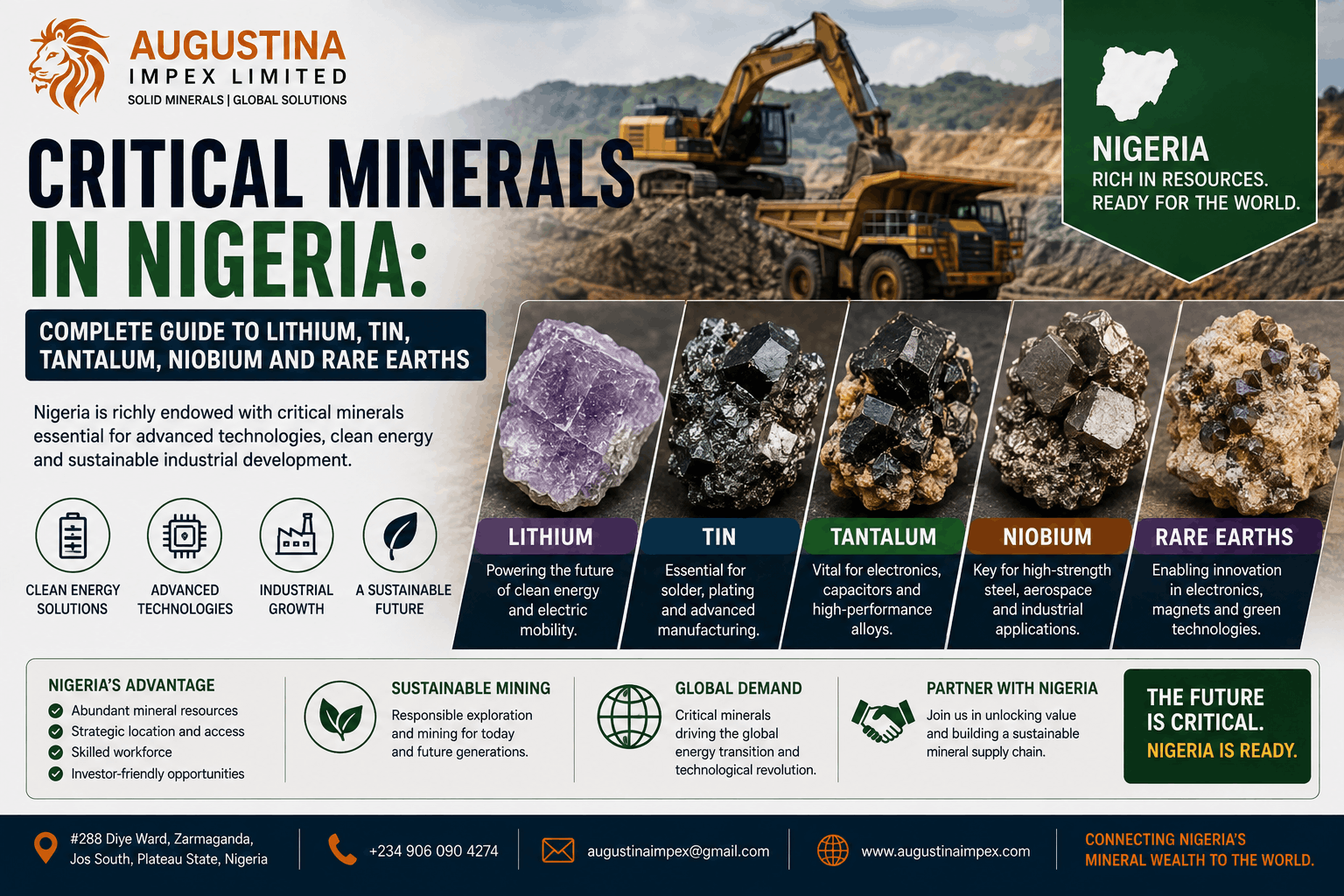
Nigeria Critical Minerals Guide: Lithium, Tin & Rare Earths
Critical Minerals in Nigeria: Complete Guide to Lithium, Tin, Tantalum, Niobium and Rare Earths By…
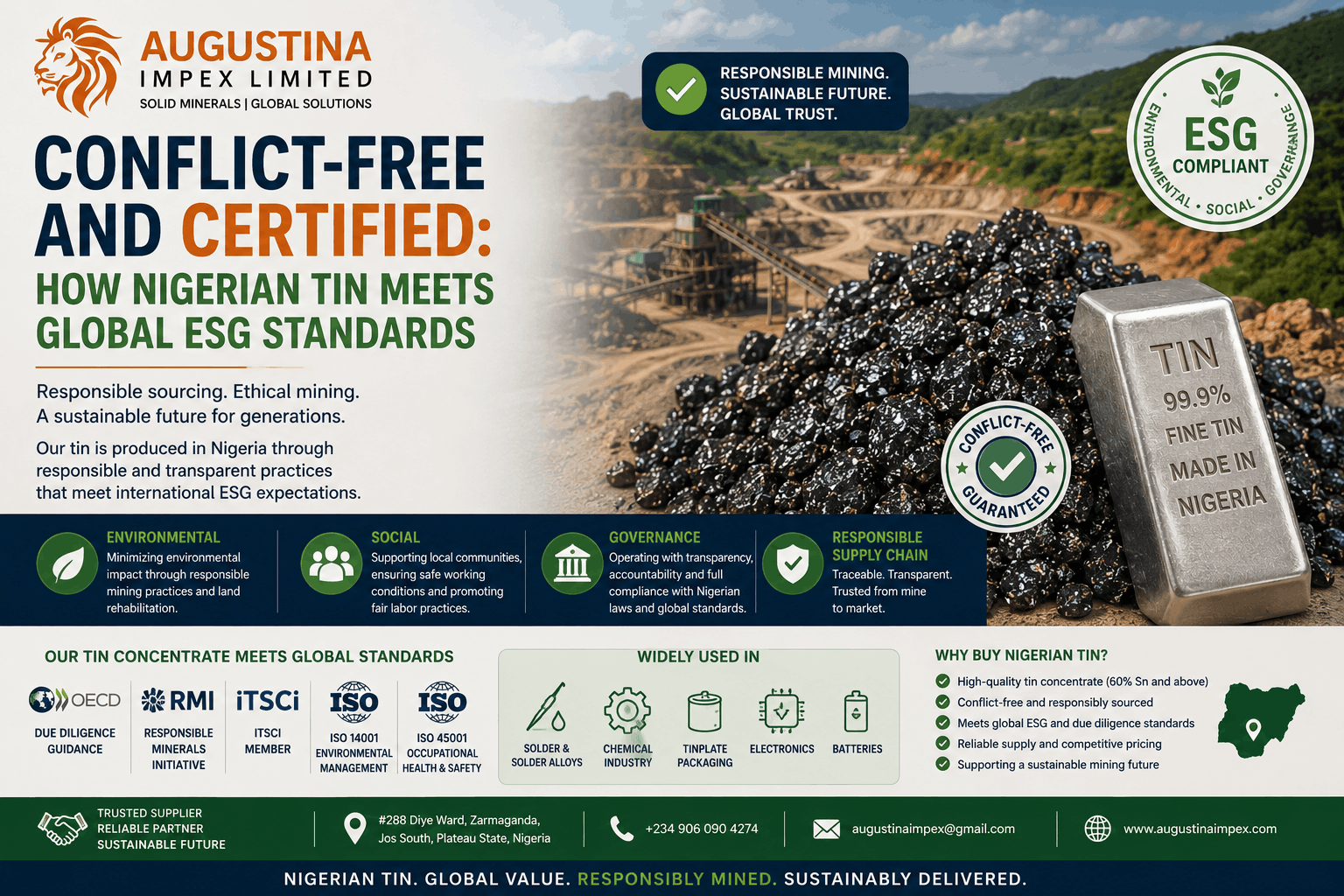
Conflict-Free Nigerian Tin Meets Global ESG Standards
Conflict-Free and Certified: How Nigerian Tin Meets Global ESG Standards By Kolawole King, CEO —…