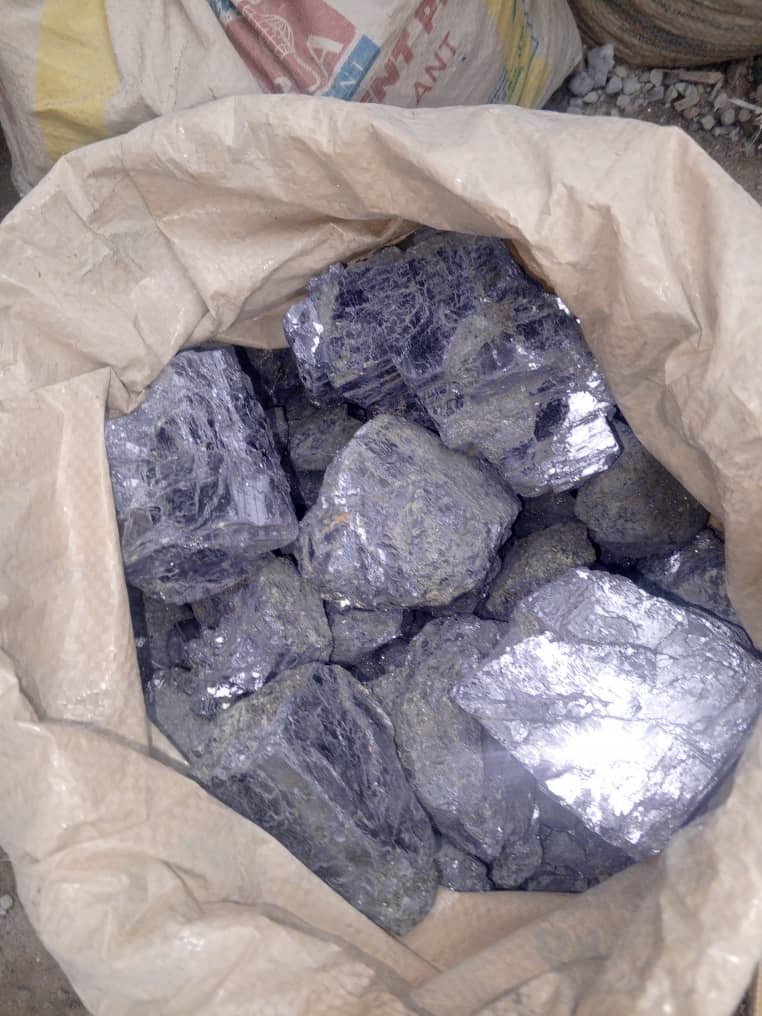

The first time I really understood heavy mineral sands, I was crouched beside a stream on the Jos Plateau watching an old tin miner swirl a calabash of black sand. He wasn’t a metallurgist. He had never read a flowsheet in his life. But as he tilted and washed, the heavier grains — the cassiterite, the columbite, the dark ilmenite — settled stubbornly to the bottom while the lighter quartz floated away. That calabash was a gravity concentrator. Everything I have learned in the twenty-five years since, every modern plant I have walked through, is essentially that same physics scaled up, refined, and instrumented. Mastering the mineral recovery techniques in heavy mineral sands is, at heart, about reading those small differences between grains and exploiting them again and again until you hold a clean, saleable concentrate in your hand.
This is the article I wish someone had handed me when I started. I want to walk you through how the valuable minerals are actually pulled out of the sand, stage by stage, in plain language — and to be honest about where the money leaks away.
Why Recovery Technique Decides Profit, Not Just Geology
People new to this industry obsess over the deposit. How rich is the grade? How many million tonnes? Those numbers matter, but I have seen good deposits ruined by poor recovery and modest deposits made very profitable by a well-designed plant. Geology gives you the cards; your recovery flowsheet decides whether you win the hand.
Heavy mineral sands are unusual among ore bodies because nature has already done the hardest job for you. Over geological time, wave action, wind and river transport have weathered, liberated and pre-concentrated the heavy grains, which means they respond exceptionally well to physical separation without expensive crushing or grinding. Because the grains are already naturally liberated by weathering and geological transport, they are exceptionally well-suited for gravity-based beneficiation. That single fact is why this whole industry runs largely on water, magnets and electric fields rather than chemistry — and why margins can be so healthy when the flowsheet is right.
The economic stakes are real. The global heavy mineral sand market was valued at around US$14.8 billion in 2025 and is projected to reach roughly US$22.6 billion by 2033, a compound annual growth rate of about 5.8%. Every percentage point of recovery you fail to capture in that environment is money walked out the back of your plant with the tailings.
Know Your Feed Before You Build a Flowsheet
You cannot design a recovery circuit for a deposit you have not characterised. Before any serious capital is committed, the run-of-mine sand must be studied grain by grain: what minerals are present, in what proportions, at what particle sizes, and — critically — what each grain’s specific gravity, magnetic susceptibility and electrical conductivity are. Those three properties are the levers every separation method pulls.
A typical Plateau or coastal assemblage will contain ilmenite, rutile and leucoxene (the titanium minerals), zircon, monazite and xenotime (the rare-earth and zirconium carriers), garnet, sometimes cassiterite, and a large mass of worthless quartz and clay. Mineral sands flowsheets vary according to the properties of the minerals present, so two deposits a hundred kilometres apart can demand quite different circuits. Skipping this characterisation work is the single most expensive mistake I see new entrants make.
Stage One: Wet Gravity Concentration — The Workhorse
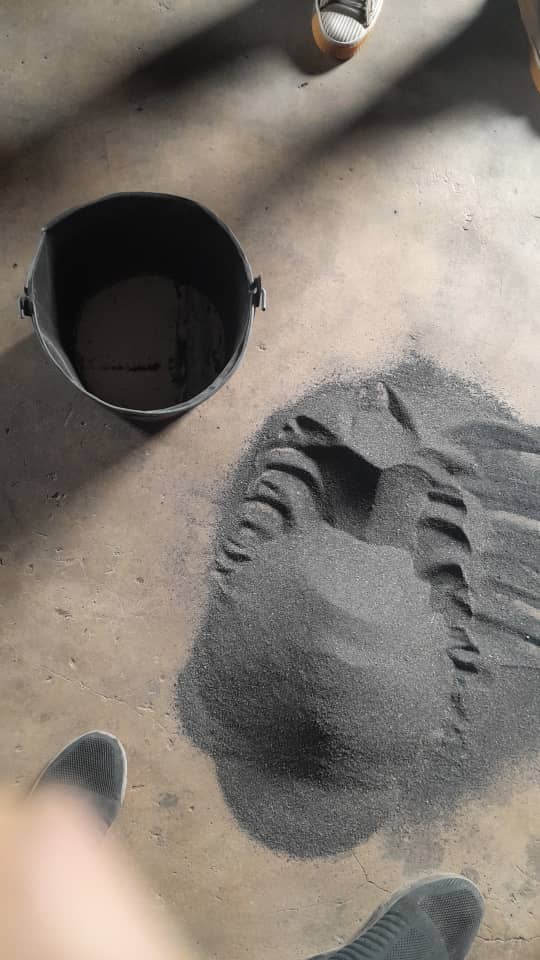
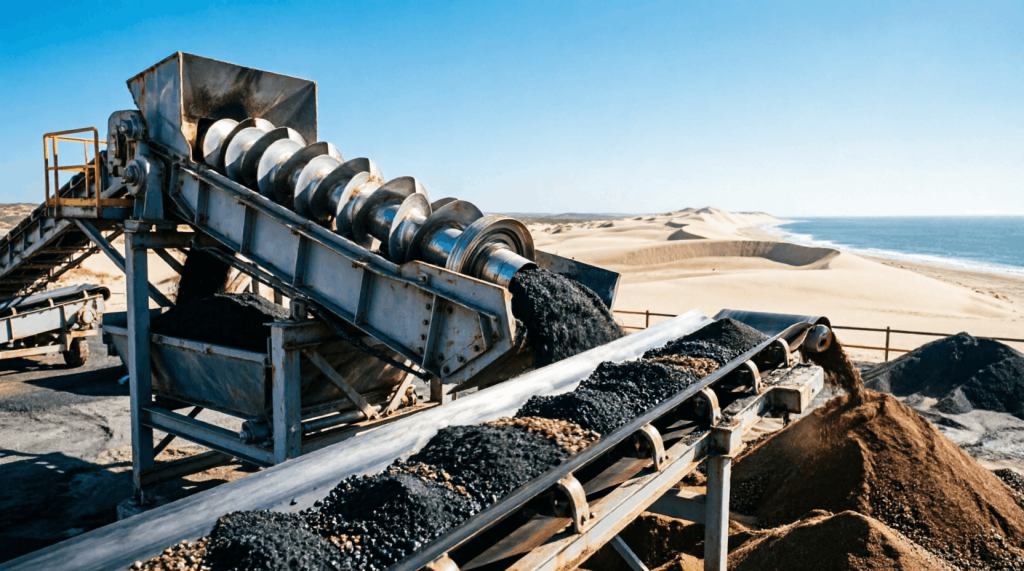
Almost every heavy mineral sands operation begins the same way: separate the dense grains from the light ones using water and gravity. This is the bulk, brute-force stage that throws away the great mass of quartz and produces what we call a heavy mineral concentrate (HMC).
The undisputed workhorse here is the spiral concentrator — a helical trough down which the sand slurry flows. As it spirals, the heavier grains migrate to the inner edge and the lighter quartz is washed to the outer edge, where splitters divert each stream. Spiral concentrators are the industry standard for this preliminary roughing stage. A modern wet plant stacks hundreds or thousands of these spirals in banks of rougher, cleaner and scavenger stages, recirculating middlings until the separation is sharp.
Done well, this stage is remarkably effective. Primary concentration through wet gravity separation can achieve around 95% mineral recovery efficiency. Shaking tables, Reichert cones and sluices play supporting roles, especially for finishing or for smaller alluvial operations of the kind we know well in tin country. The output of stage one is not a finished product — it is a dirty heavy mineral concentrate that still mixes ilmenite, rutile, zircon and monazite together. Separating those from one another is the clever part, and it happens dry.
Drying, Attritioning and Conditioning — The Bridge Stage
Between wet and dry processing sits a stage people underrate. The concentrate must be scrubbed (attritioned) to remove surface coatings of iron oxide and clay that would otherwise confuse the downstream separators, then dewatered and dried, because magnetic and electrostatic separation only work on dry, free-flowing sand. Separation of the valuable heavy minerals is carried out in two stages: wet concentration using gravity differentiation, and dry separation exploiting the magnetic and electrostatic properties of the minerals. Get the drying temperature and moisture wrong and your beautiful recovery numbers from stage one quietly evaporate in stage two.
Stage Two: Magnetic Separation
Now the real sorting begins, and the first property we exploit is magnetism. Minerals fall on a spectrum from strongly magnetic to completely non-magnetic, and we separate them accordingly.
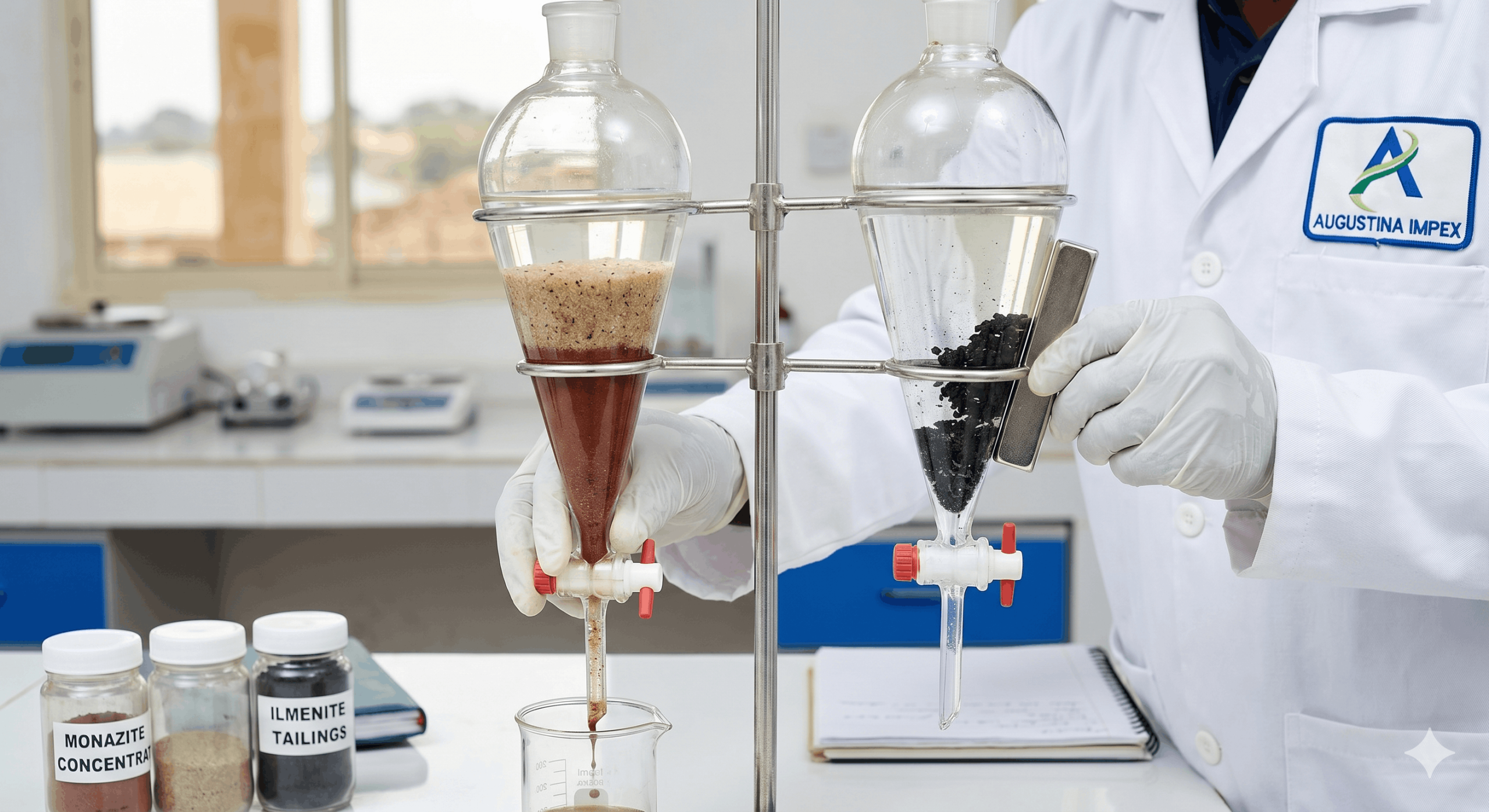
A typical sequence runs like this. Low-intensity magnetic separators (LIMS) first pull out any strongly magnetic magnetite. Then high-intensity separators take over to split the weakly magnetic minerals from the non-magnetic ones. Low-intensity drum separators remove the magnetite, after which high-intensity magnetic separators separate the magnetic ilmenite and monazite from the non-magnetic zircon and rutile. Ilmenite and monazite report to the magnetic stream; zircon and rutile, being essentially non-magnetic, pass through to be cleaned later.
There is an important practical choice here between wet and dry high-intensity magnetic separation, and it comes down to grain size. Dry high-intensity magnetic separation is the more efficient process for heavy mineral particles coarser than roughly 75–100 microns, whereas wet high-intensity magnetic separation is more effective for finer paramagnetic particles below that range. Rare-earth roll and induced-roll separators are the modern tools of choice for fine-tuning these splits, and the rare-earth magnets in particular can tease apart minerals whose magnetic susceptibilities differ only slightly — for example separating weakly magnetic leucoxene from non-magnetic rutile.
Stage Three: Electrostatic (High-Tension) Separation
The final, and to my mind the most elegant, stage exploits how well a grain conducts electricity. Pass dry sand across a charged, rotating drum and conductive minerals shed their charge quickly and fly off, while non-conductive minerals cling to the drum and are carried away separately.
In heavy mineral sands this is the master key for the non-magnetic fraction. Ilmenite and rutile are conductors; zircon and monazite are non-conductors. High-tension roll separators (HTR) and electrostatic plate separators (ESP) are therefore used to finish each product to specification. Screen electrostatic separators clean the zircon and monazite concentrates by removing fine conducting particles, while plate electrostatic separators reject coarse non-conducting particles from the rutile and ilmenite concentrates. It is the interplay of magnets and electric fields, repeated in stage after polishing stage, that takes you from a mixed concentrate to monomineral products.
The reward for getting these dry stages right is purity, and purity is where the premium lives. Advanced beneficiation combining magnetic and electrostatic technologies allows leading producers to achieve individual mineral purities exceeding 98% for ilmenite and rutile, enabling premium-grade product positioning. That is the difference between selling a discounted blend and selling a specification product that a pigment or ceramics buyer will pay top dollar for.
Recovering the Forgotten Money: Monazite and the Rare-Earth By-Product
Here is something I have argued for years: the monazite in heavy mineral sands is too often treated as waste when it should be treated as a second revenue stream. Monazite carries the rare earth elements the world is now scrambling for, and the same magnetic and electrostatic circuit that cleans your titanium and zircon products can be tuned to pull a saleable monazite concentrate out of the same feed. Combined gravity, magnetic and electrostatic techniques have been used to recover monazite concentrates exceeding 86% purity from beach sands alongside ilmenite, rutile, zircon and garnet.
The catch — and it is a serious one — is that monazite is naturally radioactive because it concentrates thorium and uranium. The electrical conductivity of mineral concentrates actually decreases as their uranium and thorium content rises, which is both a useful separation handle and a reminder of what you are handling. Recovering monazite responsibly means treating it as Naturally Occurring Radioactive Material (NORM), with proper handling, storage, documentation and regulatory clearance. In Nigeria that brings the Nuclear Regulatory Authority squarely into the picture, and any operator who ignores that is courting disaster. Done correctly, however, monazite recovery converts a disposal headache into a critical-minerals asset.
The 2025–2026 Market Backdrop: Why Recovery Efficiency Matters Now
Recovery technique is never just an engineering question; it is a commercial one, and today’s market rewards efficiency more than ever. Ilmenite remains the volume backbone of the industry — it accounts for roughly 45% of the mineral sand market, driven by its central role in titanium dioxide production for paints, coatings, plastics and titanium metal. Pricing has held firm: independent analysis from TZMI has pointed to pricing stability through 2025–2026, with zircon strengthening toward around US$1,540 per tonne and ilmenite firming to roughly US$290 per tonne, while supply constraints support premium pricing for high-grade rutile and zircon as new mine development struggles to keep pace with depletion.
That last point is the opportunity. The world’s existing mines are depleting and new high-grade discoveries are scarce, which is exactly why major players are pushing fresh projects forward. Iluka’s Balranald project was advancing toward commissioning in the second half of 2025, targeting around 60,000 tonnes of natural rutile and 50,000 tonnes of high-quality zircon a year, while Astron’s Donald project in Victoria received final state approval to mine 7.5 million tonnes of mineral sands annually for nineteen years, including ilmenite, monazite, rare earths, rutile and zircon. Notice that the newest projects are deliberately designed to recover the rare-earth by-products too. The industry is moving toward squeezing every valuable grain out of the feed, and the technology is following. Processing efficiency improvements through 2026–2033 are expected to cut extraction costs by roughly 12–15% relative to the 2025 baseline. In that environment, the operator with the tighter, smarter recovery flowsheet simply out-earns the one running on habit.
The Honest Challenges
I would be doing you a disservice if I painted this as easy. Every stage I have described loses something, and the losses concentrate in predictable places.
The first is fines. The natural concentration that makes coarse heavy minerals so easy to recover works against the very fine grains, which slip through spirals and resist clean magnetic and electrostatic sorting. A meaningful fraction of your value can leave with the slimes if your circuit is not built to capture the fine fraction.
The second is the wet-versus-dry mining decision, which shapes everything downstream. Heavy mineral sand deposits are worked by either dry mining or wet mining (dredging), and each carries its own water management, power and rehabilitation burden. Dry separation in particular is energy-hungry and dust-prone, and dust is both a health hazard and a recovery loss.
The third is regulation and provenance, especially where monazite and NORM are involved. The radioactivity is manageable but unforgiving of sloppiness, and buyers increasingly demand documented, traceable, responsibly sourced material.
And in our Nigerian context there is a fourth, very local challenge: much of the heavy mineral flow on the Plateau still moves through artisanal hands with rudimentary recovery, which means grade is lost, value is left in the ground, and the supply chain lacks the documentation international buyers require. That is a problem — but for those of us willing to invest in proper recovery and proper paperwork, it is also precisely the opportunity.
Where Augustina Impex Fits In
At Augustina Impex Limited, we have spent the better part of twenty-five years on the Jos Plateau mineral belt learning these techniques not from textbooks but from the ground up — from that calabash of black sand to modern beneficiation thinking. Our role is to bridge the gap between Nigeria’s rich heavy mineral resources and the international buyers who need clean, specification-grade, documented product.
We do not compete on volume or price alone. We compete on trust, provenance and traceability: the ability to deliver heavy mineral concentrates — ilmenite, zircon, rutile, monazite and the rest of our portfolio — with a clean, documented supply chain behind them, including proper NORM handling where rare-earth-bearing material is involved. We help investors and off-takers understand the recovery economics of a deposit before they commit, structure responsible sourcing, and connect credible local supply with global demand. If you are a buyer seeking reliable heavy mineral supply, or an investor evaluating a recovery or beneficiation opportunity in Nigeria’s solid minerals sector, that is exactly the conversation we exist to have.
The minerals are in the ground. The market is willing. The difference, as always, is in how cleanly you can recover what nature has already concentrated for you.
Kolawole King
Chief Executive Officer, Augustina Impex Limited
#288 Diye Ward, Zarmaganda, Jos South, Plateau State, Nigeria
Email: augustinaimpex@gmail.com
WhatsApp: +234 906 090 4274
Website: https://augustinaimpex.com
Blog: https://augustinaimpexng.blogspot.com/
Advert Video: https://www.youtube.com/watch?v=Izg0t7By6co
#HeavyMineralSands #MineralRecovery #MineralBeneficiation #Ilmenite #Zircon #Rutile #Monazite #CriticalMinerals #TitaniumDioxide #RareEarthElements #MiningNigeria #SolidMinerals #MineralProcessing #PlateauState #AugustinaIm
-
Previous Post
Future Demand for Strategic Minerals
Post a comment
Related Posts
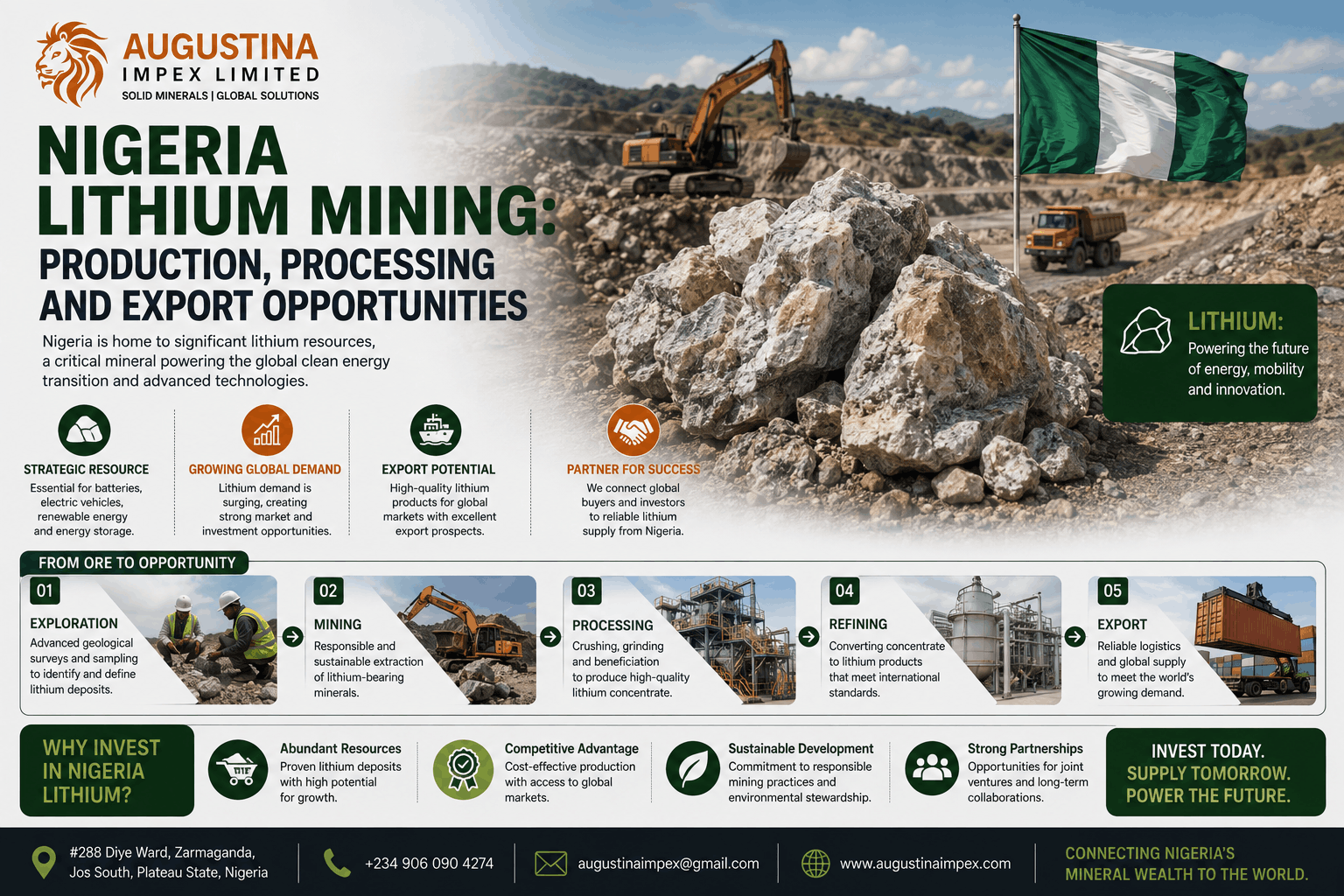
Nigeria Lithium Mining: Production, Processing & Export
Nigeria Lithium Mining: Production, Processing and Export Opportunities By Kolawole King, CEO — Augustina Impex…

Nigeria Rare Earth Minerals: Deposits & Market Potential
Nigeria Rare Earth Minerals: Deposits, Applications and Global Market Potential By Kolawole King, CEO —…
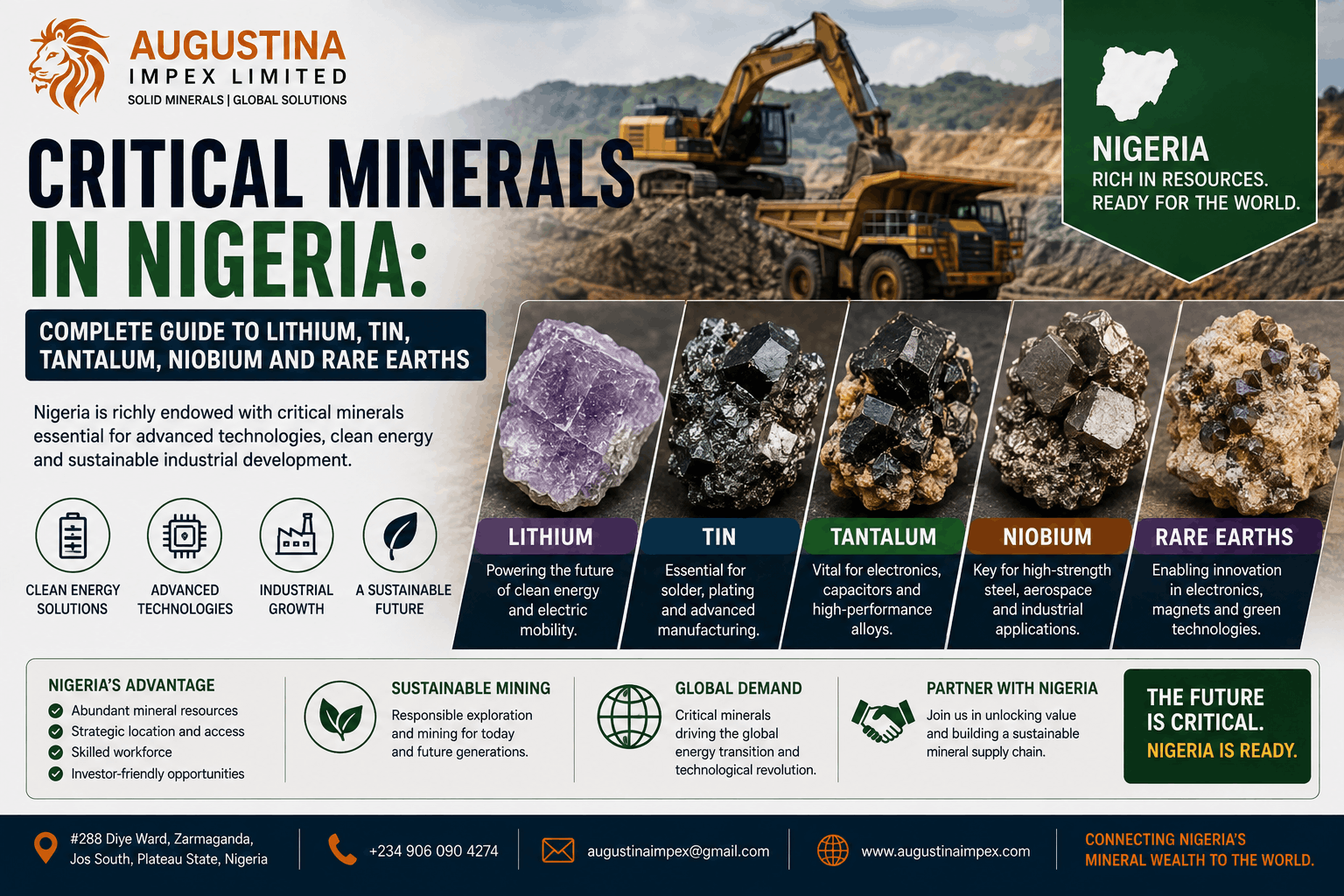
Nigeria Critical Minerals Guide: Lithium, Tin & Rare Earths
Critical Minerals in Nigeria: Complete Guide to Lithium, Tin, Tantalum, Niobium and Rare Earths By…
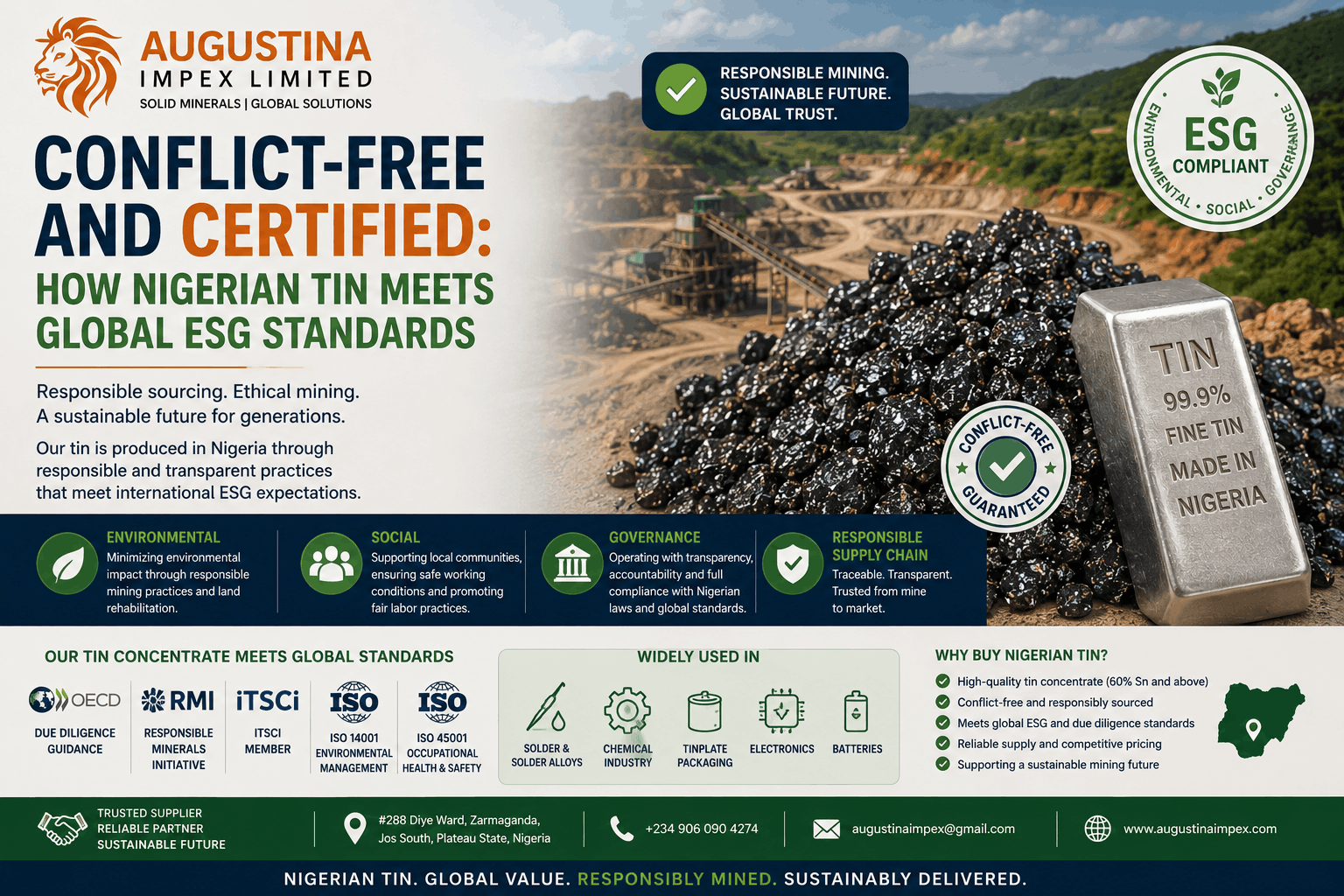
Conflict-Free Nigerian Tin Meets Global ESG Standards
Conflict-Free and Certified: How Nigerian Tin Meets Global ESG Standards By Kolawole King, CEO —…