
If your search for a reliable Nigerian Zircon Sand supplier has brought you here, you are in exactly the right place. Zircon Sand is one of the most commercially versatile industrial minerals in the world — found in the tiles on your bathroom floor, the firebricks lining high-temperature furnaces, the mould sands in metal foundries, and the zirconium alloys cladding nuclear fuel rods. Global demand for Zircon Sand is consistent, the applications are wide-ranging, and the supply chain is increasingly looking for credible sources beyond Australia and South Africa. Nigeria is one of those sources, and at Augustina Impex Limited, we are the supplier that connects Nigerian Zircon to international buyers with the professionalism, compliance rigour, and product consistency they demand.
This article is designed to give serious international buyers everything they need to know about Nigerian Zircon Sand — what it is, where it comes from, what the specifications look like, which industries use it and why, how it is priced, how to procure it from Nigeria, and why Augustina Impex Limited is the partner you want representing your supply chain in West Africa. Whether you are a first-time buyer of Nigerian minerals or a seasoned commodity trader expanding your Zircon sourcing geography, this guide has been written for you.

What Is Zircon Sand and Why Is It Commercially Valuable?
Zircon is a zirconium silicate mineral with the chemical formula ZrSiO₄. It is one of the oldest and most durable minerals on earth — some Zircon crystals have been dated to over four billion years of age, making them the oldest known terrestrial materials. In industrial terms, Zircon Sand refers to naturally occurring grains of Zircon mineral recovered from heavy mineral sand deposits, where they have been concentrated by wave, wind, and fluvial action over geological time.
The commercial value of Zircon derives from a remarkable combination of physical and chemical properties. Zircon has an extremely high melting point — approximately 2,550°C — which makes it exceptionally resistant to thermal shock and chemical attack. It has high hardness (Mohs 7.5), high density (approximately 4.65 g/cm³), and low thermal expansion, which makes it dimensionally stable under extreme conditions. Its chemical inertness means it does not react with most acids, alkalis, or molten metals under processing conditions.
These properties make Zircon Sand one of the most commercially important feedstocks across multiple heavy industries simultaneously. Rare is the mineral that serves the ceramics industry, the refractory sector, the foundry trade, the chemicals industry, and the nuclear power sector at the same time. Zircon does exactly that, and this breadth of application is one of the key reasons why Zircon Sand demand remains structurally strong even when individual industries experience cyclical downturns.
The primary commercial metric for Zircon Sand is its ZrO₂ content — zirconium dioxide expressed as a percentage of the dry weight of the mineral. The higher the ZrO₂ content, the higher the grade and the higher the commercial value. Standard grade Zircon Sand for ceramics applications typically contains 65% to 66% ZrO₂, while premium grades used in nuclear and chemical applications require 66% ZrO₂ or higher with tightly controlled impurity specifications.
Nigeria’s Zircon Sand Deposits: Geology and Commercial Significance
Nigeria is not the first country international buyers think of when they consider Zircon Sand supply — Australia, South Africa, Mozambique, and Sierra Leone are better known in this space. But Nigeria’s geological endowment of Zircon is substantial, and it is increasingly being recognised by the global minerals industry as a commercially meaningful source that is worth developing supply chain relationships with.
The Jos Plateau — Nigeria’s Heavy Mineral Sand Heartland
The dominant source region for Nigerian Zircon Sand is the Jos Plateau in Plateau State, North-Central Nigeria. This elevated region has been a productive mining area for over a century, with colonial-era tin and columbite mining operations producing heavy mineral concentrates from alluvial deposits across the Plateau’s river systems and valley floors.
The geology of the Jos Plateau provides the ideal parent environment for Zircon formation. The region is characterised by Precambrian Basement Complex formations, Pan-African granites, and Mesozoic Jurassic Biotite granites — rock types that are classically enriched in accessory minerals including Zircon, Monazite, Ilmenite, and Rutile. As these granitic parent rocks weathered over millions of years, the heavy minerals within them were liberated and transported by water into the alluvial and placer deposits that now form the Plateau’s productive heavy mineral sand resource.
Zircon occurs in these deposits as a co-product of the broader heavy mineral sand assemblage — meaning that it is found alongside Ilmenite, Monazite, Rutile, and Columbite in the same alluvial concentrate. This co-product nature of Nigerian Zircon production means that Zircon supply is linked to the broader heavy mineral sand production system, and buyers can often arrange multi-mineral offtake with the same Nigerian supplier.
Zircon Beyond the Jos Plateau
While the Jos Plateau is the best-documented and most commercially active source of Nigerian Zircon at this stage, Zircon occurrences have been recorded across a broader geographic footprint within Nigeria’s Basement Complex terrane. Notable occurrences have been identified in Cross River State, Nasarawa State, Kogi State, and parts of Ondo State and Ekiti State. The coastal areas of Ogun State and Lagos State have also been reported to contain beach and nearshore heavy mineral sand assemblages with Zircon content, reflecting the global pattern of Zircon enrichment in coastal placer systems.
While many of these occurrences are at earlier exploration stages than the Jos Plateau deposits, they indicate a Zircon resource base in Nigeria that is larger and more geographically distributed than the current production footprint suggests. As Nigeria’s mining regulatory framework continues to mature and exploration investment increases, new Zircon supply sources from beyond the Jos Plateau are likely to come on stream.
Nigerian Zircon Sand Specifications: Technical Details for International Buyers
When evaluating a Nigerian Zircon Sand supplier, the first document you should request is a current, independently verified product specification sheet. Here is a comprehensive breakdown of the key technical parameters that define Nigerian Zircon Sand quality.
ZrO₂ Content — The Primary Quality Benchmark
ZrO₂ Content: Nigerian Zircon Sand from the Jos Plateau region assays at ZrO₂ concentrations of 63% to 66% depending on the degree of processing and beneficiation applied to the raw heavy mineral sand concentrate. Standard grade Zircon Sand at 65% ZrO₂ is suitable for the majority of ceramics, refractory, and foundry applications. Material beneficiated to 66%+ ZrO₂ qualifies for premium and nuclear-grade specifications.
All ZrO₂ content figures quoted by Augustina Impex Limited are verified through independent laboratory assay at facilities certified to internationally recognised testing standards. NGSA Certificate of Analysis documentation is provided with every shipment.
Key Impurities That Affect Commercial Value
TiO₂ (Titanium Dioxide): The most closely monitored impurity in Zircon Sand for ceramics applications. High TiO₂ content imparts a yellow colouration to ceramic glazes, which is commercially undesirable for white and off-white tile applications. Premium ceramics-grade Zircon typically requires TiO₂ below 0.3%, and standard ceramics grade requires TiO₂ below 1%. Nigerian Zircon Sand TiO₂ content varies by deposit and processing method and is documented in the product specification sheet.
Fe₂O₃ (Iron Oxide): Iron contamination affects the whiteness and colour stability of ceramic applications. Low iron content is preferred, particularly for white ceramics and opacifier applications. Specification requirements vary by end use.
Al₂O₃ (Aluminium Oxide): Present in most natural Zircon sands as a product of associated clay and feldspar minerals. High aluminium content indicates the presence of clay contamination and affects processing efficiency.
P₂O₅ (Phosphorus Pentoxide): Low phosphorus is required for nuclear-grade Zircon, as phosphorus interferes with the hafnium separation process used in nuclear-grade zirconium metal production.
HfO₂ (Hafnium Oxide): Hafnium occurs naturally in Zircon at typical concentrations of 1–3% HfO₂. For most industrial applications, hafnium content is not a concern. For nuclear-grade applications, hafnium must be removed from zirconium metal (since hafnium absorbs neutrons), making the HfO₂ content of the Zircon feedstock a relevant specification parameter.
Physical Properties
Particle Size: Nigerian Zircon Sand is typically available in a particle size range of 75 to 300 microns (approximately -60+200 mesh), with the modal grain size concentrated in the 100–150 micron range for most alluvial concentrates. Specific particle size distributions can be documented per shipment.
Specific Gravity: True specific gravity of Zircon is approximately 4.65 g/cm³, which is one of the highest of all the common heavy minerals and a key property exploited in gravity separation processing.
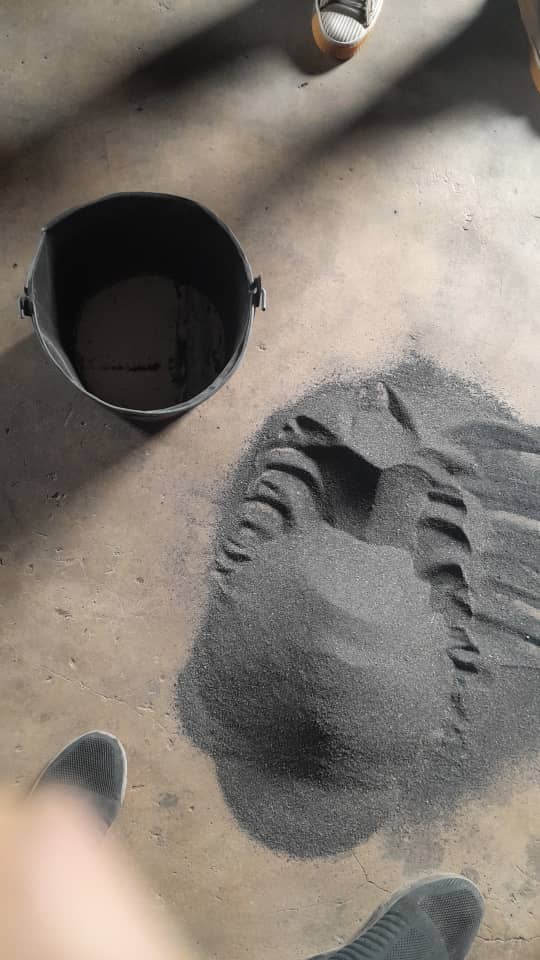
Colour: Natural Zircon Sand has a pale brownish-yellow to cream colour in bulk form. Colour can vary with TiO₂ and iron content — lower TiO₂ and iron materials trend whiter, which is commercially preferred.
Moisture: Supplied at low moisture (typically below 2% on shipment), confirmed through pre-shipment inspection gravimetric testing.
Zircon Sand Applications: The Industries That Drive Global Demand
Understanding where Zircon Sand is used — and why each application places specific demands on the raw material — is essential for any buyer making procurement decisions. Here is a comprehensive overview of the major Zircon Sand application sectors.
Ceramics and Ceramic Tile Manufacturing
The ceramics industry is the single largest consumer of Zircon Sand globally, accounting for approximately 50–55% of total Zircon demand in most years. In this application, Zircon Sand is milled into fine powder (Zircon Silicate, ZrSiO₄, or Zirconium Dioxide, ZrO₂) and used primarily as an opacifier in ceramic glazes and engobes.
A ceramic opacifier is a substance that scatters light within the glaze layer, creating the brilliant white or off-white appearance that characterises premium ceramic tiles and sanitaryware. Before the widespread use of Zircon-based opacifiers, lead-based opacifiers were the industry standard. Zircon replaced lead across the global ceramics industry because it delivers superior opacifying performance without the toxicity risks. Today, virtually every ceramic floor tile, wall tile, and porcelain sanitary product manufactured in China, Spain, Italy, India, or Brazil uses Zircon-based opacifier in its glaze system.
The ceramics sector’s demand for Zircon is closely correlated with global construction activity — particularly residential and commercial building construction in Asia, the Middle East, and the growing African construction market. As urbanisation continues to accelerate in Sub-Saharan Africa — a region where Nigeria, among others, is experiencing significant construction growth — regional demand for ceramics and therefore for Zircon opacifiers is expected to increase substantially over the next decade.
Refractory Materials
Refractory materials are engineered materials capable of maintaining their physical and chemical properties at extremely high temperatures. They are used to line furnaces, kilns, incinerators, reactors, and other high-temperature industrial equipment across the steel, aluminium, glass, cement, petrochemical, and non-ferrous metals industries.
Zircon Sand is a premium refractory raw material, used in applications where ordinary alumina or silica refractories are inadequate. Zircon’s high melting point, chemical inertness, and excellent thermal shock resistance make it the material of choice for the most demanding refractory applications, including continuous casting nozzles in steel plants, glass contact refractories, kiln furniture in ceramics production, and aluminium casting equipment.
Refractory-grade Zircon Sand typically requires ZrO₂ content of 65% or higher, with controlled impurity levels — particularly low alkali content, since alkalis flux the Zircon structure at high temperatures and reduce its thermal performance. Nigerian Zircon Sand at 65% ZrO₂ is suitable for standard refractory applications, and material beneficiated to 66%+ ZrO₂ meets the specification requirements for higher-performance refractory products.
Foundry Sand Applications
Foundry-grade Zircon Sand is used as a moulding and core sand in metal casting operations. In sand casting, a mould is packed around a pattern, the pattern is removed, and molten metal is poured into the cavity. The sand must be able to withstand the heat and pressure of the molten metal without breaking down, and it must separate cleanly from the casting surface once the metal has solidified.
Zircon Sand is the premium choice for foundry applications that require the highest thermal stability and the best surface finish. Its high specific gravity allows it to pack tightly around complex casting geometries. Its low thermal expansion (approximately one-third that of silica sand) means that moulds made with Zircon Sand maintain dimensional accuracy during casting, reducing defect rates. Its chemical inertness prevents reaction with most molten metals and alloys, giving clean, smooth casting surfaces.
Foundry-grade Zircon Sand is used in the casting of precision steel components for aerospace, automotive, power generation, and industrial equipment. The specifications for foundry-grade Zircon are typically focused on particle size distribution, grain shape, and low impurity content — particularly low clay and fines content that can affect sand permeability and mould strength.
Zirconium Chemicals and Nuclear-Grade Zirconium
Beyond its use as a bulk mineral in ceramics, refractories, and foundry applications, Zircon Sand is also the primary feedstock for the production of zirconium chemicals and — most significantly — nuclear-grade zirconium metal.
The pathway from Zircon Sand to zirconium chemicals involves chlorination or caustic fusion of the Zircon concentrate to produce zirconyl chloride or zirconium oxide, which are then refined and processed into a wide range of specialty chemical products. Zirconium compounds are used in paper coating pigments, cosmetics (as deodorant actives), water treatment chemicals, textile dye fixatives, and specialty paints and coatings.
The nuclear fuel cycle is the most demanding application for zirconium-bearing materials. Nuclear fuel rods — the assemblies used in pressurised and boiling water nuclear reactors — are encased in zirconium alloy cladding (primarily Zircaloy and ZIRLO alloys). This cladding must be essentially free of hafnium, a sister element that occurs naturally in Zircon at typical concentrations of 1–3%, because hafnium absorbs neutrons and reduces the efficiency of the nuclear chain reaction.
The production of nuclear-grade zirconium from Zircon Sand is one of the most technically demanding processes in industrial metallurgy, and the nuclear-grade Zircon feedstock specification is the most stringent in the industry. As global nuclear power capacity expands — driven by the growing recognition that nuclear energy must play a role in the low-carbon energy transition — demand for Zircon Sand as a nuclear feedstock is expected to grow significantly over the coming decade.
Glass and Specialty Applications
Zircon and zirconia (ZrO₂) are used in a range of specialty glass applications. Zirconia is incorporated into the glass matrix of certain optical glasses and specialty glasses to improve chemical durability and refractive index. Zircon is also used as a polishing abrasive for glass surfaces in the optics industry. These applications account for a smaller but high-value segment of global Zircon demand.
Nigerian Zircon Sand vs Australian Zircon: How Nigeria Positions Itself
Australia dominates global Zircon Sand supply, with major producers including Iluka Resources, Tronox (formerly Cristal), and Sheffield Resources together accounting for a substantial share of world Zircon production. For international buyers evaluating Nigerian Zircon Sand against Australian supply, here is an honest, commercially grounded comparison.
Grade: Australian Zircon Sand from Tier 1 operations typically delivers ZrO₂ content of 66%+ with very tightly controlled impurity specifications — particularly low TiO₂ and Fe₂O₃. Nigerian Zircon at 63–66% ZrO₂ is comparable in grade to mid-tier Australian and Mozambican supply, and material processed to 65%+ ZrO₂ is commercially competitive with the majority of Australian ceramics-grade Zircon.
Price: This is where Nigerian Zircon Sand offers a genuine commercial advantage. The combination of lower production costs in an emerging market, lower logistics costs for buyers in the Middle East and some Asian destinations, and the pricing premium that major Australian producers command as market leaders means that Nigerian Zircon Sand can be sourced at competitive prices that offer buyers meaningful value relative to standard Australian supply.
Documentation and Compliance: Australian operations work to JORC resource reporting standards and have highly developed export documentation systems. Nigerian operations are at an earlier stage of documentation standardisation, but professional Nigerian exporters like Augustina Impex Limited produce comprehensive, internationally compliant documentation packages that satisfy the requirements of buyers in China, India, South Korea, and the European Union.
Supply Reliability: Australian Tier 1 producers offer consistent, long-term supply at large scale. Nigerian supply, while commercially credible, is currently better suited to buyers who can work with monthly volumes in the 100 to 2,000 metric tonne range rather than the tens of thousands of tonnes that large Australian operations supply monthly. As Nigerian operations mature, supply volumes will grow.
Logistics: Nigerian Zircon Sand exports through well-established port infrastructure at Onne Port, Apapa Port (Lagos), and Lekki Deep Sea Port. Freight routes to China, India, and the Middle East are well-serviced by major container shipping lines, and transit times are competitive with South African and Mozambican origins.
The honest conclusion is that Nigerian Zircon Sand is not yet a like-for-like substitute for premium Australian Zircon at the highest grade and volume levels. But for buyers who are building diversified supply chains, sourcing complementary volumes from multiple origins, or serving markets where price competitiveness is a priority alongside quality, Nigerian Zircon Sand from a professional exporter is a genuinely attractive option.
How Zircon Sand Is Priced in the Nigerian Market
Zircon Sand is not exchange-traded in the way that base metals are. Pricing is negotiated bilaterally between buyer and supplier, and Nigerian Zircon Sand pricing reflects a combination of factors that every buyer should understand before entering into commercial negotiations.
ZrO₂ Content is the dominant pricing driver. Higher ZrO₂ grade commands a proportionally higher price per metric tonne. The spread between 63% ZrO₂ and 66% ZrO₂ material represents a meaningful price differential — typically in the range of USD 50–150 per metric tonne depending on overall market conditions — and buyers should specify their minimum acceptable ZrO₂ clearly in their enquiry.
TiO₂ Content is the second most important pricing variable for ceramics-grade Zircon buyers. Low TiO₂ material — particularly material below 0.5% TiO₂ — commands a significant premium over high-TiO₂ material because it delivers better whiteness and colour stability in glaze applications.
Global Zircon Market Conditions influence all Zircon Sand pricing worldwide. Zircon prices are published by specialist commodity intelligence firms including Fastmarkets, S&P Global (formerly IHS Markit), and Argus Media. Buyers who track the global Zircon market price will have a strong baseline for evaluating the competitiveness of a Nigerian supplier’s FOB quotation.
Volume and Offtake Duration affect pricing in the same way as any commodity market. Long-term offtake commitments with guaranteed monthly volumes attract more competitive pricing than spot purchases, and the savings on a 24-month offtake versus a one-off spot purchase can be significant.
Loading Port affects the logistical cost component of the FOB price. Material sourced from the Jos Plateau must be transported overland to the loading port — Onne Port (Rivers State) for eastern routing, or Apapa / Lekki (Lagos) for western routing. The distance and road condition to each port influences the freight-to-port cost embedded in the FOB price.
All pricing from Augustina Impex Limited is quoted as USD per metric tonne FOB Nigerian loading port, and our quotations are itemised transparently so buyers understand what they are paying for at each stage of the supply chain.
How to Buy Zircon Sand from Nigeria: A Step-by-Step Procurement Guide
The procurement process for Nigerian Zircon Sand follows a well-defined sequence that mirrors international minerals trade practice. Here is a step-by-step guide to the process as it works at Augustina Impex Limited.
Step 1 — Initial Enquiry and Soft Corporate Offer (SCO)
Begin by reaching out to us with the key parameters of your requirement: your target ZrO₂ grade, TiO₂ tolerance (particularly important for ceramics buyers), monthly volume requirement, preferred port of destination, and any specific certification or documentation requirements.
We will respond within 48–72 hours with a Soft Corporate Offer (SCO) — a non-binding document outlining the proposed supply terms, indicative FOB price, product specification, minimum order quantity, payment structure, and offer validity period. Review the SCO in detail and come back to us with any questions.
Step 2 — Due Diligence and Independent Sample Testing
Before committing to a purchase, conduct full due diligence on the supplier. Request our company registration certificate, NGSA mineral export licence, current laboratory assay reports from independently accredited testing facilities, and references from previous international buyers.
Request a product sample — typically one to two kilograms — for independent testing at your own laboratory or a laboratory you nominate. We fully support and encourage independent sample testing. No credible supplier should resist a buyer’s request for sample verification, and any supplier who does should be treated with caution.
Step 3 — Full Corporate Offer (FCO) and Sales and Purchase Agreement (SPA)
Once due diligence is complete and sample testing confirms the specification, we will issue a Full Corporate Offer (FCO) — a binding commercial offer specifying all transaction terms in detail. If the FCO terms are acceptable, both parties sign a Sales and Purchase Agreement (SPA), the formal contract that governs every aspect of the transaction from product specification to dispute resolution.
Step 4 — Letter of Credit and Pre-Shipment Inspection
Nigerian Zircon Sand transactions are settled by Irrevocable Documentary Letter of Credit (LC). Standard payment terms are as follows:
95% of invoice value — payable at sight against full shipping documents (Bill of Lading, commercial invoice, certificate of origin, NGSA certificate of analysis, pre-shipment inspection certificate, packing list)
5% final payment — payable against discharge port documents confirming weight and quality at destination
Once the LC is confirmed by our bank, we aggregate the material and schedule pre-shipment inspection by the independent third-party inspection agency of your choice — CCIC, Bureau Veritas, SGS, or Intertek. The inspection covers weight verification, representative sample collection and on-site rapid assay for ZrO₂ and key impurities, moisture measurement, particle size assessment, and cargo/container condition.
Step 5 — Loading, Export Clearance, and Shipment
Following a satisfactory pre-shipment inspection, the material is loaded into containers or bulk bags at the Nigerian loading port. Nigeria Customs Service export clearance is obtained, and the full document package is assembled and transmitted by our bank to your bank under the LC payment terms.
You receive the original Bill of Lading and shipping documents, the cargo sails to your port of destination, and you take delivery on presentation of the Bill of Lading. The 5% final payment is released after discharge port quality and weight documentation confirms delivery in accordance with the contract specification.
Export Documentation Package for Nigerian Zircon Sand
Every Zircon Sand shipment from Augustina Impex Limited comes with a complete, professionally prepared documentation package designed to satisfy the requirements of customs authorities and import regulators in all major Zircon-consuming markets.
The Commercial Invoice details the buyer and seller particulars, product description, ZrO₂ grade, quantity, unit price, and total invoice value in USD. The Bill of Lading is the primary shipping document and document of title — your bank will require the original to release payment under the LC, and you will require it to take delivery at the discharge port.
The Certificate of Origin is issued by the Nigerian Export Promotion Council (NEPC) or the relevant Nigerian Chamber of Commerce, confirming the Nigerian origin of the goods for customs purposes at the destination port. The NGSA Certificate of Analysis is issued by the Nigerian Geological Survey Agency, certifying the mineral identity, ZrO₂ content, and compliance with Nigerian mineral export standards — this is a mandatory document for every Nigerian solid mineral export and a key quality assurance instrument for international buyers.
The Pre-Shipment Inspection Certificate is issued by the buyer’s nominated inspection agency confirming weight, ZrO₂ grade, TiO₂ content, moisture, and cargo condition at the Nigerian loading port. The Packing List details bags, bag weights, container numbers, and seal numbers. Additional documents — including fumigation certificates, phytosanitary certificates, or country-specific customs pre-clearance documents — can be arranged on request.
The Nigerian Regulatory Framework for Zircon Sand Export
Understanding the Nigerian regulatory landscape is part of the due diligence that any serious international buyer of Nigerian Zircon Sand should conduct. Here is a concise overview.
The Nigerian Minerals and Mining Act (2007) is the primary legislation governing solid mineral extraction and export in Nigeria. All mining operations must hold a valid mining licence issued by the Federal Ministry of Mines and Steel Development. The licence types applicable to commercial Zircon Sand production include Mining Leases and Small Scale Mining Licences. Buyers should confirm that any material they purchase originates from a licensed mining operation — this is a basic compliance requirement and a key reputational risk management step.
The Nigerian Geological Survey Agency (NGSA) is the regulatory and technical body responsible for certifying the quality and identity of all minerals exported from Nigeria. No solid mineral export shipment can be cleared through Nigerian customs without a valid NGSA Certificate of Analysis for the specific export batch. This certification requirement is one of the most important quality control mechanisms in the Nigerian mineral export system from a buyer’s perspective — it means that every shipment has been technically assessed by a government-recognised agency.
The Nigerian Export Promotion Council (NEPC) administers the broader export licensing and documentation framework, including the issuance of export certificates and Certificates of Origin. All Nigerian solid mineral exporters must be registered with the NEPC, and export licences are issued on a per-shipment basis.
The Nigeria Customs Service (NCS) administers port-level export processing, including documentary verification, cargo examination, and issuance of customs export bills of entry.
Augustina Impex Limited operates in full compliance with all applicable Nigerian export regulations. Our documentation packages are prepared to the standards required by import customs authorities and mineral regulatory bodies in China, India, South Korea, Japan, Germany, the Netherlands, the United States, and other major Zircon-consuming markets.
Who Are the Best Buyers for Nigerian Zircon Sand?
Nigerian Zircon Sand from Augustina Impex Limited is well suited to a specific set of buyer profiles. Here is an honest assessment of who benefits most from engaging with our supply.
Ceramic Tile and Sanitaryware Manufacturers in China, India, Southeast Asia, the Middle East, and Africa who consume Zircon Sand as an opacifier feedstock are the primary natural buyers for Nigerian Zircon. These operations purchase large volumes of Zircon Sand on a continuous basis and benefit from supply diversification that reduces their dependence on a single origin. Nigerian Zircon at 65% ZrO₂ with controlled TiO₂ is commercially competitive for most standard ceramics applications.
Refractory Material Manufacturers sourcing Zircon Sand as a high-temperature material for furnace lining, kiln furniture, and casting equipment applications are a strong fit for Nigerian supply. The refractories market is less sensitive to TiO₂ content than the ceramics sector, and Nigerian Zircon at 65%+ ZrO₂ meets the grade specification for most standard refractory applications.
Foundry Sand Suppliers and Metal Casting Operations that use Zircon Sand as a premium foundry moulding sand are well matched to Nigerian supply. Foundry-grade Zircon specification is primarily driven by particle size distribution, grain shape, and chemical inertness rather than ultra-high ZrO₂ content, and Nigerian Zircon Sand performs well against standard foundry-grade specifications.
Commodity Traders and Zircon Merchants who supply Zircon Sand to downstream industrial buyers are a significant buyer category. Traders with established relationships with ceramics, refractory, or foundry customers who are looking to add Nigerian origin material to their supply portfolio are natural partners for Augustina Impex Limited.
Zirconium Chemical Producers who convert Zircon Sand into zirconium compounds for specialty chemical applications may find Nigerian Zircon a cost-competitive feedstock for their conversion operations, particularly for products where the highest ZrO₂ purity is not the primary requirement.
Why Augustina Impex Limited Is Your Ideal Nigerian Zircon Sand Supplier
There are multiple Nigerian mineral exporters who will offer you Zircon Sand. The question is which ones you can actually do business with confidently — and which ones will deliver on their commitments. Here is what sets Augustina Impex Limited apart.
We are based in Jos, Plateau State — the geographic and geological epicentre of Nigeria’s heavy mineral sand production. Our proximity to the producing areas gives us direct, current knowledge of the material being produced, the licensed operations behind it, and the quality characteristics of available supply. We are not a remote trading desk — we are on the ground.
We maintain comprehensive regulatory compliance at every step of the export process. NGSA certification, NEPC export licensing, Nigeria Customs Service clearance, and all relevant import documentation for destination markets are handled with precision and transparency. We do not work with unlicensed operations or undocumented material, and we will not bypass any regulatory step to accelerate a shipment.
We provide independent, third-party quality verification on every shipment through buyer-nominated inspection agencies. You are welcome to nominate CCIC, Bureau Veritas, SGS, or Intertek as your pre-shipment inspection agency, and we will coordinate the inspection process transparently and make all material accessible for representative sampling.
We supply multiple heavy mineral commodities from the same sourcing network — Zircon Sand, Ilmenite Sand, Monazite Sand, and other Nigerian solid minerals. Buyers who are interested in sourcing more than one mineral type can discuss a consolidated multi-commodity offtake arrangement with our team.
We invest in long-term buyer relationships rather than one-off transactions. Our most productive commercial partnerships are built on consistent delivery, honest communication, and pricing frameworks that reward loyalty and volume commitment. We allocate our best pricing, most responsive service, and most proactive supply management to buyers who commit to working with us over multiple shipment cycles.
Frequently Asked Questions About Nigerian Zircon Sand
What ZrO₂ grades are available from Nigerian Zircon Sand suppliers? From alluvial heavy mineral sand concentrate processed through gravity and magnetic separation, Nigerian Zircon Sand is typically available in ZrO₂ grades of 63% to 66%. Material processed through flotation and additional beneficiation steps can achieve 65%+ ZrO₂ suitable for ceramics and refractory applications. We specify the exact ZrO₂ content for each supply lot in our SCO and FCO, backed by NGSA and independent laboratory assay documentation.
What is the minimum order quantity for Nigerian Zircon Sand? We can accommodate trial shipments from 50 metric tonnes. Standard commercial shipments are typically in the 100–500 metric tonne range per month. Long-term monthly offtake volumes of 200 to 2,000 metric tonnes per month can be arranged subject to advance planning and agreed supply schedules.
How long from contract signing to first shipment? From signing of the SPA and confirmation of the Letter of Credit, typical lead time to loading the first shipment is 30–45 days, depending on volume, port scheduling, and pre-shipment inspection timeline.
What is the TiO₂ content of Nigerian Zircon Sand? TiO₂ content varies depending on the specific deposit and the degree of processing applied. We document TiO₂ content in our product specification sheets and NGSA certificates. Buyers with strict TiO₂ requirements — particularly ceramics buyers requiring below 0.5% TiO₂ — should specify this threshold clearly in their enquiry and we will confirm whether available supply meets the requirement.
Do you supply Zircon Silicate (milled Zircon) in addition to Zircon Sand? At this time, Augustina Impex Limited facilitates the export of Zircon Sand (unmilled mineral). We do not currently operate milling facilities in Nigeria. Buyers who require Zircon Silicate powder (200–325 mesh) will typically need to arrange milling either at a third-party facility in Nigeria or at their own facility at destination.
What payment method do you accept? All transactions are denominated and settled in United States Dollars (USD) via Irrevocable Documentary Letter of Credit. We do not accept advance bank transfer (T/T) as the primary payment instrument for first-time transactions.
Can Zircon Sand be combined with Ilmenite or Monazite in a single shipment? Multi-commodity shipments can sometimes be arranged depending on the volumes, container loading requirements, and port scheduling constraints. Buyers interested in sourcing both Zircon Sand and complementary minerals such as Ilmenite Sand or Monazite Sand are welcome to discuss a consolidated supply arrangement with our team.
Conclusion: West Africa’s Zircon Opportunity Is Real — and We Are Ready to Help You Access It
The global Zircon Sand market is well-supplied today but faces a structurally interesting medium-term outlook as the ceramics industry in Africa and Asia expands, as refractory demand grows with steel and aluminium production, and as nuclear power’s resurgence creates new demand for nuclear-grade zirconium feedstocks. Within this landscape, Nigeria is an increasingly credible source of Zircon Sand that offers international buyers something genuinely valuable: competitive pricing, professional export services, regulatory compliance, and independent quality verification — from a country whose mineral endowment is only beginning to be fully recognised.
As a dedicated Nigerian Zircon Sand supplier, Augustina Impex Limited is the bridge between Nigeria’s geological wealth and your industrial supply chain. We bring the mineral knowledge, the ground-level supply chain relationships, the export compliance infrastructure, and the long-term commercial commitment that serious buyers deserve from a mineral export partner.
If you are ready to explore what Nigerian Zircon Sand can do for your business — whether for ceramics, refractories, foundry, or specialty applications — we would love to hear from you. Send us your enquiry today, and we will respond within 48 hours with a Soft Corporate Offer tailored to your specific requirements.
Contact Augustina Impex Limited Email: augustinaimpex@gmail.com Website: www.augustinaimpex.com Location: Jos, Plateau State, Nigeria
Post a comment
Related Posts
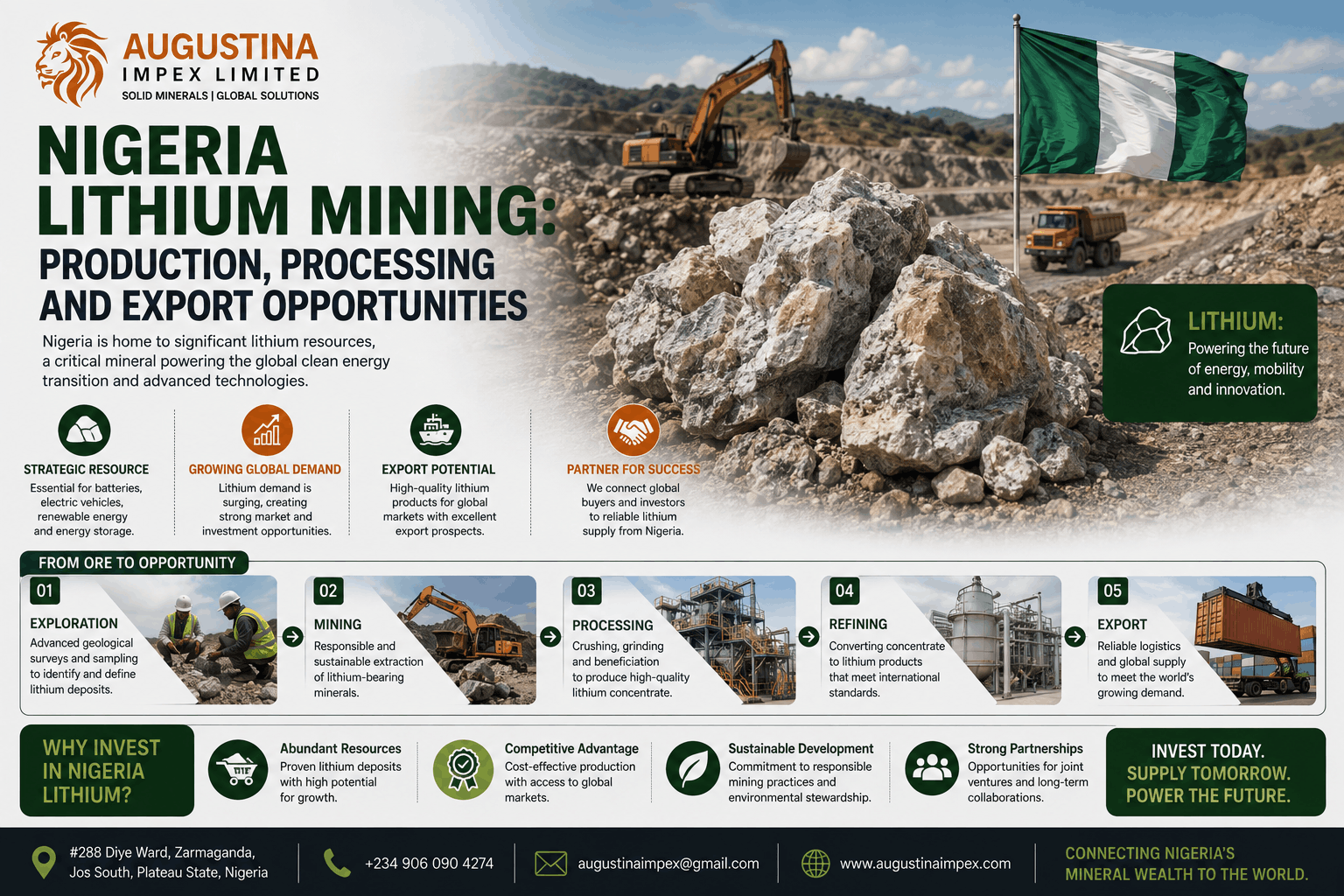
Nigeria Lithium Mining: Production, Processing & Export
Nigeria Lithium Mining: Production, Processing and Export Opportunities By Kolawole King, CEO — Augustina Impex…
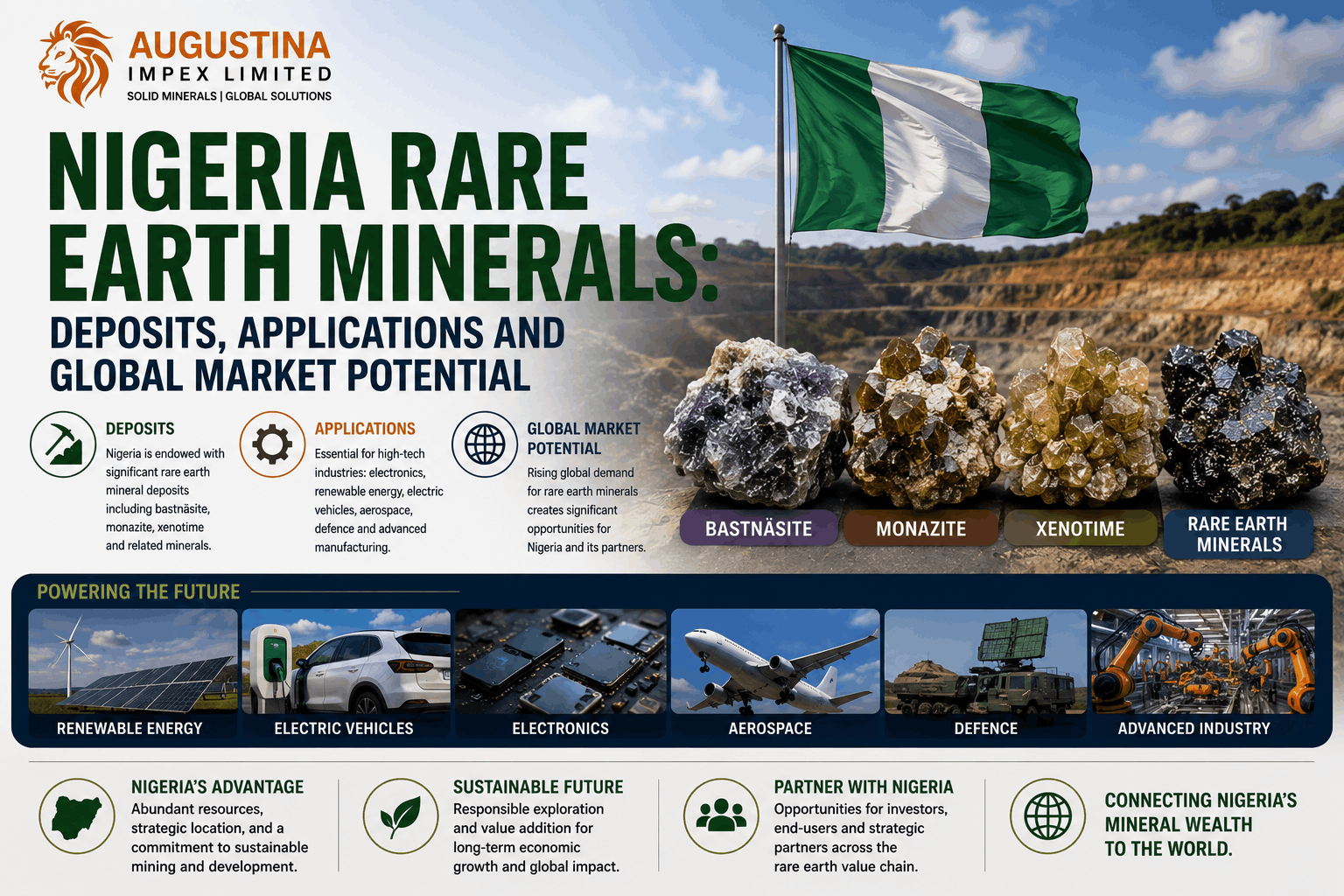
Nigeria Rare Earth Minerals: Deposits & Market Potential
Nigeria Rare Earth Minerals: Deposits, Applications and Global Market Potential By Kolawole King, CEO —…
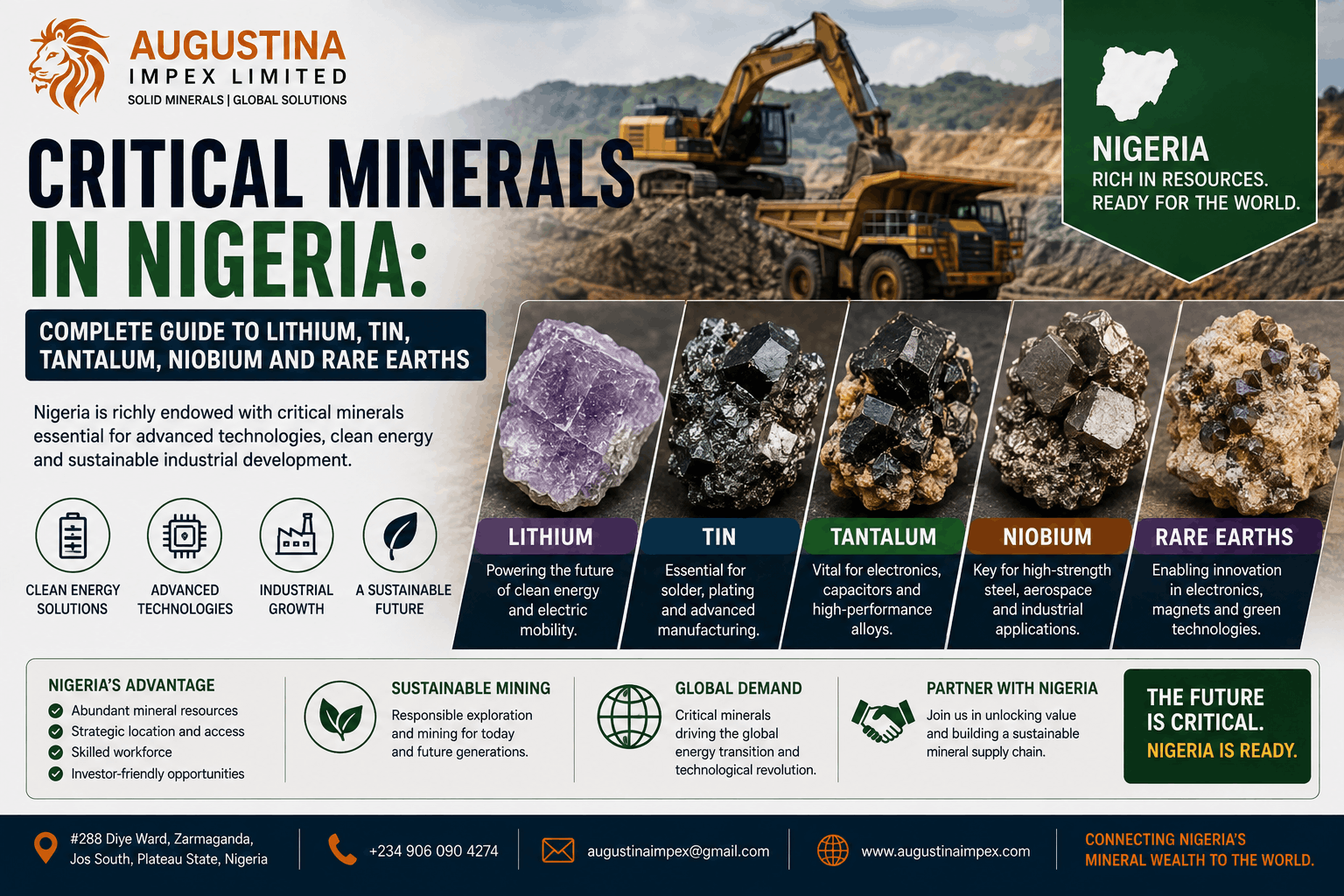
Nigeria Critical Minerals Guide: Lithium, Tin & Rare Earths
Critical Minerals in Nigeria: Complete Guide to Lithium, Tin, Tantalum, Niobium and Rare Earths By…
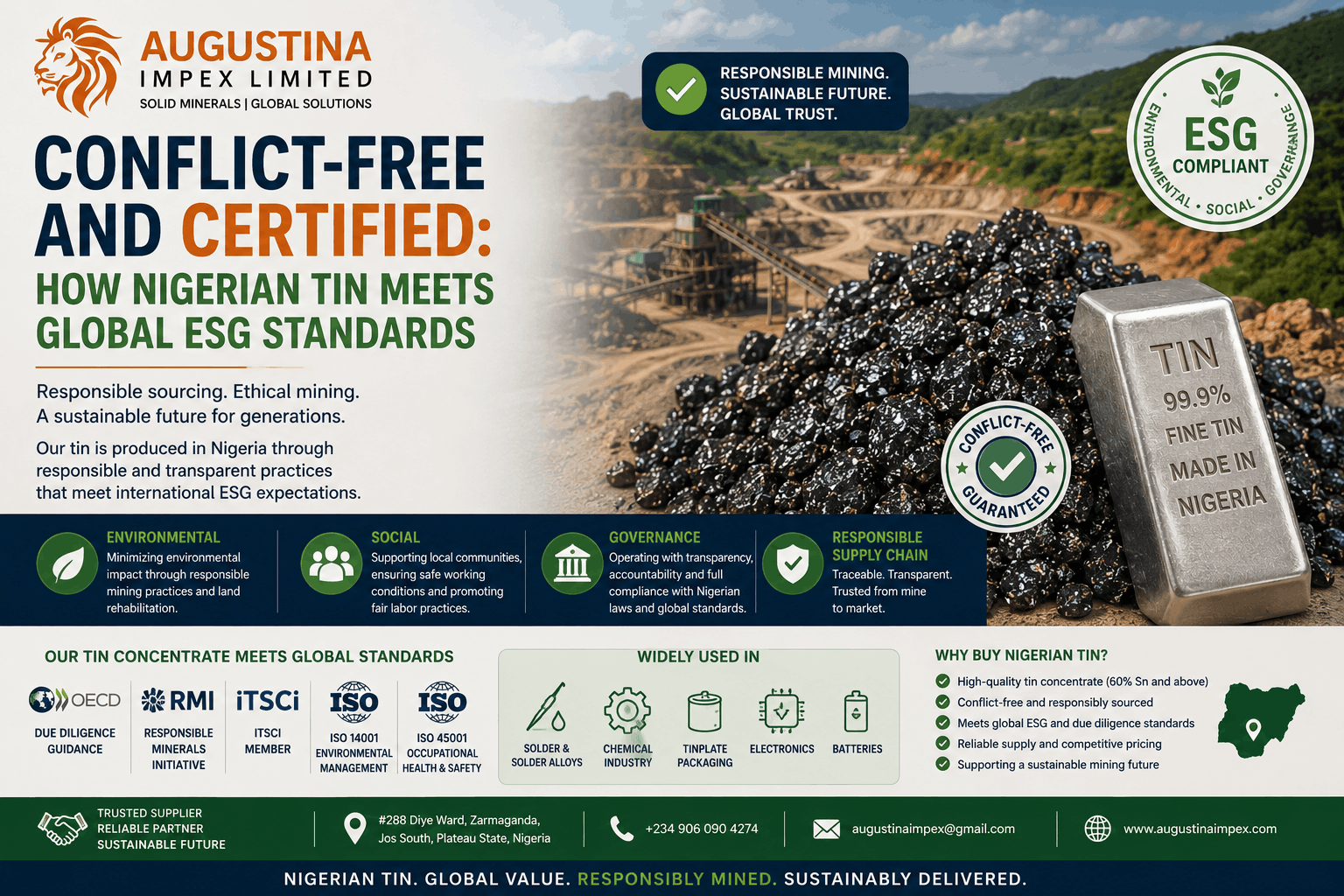
Conflict-Free Nigerian Tin Meets Global ESG Standards
Conflict-Free and Certified: How Nigerian Tin Meets Global ESG Standards By Kolawole King, CEO —…