
Mining Ebooks: 6 Expert Guides to Buying and Exporting Nigerian and African Minerals
By Kolawole King, CEO — Augustina Impex Limited | Published: October 2026 | 18 min read
Every week, my inbox and WhatsApp fill with the same questions from buyers in China, India, Europe, the Gulf and the Americas. How do I verify a Nigerian supplier before I send money? Why does my lab report not match the seller’s certificate? Is this lithium ore spodumene or lepidolite? Can monazite legally leave Nigeria? Who really controls the world’s coltan supply? These are not academic questions. They decide whether a container makes money, loses money or never ships at all.
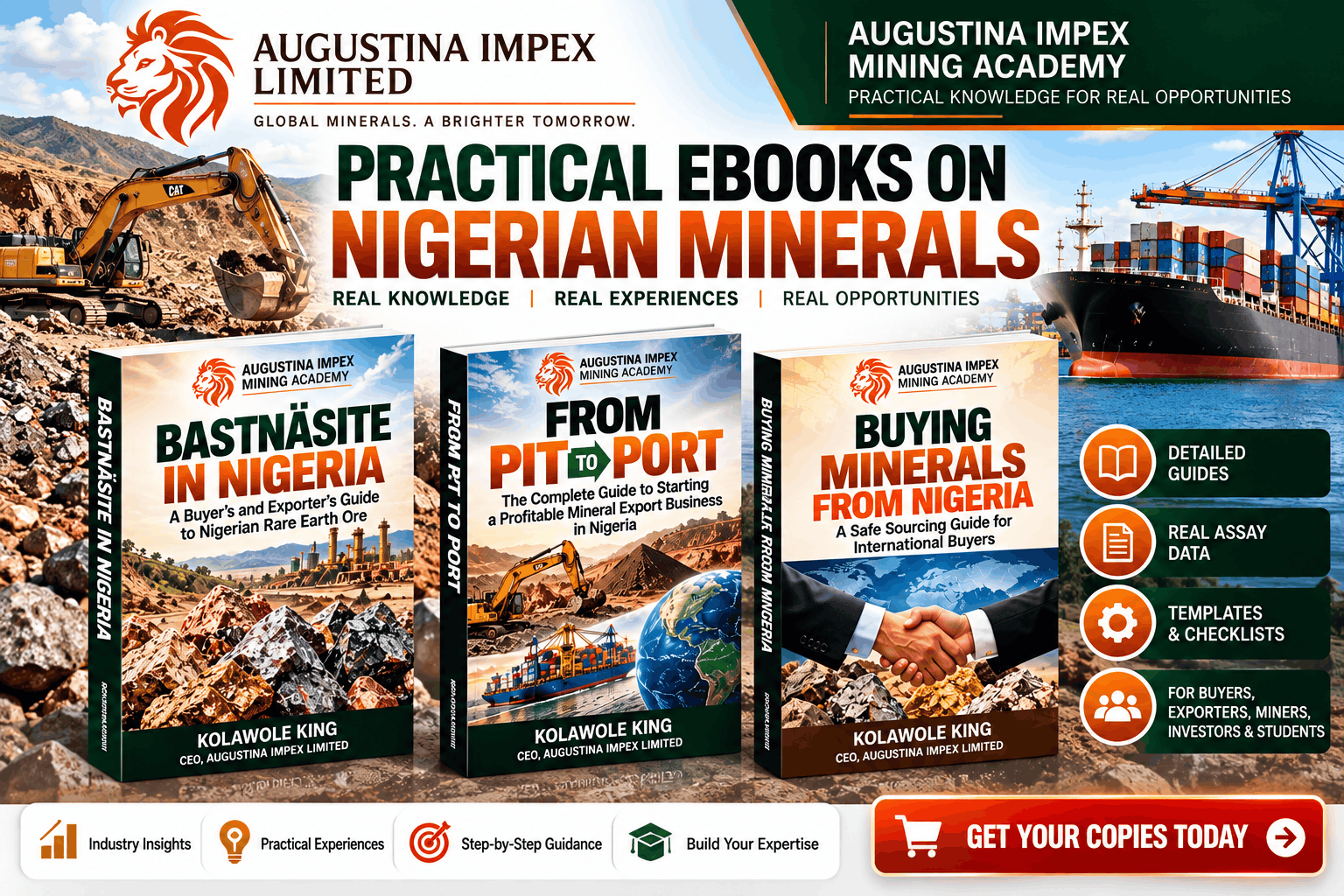
After years of answering them one conversation at a time, I decided to write the answers down properly. The result is a library of six mining ebooks published by the Augustina Impex Mining Academy: two foundation guides on how the Nigerian mineral trade works, three mineral-specific handbooks on bastnäsite, monazite and lithium, and a full market analysis report on coltan across Africa. Each one is written from the ground in Jos, Plateau State, where Augustina Impex works daily with miners, aggregators, laboratories, processing plants and international buyers.
This article is a complete guide to all six books: what each one covers, who it is for, how they fit together, and how to choose the right one for your next step in the trade. If you are trying to understand buying minerals from Nigeria, starting a mineral export business in Nigeria, or tracking critical minerals in Africa, at least one of these books was written with you in mind.
Why Practical Mining Ebooks Matter in 2026
The global race for critical minerals has turned Africa into one of the most watched mining regions on earth. Battery makers need lithium. Magnet makers need neodymium and praseodymium from rare earth ores. Electronics and AI data centres need tantalum. Governments in the United States, the European Union, China, Japan, India and the Gulf are signing minerals partnerships, building stockpiles and screening supply chains for conflict and forced labour. Nigeria, with its tin and columbite fields, its pegmatite belt and its emerging rare earth sector, sits right in the middle of this story.
Yet the information gap is enormous. Most published material on Nigerian minerals is either a short news item, a government brochure or a highly technical geological paper. None of these tells a buyer how to structure a safe payment, how to read a rare earth assay, what a fair price for 3% lithium ore looks like, or how to ship radioactive monazite legally. That gap is where money is lost, through fake certificates, unrealistic prices, cargoes that cannot be exported, and deals that collapse at the port.
In the Nigerian mineral trade, the most expensive mistakes are rarely about price. They are about knowledge: a buyer who pays a deposit to an unverified “mandate”, a seller who calls lepidolite spodumene, an exporter who does not realise monazite is regulated as radioactive material, or a trader who relies on a handheld XRF reading instead of a proper laboratory assay. Each of these mistakes can cost thousands of dollars on a single lot. The Augustina Impex Mining Academy ebooks were written specifically to prevent them.
These mining ebooks are deliberately practical. They explain how things actually work at mine sites, buying centres, laboratories, ministries and ports, and they give readers the templates, checklists and calculations they need to act on that knowledge. They are also honest. Where a figure is an estimate, it is labelled as an estimate. Where a rule must be confirmed with the Ministry of Solid Minerals Development, the book says so.
The Augustina Impex Mining Academy Library at a Glance
The six titles were designed to work as a single library. The first two teach the general method of trading Nigerian minerals. The next three apply that method to specific minerals, where grades, chemistry, regulations and prices differ sharply. The sixth steps back to analyse an entire continental market.
| Ebook | Main Focus | Best For | Format |
|---|---|---|---|
| From Pit to Port | Starting and running a mineral export business in Nigeria | New exporters, entrepreneurs, foreign partners | PDF guide |
| Buying Minerals from Nigeria | Safe sourcing, supplier verification and payment security | International buyers and traders | A5 PDF guide |
| Bastnäsite in Nigeria | Rare earth ore: assays, NdPr value, contracts and export rules | Rare earth buyers, traders, investors | 150-page A5 PDF |
| Monazite Sand in Nigeria | Rare earth concentrate, processing, radiation safety, Class 7 shipping | Processors, exporters, rare earth buyers | 150-page A5 PDF |
| Lithium Ore in Nigeria | Spodumene and lepidolite grading, pricing and export | Lithium buyers, exporters, aggregators | 150-page A5 PDF |
| Coltan in Africa | Tantalum and niobium market analysis and outlook to 2030 | Analysts, investors, traders, policy makers | 150-page A5 market report |
Together the books cover tin, columbite, tantalite and coltan, lithium, the rare earth minerals bastnäsite and monazite, and the full process of buying, documenting and exporting solid minerals from Nigeria. Each title can be read on its own, but readers who own the full set have a complete reference library on Nigerian and African minerals.
Book 1 — From Pit to Port: Starting a Profitable Mineral Export Business in Nigeria
From Pit to Port: The Complete Guide to Starting a Profitable Mineral Export Business in Nigeria is where many readers of these mining ebooks begin. It follows a mineral consignment through every stage of its journey, from the artisanal pit or small mine where the ore is dug, through aggregation, testing, documentation and transport, to the moment it is loaded onto a ship. It is written primarily for Nigerians who want to build a legitimate mineral export business in Nigeria, but foreign partners also use it to understand what their Nigerian suppliers must do on their side of the deal.
① Licensing and Permits
The book explains in plain language how the Nigerian mining title system works under the Nigerian Minerals and Mining Act 2007, the role of the Mining Cadastre Office, how mineral buying and export permits are obtained, and why royalties and proper registration protect the exporter as much as the government. It also explains the role of NEPC registration and how export facilitation partners can help new exporters.
② Sourcing, Testing and Pricing
Readers learn how to buy from miners and cooperatives without being cheated, why every lot must be sampled and assayed, how to read a certificate of analysis, and how to build a simple price calculation from a benchmark price, grade, costs and margin. This is the section that saves most beginners from their first expensive mistake.
③ Logistics, Documentation and Shipping
Finally, the book walks through packing, trucking, port procedures, the key export documents and how payment is received and repatriated through the Nigerian banking system. By the end, a reader understands what it really takes to move a mineral from pit to port, and what it costs.
Book 2 — Buying Minerals from Nigeria: A Safe Sourcing Guide for International Buyers
If From Pit to Port is written from the seller’s side, Buying Minerals from Nigeria: A Safe Sourcing Guide for International Buyers is written from the buyer’s. It is for the purchasing manager in Shanghai, Mumbai, Dubai, Rotterdam or Houston who sees real opportunity in Nigerian supply but is understandably worried about fraud. That worry is justified: fake suppliers, doctored laboratory results, “buyer’s mandate” chains and advance-fee scams are common in the international mineral trade.
① Verifying Suppliers
The book shows buyers how to verify a Nigerian company, its directors, its mining titles or buying permits, its export registration and its bank account, and how to recognise the warning signs of a fake supplier before any money changes hands.
② Inspection, Sampling and Contracts
It explains how to arrange independent inspection and sampling through internationally recognised inspection companies, how umpire laboratories resolve disputes, and which contract clauses matter most: specification, sampling, weights, penalties, force majeure and dispute resolution.
③ Safe Payment Structures and the Buyer’s Toolkit
Above all, the book explains payment structures that protect the buyer, from payment against documents to letters of credit, and closes with a Buyer’s Toolkit of ready-to-use checklists. For any foreign company considering buying minerals from Nigeria for the first time, this is the book to read before sending a deposit.
From Pit to Port teaches the Nigerian side of the trade: titles, permits, sourcing, testing, costing and export.
Buying Minerals from Nigeria teaches the buyer’s side: verification, inspection, contracts and safe payment.
Read together, they let buyers and sellers understand each other’s obligations and risks, which makes negotiations faster, fairer and far less likely to fail.
Book 3 — Bastnäsite in Nigeria: A Buyer’s and Exporter’s Guide to Nigerian Rare Earth Ore
Bastnäsite is one of the world’s two most important rare earth ore minerals, and interest in Nigerian supply has grown quickly as manufacturers and governments search for rare earth feedstock outside China. Bastnäsite in Nigeria is a 150-page guide built around something very few publications offer: six certified Nigerian bastnäsite assays analysed in full.
Those assays are used to explain what really determines the value of a rare earth lot. A buyer learns why the headline total rare earth oxide (TREO) grade is only the beginning; why the neodymium-praseodymium (NdPr) share drives value because of magnet demand for electric vehicles and wind turbines; which impurities matter; and why thorium and uranium levels affect handling, permits and buyer acceptance.
Structure: 150 pages · 20 chapters · 12 appendices · 10 practical toolkits
Data: Six certified Nigerian bastnäsite assays analysed in full (TREO, NdPr distribution, impurities, Th/U)
Market: Global rare earth demand, valuation methods and the impact of China’s rare earth export controls on demand for African ore
Practice: Sampling, laboratory selection, contracts, inspection, radioactivity checks and Nigerian export rules
For anyone sourcing Nigerian rare earth minerals, whether as a trader, a processor or an investor assessing a project, this book turns a confusing commodity into one that can be evaluated with confidence and negotiated professionally.
Book 4 — Monazite Sand in Nigeria: Sourcing, Processing and Exporting Rare Earth Concentrate Safely
Monazite is Nigeria’s second major rare earth mineral. It occurs in the heavy mineral sands and tailings of the Jos Plateau tin fields, often alongside cassiterite, columbite, zircon and ilmenite. It is valuable for its rare earth content, but it also contains thorium, and that single fact changes everything about how it must be processed, handled, permitted and shipped. Many monazite deals fail at the port precisely because sellers treat it like ordinary sand.
① Grades, Value and Pricing
The book explains monazite grades, TREO and NdPr payability, the specifications buyers ask for, and how a tonne of concentrate is priced, so that both sellers and buyers can judge an offer realistically.
② Processing on the Jos Plateau
It describes how monazite is recovered and upgraded using gravity, magnetic and electrostatic separation, how it is separated from zircon and other heavy minerals, and what a well-run processing plant looks like.
③ Radiation Safety and Class 7 Shipping
Most importantly, the book explains radioactivity in plain language: dose limits, site surveys and a practical radiation protection programme. It then shows how monazite is classified, packed, labelled and documented as Class 7 radioactive cargo (UN 2912), and the role of Nigerian regulators in permitting. A full worked case study follows a first container from plant to port.
Monazite is one of the few minerals where a safety mistake can stop a shipment entirely. By covering grades, processing, radiation protection and dangerous goods shipping in one place, Monazite Sand in Nigeria gives exporters and buyers a single reference for doing the trade safely, legally and profitably. It contains 20 chapters in five parts, 8 appendices and 8 toolkits.
Book 5 — Lithium Ore in Nigeria: A Practical Guide to Buying and Exporting Spodumene and Lepidolite
Lithium has become one of the busiest mineral trades in Nigeria, driven by global battery demand and by new processing investment in the country itself. It is also one of the most confusing trades. Buyers regularly receive handheld “assays” presented as laboratory results, lepidolite offered as spodumene, and prices that bear no relationship to the international benchmark. Lithium Ore in Nigeria brings order to that confusion across 150 pages, 27 chapters in six parts, 13 appendices and 10 toolkits.
| Topic | What the Book Explains |
|---|---|
| Mineralogy | How to tell spodumene from lepidolite, and why the difference changes price, processing and buyers |
| Pricing | How lithium concentrate is priced against the SC6 (6% Li2O) benchmark, and why 3% ore is not worth half the SC6 price |
| Geography | Where lithium is found in Nigeria, state by state, and what realistic Nigerian grades look like |
| Testing | Why fusion and ICP laboratory analysis matters, and how to sample a lot properly |
| Regulation | Nigeria’s value-addition policy, permits and rules on exporting unprocessed minerals |
| Risk | The most common lithium scams and how to defend against each one |
| Tools | A lithium value calculator, specification sheet, offer template and export document checklist |
Whether you are an international converter looking at Nigerian supply or a Nigerian aggregator trying to sell at a fair price, this book helps you judge any lithium ore in Nigeria offer in minutes rather than weeks.
Book 6 — Coltan in Africa: Market Analysis and Outlook for Tantalum and Niobium Supply
The newest of the six mining ebooks is different in character. Coltan in Africa: Market Analysis and Outlook for Tantalum and Niobium Supply is a full coltan market analysis report, written in the format that commodity analysts, investors and policy makers expect. It covers production, trade flows, pricing and policy risk across the entire African continent, with scenarios to 2030.
Coltan matters because tantalum, the metal refined from it, goes into the tiny, reliable capacitors inside smartphones, cars, medical devices and the servers that power artificial intelligence, and into the superalloys used in jet engines. According to the U.S. Geological Survey’s Mineral Commodity Summaries 2026, the Democratic Republic of Congo, Rwanda and Nigeria together produced most of the world’s mined tantalum in 2025, and on those figures Africa accounted for roughly 85% of world mine output. In 2026, deadly landslides at the Rubaya mine in eastern DRC sent tantalite prices to their highest level in more than two decades.
| Key Figure in the Report | Value | Source Basis |
|---|---|---|
| World tantalum mine output, 2025e | ≈2,500 t Ta | USGS 2026 |
| Africa’s share of tantalum mining | ≈85% | Calculated from USGS data |
| DRC / Rwanda / Nigeria output, 2025e | 1,300 / 400 / 390 t Ta | USGS 2026 |
| Brazil’s share of world niobium | ≈93% | USGS 2026 |
| Tantalite price, 2025 average | ≈US$82/lb Ta2O5 | USGS (converted) |
| Tantalite price, Europe, March 2026 | ≈US$200–210/lb | Reuters market reporting |
The report runs to 150 pages, with 33 chapters in six parts, 12 charts, country fact sheets for every major producer, a country risk heatmap and 10 appendices. It explains the conflict-minerals framework, including Dodd-Frank Section 1502, the EU Conflict Minerals Regulation and the OECD due diligence guidance for responsible mineral supply chains, and sets out three price scenarios with signposts for analysts to track.
Most coltan analysis focuses almost entirely on the DRC. This report covers every African producer and niobium project, and adds a perspective rarely found in international research: first-hand insight into Nigeria, now one of the world’s three largest tantalum producers, including its grades, pricing, export routes and buyers.
Which Mining Ebook Should You Read First?
The right starting point depends on your role and your immediate goal. Based on the questions I receive most often, here is a practical reading guide.
| If You Are… | Start With | Then Read |
|---|---|---|
| A new Nigerian exporter | From Pit to Port | The guide for your mineral |
| A foreign buyer new to Nigeria | Buying Minerals from Nigeria | The mineral-specific guide you need |
| A rare earth buyer or trader | Bastnäsite in Nigeria | Monazite Sand in Nigeria |
| A lithium buyer or aggregator | Lithium Ore in Nigeria | Buying Minerals from Nigeria |
| An analyst, investor or policy maker | Coltan in Africa | The mineral-specific guides |
| A student or trainee | From Pit to Port | The full library |
Many readers eventually own all six mining ebooks, because together they form a complete working library for anyone involved in Nigerian and African minerals.
What Makes These Mining Ebooks Different
There is no shortage of mining content online. What sets these mining ebooks from the Augustina Impex Mining Academy apart is where it comes from and how it is built.
① Written From the Field
Augustina Impex Limited works every day with artisanal miners, aggregators, laboratories, processing plants, inspection companies and international buyers in Jos and across Nigeria. The examples in the books come from real transactions, real assays and real problems, not from theory.
② Built for Action
The 150-page titles include specification sheets, offer templates, sampling records, value calculators, model contract clauses, document checklists and supplier questionnaires that readers can use on their very next lot.
③ Honest About Risk
Fake certificates, smuggling, export restrictions, radiation hazards and payment fraud are discussed openly, with practical defences. Market figures are labelled as indicative and sourced, and readers are told which authorities to confirm rules with.
④ Written for Both Sides of the Deal
Because the library covers both the seller’s and the buyer’s perspective, each side learns what the other needs. That shared understanding is often what turns a difficult negotiation into a long-term supply relationship.
How to Get the Ebooks
All six mining ebooks are delivered as PDF files that open on any phone, tablet or computer. Each sales page shows the current price and allows instant purchase through Selar by card, bank transfer or USSD, with immediate download after payment. International readers may also pay with Bitcoin or USDT (ERC-20); wallet addresses are listed on each sales page, and the PDF is emailed once the payment is confirmed on the blockchain.
Foundation guides: From Pit to Port · Buying Minerals from Nigeria
Rare earth guides: Bastnäsite in Nigeria · Monazite Sand in Nigeria
Battery metals guide: Lithium Ore in Nigeria
Market analysis report: Coltan in Africa
Payment options: Selar (card, bank transfer, USSD) · Bitcoin · USDT (ERC-20)
Frequently Asked Questions: Augustina Impex Mining Ebooks
All six books were written by Kolawole King, Chief Executive Officer of Augustina Impex Limited (RC 750691), a solid minerals trading and export company headquartered in Jos, Plateau State, Nigeria, and founder of the Augustina Impex Mining Academy. The company works daily with miners, processors, laboratories and international buyers of tin, columbite, tantalite, lithium and rare earth minerals.
No. The books are written for international buyers as much as for Nigerian sellers. Nigerian laws, procedures, institutions and trade terms are explained so that a foreign reader can follow every step of a transaction.
No. Grades, assays, processing and pricing are explained in plain language with worked examples. Technical readers will still find detailed tables, formulas, conversion factors and specifications.
The library covers tin, columbite, tantalite and coltan, lithium (spodumene and lepidolite), the rare earth minerals bastnäsite and monazite, and the general process of buying, documenting and exporting solid minerals from Nigeria. The coltan report also covers niobium and the wider African tantalum market.
Yes. Augustina Impex Limited supplies tin, columbite, tantalite, lithium, rare earth minerals and other critical minerals from Nigeria, with independent laboratory testing, inspection coordination and export facilitation through Jase Odus Nigeria Limited (NEPC RE 0039421). Buyers can request a written offer by sending their specifications.
Six practical mining ebooks from the Augustina Impex Mining Academy · Nigerian and African minerals · Selar, Bitcoin and USDT payment
📧 augustinaimpex@gmail.com
📞 WhatsApp: +234 906 090 4274
Kolawole King is the Chief Executive Officer of Augustina Impex Limited (RC 750691), a NEPC-licensed Nigerian solid mineral export company headquartered in Jos, Plateau State, and founder of the Augustina Impex Mining Academy. He is the author of From Pit to Port, Buying Minerals from Nigeria, Bastnäsite in Nigeria, Monazite Sand in Nigeria, Lithium Ore in Nigeria and Coltan in Africa. Contact: augustinaimpex@gmail.com | WhatsApp: +234 906 090 4274 | www.augustinaimpex.com | Corporate Blog | Advert Video
-
Previous Post
Nigeria Lithium Mining: Production, Processing & Export
Post a comment
Related Posts
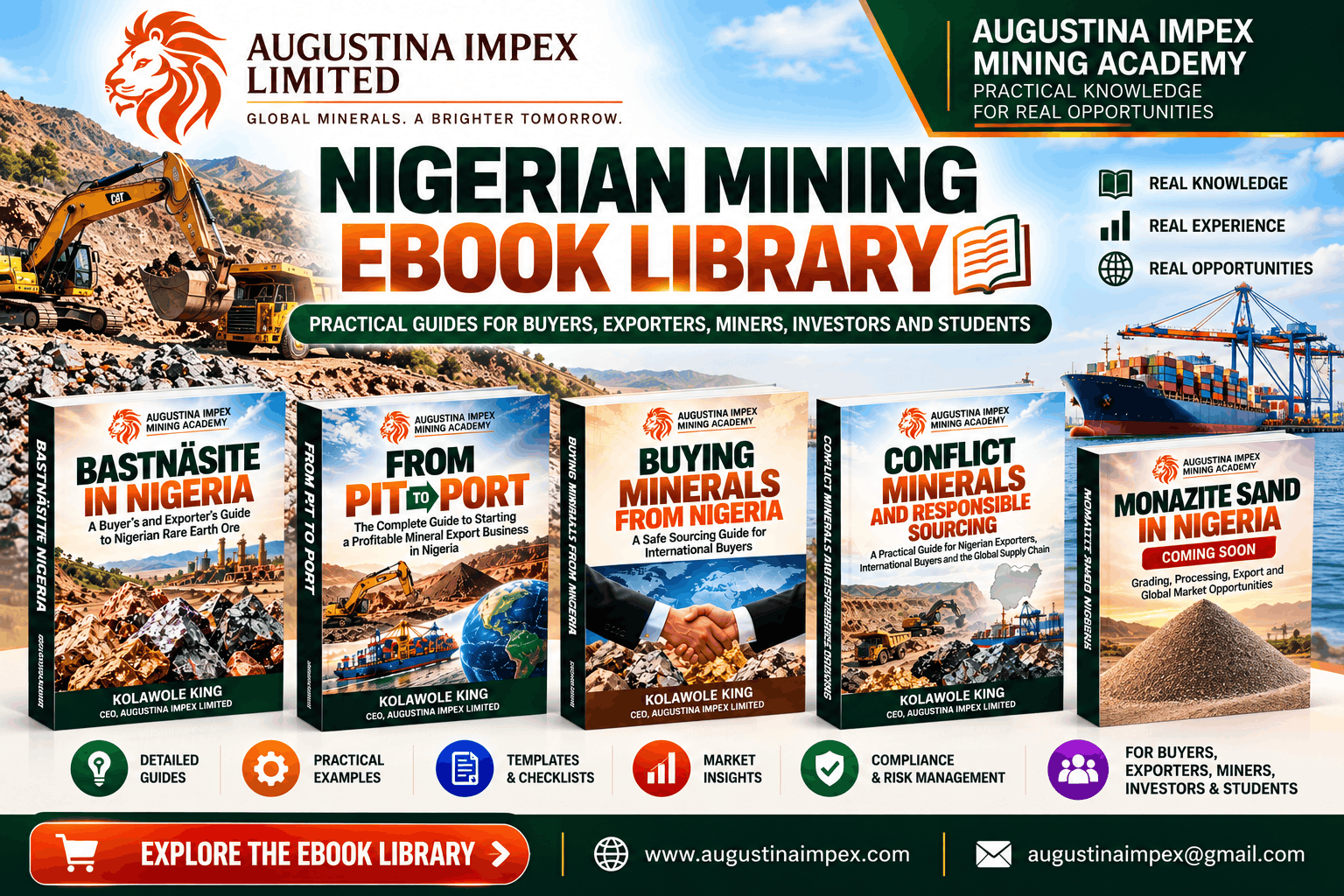
Nigerian Mining Ebook Library: 10 Practical Guides for Buyers, Exporters and Investors
Nigerian Mining Ebook Library: 10 Practical Guides for Buyers, Exporters and Investors By Kolawole King,…
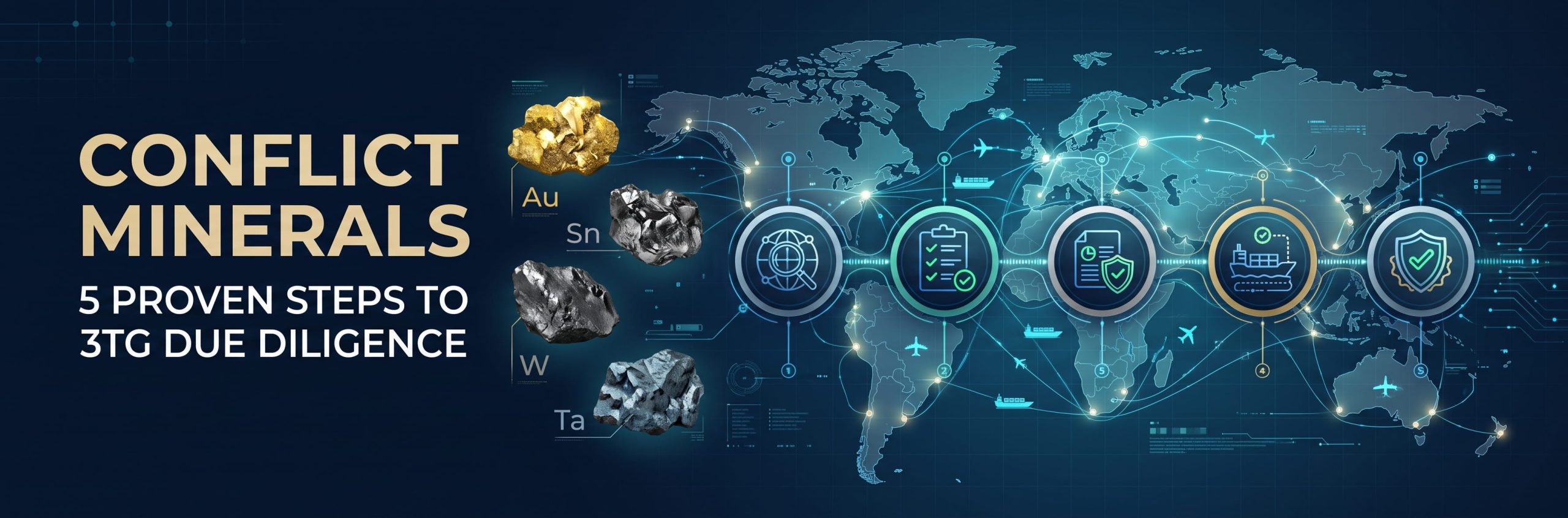
Conflict Minerals: 5 Proven Steps to 3TG Due Diligence
Conflict Minerals and Responsible Sourcing: A Practical Guide to 3TG and the OECD Due Diligence…
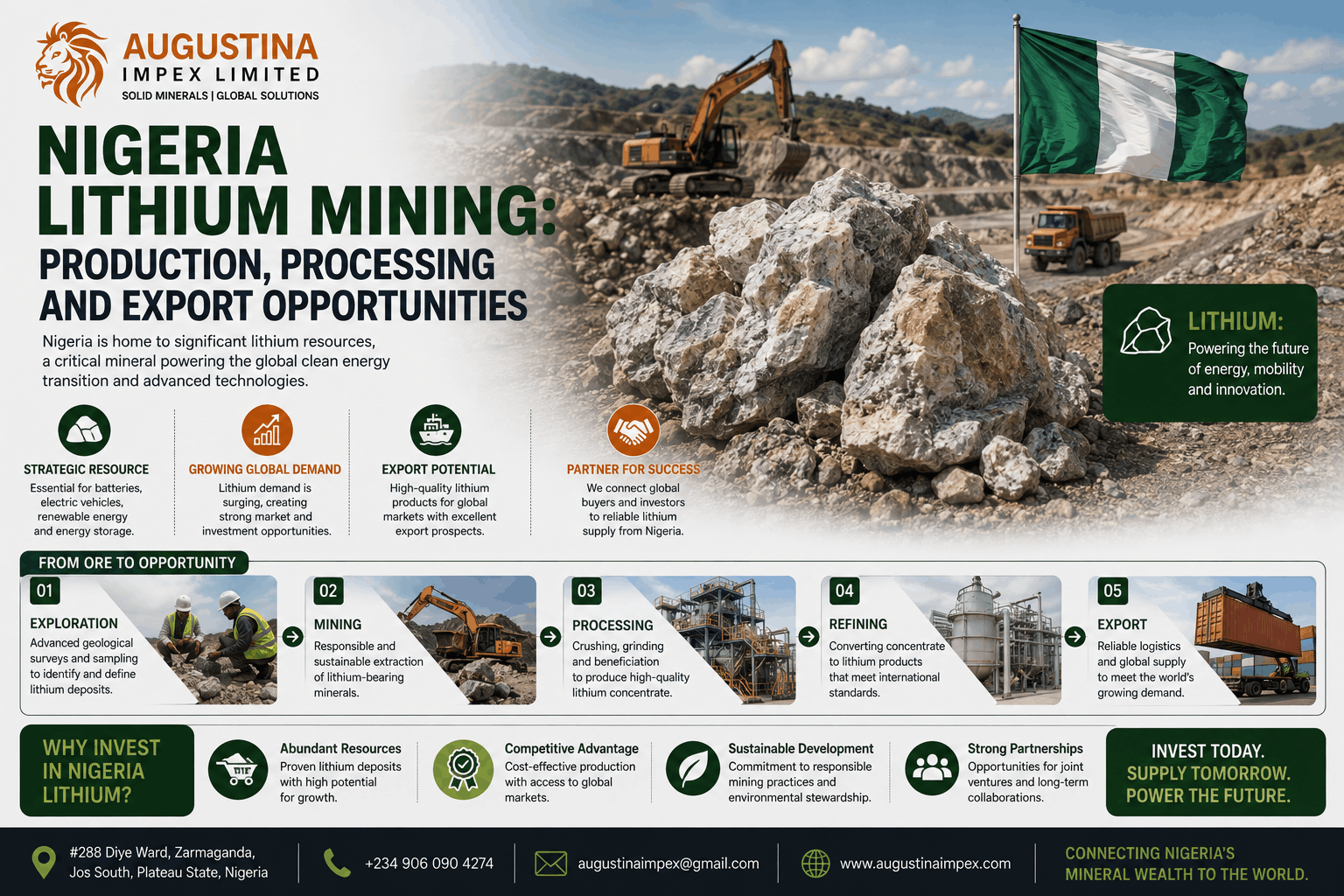
Nigeria Lithium Mining: Production, Processing & Export
Nigeria Lithium Mining: Production, Processing and Export Opportunities By Kolawole King, CEO — Augustina Impex…

Nigeria Rare Earth Minerals: Deposits & Market Potential
Nigeria Rare Earth Minerals: Deposits, Applications and Global Market Potential By Kolawole King, CEO —…