
Nigeria Lithium Mining: Production, Processing and Export Opportunities
By Kolawole King, CEO — Augustina Impex Limited | Published: August 2026 | 18 min read
Few mineral stories have moved as fast, or carry as much long-term consequence, as the global rush for lithium. In just over a decade, lithium has transformed from an obscure industrial metal — used mainly for ceramics, glass, and mood-stabilising pharmaceuticals — into one of the most strategically consequential minerals on Earth. It is the foundational element of the lithium-ion battery, the technology that powers the electric vehicle revolution, stores renewable energy at grid scale, and gives every smartphone, laptop, and wearable device its energy-dense portable power source. Without lithium, the clean energy transition as currently envisioned cannot proceed at the pace that climate science demands.
Nigeria has entered this story as a significant and growing player. Long known within the specialist minerals community for its columbite (niobium) and tin production on the Jos Plateau, Nigeria’s pegmatite belt hosts extensive lithium-bearing mineral deposits — spodumene, kunzite, and lepidolite — that are now attracting serious attention from international buyers, battery manufacturers, and mining investors who recognise that the global lithium supply chain cannot rely indefinitely on the Chilean and Australian deposits that have dominated supply for the past decade. This article provides a comprehensive, practical guide to Nigeria’s lithium mining sector — the geology, the mineralogy, the production landscape, the processing pathways, the export framework, and the commercial opportunities that exist today for buyers who are willing to engage with one of Africa’s most genuinely promising lithium supply jurisdictions.
Why Lithium? Understanding the Demand That Is Reshaping Global Mining
Lithium demand is not a speculative story — it is being driven by real, policy-mandated technology transitions that are already well advanced. The IEA’s Stated Policies Scenario (STEPS) projects global EV sales reaching 40–45 million units per year by 2030. Under its Net Zero Emissions (NZE) scenario, the figure exceeds 60 million per year. Each battery electric vehicle (BEV) requires approximately 5–15 kg of lithium carbonate equivalent (LCE) in its battery pack, depending on pack size and chemistry. That translates to 200,000–900,000 MT of LCE annually from the EV sector alone by 2030 — compared to approximately 130,000 MT of total lithium production in 2023.
Add grid-scale energy storage (lithium iron phosphate, or LFP, batteries for stationary storage) and consumer electronics (smartphones, laptops, tablets), and the aggregate lithium demand picture becomes one of the clearest supply-demand imbalances in any commodity market. Multiple credible analyses — from Goldman Sachs, BloombergNEF, Wood Mackenzie, and the IEA — project a structural lithium supply deficit emerging in the late 2020s, with prices recovering from their 2023–2024 cyclical trough as demand growth progressively outpaces supply growth from currently known and financed projects.
| Demand Sector | Lithium Use | 2025 Share | 2035 Projected Share |
|---|---|---|---|
| Battery Electric Vehicles | NMC, NCA, LFP battery cathode | ~55% | ~70–75% |
| Grid-Scale Energy Storage | LFP stationary storage | ~10% | ~15–18% |
| Consumer Electronics | Li-ion batteries (smartphones, laptops) | ~20% | ~8–10% |
| Industrial / Other | Glass, ceramics, greases, pharmaceuticals | ~15% | ~5–7% |
The supply side is dominated by two geological types: hard rock spodumene deposits (primarily in Australia, which accounts for roughly 50% of global mine supply, plus Zimbabwe, Portugal, and now Nigeria) and brine deposits (lithium-rich subsurface brines in the “Lithium Triangle” of Chile, Argentina, and Bolivia, which produce approximately 30–35% of global supply). Both types produce lithium concentrate (spodumene) or lithium chloride (brine) that is then chemically converted to battery-grade lithium carbonate (Li₂CO₃) or lithium hydroxide (LiOH·H₂O) — the forms required by battery cathode manufacturers.
Nigeria’s Lithium Geology: The Pan-African Pegmatite Belt
Nigeria’s lithium mineralisation is hosted in a series of granitic pegmatite intrusions that form part of the Pan-African Pegmatite Belt — a geological province that extends across West and Central Africa, formed approximately 600–500 million years ago during the Pan-African orogenic episode. This belt — which in Nigeria traverses Kaduna, Kogi, Nasarawa, Kwara, Ekiti, Cross River, Ondo, and Ogun states — is one of the most extensive and mineralogically diverse pegmatite terrains in Africa.
Pegmatites are coarse-grained igneous rocks that crystallise from the last residual fraction of a cooling granite magma — a fraction that is enriched in volatile elements (lithium, boron, fluorine) and incompatible elements (tantalum, niobium, cesium, beryllium) that were excluded from the earlier-crystallising rock-forming minerals. The result is a rock that concentrates lithium minerals — spodumene (LiAlSi₂O₆), lepidolite (K(Li,Al)₃(Al,Si)₄O₁₀(F,OH)₂), kunzite (the pink gem variety of spodumene), and petalite (LiAlSi₄O₁₀) — at grade levels that can be economically significant even at artisanal and small-scale mining (ASM) production scales.
The geological framework of Nigerian lithium pegmatites is broadly analogous to the granite-pegmatite systems that host lithium in Zimbabwe (Bikita, Kamativi), the Democratic Republic of Congo (Manono), Mali (Bougouni — one of Africa’s largest undeveloped lithium deposits), and Ghana (Ewoyaa). Nigeria’s pegmatite belt has the advantage of significantly more accessible terrain and established road and export infrastructure compared to many of its African counterpart lithium jurisdictions.
Lithium Minerals in Nigeria: Spodumene, Kunzite, and Lepidolite
① Spodumene — The Primary Commercial Lithium Mineral
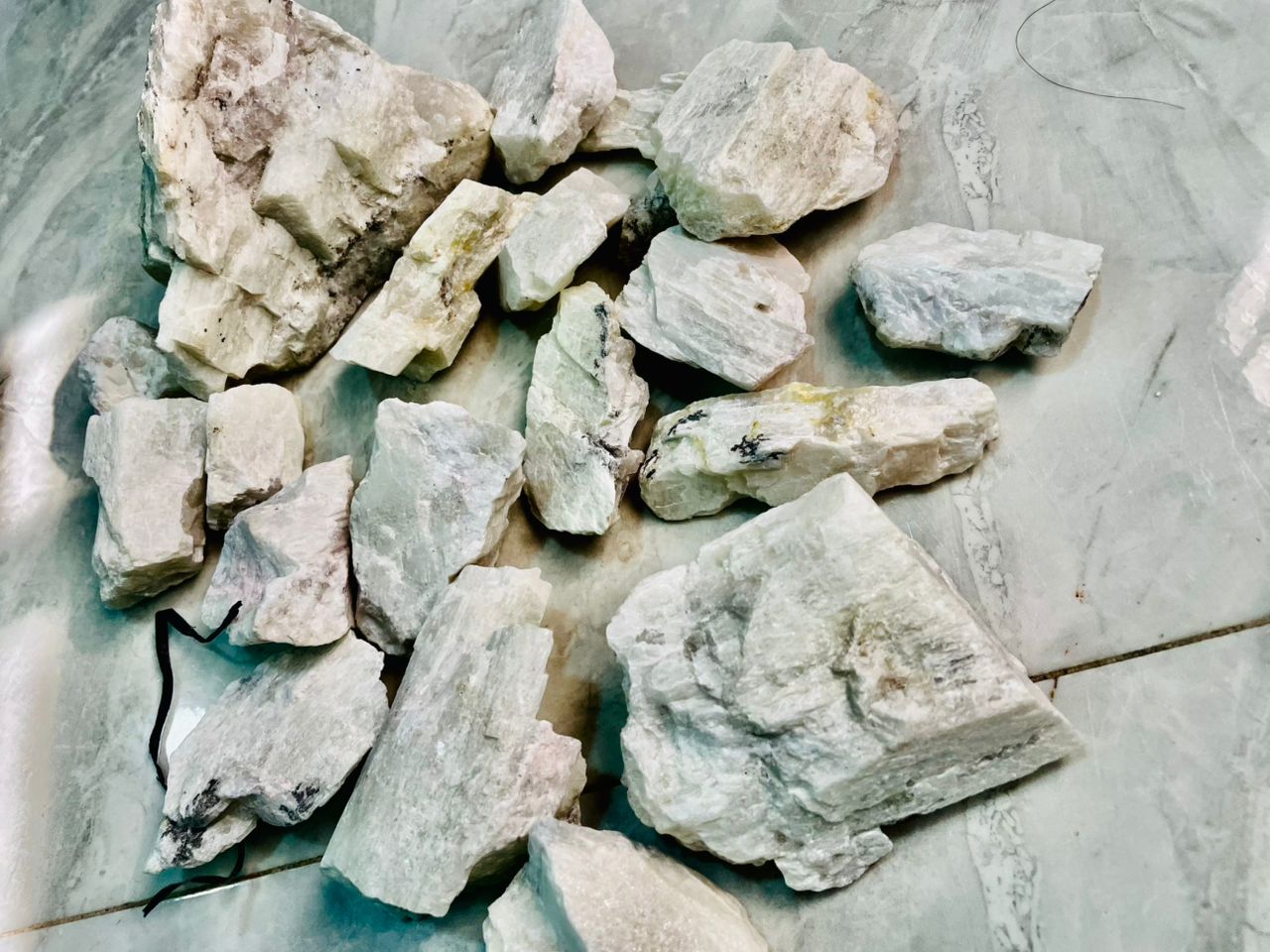
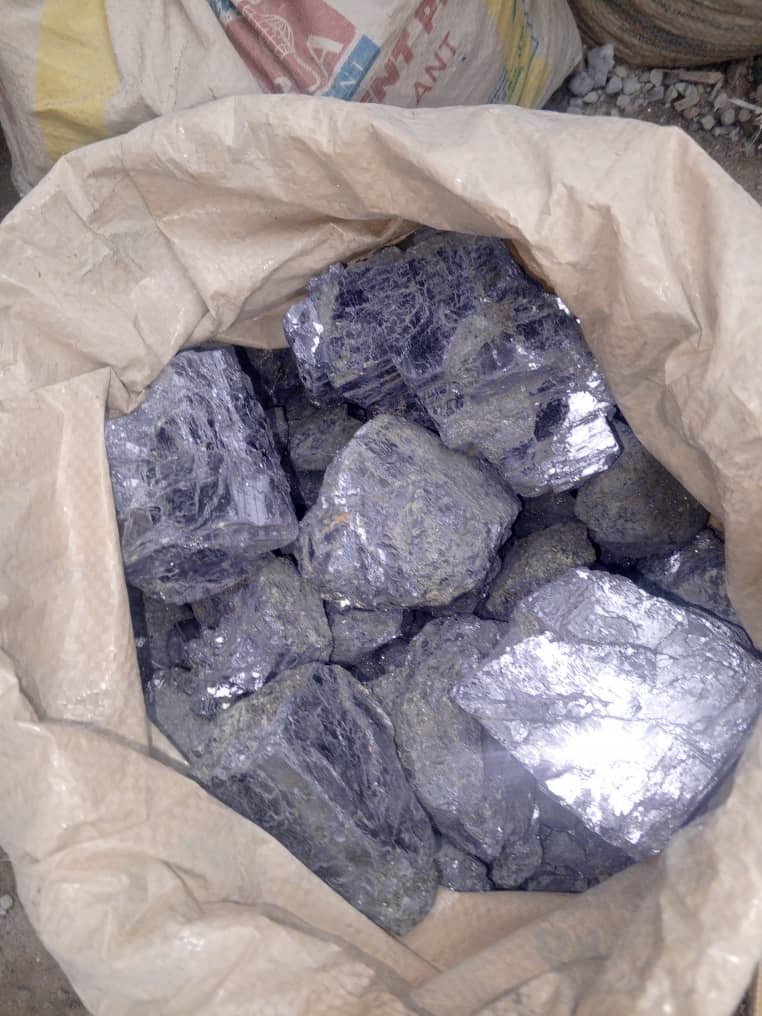
Spodumene (LiAlSi₂O₆) is the world’s primary commercial hard rock lithium mineral and the dominant lithium species in Nigeria’s commercial production. A chain silicate mineral (pyroxene group) with a theoretical Li₂O content of 8.03%, spodumene typically occurs in economic deposits at Li₂O grades of 1.0–5.5%, depending on the degree of pegmatite differentiation and alteration. Nigerian spodumene is characterised by:
① Li₂O Grade Range: 1.0% to 5.5%+ — the widest grade range in the Nigerian portfolio, reflecting the diversity of pegmatite systems across the country. Best-grade material (4%+ Li₂O) is typically associated with well-differentiated, coarse-grained pegmatites with characteristic white to pale grey spodumene crystals. Lower-grade material (1–2% Li₂O) is more widespread and suitable for bulk processing to concentrate.
② Crystal Size: Typically 2–30cm in length in well-developed pegmatites; smaller in marginal occurrences. Larger crystals facilitate gravity and dense medium separation for beneficiation without intensive flotation.
③ Alteration: Nigerian spodumene in some deposits shows partial alteration to muscovite, kaolinite, or other secondary Li-Al minerals (spodumene is prone to alteration in tropical lateritic weathering environments). Buyers should assess alteration levels from assay data, as heavily altered material may have lower effective Li₂O recovery in processing.
④ Associated Minerals: Typical pegmatite assemblage — feldspar (albite, microcline), quartz, muscovite, columbite-tantalite, beryl, tourmaline, apatite. The columbite-tantalite co-occurrence in many Nigerian lithium pegmatites means that lithium mining operations can potentially recover coltan as a by-product, materially improving project economics.
② Kunzite — Gem-Quality Spodumene with Dual Market Value
Kunzite is the pink to violet gem variety of spodumene — coloured by trace manganese — and is found in several Nigerian pegmatite deposits, particularly in Kaduna State (Minna area) and Kogi State. Kunzite carries dual market value: high-quality gem material commands significant premiums in the coloured gemstone market (particularly from Chinese and US buyers), while lower-quality or non-gem material is still commercially valuable as a high-Li₂O spodumene source (gem-quality kunzite can carry 6–8% Li₂O). For artisanal miners who encounter kunzite in their pegmatite workings, the gem premium can exceed the industrial lithium value by a substantial margin — though gem-quality assessment requires specialist gemmological expertise that ASM miners often lack.
③ Lepidolite — Lithium Mica from Auchi, Edo State
Lepidolite (K(Li,Al)₃(Al,Si)₄O₁₀(F,OH)₂) is a lithium-bearing mica mineral that occurs in the later-stage, most evolved portions of granitic pegmatites. It is characterised by its distinctive lilac to purple colour — caused by manganese — and its micaceous cleavage. Unlike spodumene, which is a chain silicate with relatively straightforward processing characteristics, lepidolite is a sheet silicate (phyllosilicate) whose processing to extract lithium requires more complex hydrometallurgical routes — sulphate roasting, pressure leaching, or limestone roasting — compared to the thermal β-spodumene conversion used for spodumene processing.
Nigeria’s commercially accessible lepidolite production comes from Auchi, Edo State, through a supply network coordinated by Augustina Impex’s associate Rahim Momoh. This lepidolite carries Li₂O grades of 1.2–2.5% and is priced Ex-Works Auchi at the following schedule:
| Li₂O Grade Band | Price (Ex-Works Auchi) | Suitable For |
|---|---|---|
| 1.2% – 1.5% Li₂O | ₦150,000 / MT | Processors with lepidolite sulphate roast / pressure leach capacity |
| 1.5% – 2.0% Li₂O | ₦180,000 / MT | Chinese and European lepidolite processors; ceramic/glass lithium source |
| 2.0% – 2.5% Li₂O | ₦230,000 / MT | Premium-grade lepidolite — battery-grade Li₂CO₃ precursor processors |
Lepidolite processing was traditionally considered less economical than spodumene due to its more complex hydrometallurgy — but this calculus has shifted significantly with the dramatic rise of lithium prices in 2021–2022 and the recognition that lepidolite deposits in China (particularly in Jiangxi Province) have been successfully commercialised at scale by Yongxing Special Materials and Jiangxi Ganfeng Lithium. Several Chinese and European processors now actively seek lepidolite feedstock, making the Nigerian Auchi lepidolite commercially relevant to a market that did not exist for it five years ago.
Current Production Landscape: ASM and Junior Mining in Nigeria
Nigeria’s lithium production in 2026 is overwhelmingly driven by artisanal and small-scale mining (ASM) — informal and semi-formal mining operations conducted by individual miners, family groups, and cooperative associations working directly in the pegmatite outcrops and shallow workings of the Pan-African belt. This ASM sector is the foundation of Nigeria’s lithium supply, and understanding its characteristics — and limitations — is essential for buyers assessing Nigerian lithium sourcing.
Nigerian lithium ASM is characterised by:
① Selective Hand-Mining: ASM miners primarily target visible, high-grade spodumene crystals and crystal aggregates in pegmatite outcrops — the white to pale grey masses that are the most visually distinctive feature of spodumene-bearing rock. This selective approach naturally concentrates on higher-grade material, meaning that ASM-produced ROM ore tends to be of better visual grade than bulk mechanical mining would achieve. However, it also means that production is irregular and dependent on outcrop quality at active workings.
② Production Volume: Individual ASM sites produce from 1–50 MT per month of ROM spodumene ore or hand-sorted crystal material. Aggregators — of which Augustina Impex is one — collect from multiple ASM sites across a region to assemble commercial volumes of 20–200 MT for export.
③ Junior Mining Companies: A growing number of Nigerian and foreign-backed junior mining companies have acquired exploration licences and small-scale mining licences (SSMLs) over lithium-bearing pegmatite ground in Kaduna, Ekiti, Kogi, Kwara, and Cross River states. These companies are progressively advancing from exploration to small-scale production, with some beginning to install beneficiation infrastructure (jaw crushers, dense medium separation, flotation cells) to upgrade ROM ore to spodumene concentrate before export.
④ Formalisation Progress: The Federal Ministry of Mines and Steel Development (FMMSD) has been actively issuing Small-Scale Mining Licences to lithium mining cooperatives — particularly in Kaduna and Ekiti states where lithium pegmatite activity is highest. This formalisation process is critical for supply chain documentation and the ESG compliance requirements of international buyers. Augustina Impex prioritises sourcing from SSML-licensed operations to ensure documentable mineral origin.
Processing Pathways: From Run-of-Mine Ore to Spodumene Concentrate
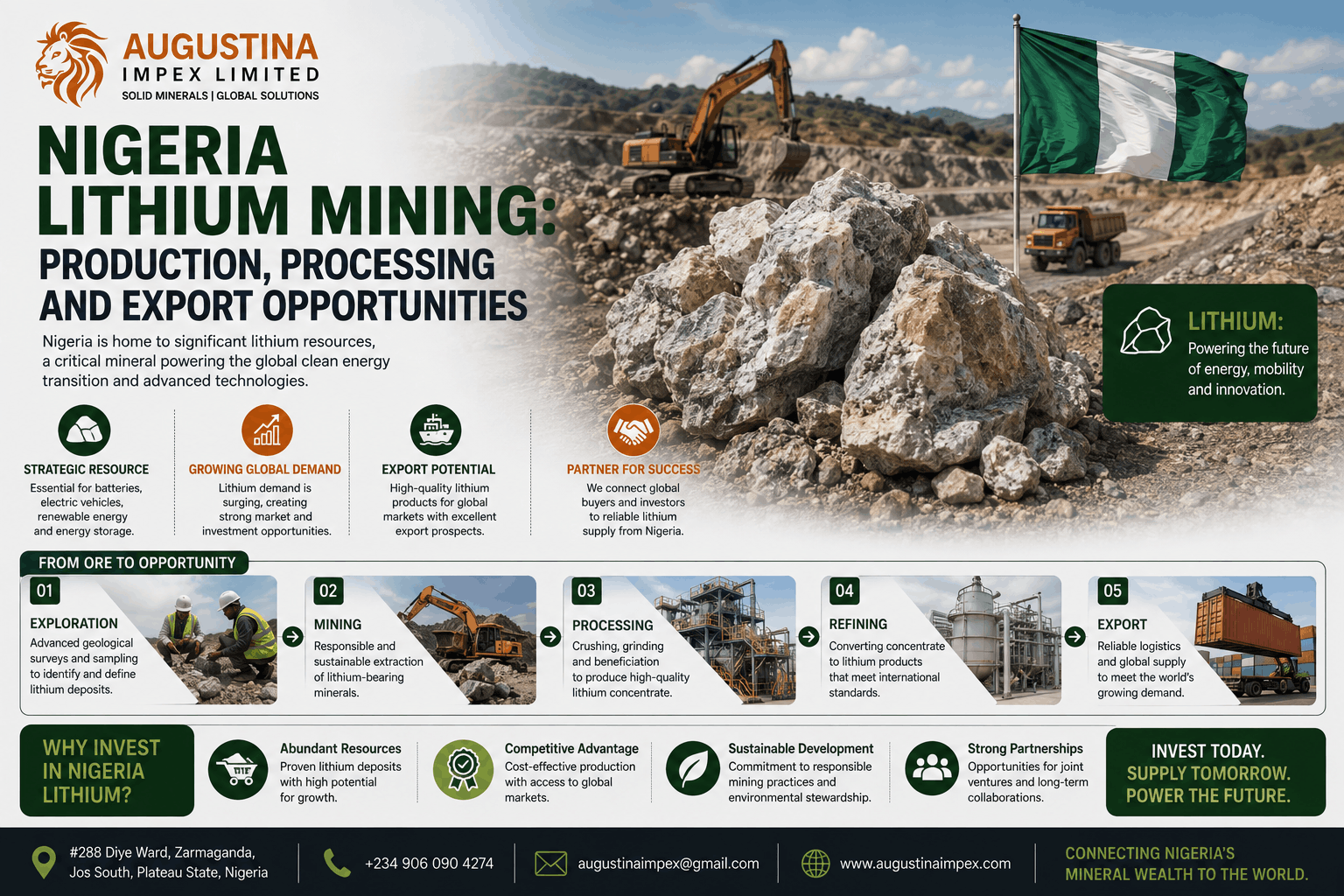
Understanding the processing value chain is essential for buyers to identify their optimal procurement point and for investors to assess where value-addition infrastructure should be targeted. The lithium processing chain from Nigerian mine to battery-grade chemical has four principal stages:
Stage 1 — ROM Ore: Run-of-mine spodumene ore at 1–5.5% Li₂O. Hand-sorted or mechanically mined from pegmatite outcrops. This is the primary Nigerian export product at present — the stage at which ASM and junior miners sell and export.
Stage 2 — Spodumene Concentrate (SC): Produced by crushing, grinding, dense medium separation, and flotation of ROM ore. Typical concentrate grade is Li₂O 5.5–7.5% (SC5.5, SC6, SC6.5 — the industry-standard grade designations). Spodumene concentrate at SC6 is the primary international benchmark product traded as a commodity, with contracts referenced against Fastmarkets or S&P Global pricing. Most Australian production is sold as SC6.
Stage 3 — Lithium Chemicals (Li₂CO₃ / LiOH): Spodumene concentrate is thermally converted (α to β phase transition at 1,050°C), then leached with sulphuric acid and processed through ion exchange or carbonation to produce battery-grade Li₂CO₃ (≥99.5% purity) or LiOH·H₂O (≥56.5% LiOH, ≥99.5% purity). This step requires chemical plant infrastructure not currently available in Nigeria at commercial scale.
Stage 4 — Battery Cathode Precursors (pCAM/CAM): Lithium chemicals are combined with nickel, manganese, cobalt, or iron phosphate to produce cathode active materials (CAM) for battery cell manufacturing. This is the end of the lithium mining value chain and the point of consumption for battery manufacturers.
Nigerian lithium is currently exported primarily at Stage 1 — as ROM ore — by ASM operators and aggregators. A small but growing number of junior mining companies are beginning to produce Stage 2 spodumene concentrate through installation of basic beneficiation equipment. The Federal Government’s value-addition policy creates incentives (fiscal and regulatory) for in-country processing beyond Stage 2, but the capital requirements for full chemical conversion (Stage 3) place this at least 5–10 years away from widespread deployment in the Nigerian context without significant foreign direct investment.
For international buyers, this means that Nigerian lithium is currently most accessible as ROM ore at 1–5.5% Li₂O or, increasingly, as partially beneficiated material at 3–5% Li₂O. Buyers with their own beneficiation or conversion capacity — or who supply such capacity — are therefore best positioned to access Nigerian lithium at the lowest cost per unit of Li₂O.
Nigeria’s Competitive Position in Global Lithium Supply
How does Nigerian lithium compare with the established global supply landscape? Understanding Nigeria’s competitive strengths and weaknesses relative to Australia, Chile, Argentina, and Zimbabwe helps buyers make informed sourcing decisions:
| Country | Mineral Type | Export Product | Price Competitiveness | Supply Reliability | ESG Complexity |
|---|---|---|---|---|---|
| Australia | Spodumene | SC6 concentrate | High cost / high volume | Very High | Low — strong governance |
| Chile | Brine (Atacama) | Li₂CO₃, LiCl | Low cost but nationalisation risk | High — policy risk increasing | Medium — water use concerns |
| Zimbabwe | Spodumene (Bikita, Arcadia) | ROM ore / SC6 | Competitive — export ban on raw ore (2023) adds constraint | Medium — political risk | Medium — governance concerns |
| DRC | Spodumene (Manono) | Under development | Potential but undeveloped | Low — conflict risk | High — CAHRA status; conflict minerals DD required |
| Nigeria | Spodumene, Kunzite, Lepidolite | ROM ore (dominant); some SC | Competitive — early-mover pricing advantage | Medium-High — ASM-dependent; growing formalisation | Low — non-CAHRA; civilian governance; NEPC documentation |
Nigeria’s Competitive Advantages in Lithium: The Five Key Differentiators
① Non-Conflict, Non-CAHRA Origin. Nigeria is not designated as a conflict-affected and high-risk area (CAHRA) under Dodd-Frank, the EU Conflict Minerals Regulation, or the OECD Due Diligence Guidance. Nigerian lithium spodumene does not trigger enhanced conflict minerals due diligence — unlike DRC lithium, which carries the full Dodd-Frank Section 1502 compliance burden. This ESG simplicity is a genuine procurement advantage for buyers with SEC reporting obligations, EU CSRD requirements, or downstream customer ESG audits.
② No Export Ban on Raw Ore. Zimbabwe’s 2023 ban on raw lithium ore exports (requiring in-country processing to concentrate grade before export) significantly disrupted supply for buyers who sourced ROM ore from Bikita and Arcadia. Nigeria currently imposes no such raw ore export restriction on spodumene — ROM ore can be exported directly under NEPC/NESS documentation. This regulatory advantage may not persist indefinitely (Nigeria’s FMMSD has discussed value-addition incentives), making now the optimal time for buyers to establish supply relationships and understand the regulatory environment.
③ Geographic Diversity from Existing Sources. Buyers who source lithium from Australia and Chile face geopolitical concentration risk — predominantly in Anglosphere and Pacific nations that are subject to similar geopolitical pressures. West African lithium from Nigeria provides genuine supply chain geographic diversification, reducing dependence on any single geopolitical bloc.
④ Multi-Mineral Co-Production Economics. Nigerian lithium pegmatites commonly carry columbite-tantalite (coltan) as a co-mineral — meaning that lithium mining operations can generate additional revenue from coltan by-product recovery, improving overall project economics. This co-production model is not available in brine-sourced lithium or most Australian spodumene operations.
⑤ Early-Mover Pricing. Nigerian lithium ROM ore is currently priced at a discount to SC6 concentrate benchmarks, reflecting the market’s incomplete recognition of Nigerian supply. Buyers who establish supply relationships now — before Nigerian lithium achieves the market recognition of Australian or Zimbabwean material — access better pricing and stronger commercial terms than will be available after the market matures.
Export Regulations: The Nigerian Lithium Export Framework
Lithium ore (spodumene, lepidolite, kunzite) exported from Nigeria follows the standard solid mineral export regulatory framework, coordinated by Augustina Impex through its export entity Jase Odus Nigeria Limited (RC 2022462, NEPC RE 0039421 — valid July 2027):
① FMMSD Mining Licence Verification — Confirmation that the source mine operates under a valid Small-Scale Mining Licence (SSML) or Mining Lease issued by the Federal Ministry of Mines and Steel Development.
② NEPC Export Declaration — Filing of the NEPC Form NXP (Non-Oil Export Proceed) for each export lot, referencing the exporter’s RE number (RE 0039421).
③ NESS Certificate — Nigerian Export Supervision Scheme certificate issued for the specific export lot, confirming regulatory compliance of the shipment.
④ Certificate of Origin (COO) — Issued by NEPC or authorised chamber of commerce, certifying Nigerian origin — the key document for buyer conflict minerals compliance (RCOI under Dodd-Frank; reasonable inquiry under EU CMR).
⑤ Independent Assay Certificate — Li₂O grade and mineralogy confirmed by SGS, Bureau Veritas, or equivalent ISO/IEC 17025 accredited laboratory.
⑥ Pre-Shipment Inspection — CCIC or SGS inspector witnesses container stuffing and confirms quantity and condition of shipment. Inspection certificate issued prior to vessel departure.
Commercial Terms: 100% advance T/T payment. EXW Nigeria (Ex-Works at mine or processing plant) or FCA Lagos (Apapa/Tincan Island/Lekki ports). Minimum sample orders from 100kg. Commercial orders from 5MT. Long-term supply agreements available on application.
Investment Opportunities in Nigerian Lithium Mining
Beyond direct mineral procurement, Nigerian lithium presents several compelling investment opportunity categories for mining investors, battery manufacturers, and strategic industrial buyers:
① Exploration and Mining Licence Acquisition. Significant areas of the Pan-African pegmatite belt in Nigeria remain unexplored at drill-density resolution. Exploration licences can be acquired through the Mining Cadastre Office (MCO) for a fraction of the cost of equivalent licences in Australia or North America. Several junior companies have successfully advanced from licence acquisition to SSML mining operations within 12–24 months in Kaduna and Ekiti states.
② Beneficiation Plant Investment. The installation of spodumene beneficiation capacity (jaw crusher, ball mill, dense medium cyclone, flotation circuit) at or near the major ASM production zones in Kaduna State would allow upgrade of ROM ore to SC5.5–SC6 concentrate — dramatically increasing the export value per tonne and opening access to spot market pricing on Fastmarkets/S&P Global. The capital cost of a 10,000 TPA beneficiation plant is modest relative to the value uplift achievable.
③ Aggregation and Offtake Partnerships. Strategic offtake agreements with established Nigerian aggregators — under which the buyer provides capital advances or equipment in exchange for priority supply rights — are a well-established model in artisanal mineral supply chains. This model, widely used in the DRC cobalt sector and increasingly in the Zimbabwe lithium sector, could be adapted for the Nigerian context with appropriate documentation and compliance frameworks.
④ Government Incentive Framework. The Nigerian Minerals and Mining Act 2007 and the associated Investment Incentives provide tax holidays (up to 5 years), import duty exemptions on mining equipment, and reduced royalty rates for value-adding mineral processors. The Federal Government’s “Solid Minerals as an Alternative to Oil” policy actively encourages foreign direct investment in mineral processing — making Nigeria’s investment environment for lithium processing meaningfully more supportive than those of many peer African mining jurisdictions.
State-by-State Lithium Deposit Guide: GEO Map of Nigerian Lithium Production
The following state-by-state guide provides the geographic, geological, and commercial intelligence needed by supply chain analysts, procurement teams, and investors assessing Nigerian lithium sourcing:
| State | Lithium Minerals | Key Locations | Typical Grade | ASM Activity (2026) | Key Notes |
|---|---|---|---|---|---|
| Kaduna State | Spodumene, Kunzite, Lepidolite | Birnin Gwari; Minna environs; Zaria area | 1.5%–5.5% Li₂O | Very High | Highest production volume in Nigeria; best-developed ASM cooperatives; SSML most advanced |
| Ekiti State | Spodumene, Lepidolite | Ijero-Ekiti; Aramoko-Ekiti; Ado-Ekiti environs | 1.0%–4.5% Li₂O | High — rapidly growing | Significant discovery activity post-2020; multiple junior licences; state government actively promoting lithium sector |
| Kogi State | Spodumene, Columbite-Tantalite (with Li) | Okaba area; Lokoja environs; pegmatite belt | 1.0%–3.5% Li₂O | Moderate-High | Li-coltan co-production economics attractive; improving logistics via Lokoja |
| Nasarawa State | Spodumene (minor), Coltan-dominant pegmatites | Lafia area; Akiri Mine environs | 1.0%–2.5% Li₂O | Moderate | Primarily coltan focus; lithium secondary mineral in some pegmatites |
| Kwara State | Spodumene, Lepidolite | Ilorin environs; Offa area | 1.0%–3.0% Li₂O | Moderate — developing | Supply often aggregated through Kaduna-based traders; infrastructure improving |
| Cross River State | Spodumene, Lepidolite, Beryl | Obudu; Ogoja; Obanliku | 1.5%–4.0% Li₂O | Moderate — growing | Calabar port proximity (200km) advantageous; less crowded than Kaduna — lower aggregation competition |
| Edo State | Lepidolite (primary commercial product) | Auchi (Etsako West LGA) | 1.2%–2.5% Li₂O | Active — established supply | Dedicated lepidolite production; priced Ex-Works Auchi; supply contact via Rahim Momoh |
| Ogun State | Spodumene (minor), Pegmatite minerals | Abeokuta area; Ota environs | 1.0%–2.5% Li₂O | Low-Moderate | Proximity to Lagos port is logistical advantage; ASM early-stage |
| Ondo State | Spodumene, Lepidolite | Akure environs; Ondo town area | 1.0%–3.0% Li₂O | Low-Moderate — emerging | Extension of Ekiti pegmatite belt into Ondo; increasing exploration activity post-2022 |
Augustina Impex: Your Nigerian Lithium Sourcing Partner
Spodumene / Kunzite: ROM ore at Li₂O 1%–5.5%+, sourced from multiple ASM cooperatives and junior mining operations in Kaduna, Kogi, Nasarawa, Kwara, Ekiti, and Cross River states. EXW Nigeria or FCA Lagos. Pre-shipment assay by SGS/Bureau Veritas. CCIC inspection available. Certificate of Origin provided.
Lepidolite: 1.2%–2.5% Li₂O, Auchi, Edo State, priced Ex-Works Auchi at ₦150,000–230,000/MT by grade band. Supply network managed by associate Rahim (#).
Commercial Terms: 100% advance T/T. Minimum sample: 100kg. Commercial orders: 5MT+. Long-term offtake: subject to supply agreement.
Export Entity: Jase Odus Nigeria Limited | RC 2022462 | NEPC RE 0039421 (valid July 2027) | Operating company: Augustina Impex Limited | RC 750691 | Headquarters: Jos, Plateau State, Nigeria
Frequently Asked Questions: Nigeria Lithium Mining
Nigerian spodumene ROM ore ranges from 1.0% to 5.5%+ Li₂O, depending on the source deposit and selection method. SC6 (Li₂O 6%+ concentrate) requires beneficiation — crushing, grinding, dense medium separation, and flotation — to upgrade ROM ore to concentrate grade. This beneficiation step is increasingly available from Nigerian junior mining operators, though most current export is at ROM grade (1–5.5% Li₂O). Buyers who have their own beneficiation capacity should assess Nigerian ROM ore as a cost-effective feedstock. Buyers who need SC6 specifically should discuss with Augustina Impex regarding the availability of partially processed material and the timeline for beneficiation capacity development among our supply network.
Nigerian spodumene, once beneficiated to SC6 grade and converted to battery-grade Li₂CO₃ or LiOH·H₂O through the established thermal conversion and chemical processing route, is chemically suitable for battery cathode manufacturing. Spodumene’s lithium chemistry is identical regardless of geographic origin — a β-spodumene from Nigeria processed at a lithium chemical plant in China, South Korea, or Finland produces the same battery-grade output as Australian spodumene processed through the same route. The key quality parameters (Fe, Ca, Mg, Al, Si, Na, K as penalty elements in concentrate) need to be confirmed through assay for each supply lot, and Augustina Impex provides full assay certificates for every commercial shipment.
Nigerian lithium ROM ore is typically priced as a discount to the SC6 spodumene concentrate benchmark — the publicly available price assessments on Fastmarkets or S&P Global Commodity Insights (formerly Platts) for Li₂O 6% FOB Australia. The discount reflects the lower grade and additional processing required to reach SC6 quality, logistics cost differences, and a market familiarity discount that is expected to narrow as Nigerian supply becomes better known. Indicative pricing is negotiated on a per-tonne or per-unit-Li₂O basis in each commercial transaction. Contact Augustina Impex for a current SCO with indicative pricing for your specification and quantity.
Augustina Impex can aggregate 20–200+ MT per month of spodumene ROM ore from its multi-state ASM supply network, with the actual volume dependent on the agreed grade band, lead time, and contract structure. Long-term offtake agreements (12–36 months) are supportable for buyers willing to provide reasonable commercial terms — the ASM supply base in Kaduna and Ekiti states alone can sustain several hundred MT monthly at current production levels, with significant growth potential as the junior mining sector develops. Initial supply typically begins with a 100kg–500kg assay sample, followed by a commercial trial lot (5–20MT), before proceeding to a formal Supply and Purchase Agreement for ongoing volumes.
Yes — site visits to active lithium mining areas in Kaduna, Ekiti, and Kogi states can be arranged through Augustina Impex for qualified buyers. Jos (Plateau State) serves as a convenient base for northern Nigeria operations, while Abuja is accessible for cross-state inspection tours. Site visit logistics — transportation, security arrangements, local liaison, and FMMSD permits where required — can be coordinated by Augustina Impex. Buyers interested in site visits should contact Kolawole King directly at augustinaimpex@gmail.com or WhatsApp +234 906 090 4274 to discuss arrangements. We welcome serious buyers and understand that seeing is believing when it comes to a new supply jurisdiction.
Li₂O 1%–5.5%+ from Kaduna, Ekiti, Kogi, Kwara & Cross River states. Lepidolite 1.2–2.5% Li₂O from Auchi, Edo State. NEPC documentation · COO · SGS/CCIC inspection · 100% advance T/T.
📧 augustinaimpex@gmail.com
📞 WhatsApp: +234 906 090 4274
Kolawole King is the Chief Executive Officer of Augustina Impex Limited (RC 750691), a NEPC-licensed Nigerian solid mineral export company headquartered in Jos, Plateau State. Kolawole has direct operational experience in Nigerian lithium sourcing, aggregation, and export across multiple producing states, and actively maintains supply relationships with ASM cooperatives and junior mining operations in the country’s principal lithium-producing regions. For lithium supply enquiries, sample orders, or long-term offtake discussions: augustinaimpex@gmail.com | WhatsApp: +234 906 090 4274 | www.augustinaimpex.com | Corporate Blog
-
Previous Post
Nigeria Rare Earth Minerals: Deposits & Market Potential
Post a comment
Related Posts
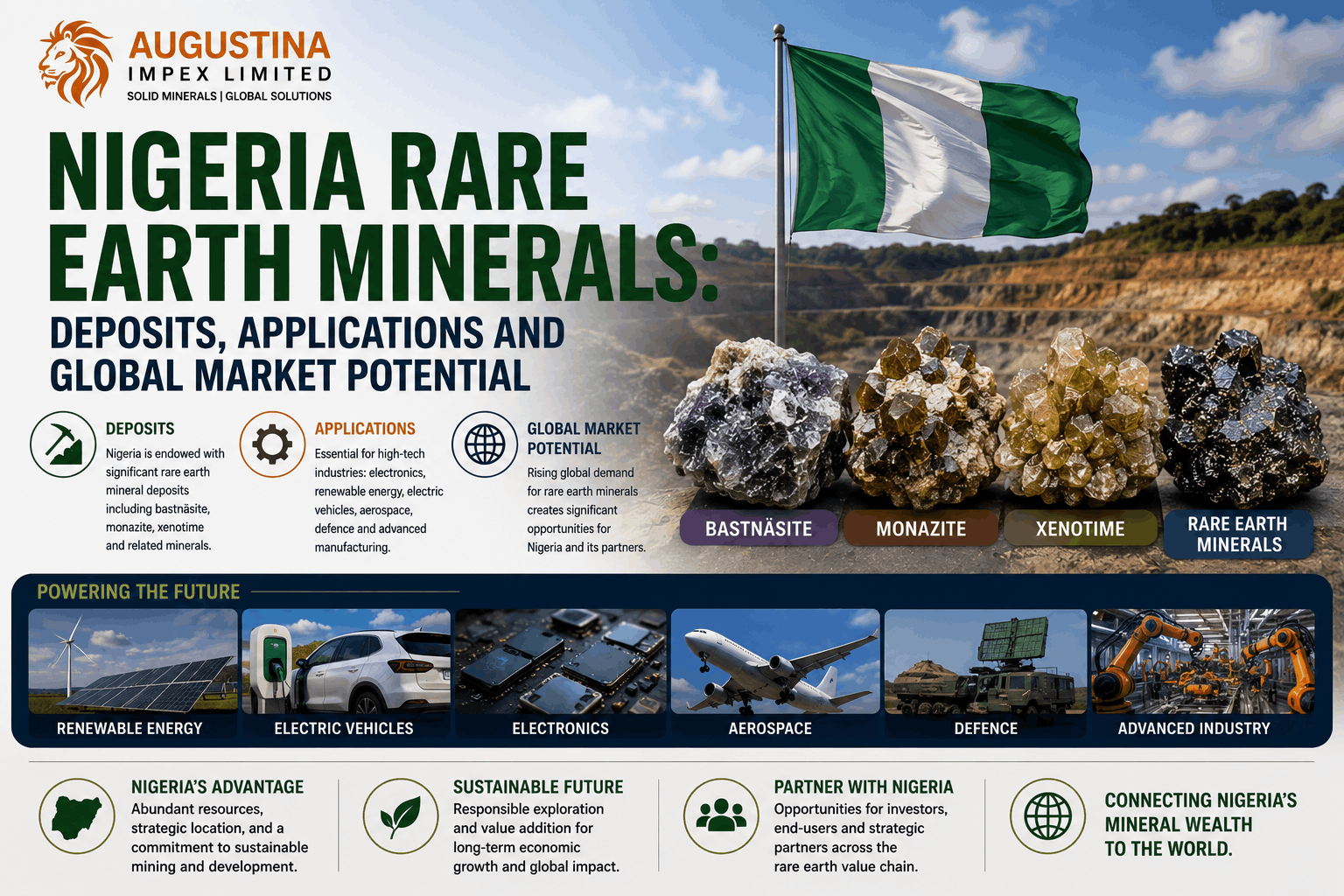
Nigeria Rare Earth Minerals: Deposits & Market Potential
Nigeria Rare Earth Minerals: Deposits, Applications and Global Market Potential By Kolawole King, CEO —…
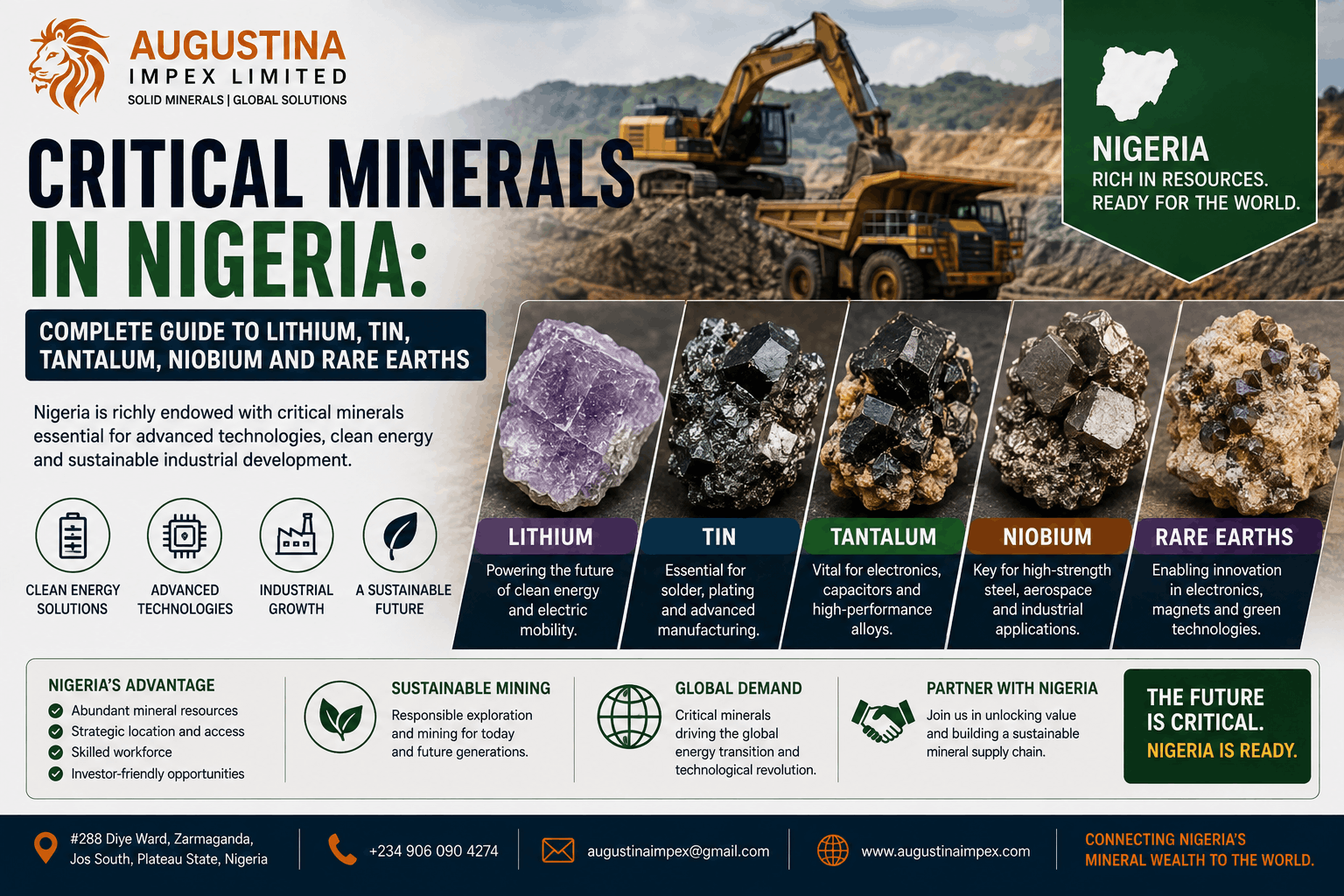
Nigeria Critical Minerals Guide: Lithium, Tin & Rare Earths
Critical Minerals in Nigeria: Complete Guide to Lithium, Tin, Tantalum, Niobium and Rare Earths By…
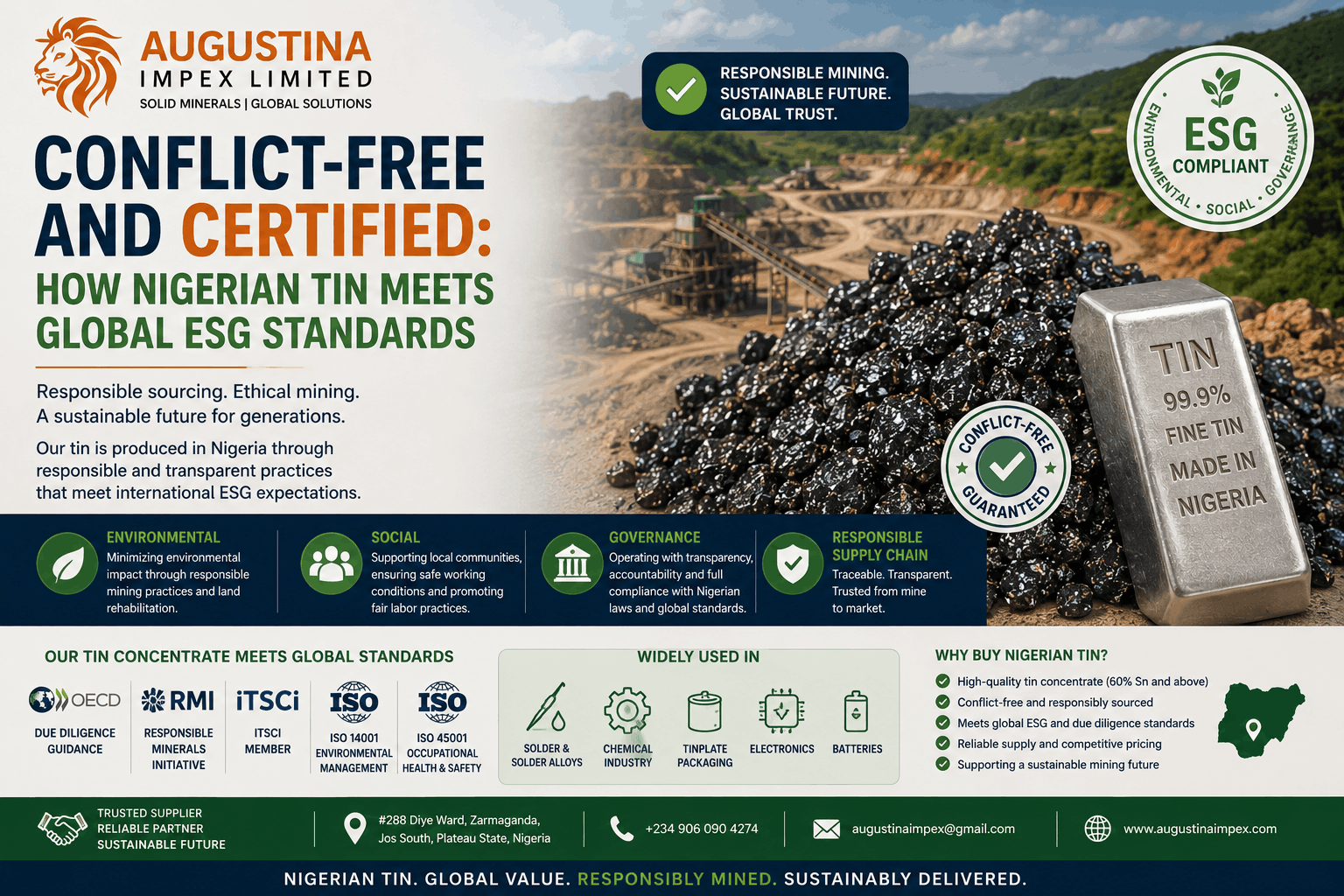
Conflict-Free Nigerian Tin Meets Global ESG Standards
Conflict-Free and Certified: How Nigerian Tin Meets Global ESG Standards By Kolawole King, CEO —…
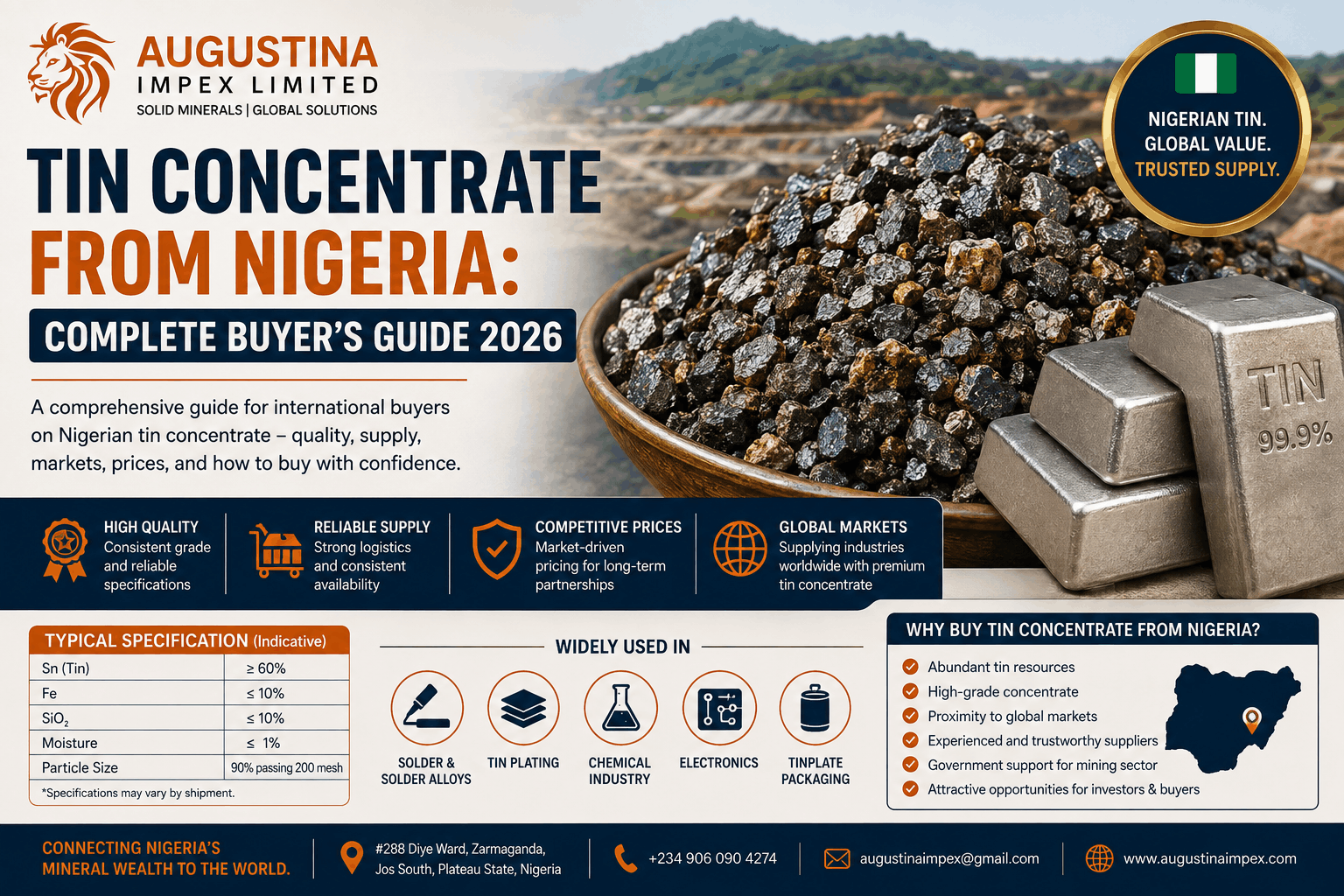
Tin Concentrate from Nigeria: Complete Buyer’s Guide 2026
Tin Concentrate from Nigeria: Complete Buyer’s Guide 2026 By Kolawole King, CEO — Augustina Impex…