
LME Tin Pricing Explained: How We Calculate Prices for Nigerian Cassiterite
By Kolawole King, Chief Executive Officer — Augustina Impex Limited | Jos, Plateau State, Nigeria
If you have ever sent an enquiry for Nigerian tin concentrate and received a price that references
the LME — and wondered exactly what that means and how the final number is arrived at —
this article is written specifically for you. At Augustina Impex Limited, transparency
is one of our core values. We believe that every buyer deserves to understand not just the price
they are being quoted, but the logic, the methodology, and the industry conventions that sit behind it.
In this guide, we walk you through the London Metal Exchange (LME) tin pricing mechanism,
explain exactly how it translates into a commercial price for Nigerian cassiterite (tin concentrate),
break down the industry-standard payability and grade formula we use, and tell you what factors
can move your price up or down. Whether you are a first-time buyer of Nigerian minerals or an
experienced commodity trader, this is the most complete explanation of tin concentrate pricing
from a Nigerian supplier that you will find online.
What Is the London Metal Exchange (LME)?
The London Metal Exchange — commonly abbreviated as the LME — is the
world's oldest and most prestigious metals trading exchange. Founded in 1877 and headquartered
in London, United Kingdom, it serves as the global benchmark price-setting institution for most
major non-ferrous metals, including aluminium, copper, zinc, lead, nickel — and crucially
for our purposes — tin.
The LME operates a system of futures contracts, forwards, and options. But when commodity buyers
and sellers refer to “the LME price,” they are almost always talking about one specific
figure: the LME Official Cash Settlement Price, published each business day.
This price represents what it costs to buy or sell one metric ton of refined tin metal for
immediate (cash) settlement — in other words, delivery within two business days.
The LME tin price is expressed in US Dollars per metric ton (USD/MT) and is
universally accepted as the standard reference price in international tin trade — from
concentrate sellers in Nigeria and Indonesia to smelters in China, Malaysia, and Europe.
Why does the LME price matter so much? Because the global tin market — like most metals
markets — is not a fixed-price market. The price of tin changes every single trading day
in response to global supply and demand dynamics, macroeconomic conditions, currency movements,
and geopolitical events. The LME gives all participants in the value chain a single, universally
agreed reference point that everyone can independently verify.
What Is Cassiterite? Understanding Nigerian Tin Concentrate
Before we go further into pricing, it is worth establishing exactly what product we are pricing.
Cassiterite is the primary ore mineral of tin. Its chemical formula is SnO₂
(tin dioxide), and it is the world's most important source of commercial tin metal.
When cassiterite ore is extracted from the ground — whether by alluvial washing in a riverbed,
open-pit mining, or hard-rock drilling — it does not come out as pure tin metal. It comes out
mixed with silica, clay, iron oxides, and other minerals. This raw material is called
run-of-mine (ROM) ore, and it may contain only 0.1% to 2% tin by weight.
To make this economically exportable and valuable to smelters, the ROM ore is put through a process
called beneficiation — a series of physical separation processes (crushing,
washing, gravity concentration, magnetic separation) that progressively removes gangue minerals and
concentrates the cassiterite particles. The end product is called tin concentrate.
At Augustina Impex Limited, working with our processing partner Saso Mines Nigeria
Limited in Jos, Plateau State, we supply tin concentrate with a
minimum tin (Sn) content of 70% by dry weight — the internationally
recognised benchmark grade for high-quality tin concentrate, and the grade on which our pricing
formula is based.
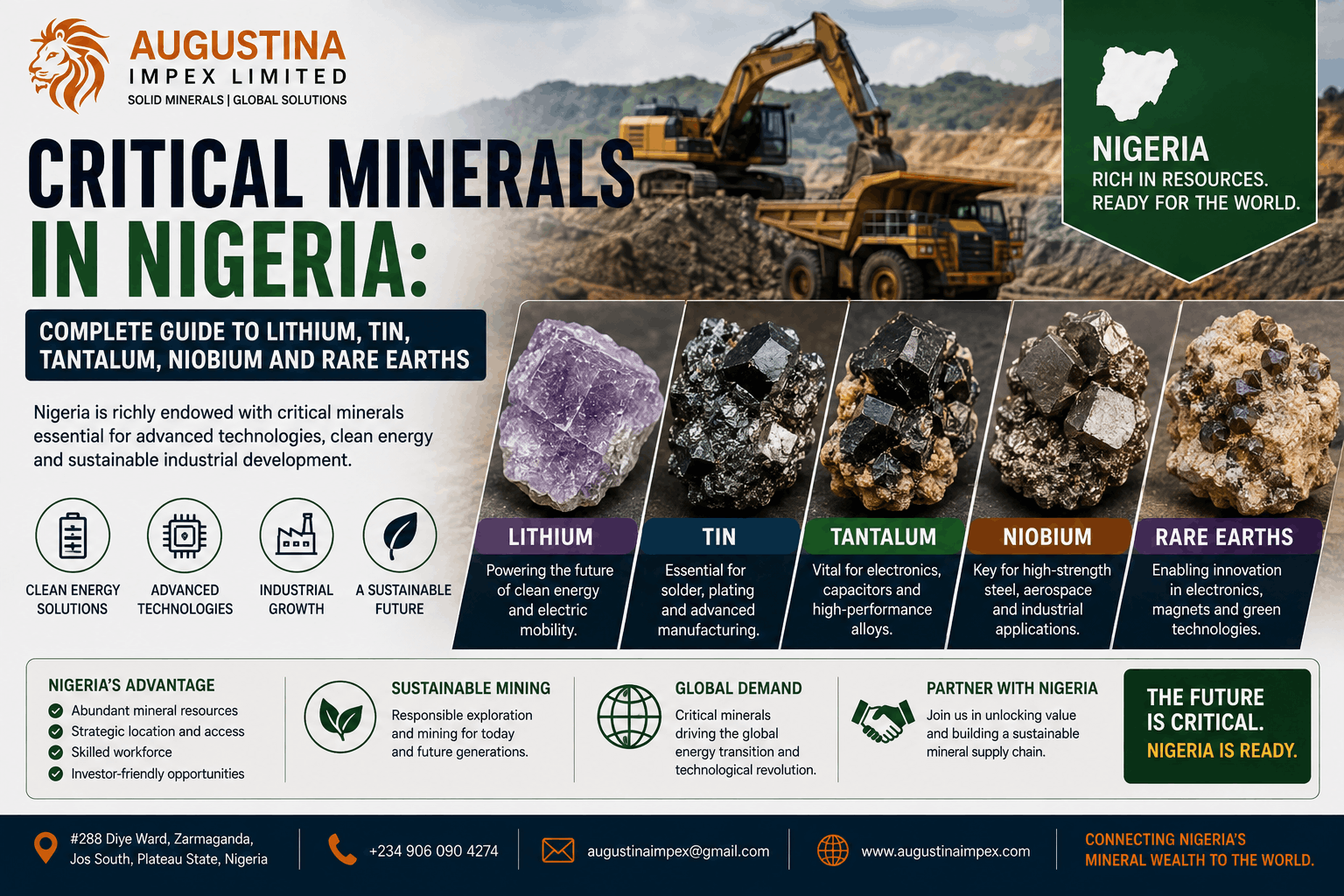
Nigerian cassiterite — particularly from the Jos Plateau tin belt in
Plateau State and the alluvial deposits of Nassarawa State — is widely
regarded in the global market for its relatively clean mineralogy. It is low in deleterious
elements such as bismuth, arsenic, and lead that are common in concentrates from other origins,
which translates directly into better payability terms from smelters.
The LME Tin Pricing Formula for Concentrates
Here is the most important thing to understand about pricing tin concentrate: you are
not buying tin metal. You are buying tin in the form of a concentrate —
a material that still needs to go through smelting and refining before it becomes finished tin
metal. That distinction is critical to understanding why the concentrate price is not the same
as the LME metal price.
The universally accepted industry approach is to price tin concentrate as a percentage of the
LME metal price, adjusted for the tin grade of the concentrate. The formula has two components:
- Payability Factor — the percentage of the tin value that the buyer pays,
after deducting smelting, refining, and treatment costs. - Grade Factor — the actual Sn content of the concentrate as a percentage
of the whole.
Industry Standard Formula:
Concentrate Price (USD/MT) = LME Cash Price (USD/MT) × Payability% × Sn Grade%
Augustina Impex Standard Formula:
Price = LME USD × 94% × 70%
Component 1: The LME Cash Price
This is the LME Official Cash Settlement Price for Tin on the date agreed between buyer and seller.
The specific date — or range of dates — used for pricing is called the
Quotational Period (QP), and it is agreed in the Sales and Purchase Agreement (SPA)
before the shipment takes place. We are flexible and work with our buyers to agree a QP that suits
both parties.
Component 2: The Payability Factor (94%)
Payability is the percentage of the contained tin value that the buyer agrees to pay for. The
remaining percentage — in our case 6% — represents the buyer's margin for smelting
costs, refining losses, and treatment charges (TC/RC). In the global tin concentrate market,
payability typically ranges from 88% to 95%, depending on concentrate grade,
impurity levels, and market conditions.
At 94% payability, our offer is highly competitive and reflects the clean
mineralogy of Nigerian cassiterite from Plateau and Nassarawa States — specifically, its
low levels of penalty elements such as bismuth and arsenic.
Component 3: The Sn Grade Factor (70%)
This is the tin content of the concentrate, expressed as a percentage. Our concentrates contain
a minimum of 70% Sn by dry weight — the standard high-grade benchmark for
international tin concentrate trade. If the actual assayed Sn content comes back higher than 70%,
the price is recalculated on the actual assayed grade. You pay for exactly what is in the bag.
Step-by-Step Price Calculation: A Real-World Example
Let us run through a complete calculation using real reference figures:
- LME Official Cash Settlement Price for Tin: USD 50,553.00 / MT
- Agreed Payability: 94%
- Actual Assayed Sn Grade: 70%
  USD 50,553.00  ×  94%  ×  70%
  = USD 50,553.00  ×  0.94  ×  0.70
  = USD 50,553.00  ×  0.658
  = USD 33,263.87 per metric ton of tin concentrate
Applied to shipment quantities:
- Trial Shipment (25 MT): 25 × USD 33,263.87 = USD 831,596.75
- Full Contract (500 MT): 500 × USD 33,263.87 = USD 16,631,935.00 (indicative)
These figures are indicative and will be recalculated at the actual LME price on the agreed
Quotational Period date. Since the LME price moves daily, the final settlement price will reflect
the market on the day(s) agreed in your SPA.
Quality Parameters That Affect Your Final Price
Grade and payability are the two primary drivers of price, but they are not the only ones.
The following quality parameters determine whether you receive the standard price or whether
penalties (deductions) apply:
1. Tin (Sn) Content — the Grade
Our minimum declaration is 70% Sn. If the third-party assay reveals a higher grade, the price
is adjusted upward proportionally. If it reveals a grade below the declared minimum, the shipment
may be subject to renegotiation or rejection, depending on your SPA terms.
2. Moisture Content
Price is calculated on a dry metric ton (DMT) basis. Our concentrates are dried
to a maximum of 5% moisture before shipping. The moisture content is deducted from the gross weight
to arrive at the dry weight on which the price is calculated.
3. Lead (Pb) — Penalty Element
If Pb exceeds the threshold agreed in the SPA (commonly 0.10%), a penalty deduction per unit
of Pb above threshold is applied. Nigerian cassiterite from Jos Plateau and Nassarawa is generally
low in lead — a significant commercial advantage.
4. Arsenic (As) — Penalty Element
High-arsenic concentrates create processing challenges and environmental liability for smelters.
A deduction per unit above the agreed maximum applies. Nigerian cassiterite is typically low in
arsenic compared with competing origins.
5. Bismuth (Bi) — Penalty Element
Bismuth is one of the most penalised elements in tin concentrates because it is notoriously
difficult to remove during refining and can downgrade finished tin metal quality. Our concentrates
carry commercially acceptable Bi levels.
Quick-Reference Quality Table
| Parameter | Our Specification | Penalty Threshold | Status for Nigerian Cassiterite |
|---|---|---|---|
| Tin (Sn) | Min 70% | Bonus above 70% | Excellent — meets benchmark |
| Moisture | Max 5% | Weight deduction above 5% | Controlled through plant drying |
| Lead (Pb) | Max 0.10% | Deduction per 0.01% above | Generally low — competitive |
| Arsenic (As) | Max 0.10% | Deduction per 0.01% above | Generally low — competitive |
| Bismuth (Bi) | Max 0.05% | Deduction per 0.01% above | Low — advantage vs. other origins |
LME Spot Price vs. 3-Month Forward Price: Which One Do We Use?
The LME publishes several different prices for tin each day. Here is what each one means:
- LME Cash (Spot) Settlement Price: The price for delivery within two business
days. This is the most commonly used reference in concentrate contracts — and the one
Augustina Impex uses as the default reference. - LME 3-Month Price: The forward price for delivery three months from today.
Used more in financial hedging and futures trading. - LME Monthly Average: The average of all daily Cash prices during a calendar
month — often used as the Quotational Period basis in concentrate sales contracts.
Our standard SPA terms reference the LME Official Cash Settlement Price on the
Bill of Lading date, or the average of LME Cash prices during the month of shipment —
whichever is agreed with the buyer. This is the most transparent and widely accepted convention
in West African tin concentrate trade.
The Quotational Period (QP): When Is the Price Fixed?
The Quotational Period is the time window during which the LME price is observed to determine
the final settlement price. Common QP arrangements include:
- Bill of Lading (BL) date: Price set on the single day the shipment departs
port — simple and unambiguous. - Month of shipment average: Price averaged across all LME trading days in
the shipping month — reduces the risk of a single bad price day. - Month of arrival average: Price averaged during the month the cargo arrives
at the buyer's facility — favoured by buyers who hedge on arrival. - Split QP: Part of the price fixed on shipment, part on arrival —
shares the price risk between both parties.
We discuss and agree the QP with each buyer during SPA negotiation. There is no single
“correct” choice — it depends on each party's hedging position and risk appetite.
The Role of SGS and Intertek: Independent Assay and Price Determination
In international commodity trade, the final price settlement is not based on what the seller
claims the assay is, or what the buyer's laboratory says. It is based on the results of an
independent, internationally accredited third-party inspection.
For all our shipments, we coordinate inspection and sampling by SGS Nigeria or
Intertek Nigeria — the world's two most respected commodity inspection
companies. These inspectors attend the loading, witness the sampling of the concentrate from the bags
or stockpile, prepare a representative sample, and submit it to an accredited analytical laboratory.
The resulting Certificate of Analysis (CoA) is the definitive document on which
the commercial price is settled.
If the buyer's own laboratory produces a result materially different from the SGS/Intertek CoA
(typically, more than 1% Sn different), either party can invoke the umpire assay
process — appointing a mutually agreed third laboratory to re-assay the retained reference
sample. The umpire result is final and binding on both parties. We welcome buyer inspection and
encourage buyers to appoint their own surveyor to attend loading alongside ours.
Why Nigerian Cassiterite Is Competitively Priced in the Global Market
With tin concentrate sourced globally from Indonesia, China, Peru, Bolivia, the DRC, and Myanmar,
the question that matters to any serious buyer is: why Nigeria? The pricing formula gives part of
the answer. Here is the full commercial picture:
1. Clean Mineralogy, Better Effective Payability
Nigerian cassiterite from Plateau and Nassarawa States carries lower levels of penalty elements
than most competing origins. This translates into a higher effective payability — meaning
you pay less in penalty deductions and receive more value per tonne than a headline payability
figure might suggest.
2. Non-Conflict Origin with Full Documentation
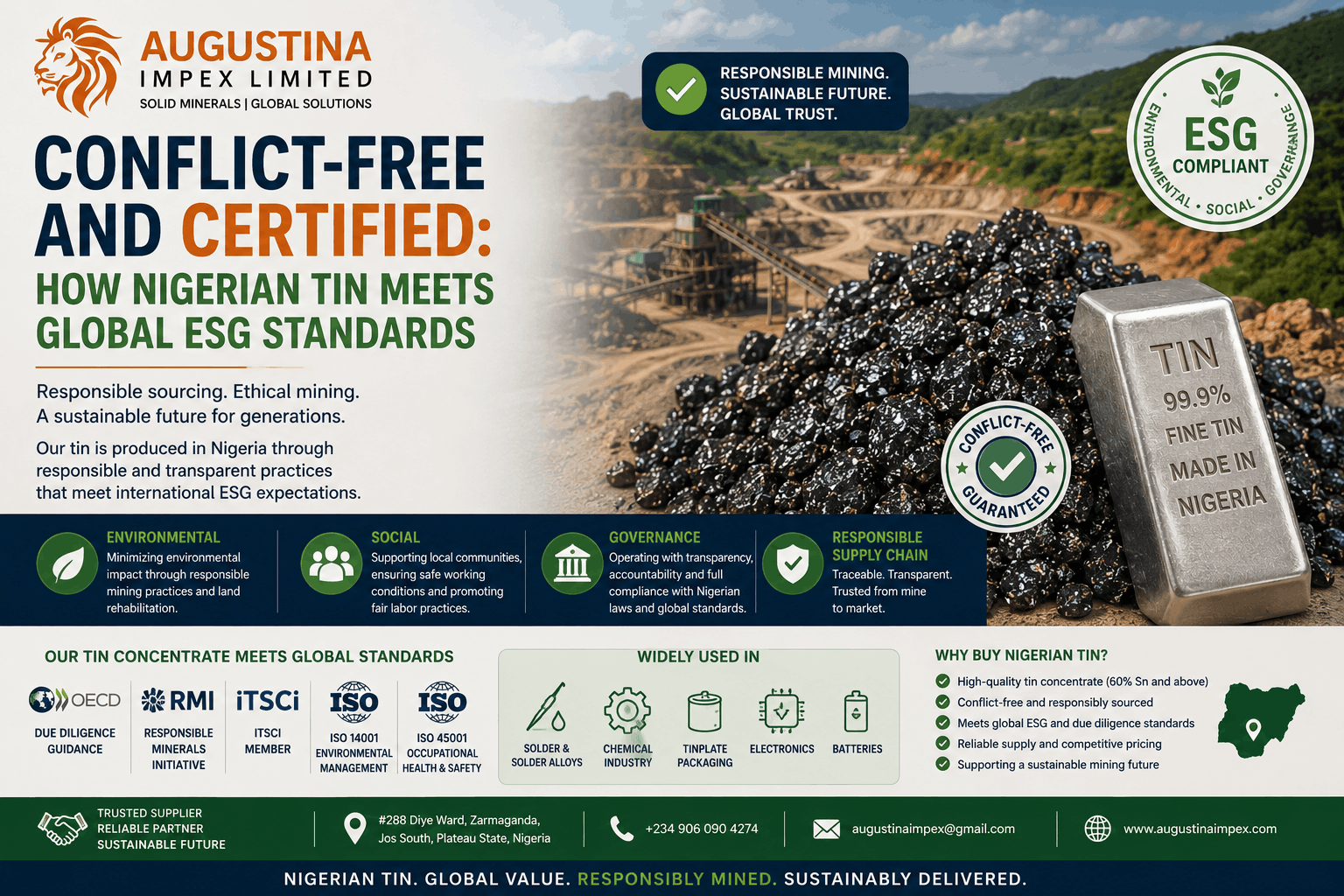
Nigerian tin from licensed operators in the Plateau and Nassarawa belt is non-conflict. We provide
full NEPC export certificates, SON certificates of conformity, and can support ITSCI traceability
where your supply chain due diligence framework requires it. For buyers subject to the EU Conflict
Minerals Regulation or the US Dodd-Frank Act, Nigerian tin from our supply chain is fully defensible.
3. Consistent Supply Through a Formalised Supply Chain
Working with Saso Mines Nigeria Limited's processing plant in Jos, we offer a documented supply
chain from mine through beneficiation to bagging and export. This consistency of supply and
documentation is a material advantage for buyers with ESG reporting obligations and repeat
off-take requirements.
4. Full Nigerian Export Regulatory Compliance
Every shipment departs under full compliance with Nigerian export regulations: NEPC Export
Certificate, SON Certificate of Conformity, Form NXP (Central Bank of Nigeria), NESS levy
clearance, and all standard shipping documentation. Buyers face zero compliance or customs risk
purchasing from Augustina Impex Limited.
How Augustina Impex Structures Pricing for Buyers
Here is our end-to-end commercial process, from enquiry to final price settlement:
- Initial Enquiry & SCO: You contact us; we issue a Soft Corporate Offer
(SCO) with our indicative price formula and terms, valid for 15 banking days. - LOI / Acceptance: You issue a Letter of Intent (LOI); we issue a Full
Corporate Offer (FCO) signed by our authorised producer. - SPA Execution: Both parties sign a Sales and Purchase Agreement defining
the Quotational Period, payment terms, delivery terms, and quality specifications. - Advance Payment (20%): Buyer remits a 20% advance on SPA execution to
mobilise the shipment. - Loading & Inspection: SGS or Intertek attends loading; Certificate of
Analysis (CoA) issued within 5–7 working days of sampling. - Balance Payment & Price Settlement: Final price is calculated based on
CoA results and the LME price on the agreed QP date; balance is paid per SPA terms. - Shipping Documentation: Full documents released on receipt of balance
payment — Bill of Lading, Certificate of Origin, NEPC Certificate, CoA, SGS/Intertek
report, packing list, and commercial invoice.
Frequently Asked Questions
What is the current LME tin price?
The LME tin cash settlement price fluctuates daily. As of our most recent reference date, the
LME Official Cash Settlement Price for Tin stood at approximately USD 50,553 per metric
ton. Buyers should always check lme.com
or contact us directly for the latest indicative price.
How is the price of Nigerian cassiterite calculated?
Nigerian cassiterite is priced using: LME Cash Price × Payability% × Sn Grade%.
Our formula is LME USD × 94% × 70%, yielding approximately
USD 33,263.87 per metric ton at current LME levels. The exact price is set on
the agreed Quotational Period date in the Sales and Purchase Agreement.
What grade of tin concentrate does Augustina Impex supply?
We supply tin concentrate with a minimum Sn content of 70% by dry weight, sourced
from licensed mining and beneficiation operations in Plateau State and Nassarawa State, Nigeria.
Third-party assay by SGS or Intertek confirms grade on every shipment.
What is payability in tin concentrate trading?
Payability is the percentage of the contained metal value that the buyer pays to the seller, after
deducting smelting costs, refining losses, and treatment charges. For tin concentrates, payability
typically ranges from 88% to 95%. Augustina Impex offers 94% payability
— among the most competitive in West Africa.
Is Nigerian tin conflict-free and ESG-compliant?
Yes. Nigerian tin from licensed operators in Plateau and Nassarawa States is sourced from non-conflict,
commercially developed mining zones. We provide full NEPC export documentation on every shipment
and can support ITSCI traceability certification where required by buyers' ESG or due diligence
frameworks. Our supply chain is defensible under both the EU Conflict Minerals Regulation and the
US Dodd-Frank Act Section 1502.
What is the minimum order quantity?
Our minimum order for a trial shipment is 25 metric tons (MT). Full contract
quantities are structured at 500 MT per contract cycle over a 6-month period.
We do not typically offer quantities below 25 MT due to the logistics and documentation cost
structure of Nigerian mineral exports.
How do I request a price quote?
Since the LME price changes daily, we do not publish a fixed price online. To receive a current
indicative price and our formal Soft Corporate Offer (SCO), email us at
augustinaimpex@gmail.com or WhatsApp us on
+234 906 090 4274. We respond to all serious enquiries
within one business day.
Conclusion: Transparent Pricing Is the Foundation of Trust
The LME tin pricing formula is not a mystery. It is a well-established, internationally standardised
methodology that has governed global tin concentrate trade for decades. At Augustina Impex Limited,
we apply this formula openly — explaining every component, welcoming third-party inspection,
and publishing our formula so that our buyers always know exactly what they are paying for and why.
Nigerian cassiterite from Plateau State and Nassarawa State is a premium product: high grade, low in
penalty elements, fully documented, and sourced from a non-conflict origin in a country that is
rapidly formalising and scaling its solid minerals export sector. The combination of a clean product
and a transparent pricing methodology makes Augustina Impex a partner that serious international
buyers can build a long-term supply relationship with.
If you are ready to receive a current indicative price and our formal Soft Corporate Offer,
we would love to hear from you. Reach out today — we respond within one business day.
Augustina Impex Limited
📧 augustinaimpex@gmail.com
📱 WhatsApp: +234 906 090 4274
🌐 www.augustinaimpex.com
📍 #288 Diye Ward, Zarmaganda, Jos South, Plateau State, Nigeria