
Nigerian Lithium Ore Miner: The People, Communities, and Craft Behind Nigeria’s Lithium Industry
Before the lithium in your electric vehicle battery was a cathode, before it was lithium carbonate, before it was a spodumene concentrate in a sealed container on a cargo vessel, it was ore in the ground. And before it was ore in the ground, it was invisible — geology waiting for someone who knew how to find it, knew how to read the rock, knew which crystals to break out and which to leave behind. In Nigeria, that someone is the Nigerian lithium ore miner. Not a corporation, not an algorithm, not a machine — a person. Often a man who learnt to read pegmatite rock from his father, who learnt it from his father before him, who has been working the mineral fields of the Jos Plateau or the Taraba highlands or the hills of Edo State for more years than most energy analysts have been discussing the lithium transition.
This article tells the story of the Nigerian lithium ore miner — who they are, how they work, where they operate, what drives their commercial decisions, what challenges they face every day, and how the commercial relationship between Nigerian miners and international lithium buyers actually functions in practice. It is written from the ground up, informed by direct field experience, and it makes no attempt to present a sanitised version of a mining sector that is raw, skilled, economically vital, and in the middle of a rapid and sometimes chaotic transformation driven by the global energy transition.
Understanding the Nigerian lithium ore miner is not just a matter of commercial intelligence — though it is that too, and buyers who understand the production base they are sourcing from make better commercial decisions. It is also a matter of respect. The men and communities who are digging Nigeria’s lithium out of the ground by hand, with hammers and chisels and shovels in the tropical heat and rain, are the foundation of the entire Nigerian lithium supply chain. Every export shipment, every supply contract, every buyer relationship that Augustina Impex has built rests on the productive capacity and the accumulated knowledge of Nigeria’s mining communities. That foundation deserves to be understood, honestly and in depth.
Who Is the Nigerian Lithium Ore Miner? — A Human Portrait
The Nigerian lithium ore miner does not fit a single demographic profile. The sector encompasses a wide range of actors — from the young man who started mining last year when a neighbour told him about lithium prices, to the veteran miner who has spent thirty years on the Jos Plateau producing cassiterite and columbite and has now added spodumene to his commercial repertoire, to the community chief who organises collective mining effort on land his family has farmed and mined for generations, to the small entrepreneur who has invested in a secondhand excavator and a group of salaried workers and operates as a de facto small mining company. What they share is the specific knowledge of how to find, identify, and extract lithium-bearing minerals from the rock formations of their home region — knowledge that is place-specific, experience-derived, and not easily replicable by outsiders.
① The Individual Artisanal Miner (Sole Operator): Works alone or with one or two family members. Uses hand tools — pick axes, hammers, chisels, crowbars, shovels, and buckets. Selects his mining site based on visible pegmatite outcrops or known mineral occurrences communicated through community knowledge networks. Produces 0.5–5 MT of sorted ore per week depending on the richness of the site. Sells directly to local aggregator representatives or at weekly mineral market gatherings. Income is entirely irregular, rising and falling with production and market prices.
② The Mining Team Leader (Gang Boss): Organises a group of 5–20 individual miners who work a shared pit or series of outcrop faces collectively. Negotiates access with the landowner or community authority, manages the division of labour within the team, handles commercial sales to aggregators, and distributes payments to team members. The gang boss is often the most commercially experienced member of the group and serves as the primary commercial interlocutor between the mining team and outside buyers or aggregators. Produces 5–30 MT of sorted ore per week.
③ The Mine Owner Representative: A land or mine licence owner who provides access rights and financial capital in exchange for a share of production revenue, often without being physically present at the mine. The mine owner representative coordinates between the land owner, the active mining crews, and the aggregators or export companies buying the ore. This role is common in areas where the valuable pegmatite land has become legally contested or where SSML licences have been granted to individuals who prefer to operate through hired miners rather than working themselves.
④ The SSML Operator (Small-Scale Licensed Miner): Holds a Small-Scale Mining Licence (SSML) issued by the Federal Ministry of Mines and Steel Development, granting the formal legal right to mine on a defined area using small-scale mechanised equipment. SSML operators are the most commercially formalised tier of the artisanal sector — they can enter supply contracts, provide documentation of mining licence status to export companies, and access financing from the Solid Minerals Development Fund. Their production is more consistent in volume and grade than pure artisanal operations. Produces 20–200 MT per week from mechanised operations.
The Mining Communities — Where Nigerian Lithium Miners Live and Work
Nigerian lithium ore mining is not an abstract sector statistic — it is lived in specific communities, specific landscapes, specific cultural contexts. The following geographic guide to Nigeria’s principal lithium mining communities is written from field-level understanding, not desk research, and provides the kind of place-specific detail that illuminates what “sourcing Nigerian lithium” actually means in human and geographic terms.
① Jos, Plateau State — The Heart of Nigerian Mining Culture: The city of Jos and its surroundings — Jos South, Jos North, Bassa LGA — sit in the middle of the Jos–Bukuru Pegmatite Field, the most productive mineral zone in Nigerian history. Mining is not a new activity here — it is a generational tradition that has defined the economic and social character of the Plateau for over a century. The mining community in Jos is diverse: Berom, Anaguta, Afizere, and other Plateau indigenous communities who have worked the land since before colonial mining began; Hausa traders and mineral merchants who arrived during the colonial tin boom and stayed; and more recently, young men from across Nigeria’s north who have migrated to the Plateau following lithium’s price rise and the opportunity it represents. The Jos mineral market — where ore is physically traded in sacks and buckets at prices negotiated in Hausa, Berom, and English — is the commercial centre of northern Nigeria’s ASM mineral trade.
② Nasarawa–Eggon, Nasarawa State — The Agricultural Mining Belt: The communities of Nasarawa–Eggon LGA are predominantly farming communities — Eggon, Mada, and other agricultural peoples who have integrated seasonal mineral extraction into their livelihood strategies. Mining activity here is more seasonal than in Jos — intensifying in the dry season when farm labour demands are lower and road access to mine sites is better. Lithium mining in Nasarawa–Eggon is typically organised around community-level arrangements in which a local leader negotiates collective access to mineral-bearing land and organises community members into mining teams during the dry season mineral rush.
③ Mambilla Plateau, Taraba State — Nigeria’s Most Remote Mining Frontier: The Mambilla Plateau is perhaps the most dramatically beautiful and most logistically challenging of Nigeria’s lithium mining environments. At over 1,600m elevation, with cooler temperatures, frequent mist, and a distinctive highland ecology, Mambilla has more in common with East African highland farming communities than with the semi-arid Jos Plateau. Fulani pastoralists, Mambilla farmers, and migrant miners from other states co-exist in a tense but commercially productive relationship with the mineral wealth beneath the plateau’s surface. Lithium mining here is at an earlier commercial stage than Plateau State — communication and trust-building with Mambilla mining communities requires patience, cultural sensitivity, and established relationships that Augustina Impex has developed through consistent field presence.
④ Auchi, Edo State — Nigeria’s Lepidolite Community: The Auchi area of Etsako West LGA is the hub of Nigeria’s lepidolite production. Auchi is a predominantly Etsako community with a strong commercial tradition — the town is known for trade and business across Edo State. The lepidolite mining community in Auchi has developed a relatively organised small-scale mining ecosystem, with local aggregators coordinating between the individual miners who work the pegmatite outcrops in the surrounding hills and the larger-volume buyers and export companies. Augustina Impex’s associate supplier Rahim Momoh (Rahimmomoh1234@gmail.com) is a central figure in the Auchi lepidolite supply network — managing day-to-day aggregation and quality sorting in the local field, and providing a reliable supply bridge to the Augustina Impex export platform.
A Day in the Life — The Nigerian Lithium Miner at Work
The following is a composite portrait of a typical working day for an artisanal spodumene miner in the Jos Plateau field — drawn from field observations and representative of the experience of the many individual miners who form the productive base of Augustina Impex’s supply network. It is a humanised account written to give international buyers and investors an honest, vivid understanding of the supply chain reality they are engaging with when they source Nigerian lithium ore.
The day begins before six in the morning. By the time the sun clears the eastern hills of the Jos Plateau, the miner has already eaten — typically a meal of akamu (corn porridge) or waina (rice pancakes) — and is walking the thirty to ninety minutes from his home in the surrounding villages to the mine site. He carries his tools on his shoulder or in a wheelbarrow: a pick axe, two or three flat steel chisels of different widths, a sledgehammer, a crowbar, a short-handled hoe, a bucket, and a supply of rice sacks. The walk to the site is familiar — he has done it hundreds or thousands of times.
At the mine site — an open cut or series of open cuts in the residual soil and weathered rock above a productive pegmatite body — he assesses the morning. If there has been rain, the shallow workings may have pooled water that must be scooped out or allowed to drain before work can proceed. If it is dry season, the site is dusty and the weathered pegmatite crumbles readily under the pick. He selects his working area — a fresh face in the weathered zone where he can see the characteristic pale green or lilac glint of spodumene crystals in the rock — and begins.
The work is physical and skilled simultaneously. Not every strike of the pick is the same — the miner is reading the rock as he works, following the spodumene-rich bands in the pegmatite, breaking out the crystal-rich material and sorting it into a separate pile from the barren quartz-feldspar gangue. The sorting judgment is rapid and intuitive — a lifetime of experience compressed into a half-second glance at each fragment of rock before it is assigned to the ore pile or the waste pile. By midday, the ore pile might hold 200–400 kg of sorted, visually assessed high-grade spodumene material. The miner breaks for water and food — typically brought to the site from home or purchased from the young women who sell cooked food, water, and soft drinks to mining communities across the Plateau.
The afternoon continues. By four or five o’clock, the light begins to soften and the miner bags his day’s production into rice sacks, labels or marks them as his, and either stores them on-site or moves them to a roadside collection point where the aggregator’s truck or representative will weigh and price them. The transaction is often informal — a handshake price based on visual assessment of the sack’s content and the day’s market price — but within a community where reputation and ongoing commercial relationships matter enormously, the informality is underpinned by strong social accountability. A miner who misrepresents his ore’s grade will find it harder to sell the next batch and will be excluded from the most reliable commercial networks.
Tools and Techniques — The Craft Knowledge of the Nigerian Lithium Miner
The tools of the Nigerian artisanal lithium miner are simple in material but sophisticated in application. Understanding how they are used — and what knowledge guides their use — reveals why artisanal mining is not just brute physical labour but a skilled craft that takes years to master.
① Pick Axe (Primary Excavation Tool): The workhorse of artisanal pegmatite mining. Used to loosen and break the weathered pegmatite-soil matrix, expose fresh rock faces, and break out larger fragments of ore. The swing direction and force are adjusted based on the rock hardness — lighter strikes in soft weathered material, heavier strikes for harder fresh rock. An experienced miner can read from the sound and feel of the pick strike whether he is hitting ore-rich or barren rock.
② Flat Chisel and Sledgehammer: Used for breaking fresh, unweathered pegmatite and for splitting larger rock fragments along crystal planes to expose and liberate spodumene crystals. The chisel is placed along a pegmatite cleavage plane — a plane of weakness in the rock — and struck with the sledgehammer to produce a controlled split that exposes the interior of the rock mass without shattering the spodumene crystals. This technique requires understanding of mineralogical cleavage and rock mechanics that experienced miners develop intuitively.
③ Short-Handled Hoe (Oja): Used for surface scraping and cleaning — removing loose soil and clayey material from the weathered zone to expose the underlying pegmatite, and for gathering loose spodumene fragments from the weathered residual soil around productive pegmatite bodies. Eluvial spodumene — spodumene crystals and fragments that have been liberated from the pegmatite by weathering and dispersed into the surrounding soil — can be collected with the hoe from the soil surface and immediate sub-surface in productive zones.
④ Bucket and Hand Washing Pan (Sluice Pan): Used for simple water-based gravity concentration in miners who work near streams or water sources. Coarser gangue material floats or disperses while denser spodumene fragments settle — a rudimentary gravity separation that improves the visual grade of the collected ore before bagging. This technique works best for fine to medium-grained spodumene in weathered, disaggregated ore.
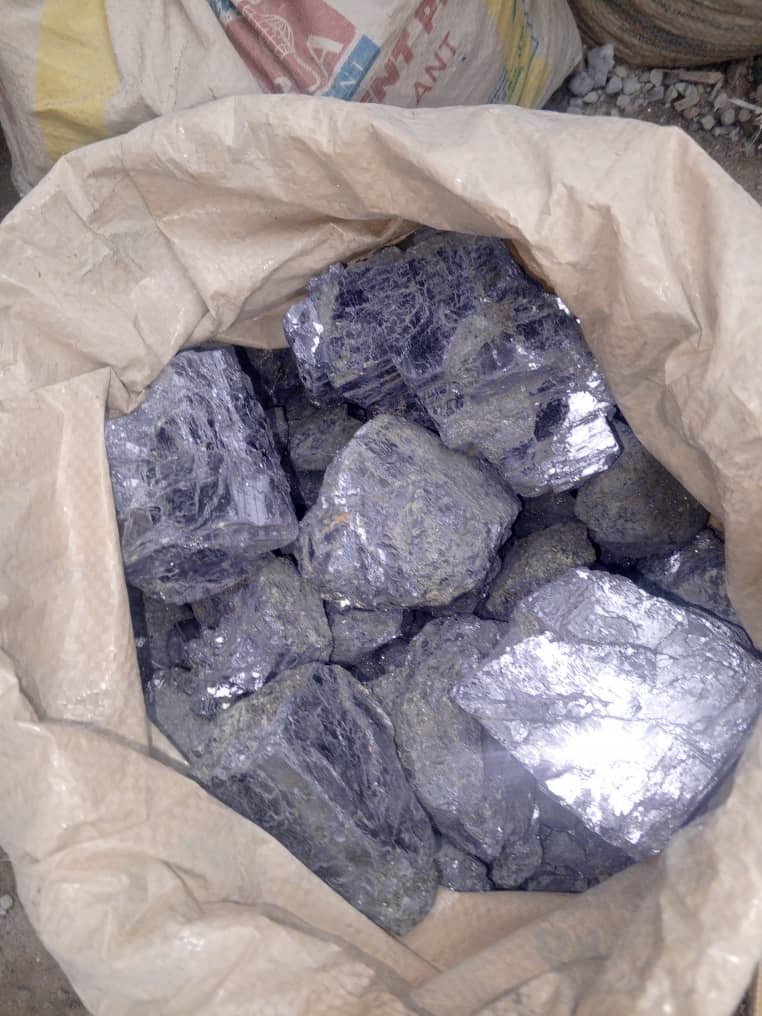
⑤ Rice Sacks and Weighing Scale: The primary commercial containers for Nigerian artisanal mineral production. A standard rice sack (50–100 kg capacity) filled with sorted spodumene ore is the basic commercial unit in which ore is weighed, priced, transported, and traded. The portable hanging scale — used by aggregator representatives at field buying points — is the instrument that translates the miner’s physical production into a commercial transaction.
How Nigerian Lithium Miners Identify and Grade Their Ore
One of the most commercially significant skills of the experienced Nigerian lithium miner — and one of the least understood by external buyers — is his ability to identify, assess, and grade lithium ore by visual inspection. This is not guesswork. It is applied mineral identification, developed through years of hands-on experience, that produces grade estimates accurate enough to anchor commercial transactions — before any laboratory assay has been run.
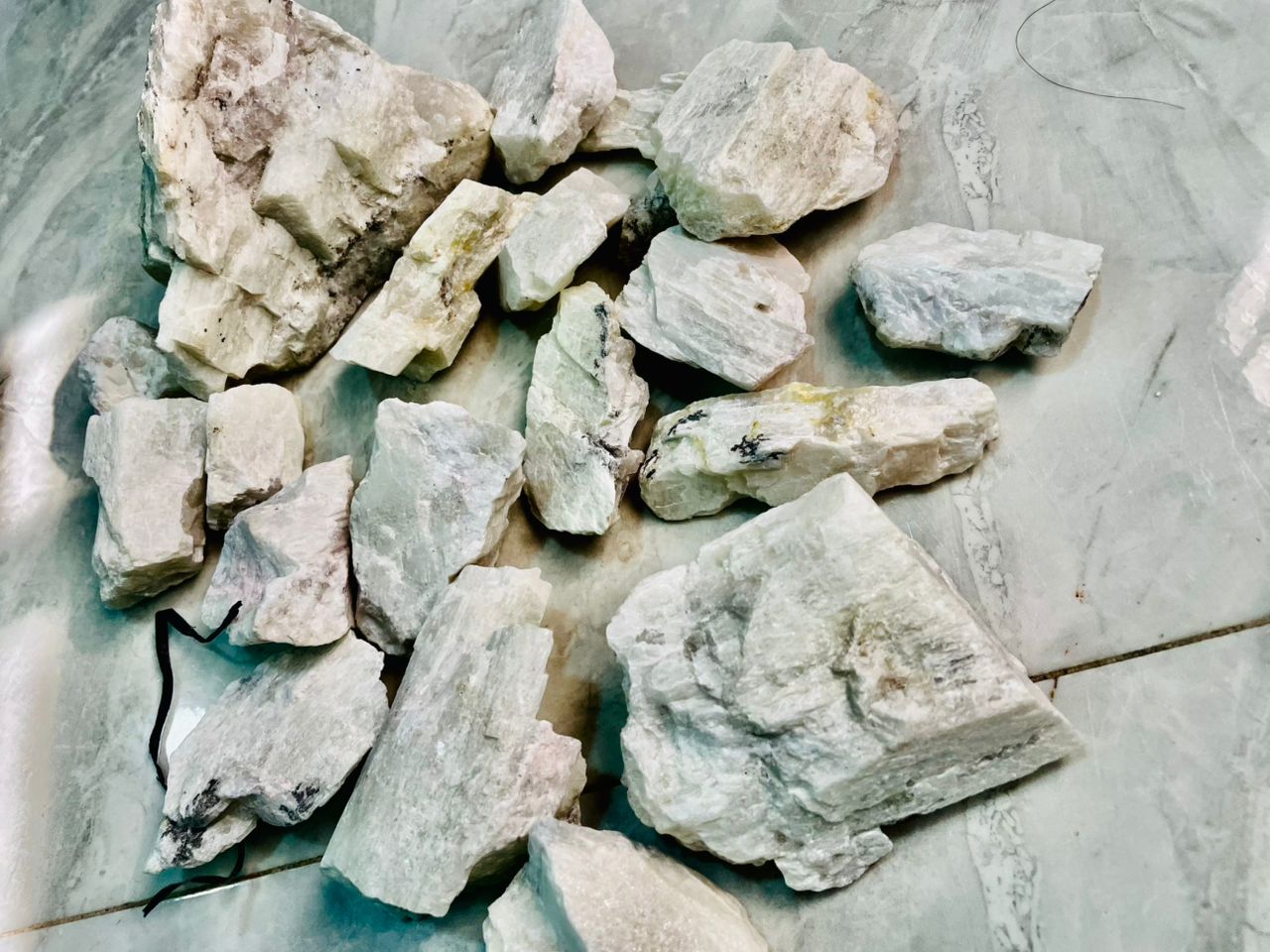
Spodumene is visually distinctive in a fresh or weathered Nigerian pegmatite. The mineral occurs as elongated, bladed or tabular crystals with a characteristic vitreous (glassy) to pearly lustre on fresh cleavage surfaces. Its colour range — from colourless to pale grey-green, often with a faint lilac or pink tinge in the kunzite gem variety — contrasts clearly with the white to cream feldspar and translucent grey quartz that dominate the pegmatite matrix. In a high-grade section of pegmatite, the spodumene crystals can be 5–30cm long and several centimetres across — visible and identifiable at a glance even in a mixed rock pile. In lower-grade material, spodumene crystals are smaller (1–5cm) and more dispersed, requiring more careful visual assessment to estimate the proportion of the rock mass that is spodumene versus gangue.
| Visual Indicator | What It Suggests | Approx. Li₂O Implication |
|---|---|---|
| Dense, large spodumene crystals (5–30cm), covering >40% of rock face | High-grade pegmatite core zone | 3.5%–5.5%+ Li₂O |
| Moderate spodumene crystals (2–10cm), covering 15–40% of face; visible in cross-section | Medium-grade zone; mixed spodumene and feldspar | 1.8%–3.5% Li₂O |
| Scattered small spodumene crystals (1–3cm), covering <15% of face; predominantly feldspar | Low-grade or pegmatite margin zone | 1.0%–1.8% Li₂O |
| Lilac-purple mica aggregates (lepidolite) on cleavage surfaces; soft, scaly texture | Lepidolite-dominant zone (Edo State) | 1.2%–2.5% Li₂O |
| Predominantly white feldspar and grey quartz; no visible spodumene or lepidolite | Barren pegmatite or gangue — waste | <0.5% Li₂O — not commercial |
This visual grading system is not perfectly precise — laboratory assay will always give a more accurate Li₂O number than visual assessment. But it is commercially functional: experienced miners consistently produce visual grade estimates that are within 0.5%–1.0% Li₂O of the laboratory assay result, which is accurate enough to support pricing negotiations at the field buying point and to guide the ore sorting decisions that determine what goes into the export shipment and what is left behind as waste.
How Nigerian Lithium Miners Are Organised — Community Structures and Commercial Networks
The organisation of Nigerian artisanal lithium mining is not chaotic — it is organised, but along lines that are unfamiliar to those accustomed to formal corporate mining structures. The dominant organising frameworks are community-based, relationship-based, and commercially pragmatic rather than legally formalised — though the degree of formalisation is increasing as the commercial stakes rise with lithium’s global price.
At the community level, mining in a particular area is typically governed by a community arrangement that determines who can mine on specific land and on what terms. This arrangement usually involves the traditional land owner or community chief — who holds the effective authority over land use in rural Nigeria regardless of formal cadastral tenure — negotiating an access arrangement with a mine operator or mining cooperative. The arrangement might involve a royalty (a fixed amount per bag or per tonne of ore produced), a labour contribution (employment of community members in the mining team), or a social benefit contribution (investment in community infrastructure such as a borehole or school materials). These community agreements are unwritten but binding within the social norms of the community, and disrupting them carries reputational and social consequences that experienced mine operators take seriously.
① Miner → Field Aggregator (Local Buyer): The individual miner sells directly to a local aggregator — a trader or buying agent who is physically present at field collection points on a daily or weekly basis, with a scale for weighing and cash for immediate purchase. The field aggregator is typically a local businessman with no formal mining licence, operating as a commodity broker between the miner and the larger aggregation and export companies. Field aggregators provide the critical function of immediate cash liquidity for miners — who need cash for food and family expenses and cannot wait weeks for a formal export company to complete its documentation and payment cycle.
② Field Aggregator → Export Aggregator (Augustina Impex): The field aggregator accumulates ore from multiple individual miners over days or weeks and then sells to larger export aggregators like Augustina Impex, who have the volume requirements, documentation capability, and international buyer relationships to actually export the material. Export aggregators typically buy in minimum lots of several tonnes and at prices that reflect the lower grade uncertainty of aggregated multi-source material versus single-source selected ore.
③ Direct Mine-to-Export Company Arrangements: For SSML operators and larger, more commercially formalised artisanal operations, direct supply agreements with export companies are possible. Augustina Impex maintains a number of such direct relationships with SSML licence holders in Plateau and Nasarawa States who can produce 20–100 MT per month of consistent-grade ore under ongoing supply arrangements. These direct relationships reduce the number of intermediary steps, improve grade consistency, and allow for more structured commercial terms including advance partial payment, price fixing mechanisms, and quality standards agreements.
④ Mining Cooperative Structures: In some Nigerian mining communities — particularly in the more organised parts of the Jos Plateau field — artisanal miners have formed informal cooperative groups that pool their production for collective sale, share equipment access, and negotiate collectively with aggregators for better pricing. Cooperative structures reduce the bargaining power disadvantage that individual miners face when negotiating with aggregators and provide a degree of income smoothing for individual members.
The Economic Life of the Nigerian Lithium Miner — Income, Pricing, and Commercial Reality
The economic reality of Nigerian artisanal lithium mining is complex — more complex than either the optimistic narrative (“lithium is the new oil, miners are getting rich”) or the exploitative narrative (“miners are being cheated by Chinese buyers and export companies”) that circulate in different media contexts. The truth is more nuanced and more interesting than either version.
An individual artisanal miner working a productive Jos Plateau spodumene site can produce 100–400 kg of sorted ore per day in good conditions. At a typical field buying price of ₦15,000–₦40,000 per 50 kg bag (depending on grade and market conditions), a miner producing 200 kg (4 bags) per day earns ₦60,000–₦160,000 per day — equivalent to approximately $40–$100 USD at current exchange rates. This is significantly above the Nigerian average daily wage for unskilled agricultural or urban informal labour, which explains why lithium mining has attracted large numbers of new entrants since prices rose. However, these income figures must be adjusted for the significant costs and income variability the miner bears: tool replacement and maintenance, land access fees, transport to the field, seasonal production interruptions due to rain or site flooding, and the variable period between productive finds — a miner working a marginal or depleted site may produce only 50 kg on a bad day.
The pricing chain from the miner to the international buyer involves multiple intermediary stages, each adding a margin that reflects the value of the service provided. The miner receives the lowest price in the chain — reflecting the fact that he bears the physical production risk but lacks the commercial infrastructure (documentation, buyer access, logistics, capital) to capture the export value directly. The field aggregator takes a small margin for providing immediate liquidity. The export aggregator takes a larger margin for providing supply consolidation, quality control, PSI coordination, documentation, and international buyer access. The international buyer pays the export company a price that reflects the total delivered value of the ore, including all these services.
Augustina Impex’s commercial philosophy is that fair, direct, and transparent pricing relationships with Nigerian miners are not just ethically correct — they are commercially rational. Miners who are paid fairly and consistently will prioritise quality, maintain ongoing supply relationships, and communicate honestly about grades and availability. Miners who are systematically underpaid or deceived will dilute grade, reduce effort, and divert production to competing buyers at the first opportunity. We therefore work to establish direct relationships with miners and SSML operators wherever possible, paying transparent market-based prices, minimising unnecessary intermediary steps, and building the kind of trust-based commercial relationships that produce consistent, documented, grade-verified supply over the long term. This approach is also what allows us to honestly represent our supply chain to international buyers who ask about the ethical and traceability dimensions of our Nigerian lithium sourcing.
Safety in Nigerian Lithium Mining — Risks, Realities, and Improvements
Artisanal mining anywhere in the world carries occupational safety risks, and Nigerian lithium mining is no exception. Honest engagement with these risks — rather than pretending they do not exist or deflecting with false reassurance — is important both ethically and commercially, as international buyers increasingly expect supplier transparency on occupational health and safety (OHS) dimensions of their mineral supply chain.
① Open Pit Wall Collapse: Open-cut artisanal pits, particularly in weathered and partially consolidated rock, are subject to wall collapse if pit walls are undercut or over-steepened. Wall collapses are the most serious safety risk in artisanal lithium mining — they occur without warning and can be fatal. Good practice — which experienced miners generally observe — involves avoiding work directly beneath unsupported overhanging walls and maintaining appropriate pit wall angles. The absence of formal safety enforcement means that wall safety depends primarily on experienced miner judgement and peer community norms rather than regulatory compliance.
② Tool Injuries: Working with pick axes, sledgehammers, chisels, and crowbars in close proximity to other miners creates risk of impact injuries from mishandled tools, flying rock fragments, and hand injuries from chisel work. These are the most common injuries in the artisanal mining environment — typically minor lacerations and bruising, but occasionally more serious. Personal protective equipment (PPE) — particularly safety glasses and steel-toed boots — is unevenly used across artisanal mining communities.
③ Dust Inhalation: Breaking and sorting crystalline rock in dry conditions produces silica-bearing dust that, with prolonged unprotected exposure, can cause silicosis — a chronic, progressive lung disease. This risk is particularly relevant to miners who spend many years in continuous artisanal mining. Dust suppression (water spraying) and respiratory protection (dust masks) reduce this risk but are not universally adopted in artisanal settings.
④ Heat and Dehydration: Working physically outdoors in Nigeria’s middle belt climate — particularly in the dry season when temperatures in the Jos Plateau area can reach 32–38°C — creates risk of heat stress and dehydration. Experienced miners manage this through regular water breaks, working in the early morning and late afternoon, and taking extended midday rest periods. Younger, less experienced miners are more vulnerable to heat-related illness.
⑤ What Is NOT a Risk in Lithium Mining (unlike cobalt or gold): Nigerian lithium mining has no chemical processing on-site — there is no cyanide, mercury, sulphuric acid, or other toxic reagents involved in the artisanal extraction process. Spodumene and lepidolite are not toxic minerals. The gangue material (quartz-feldspar pegmatite) is chemically inert. There is no acid rock drainage. This is an important distinction from artisanal gold mining (which often involves mercury use) and artisanal cobalt mining (which involves chemical processing hazards). From a toxicological perspective, artisanal lithium mining is among the safer forms of artisanal hard-rock mining.
The Path from Informal Miner to Formal SSML Operator
The formalisation of artisanal miners — converting informal, unlicensed mining activity into licensed, documented, compliant production — is one of the most important policy and commercial priorities in Nigeria’s mining sector development. For the individual miner, formalisation offers access to legal protection, bank financing, formal supply contracts, and higher-value commercial relationships. For the sector, formalisation converts a production base that is difficult to document, difficult to tax, and difficult to quality-assure into a transparent, accountable supply chain that meets international commercial standards.
① Step 1 — Land Access Documentation: The miner documents his access arrangement with the land owner or community authority — ideally through a formal written agreement registered with the local government. This land access document is a prerequisite for SSML licence application and provides legal certainty for the mining operation.
② Step 2 — SSML Application to FMMSD: The miner files an SSML application with the Federal Ministry of Mines and Steel Development, including the site coordinates, land access documentation, and a basic environmental impact assessment. The SSML licences a defined area (typically 5–10 hectares) for small-scale mining.
③ Step 3 — Business Registration with CAC: The miner registers a business entity with the Corporate Affairs Commission (CAC), which gives them a legal commercial identity — a prerequisite for opening a business bank account, entering formal contracts, and accessing government financing programmes.
④ Step 4 — Formalised Supply Agreement with Export Company: With SSML licence and CAC registration in hand, the formalised miner can enter a formal supply agreement with Augustina Impex or another NEPC-registered export company — specifying grade, volume, pricing, payment terms, and quality control protocols. This formal agreement is the bridge between the miner’s production and the international export market.
⑤ Step 5 — Access to SMDF Financing: SSML holders with a track record of formal supply and CAC registration can apply for concessional financing from the Solid Minerals Development Fund (SMDF) to invest in equipment — a small excavator, water pump, or mobile crusher — that increases production capacity and improves grade consistency. This equipment investment is the step that converts a marginal artisanal operation into a commercially significant SSML business.
Augustina Impex actively supports the formalisation pathway for miners in our supply network — not as a charitable programme but as a commercial strategy. A formalised, SSML-licensed supplier can enter a formal supply contract; an informal artisanal miner cannot. A supplier with a bank account can receive formal payment by transfer; a supplier without one receives cash from intermediaries who take a margin for that cash liquidity service. Every miner in our network who completes the formalisation pathway becomes a more reliable, more commercially sophisticated, and ultimately more valuable supplier — which benefits both the miner and Augustina Impex’s supply chain quality.
The Future for Nigerian Lithium Miners — A Transitional Moment
The Nigerian lithium miner is at a genuinely pivotal moment in the history of their sector. For the first time, the global industrial economy needs what they produce — urgently and in large quantities. The skills, knowledge, and community organisation they have built over generations of mineral extraction are suddenly commercially relevant at a global scale that would have been incomprehensible even ten years ago. This is a moment of extraordinary opportunity for Nigerian mining communities — and also a moment of risk, as rapid commercialisation without adequate formalisation can produce outcomes that disadvantage the mining communities rather than enriching them.
The positive scenario for Nigerian lithium miners over the next decade involves: progressive SSML formalisation that gives miners legal protection and market access; investment in shared processing infrastructure (HMS plants, DMS circuits, eventually flotation) that allows miners to sell processed concentrate rather than raw ore and capture more of the value chain; the development of community-level marketing cooperatives that give miners collective bargaining power with aggregators and export companies; and the creation of long-term offtake agreements with formal companies that provide income certainty for planning and investment rather than the current spot-market volatility.
Augustina Impex’s vision for the Nigerian lithium mining sector is one in which the miners who dig the ore are also beneficiaries of the commercial value that ore creates in the global market. This is not idealism — it is practical commercial logic. A supply chain that enriches its upstream participants is a more stable, more productive, and more sustainable supply chain than one that extracts maximum value from the production base while returning as little as possible to it. The Nigerian lithium miner is not just our supplier. He is our partner in building a Nigerian critical minerals sector that the world takes seriously.
Frequently Asked Questions — Nigerian Lithium Ore Miners
Precise numbers are not available because the majority of artisanal miners are not registered or counted by formal statistics systems. Based on field observation and the scale of production visible in mineral markets and export volumes, industry estimates suggest between 5,000 and 20,000 individuals are actively engaged in some form of artisanal lithium ore mining across Nigeria’s principal producing states (Plateau, Nasarawa, Taraba, Kwara, Ekiti, Zamfara, Edo) at any given time during the dry season peak. The number rises significantly during peak lithium price periods and contracts during prolonged market downturns. For context, Nigeria’s tin and columbite mining sector had over 100,000 artisanal miners at peak production in the 1970s — the current lithium sector is much smaller but growing rapidly.
The use of child labour in Nigerian artisanal mining varies by community and by type of activity. In some Nigerian ASM contexts, children assist with light tasks such as carrying water or sorting small mineral fragments — activities that are common in rural subsistence economies where family labour is pooled. However, the physically demanding and hazardous work of breaking rock and working in open pits is predominantly done by adult males. Augustina Impex does not knowingly source from operations that engage child labour in mining activities, and as part of our supply chain due diligence process, we conduct field assessments of our principal supply sources. We are transparent with buyers who ask about our child labour policy and the practical measures we take to implement it in our field supply network.
Augustina Impex works with miners at multiple levels. We maintain direct commercial relationships with a number of SSML licence holders who can provide formalised, documented supply under ongoing supply agreements. We work through field aggregators and local buying agents — some of whom are community members with deep miner relationships — to access ASM production in areas where individual miner relationships are not practical to maintain directly. And we accept supply from mine owner representatives and gang bosses who consolidate production from multiple individual miners before selling to us. Our field representatives visit key supply zones regularly, assess ore quality, maintain commercial relationships, and communicate market intelligence back to miners — including information about grade requirements, volume needs, and timing — that helps miners make better production and investment decisions.
Yes — site visits to Nigerian lithium mining operations can be arranged for serious buyers and investors who want to see the production reality they are engaging with. Augustina Impex can arrange accompanied visits to selected mining sites in the Jos Plateau field and, where appropriate, to aggregation and processing points at the HMS plant partnership in Jos. Site visits require advance planning, appropriate logistics, and cultural sensitivity in engaging with mining communities. They are strongly encouraged for buyers placing significant initial orders and for investors evaluating Nigerian lithium opportunities — nothing replaces the ground-truth understanding that a well-organised site visit provides. Contact us to discuss arrangements.
Augustina Impex Limited connects Nigerian lithium ore miners across seven states to qualified international buyers through a documented, PSI-inspected, NEPC-registered export platform. We know the miners. We know the fields. We know the ore. Partner with us for Nigerian lithium supply that is commercially reliable, ethically grounded, and fully documented.
📧 augustinaimpex@gmail.com | 📞 WhatsApp: +234 906 090 4274
Visit Our Website
Read Our Corporate Blog
▶ Watch Our Advert Video
Kolawole King is the Chief Executive Officer of Augustina Impex Limited (RC 750691), a NEPC-registered Nigerian solid minerals export company headquartered in Jos, Plateau State — at the centre of Nigeria’s lithium ore mining region. With field operations spanning Plateau, Nasarawa, Taraba, Kwara, Ekiti, Zamfara, and Edo States, and an operational HMS processing plant partnership in Jos, Augustina Impex has built deep working relationships with the miners, communities, and commercial networks that form the productive foundation of Nigeria’s growing lithium sector. Visit www.augustinaimpex.com or follow the corporate blog at augustinaimpexng.blogspot.com.
Post a comment
Related Posts
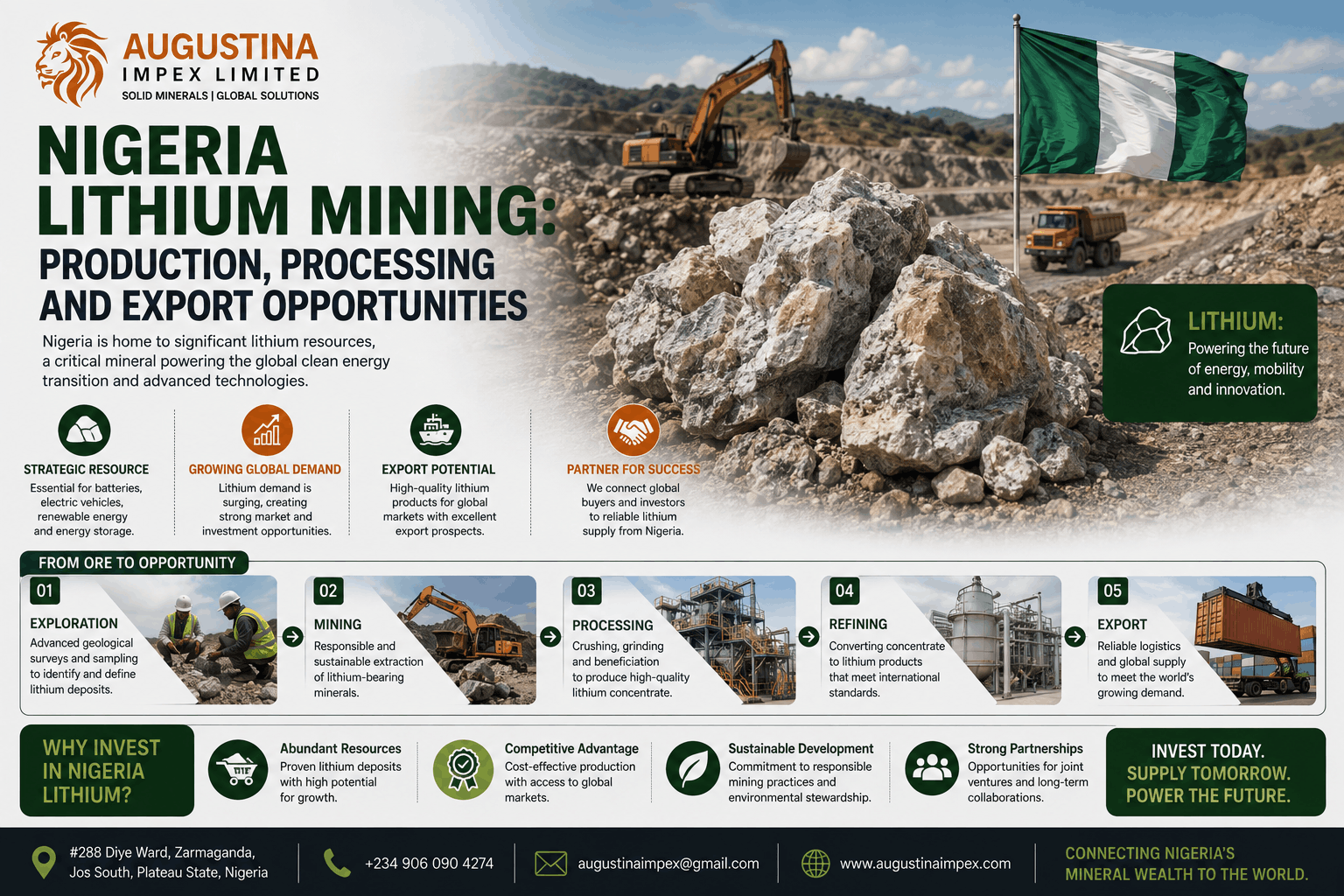
Nigeria Lithium Mining: Production, Processing & Export
Nigeria Lithium Mining: Production, Processing and Export Opportunities By Kolawole King, CEO — Augustina Impex…

Nigeria Rare Earth Minerals: Deposits & Market Potential
Nigeria Rare Earth Minerals: Deposits, Applications and Global Market Potential By Kolawole King, CEO —…
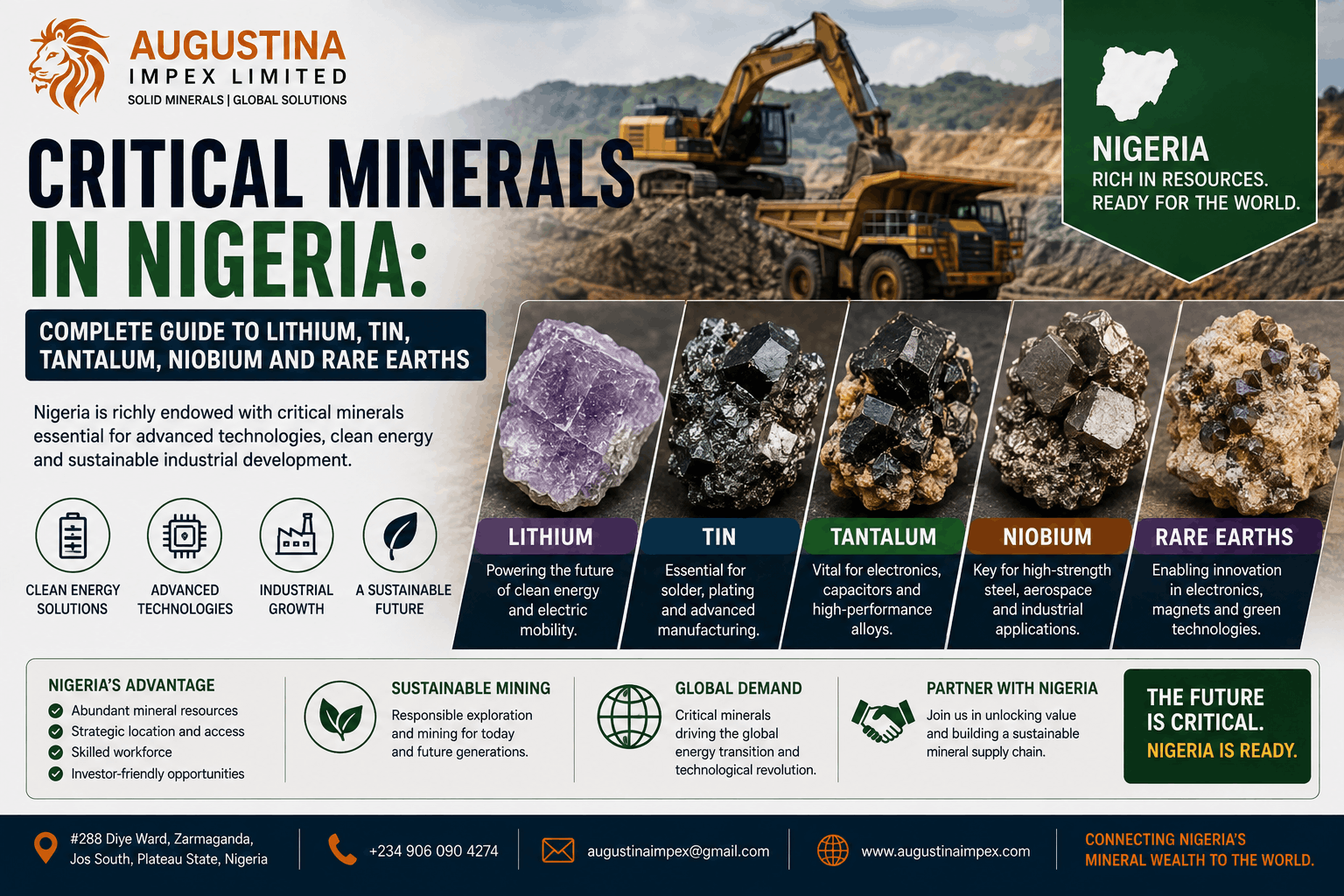
Nigeria Critical Minerals Guide: Lithium, Tin & Rare Earths
Critical Minerals in Nigeria: Complete Guide to Lithium, Tin, Tantalum, Niobium and Rare Earths By…
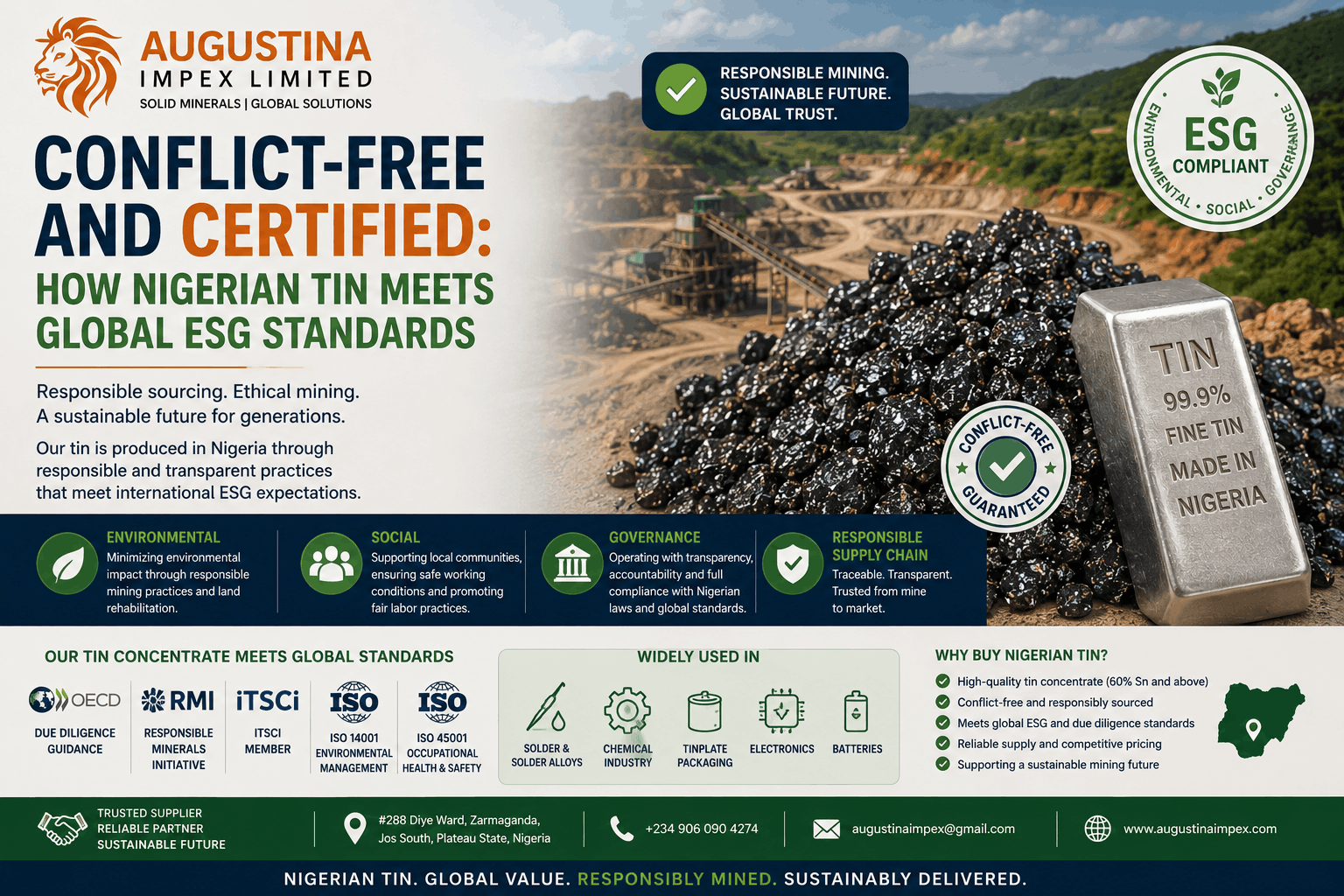
Conflict-Free Nigerian Tin Meets Global ESG Standards
Conflict-Free and Certified: How Nigerian Tin Meets Global ESG Standards By Kolawole King, CEO —…