
Lithium Mining in Nigeria: Opportunities and Challenges
There is a quiet revolution happening beneath Nigeria’s ancient soils — and it is being driven by one of the most sought-after elements in the modern world. Lithium, once known primarily to chemists and psychiatrists, has become the defining mineral of the twenty-first century’s energy economy. It is the essential ingredient in the lithium-ion batteries that power electric vehicles, store renewable energy, and keep the mobile devices of four billion people charged and connected. And Nigeria — largely overlooked for decades by the global mining industry — has emerged as a significant holder of lithium mineral resources that the world urgently needs.
This article provides the most comprehensive overview available of lithium mining in Nigeria — covering the country’s geological endowment, the specific lithium minerals found and their grades, the state-by-state geography of Nigeria’s lithium deposits, the opportunities and challenges facing the sector, the export process, the global market context, and practical guidance for international buyers who want to source Nigerian lithium ore. Whether you are a mineral trader, a battery manufacturer, an investment analyst, or simply a curious reader trying to understand why Nigeria is being talked about in boardrooms in Beijing, Seoul, Tokyo, and Brussels, this article is your definitive guide.
Let us begin with the fundamentals.
What Is Lithium and Why Is It So Critical?
Lithium is the lightest metal and the lightest solid element on the periodic table, with an atomic number of 3. In its pure metallic form it is soft enough to be cut with a kitchen knife and so reactive with water that it must be stored under mineral oil. But it is precisely this extreme reactivity — lithium’s eagerness to give up its single outer electron — that makes it the ideal material for battery electrodes. Lithium-ion batteries store and release energy through the reversible movement of lithium ions between anode and cathode, and no other element has yet been found that can perform this function as efficiently, safely, and economically at commercial scale.
The numbers behind lithium demand are staggering. In 2023, global lithium consumption was approximately 180,000 tonnes of lithium carbonate equivalent (LCE). By 2030, the International Energy Agency (IEA) projects demand to reach between 500,000 and 900,000 tonnes LCE — a three-to-five-fold increase in less than a decade. By 2040, under aggressive net-zero scenarios, demand could reach 3–4 million tonnes LCE annually. No existing or planned lithium mine project pipeline can come close to meeting that demand without the rapid development of new sources — sources that include, with increasing urgency, Nigeria.
① Electric Vehicles (EVs): Each EV battery pack requires 6–12 kg of lithium metal equivalent (40–80 kg LCE). With global EV sales projected to reach 40–50 million units per year by 2030, the automotive sector alone will consume enormous lithium volumes.
② Grid Energy Storage: Utility-scale battery storage — needed to balance intermittent solar and wind power — is the fastest-growing lithium end market, with installed capacity growing from ~30 GWh in 2022 to projected 700+ GWh by 2030.
③ Consumer Electronics: Smartphones, laptops, tablets, and wearables each contain 1–10 grams of lithium. With 1.5 billion smartphones sold annually, this remains a large baseline demand.
④ Ceramics and Glass: Lithium compounds improve the thermal shock resistance and reduce the thermal expansion of glass and ceramics — applications in cookware, telescope mirrors, and flat-panel displays.
⑤ Lubricating Greases: Lithium-based greases are the world’s most widely used industrial lubricants, accounting for approximately 70% of global grease production by volume.
Nigeria’s Geological Endowment — The Precambrian Basement Complex
To understand why Nigeria holds lithium resources, you need to understand Nigeria’s geology — specifically, the Precambrian Basement Complex that underlies approximately 50% of the country’s landmass. This ancient geological formation, ranging from 600 million to over 2 billion years old, is the geological source of the vast majority of Nigeria’s solid mineral wealth, including its lithium resources.
Nigeria’s Basement Complex is dominated by three geological units: the migmatite-gneiss complex (the oldest rocks), the schist belts (metamorphosed sedimentary and volcanic sequences that host many of Nigeria’s gold, lead, zinc, and baryte deposits), and — most importantly for lithium — the younger granites and associated pegmatites of the Pan-African age (approximately 500–700 million years old). It is within these pegmatites that Nigeria’s lithium minerals are primarily found.
Pegmatites are coarse-grained igneous rocks that form during the final stages of magma crystallisation, when residual magmatic fluids become enriched in rare and incompatible elements — including lithium, caesium, tantalum, niobium, and rubidium. The Jos–Bukuru Pegmatite Province of Plateau State is one of the most extensively documented and historically mined pegmatite fields in West Africa, having been systematically exploited for tin, columbite, and related minerals since the early twentieth century. But it is only in recent years — as lithium prices soared and exploration technology improved — that the full extent of the lithium mineral potential within these same pegmatites has begun to attract serious commercial attention.
Nigeria’s lithium-bearing pegmatites are classified as LCT (Lithium-Caesium-Tantalum) pegmatites — the same geological class as the world’s most productive lithium pegmatite mines in Western Australia (Greenbushes, Pilbara), Brazil (Araçuaí), and Zimbabwe (Bikita). This classification provides geological confidence that Nigerian pegmatites are capable of hosting economic lithium mineralisation at comparable grades and structures to proven global deposits.
State-by-State Guide to Nigeria’s Lithium Deposits
Nigeria’s lithium resources are not confined to a single state or geological province — they span a broad arc across the country’s Middle Belt and southern states, following the distribution of the Basement Complex and its associated pegmatite belts. Understanding this geographic spread is essential for buyers seeking to evaluate supply availability and logistics from different origin points.
| State | Lithium Mineral | Key Localities | Li₂O Grade Range | Activity Level |
|---|---|---|---|---|
| Plateau State | Spodumene-Kunzite, Lepidolite | Jos–Bukuru Pegmatite Field, Naraguta, Ropp | 1.0%–5.5%+ | Very Active |
| Nasarawa State | Spodumene, Amblygonite | Akiri area, Lafia Zone, Keffi | 1.0%–3.5% | Active |
| Cross River State | Spodumene, Lepidolite | Obudu Plateau, Oban Hills | 1.0%–3.0% | Active |
| Edo State | Lepidolite (primary) | Auchi, Etsako West LGA, Okpella | 1.2%–2.5% | Active — supply available |
| Kwara State | Spodumene, Lepidolite, Columbite | Ilorin Southwest, Kaiama, Oke-Onigbin | 1.0%–2.8% | Moderate |
| Taraba State | Spodumene, Lepidolite | Sardauna LGA, Gashaka–Gumti Zone | 1.0%–2.5% | Emerging |
| Oyo State | Spodumene-bearing pegmatites | Ibadan North, Egbeda Pegmatite Belt | 1.0%–2.0% | Emerging |
| Kogi State | Pegmatite-hosted lithium | Okene, Lokoja Zone | 1.0%–2.0% | Early Stage |
Of these producing regions, Plateau State remains the most active and best-documented, followed by Nasarawa and Cross River. Edo State’s Auchi region deserves special mention as the primary source of lepidolite — a distinct lithium mica mineral — which is actively mined and available for export through established supply channels.
The Lithium Minerals of Nigeria — Spodumene, Lepidolite, and Beyond
Not all lithium ore is the same. The term “lithium ore” encompasses several distinct mineral species, each with different chemical compositions, processing routes, and commercial values. Understanding which lithium mineral you are buying — and what processing it will require before it can be converted into battery-grade lithium carbonate or lithium hydroxide — is fundamental to evaluating any commercial offer from a Nigerian lithium supplier.
Spodumene — Nigeria’s Primary Lithium Mineral
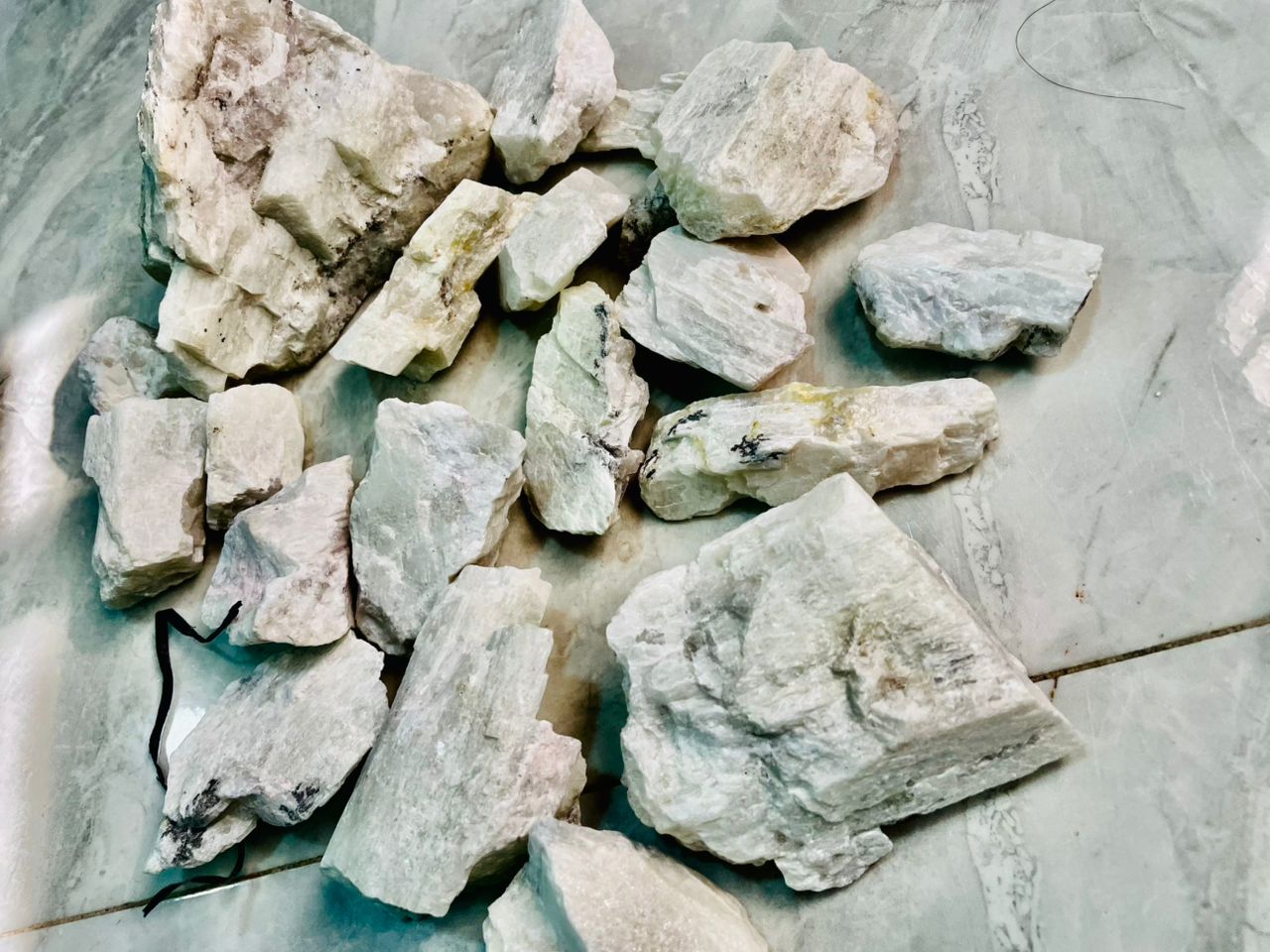
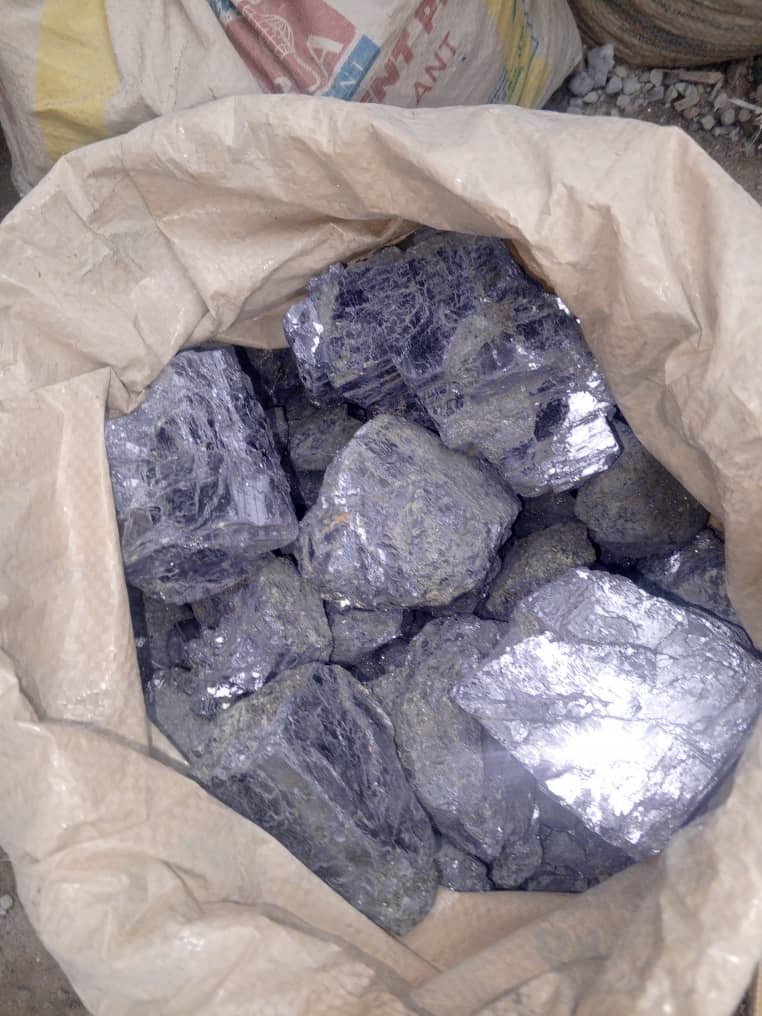
Spodumene (LiAlSi₂O₆) is a pyroxene mineral that is the world’s dominant hard-rock lithium source. It is found in LCT pegmatites, typically occurring as large, white-to-grey or pink prismatic crystals — sometimes reaching spectacular sizes of several metres in length in well-developed pegmatite bodies. The gem variety of spodumene, known as kunzite (pink-lilac) or hiddenite (green), is found in many Nigerian pegmatites and its presence is a reliable geological indicator of lithium mineralisation.
The theoretical maximum Li₂O content of pure spodumene is 8.03%. In practice, commercial spodumene concentrates are produced at 6%–7.5% Li₂O through beneficiation of ore bodies that typically contain 1%–3% Li₂O. Nigerian spodumene ore assays range from 1.0% to 5.5%+ Li₂O, with the higher grades occurring in well-developed, core zone pegmatites. For Chinese spodumene processors and lithium carbonate converters, a minimum concentrate specification of 6% Li₂O is typically required — meaning lower-grade Nigerian ore (below approximately 1.5% Li₂O) requires beneficiation before it can be economically shipped to Asian converters.
| Grade | Li₂O Content | Commercial Status | Processing Required |
|---|---|---|---|
| High Grade | 3.5%–5.5%+ | Premium ore; direct export viable | Minimal — crushing and screening |
| Mid Grade | 1.5%–3.5% | Good commercial ore | Dense media separation or flotation for upgrade |
| Low Grade | 1.0%–1.5% | Requires significant upgrading | Beneficiation to concentrate required |
Lepidolite — Nigeria’s Secondary Lithium Mineral
Lepidolite is a lithium-bearing mica mineral of the formula K(Li,Al)₃(AlSi)₄O₁₀(F,OH)₂. It typically occurs as fine-to-coarse scaly aggregates or books of lilac, pink, or pale purple mica — the colour making it one of the more visually distinctive minerals in a Nigerian pegmatite. Lepidolite’s Li₂O content is lower than spodumene’s (theoretical maximum approximately 7.7%), and commercial ores typically assay at 1.2%–3.5% Li₂O.
Lepidolite’s processing route to lithium carbonate is more complex than spodumene’s — it typically requires sulphate roasting or pressure acid leach (PAL) rather than the simpler high-temperature conversion used for spodumene — but it is a commercially established and widely used lithium source. Edo State’s Auchi region has emerged as Nigeria’s primary lepidolite producing area, with supply managed through local mining associations and aggregated through established export channels. Pricing is typically offered on an ex-works basis at the processing or storage point in Auchi.
| Li₂O Grade | Price per MT (Naira) |
|---|---|
| 1.2%–1.5% Li₂O | ₦150,000 per MT |
| 1.5%–2.0% Li₂O | ₦180,000 per MT |
| 2.0%–2.5% Li₂O | ₦230,000 per MT |
Note: Pricing is indicative ex-works Auchi, Edo State. Subject to independent assay verification. International pricing in USD on request from Augustina Impex Limited.
Other Lithium Minerals Found in Nigerian Pegmatites
While spodumene and lepidolite are the dominant lithium minerals in Nigeria, two other species merit attention for buyers exploring the full range of Nigerian lithium supply options:
Amblygonite / Montebrasite (LiAlPO₄F / LiAlPO₄OH) is a phosphate mineral with high Li₂O content (up to 10.2% theoretical). It is less common than spodumene or lepidolite in Nigerian pegmatites but has been documented in Nasarawa State’s Akiri area. It is a higher-value, lower-volume lithium mineral that some specialty chemical processors prefer for direct lithium extraction.
Petalite (LiAlSi₄O₁₀) is a lithium aluminosilicate mineral prized in the glass and ceramics industry for its ability to produce zero-expansion glass ceramics (such as the material used in Schott Ceran cooktops). Petalite has been identified in limited quantities in Nigerian pegmatites and is an area of active exploration interest.
How Nigerian Lithium Ore Is Mined — Current Practices
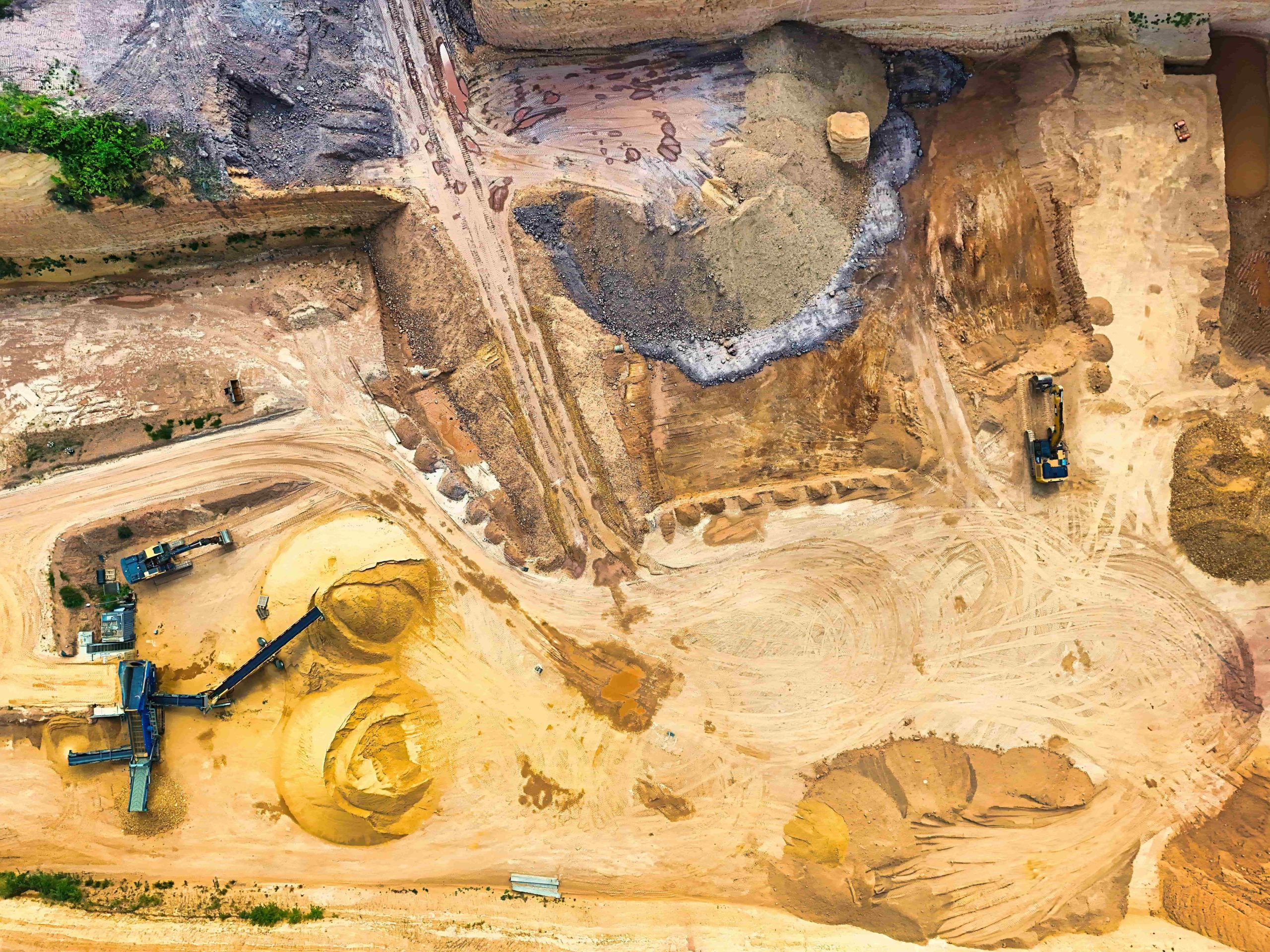
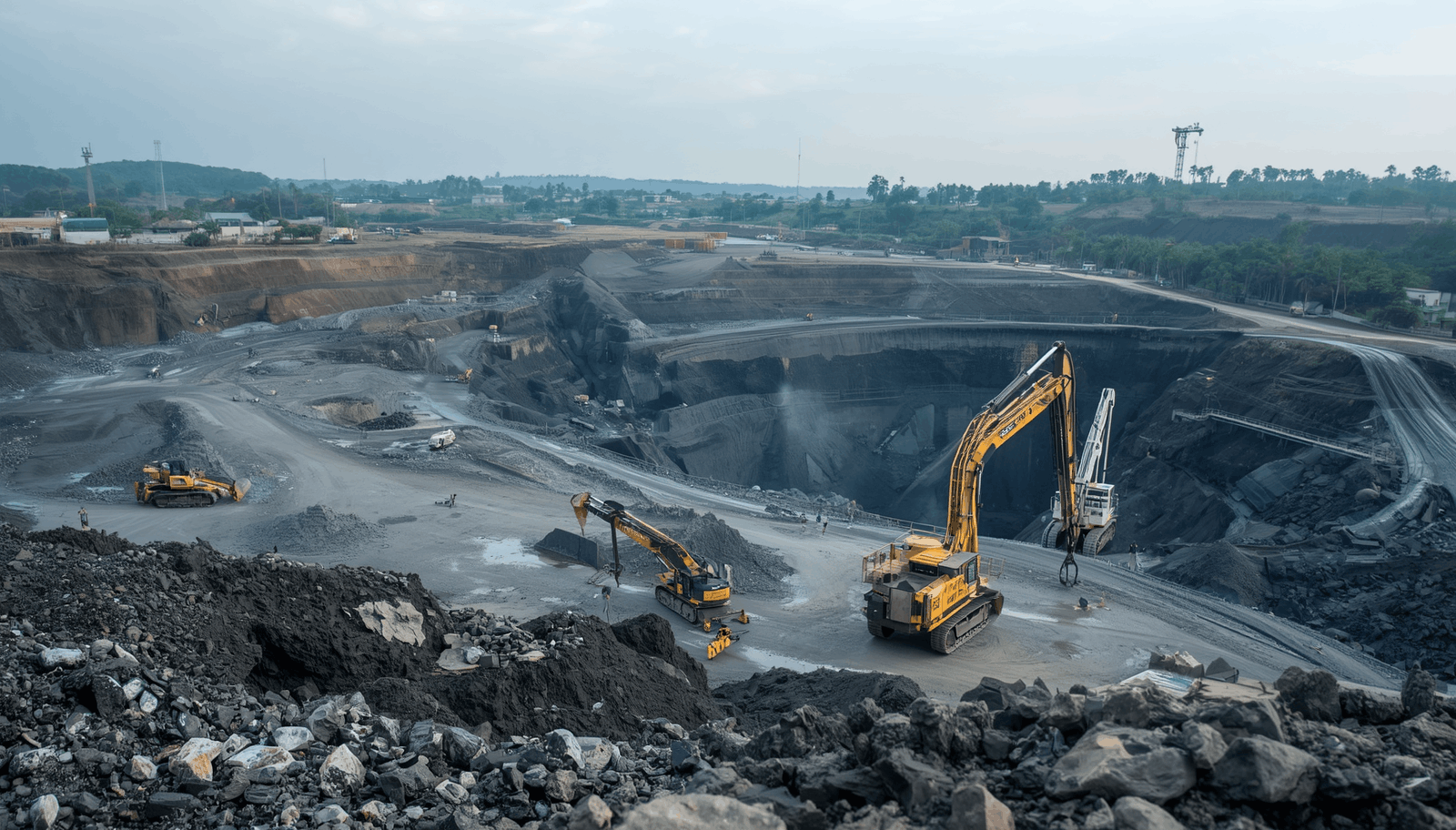
The reality of lithium mining in Nigeria today is that it is dominated by artisanal and small-scale mining (ASM) — a far cry from the mechanised open-cut and underground mines of Australia, Chile, or China. This is not a weakness unique to Nigeria: it reflects the global pattern in which large-scale industrial mining of a resource typically lags the discovery of ASM activity by one or two decades. Understanding how ASM lithium mining works in Nigeria — and what that means for supply consistency and quality — is essential for any serious buyer.
① Prospecting and Identification: Experienced local miners identify spodumene-bearing pegmatites through visual indicators — the presence of tourmaline, cassiterite, columbite, and quartz megacrysts, all co-occurring minerals that signal LCT-type pegmatite bodies. Where kunzite (pink spodumene) outcrops are visible, spodumene mineralisation is confirmed.
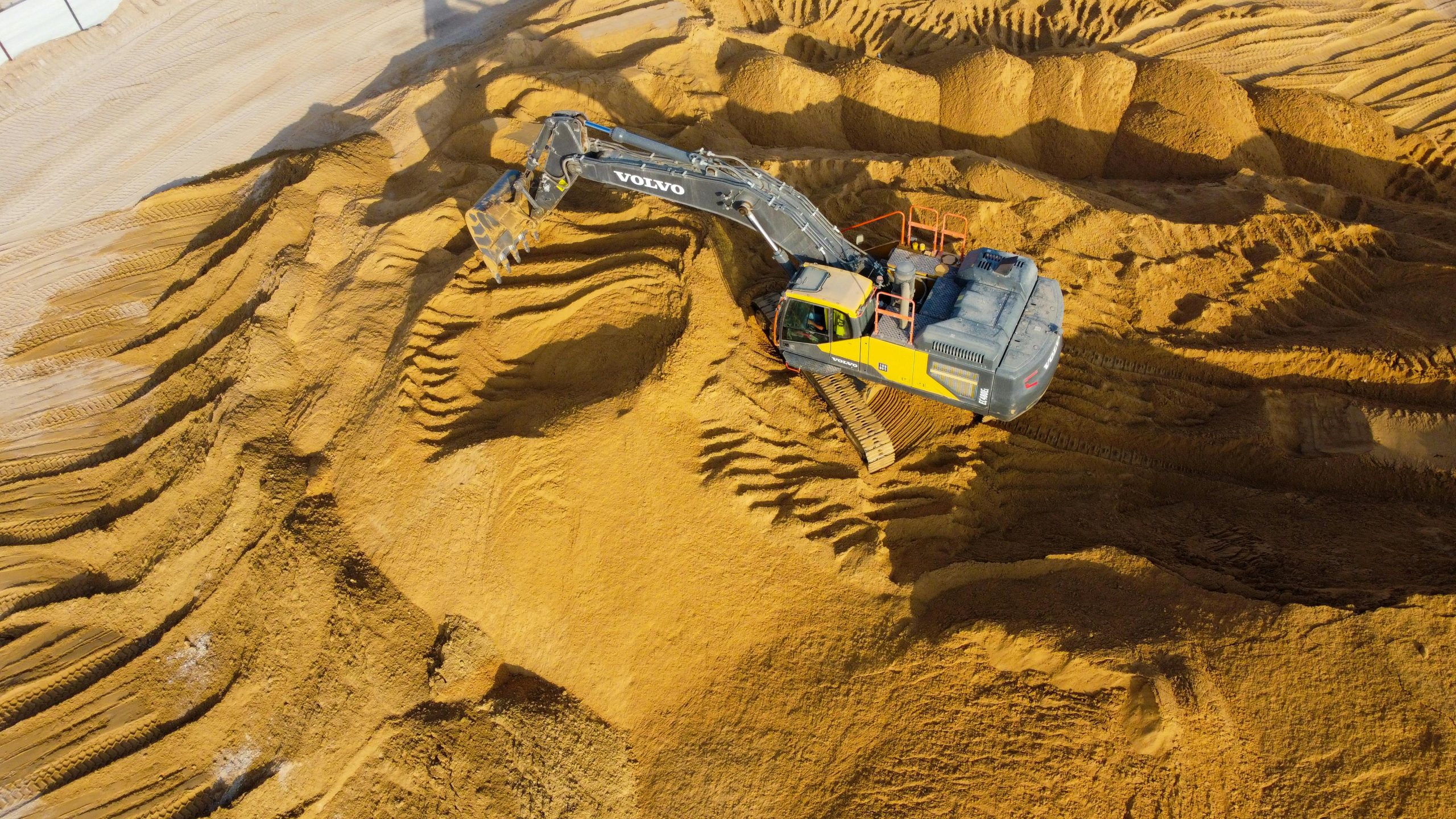
② Open-Cut Pit Excavation: Most Nigerian lithium ASM is open-cut. Shallow (<10m) pegmatite outcrops are excavated with hand tools, pneumatic drills, and basic mechanical excavators. The pegmatite rock is broken out in large fragments. ③ Manual Sorting: At the pit face or a nearby sorting yard, lithium mineral-rich rock is hand-sorted from barren waste rock. Experienced sorters can visually identify spodumene and lepidolite. This sorting step significantly upgrades the material compared to run-of-mine grade but introduces variability.
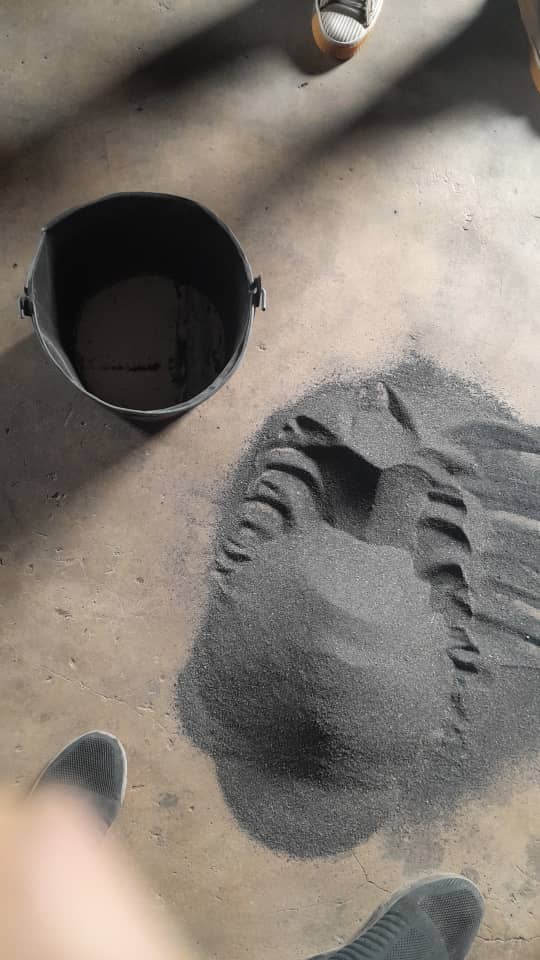
④ Crushing and Screening: Where basic processing equipment is available, ore is crushed to a consistent particle size (typically -50mm to +10mm) and screened to remove fines. Some aggregators perform a secondary magnetic separation to remove iron-bearing minerals that depress lithium content assay values.
⑤ Aggregation and Stockpiling: Individual mine owners typically produce 10–100 MT per month. Export-ready quantities (500+ MT) require aggregation from multiple mine sites. Reputable aggregators — such as Augustina Impex Limited — manage multi-source aggregation, blending, and quality control.
The transition from ASM-dominated supply to industrial-scale lithium mining in Nigeria is beginning — with several early-stage exploration and development companies having staked claims in Plateau and Nasarawa States. However, for the near-to-medium term (2024–2028), the bulk of Nigeria’s exportable lithium supply will continue to come from ASM sources, aggregated by export companies that can verify quality, manage documentation, and provide the pre-shipment inspection access that international buyers require.
Beneficiation of Nigerian Lithium Ore — From Mine to Market
Raw, run-of-mine lithium ore from Nigerian pegmatites rarely reaches the grade specifications required by Chinese, South Korean, or European lithium chemical converters in its unprocessed form. Beneficiation — the upgrading of raw ore to a higher-grade product through physical and chemical separation — is therefore a critical value-adding step that determines the commercial attractiveness of Nigerian lithium supply to different buyer segments.
The principal beneficiation methods applicable to Nigerian lithium ore are:
① Dense Media Separation (DMS): Separates minerals based on density. Spodumene (SG 3.1–3.2) is denser than most gangue minerals (quartz SG 2.65, feldspar SG 2.56), allowing gravity-based separation in a dense media bath (typically ferrosilicon suspension). DMS is effective at upgrading spodumene ore from 1–2% Li₂O to 4–6% Li₂O concentrate.
② Froth Flotation: The industry standard for producing high-grade (6%+ Li₂O) spodumene concentrate for export. Flotation uses chemical reagents (collectors, frothers, depressants) to selectively attach air bubbles to spodumene particles and float them away from gangue. Produces 6.0–7.5% Li₂O concentrate suitable for direct shipment to lithium chemical plants.
③ Magnetic Separation: Removes iron-bearing minerals (magnetite, ilmenite) that contaminate lithium concentrates and complicate downstream processing. Applied as a secondary cleaning step after DMS or flotation.
④ Hand Sorting + Crushing (Low-Tech): For high-grade spodumene pegmatites (3.5%+ Li₂O), manual sorting combined with crushing and screening can produce marketable ore parcels without capital-intensive processing equipment — directly accessible at Nigerian ASM scale.
Augustina Impex Limited works with partner processing facilities in Jos, Plateau State, to provide basic crushing, screening, and magnetic separation services for lithium ore destined for export. For buyers who require higher-grade concentrate (6%+ Li₂O), we can coordinate with beneficiation partners and discuss appropriate pricing structures that account for the value-adding processing cost.
The Opportunities in Nigeria’s Lithium Mining Sector
Nigeria’s lithium mining sector presents a genuinely compelling set of opportunities for multiple categories of stakeholders — from international commodity buyers to mining investors to Nigerian entrepreneurs seeking to participate in the global energy transition value chain. Let us examine each opportunity category in turn.
The global lithium supply chain is concentrated to a degree that makes battery manufacturers and governments deeply uncomfortable. Australia supplies approximately 45–50% of global lithium ore. Chile provides roughly 25% of global lithium brine. China dominates lithium chemical processing. Any disruption to Australian supply — whether from weather events, industrial action, regulatory changes, or geopolitical shifts — would cause severe price and supply volatility across the entire battery supply chain. Nigerian lithium, sourced from a politically stable, English-speaking, NEPC-registered export framework, offers genuine supply chain diversification that Chinese, South Korean, and Japanese battery manufacturers are actively seeking.
Nigeria’s lithium sector is at an early stage of formalisation — which means the risks of early investment are real but so are the rewards. Companies and investors that establish offtake agreements, secure mining licences, or build processing infrastructure in Nigeria now will benefit from first-mover advantages as the sector matures. The trajectory of comparable early-stage lithium jurisdictions — Zimbabwe, Ethiopia, Mali — suggests that early investors in Nigeria can achieve significant asset value appreciation as the sector develops regulatory clarity, attracts exploration capital, and begins to produce at industrial scale.
Nigeria’s Federal Government has explicitly articulated a policy of promoting in-country value addition to raw mineral exports rather than exporting unprocessed ore. The Nigerian Economic Sustainability Plan and the Solid Minerals Development Fund have earmarked incentives for companies that establish mineral processing facilities within Nigeria. For an entrepreneur or foreign investor who can establish a spodumene flotation plant or a lithium carbonate conversion facility within Nigeria, the combination of cheap raw ore supply, growing domestic power infrastructure, available industrial land, and government incentives makes in-country value addition a viable business model — and one that could position Nigeria as an African lithium chemical producer rather than merely an ore exporter.
The European Union’s Critical Raw Materials Act (CRMA), adopted in 2024, establishes binding supply chain diversification targets for EU member states and EU-based manufacturers. The CRMA explicitly identifies African nations — including Nigeria — as priority Strategic Partnership targets for critical mineral supply. This creates a formal diplomatic and commercial framework through which Nigerian lithium exporters can engage with European buyers who are under legal obligation to diversify their supply chains. NEPC-registered Nigerian exporters are well-positioned to participate in these emerging supply partnerships.
The Nigerian Minerals and Mining Act 2007 provides a clear framework for joint venture (JV) mining development between Nigerian licence holders and foreign investors. Under a JV structure, a foreign company can provide capital, equipment, and technical expertise while the Nigerian partner holds the Small-Scale Mining Licence (SSML) or Mining Lease — structuring the partnership in compliance with Nigerian law while giving the foreign party meaningful economic participation in the mine’s production. This JV model has been successfully used in Nigeria’s gold, lead-zinc, and now increasingly, lithium sectors.
The Challenges Facing Nigeria’s Lithium Mining Sector
A fair analysis of Nigeria’s lithium sector must acknowledge the challenges alongside the opportunities. These challenges are real, they affect the sector’s current performance, and understanding them is essential for any investor or buyer who wants to make informed decisions. The good news is that none of these challenges are insurmountable — and many are actively being addressed.
The majority of lithium mining activity in Nigeria is currently conducted by artisanal miners who operate informally — without valid mining licences, without compliance with environmental management requirements, and without the supply chain documentation that international buyers increasingly require. This makes it difficult for export companies to provide fully documented supply chains for all the ore they aggregate. The Nigerian government’s mining formalisation agenda is gradually improving this situation, but progress is uneven across states and mineral types. Reputable exporters like Augustina Impex work exclusively with licensed mining partners to ensure that supply chain documentation is compliant.
Because Nigerian lithium comes from multiple individual ASM mines of varying geological quality, aggregate supply can show significant grade variability between shipments. A buyer who receives 2.5% Li₂O ore in one shipment may receive 1.8% Li₂O in the next, unless the seller has robust blending and quality control procedures. This variability is a significant challenge for buyers who need consistent feed specifications for their processing plants. The solution lies in working with aggregators who use accredited laboratory testing at each source point and blend material to target specifications — a quality management approach that Augustina Impex employs.
Nigeria’s road, rail, and port infrastructure, while improving, remains a significant constraint on mineral export logistics. Many lithium mining areas in Plateau and Nasarawa States are accessible only by poor-quality rural roads that are difficult to navigate with heavy-duty trucks during the rainy season (June–October). Power supply for processing facilities is unreliable — a critical issue for energy-intensive beneficiation processes. Port congestion at Lagos Apapa Port adds 5–15 days of additional delay to shipments. These infrastructure challenges add cost and uncertainty to Nigerian mineral supply chains relative to competing jurisdictions.
The high global price of lithium minerals has attracted a wave of fraudulent actors — both in Nigeria and internationally — who make supply claims backed by fabricated assay reports, non-existent stockpiles, or grossly exaggerated grade claims. International buyers who have been defrauded in Nigerian lithium transactions are understandably cautious about re-entering the market. The antidote is due diligence: always insist on independent assay samples from an accredited laboratory of your own choosing, never pay advance fees without verified assay results and documented mine access, and work through established, NEPC-registered export companies with verifiable track records.
Nigeria currently lacks industrial-scale spodumene flotation or dense media separation plants capable of producing the 6%+ Li₂O concentrate that most Asian lithium chemical converters require as feed. This means that Nigerian lithium ore must either be exported at lower grades — accepted by buyers at discounted pricing — or sent to offshore processors for upgrading before final conversion. The absence of in-country beneficiation infrastructure is one of the most significant structural constraints on Nigeria’s lithium export value proposition, and addressing it through investment in local processing capacity is both a challenge and an opportunity.
Nigeria’s mineral export regulatory framework — NESS certification, NEPC registration, CBN Form NXP, FMMSD licensing oversight — involves multiple agencies whose coordination and enforcement quality can be inconsistent. Delays in obtaining required certificates can add weeks to export timelines. Regulatory reforms are ongoing, but the complexity of the current framework imposes compliance costs and time burdens on exporters that their competitors in more streamlined jurisdictions do not face. Working with an experienced, NEPC-registered exporter who has established regulatory relationships is the most effective way to navigate this complexity.
The Global Lithium Market — Where Nigeria Fits
To properly assess the opportunity represented by Nigerian lithium, it is essential to understand the structure of the global lithium market and how Nigeria competes within it. The global lithium market is divided into upstream (mining), midstream (chemical conversion), and downstream (battery manufacturing and end-use) segments — each with its own pricing dynamics, supply chain relationships, and competitive dynamics.
At the upstream level, lithium ore and concentrates are traded in three primary product forms: spodumene concentrate (6% Li₂O, the standard export form from hard-rock lithium mines), lithium carbonate (Li₂CO₃, produced from brine and hard-rock sources by Chinese chemical plants), and lithium hydroxide (LiOH, the preferred form for high-energy-density NMC battery cathodes). Nigerian lithium currently participates primarily at the spodumene ore and concentrate level — before chemical conversion — which means Nigerian suppliers are competing on ore grade, consistency, logistics, and price.
| Factor | Australia | Chile/Argentina | Nigeria |
|---|---|---|---|
| Mineral Type | Spodumene | Lithium Brine | Spodumene, Lepidolite |
| Scale | Industrial — millions MT/yr | Industrial — large SQM/Albemarle | ASM + early-stage industrial |
| Grade | 1–3% Li₂O ore; 6% concentrate | 300–500 mg/L Li brine | 1–5.5% Li₂O (variable) |
| Supply Consistency | Very high | High | Moderate — improving |
| Conflict-Free / Ethical | High | Moderate (water use concerns) | High (NEPC/NESS certified) |
| Price vs Spot | Spot market benchmark | Long-term contract pricing | Competitive discount to Australian concentrate |
Nigeria’s competitive positioning in the global lithium market is as a supplier of raw and semi-processed spodumene ore at competitive pricing, for buyers who can tolerate some grade variability in exchange for supply chain diversification and pricing advantage relative to Australian spot market levels. As Nigerian beneficiation infrastructure improves, the competitive position will strengthen toward higher-grade concentrate supply.
The Lithium Ore Export Process — Step by Step
For an international buyer purchasing Nigerian lithium ore for the first time, understanding the end-to-end export process is critical to setting realistic timelines, preparing your import clearance arrangements, and managing your quality risk. Here is the complete process, from initial contact to vessel loading.
① Buyer Enquiry and Specification Submission (Day 1–3): Buyer submits target specifications: Li₂O minimum, form (lump/chips/fines), maximum deleterious elements (Fe₂O₃, MgO, CaO, P), target volume per shipment, frequency, incoterms, and payment terms preference.
② Assay Sample Shipment (Day 4–14): Seller dispatches a 2–5 kg bulk sample to buyer’s nominated laboratory via DHL or FedEx. Buyer receives sample and commissions full chemical assay (XRF or ICP-OES). Typical assay turnaround: 5–10 working days.
③ Soft Corporate Offer (SCO) Issuance (Day 15–18): Upon assay confirmation, seller issues SCO detailing price (USD/MT), volume, incoterms, payment terms (typically 100% T/T advance), validity period, and documentation list.
④ Contract Execution (Day 19–30): Both parties negotiate and execute a supply contract or MOU covering grade warranty, quantity tolerances, pricing mechanism, NESS/NEPC documentation requirements, dispute resolution, and governing law.
⑤ Advance Payment and Production (Day 31–75): Buyer makes advance T/T payment. Seller begins mineral aggregation from mine network. Quality control testing at aggregation point. Target stockpile assembled (typically 500–2,000 MT for a single 20ft or 40ft container or LCL shipment).
⑥ Pre-Shipment Inspection (Day 76–85): Buyer’s nominated inspector (CCIC, SGS, Bureau Veritas) attends at the aggregation point. Inspector verifies: quantity (weighbridge ticket), grade (PSI sampling and on-site rapid assay or sample retention), moisture, particle size, and visual condition. PSI certificate issued.
⑦ Export Documentation (Day 86–95): NESS certificate, NEPC Form NXP, commercial invoice, packing list, certificate of origin, Bill of Lading, and any applicable test certificates compiled and issued.
⑧ Cargo Delivery to Port and Loading (Day 96–110): Cargo transported to Lagos Apapa Port or Tin Can Island Port by road. Customs clearance, terminal handling, container stuffing or bulk loading, vessel booking. Bill of Lading issued upon vessel departure.
A realistic timeline from initial buyer engagement to vessel departure is 60–120 days for a first-time transaction — longer than comparable transactions with established Australian or Chilean producers, but comparable to other African mineral supply chains and improving as Nigeria’s export infrastructure matures.
Key Regulatory Requirements for Nigerian Lithium Exports
Nigerian lithium ore export is subject to a specific set of regulatory requirements that both seller and buyer need to understand before committing to a transaction. The principal requirements are:
① FMMSD Mining Licence: All lithium ore must originate from a validly licensed mining operation under the Federal Ministry of Mines and Steel Development. The relevant licence types are the Small-Scale Mining Licence (SSML) for artisanal-scale operations and the Mining Lease (ML) for larger formal operations.
② NEPC Exporter Registration: The exporting company must be a registered exporter with the Nigerian Export Promotion Council (NEPC). The NEPC RE (Registered Exporter) number must appear on all export documentation. Augustina Impex holds NEPC RE No. 0039421, valid through July 2027.
③ NESS Certificate: The Nigerian Export Supervision Scheme (NESS) requires a pre-export verification certificate for bulk mineral shipments above the applicable threshold value. This certificate is issued by an approved inspection body and confirms the quality and value of the exported cargo.
④ CBN Form NXP: All export transactions must be registered with the Central Bank of Nigeria through the exporter’s bank via Form NXP, ensuring that foreign exchange earnings are properly declared and repatriated.
⑤ Nigerian Customs Service (NCS): Export declaration must be filed with the Nigerian Customs Service through the Nigeria Single Window platform. Customs duties on mineral exports have been periodically revised by the Federal Government — current exemptions or duty rates should be verified at the time of transaction.
⑥ State Government Royalty: Mineral royalties are payable to the Nigerian federal government (through FMMSD) based on the declared export value. Rates vary by mineral type. The royalty payment receipt must accompany export documentation.
Frequently Asked Questions — Buying Lithium Ore from Nigeria
For commercial shipments, the practical minimum is 500 MT per shipment (one 20ft container at approximately 25–27 MT, or LCL groupage for smaller lots). For buyers requiring larger volumes (1,000–5,000 MT/month), Augustina Impex can coordinate multi-source aggregation from our mine network across Plateau, Nasarawa, and Cross River States. For initial sample evaluation, we ship 2–5 kg laboratory samples and can arrange 50–250 kg bulk samples for pilot plant trials.
From our current supply network, we can consistently supply spodumene-kunzite ore at 1.0%–3.5% Li₂O on an EXW basis. Higher-grade material (3.5%–5.5% Li₂O) is available in smaller volumes from select high-grade pegmatite sources in Plateau State. Lepidolite from Edo State is available at 1.2%–2.5% Li₂O. All shipments are subject to independent pre-shipment assay, and we provide assay certificates from accredited laboratories with every commercial shipment.
Nigerian lithium ore is typically priced at a discount to Australian 6% spodumene concentrate, reflecting the lower grade of most Nigerian ore exports and the higher processing cost burden placed on the buyer. The exact pricing depends on grade, form, volume, and market conditions at the time of transaction. We do not publish indicative prices without receiving buyer specifications — contact Augustina Impex to receive a Soft Corporate Offer based on your specific requirements.
Absolutely — and we actively encourage it. Augustina Impex welcomes pre-shipment inspection by CCIC, SGS, Bureau Veritas, Intertek, or any other internationally accredited inspection body of the buyer’s choosing. We facilitate site access for inspectors and provide all necessary logistical support. PSI costs are borne by the buyer; we consider PSI a cornerstone of transparent, trustworthy trading relationships and have never refused a buyer’s inspection request.
Nigerian spodumene ore at 1.5%–3.5% Li₂O can be accepted as direct feed by Chinese converters who blend multiple-grade ore streams, provided deleterious elements (particularly iron, phosphorus, and calcium) are within acceptable limits. Higher-grade material (3.5%+) is more directly usable. For converters who require 6% concentrate as feed, Nigerian ore requires beneficiation at origin (flotation) or at the converter’s own pre-processing facility. We are happy to discuss your specific converter specifications and tailor our supply offer accordingly.
The Future of Lithium Mining in Nigeria — A Realistic Outlook
Where is Nigeria’s lithium sector heading? Based on observable trends in mineral exploration activity, government policy, and global demand dynamics, the following trajectory appears most likely over the next five to ten years.
In the near term (2024–2026), Nigeria’s lithium export volumes will continue to grow incrementally from the ASM base, with NEPC-registered exporters like Augustina Impex playing the central role in aggregating ASM production and matching it with qualified international buyers. Export volumes of 5,000–20,000 MT/year of raw lithium ore are achievable without significant new capital investment, simply through better aggregation and export facilitation of existing ASM production.
In the medium term (2026–2030), if one or more of the exploration-stage lithium projects in Plateau or Nasarawa States reaches production decision and secures project financing, Nigeria could see its first industrial-scale lithium mine producing 100,000–500,000 MT/year of ore — a transformative scale-up that would establish Nigeria as a meaningful global lithium supplier. This scenario is plausible but depends on sustained high lithium prices, resolution of infrastructure bottlenecks, and continued regulatory stability.
In the long term (2030–2040), if the in-country value addition policy succeeds and beneficiation/conversion infrastructure is established within Nigeria, the country could aspire to export lithium chemicals (carbonate, hydroxide) rather than ore — capturing the full value chain margin and contributing to Nigeria’s ambition to be an industrial mineral economy rather than simply a raw material exporter. This is an ambitious vision but one that is not inconsistent with Nigeria’s economic aspirations or its geological endowment.
For buyers and investors engaged with Nigeria’s lithium sector today, these trajectories suggest that the relationships and supply chain structures established in 2024–2026 will have significant long-term strategic value as the sector matures and scales. The time to build your Nigerian lithium supply chain is now — while supply is available at competitive pricing and before the competition for quality Nigerian supply intensifies.
How Augustina Impex Limited Supports Your Nigerian Lithium Sourcing
Augustina Impex Limited was founded with a clear mission: to be the most credible, transparent, and capable bridge between Nigeria’s mineral wealth and the global industrial minerals market. In the lithium sector specifically, we offer a complete set of capabilities that make sourcing Nigerian lithium ore simpler, safer, and more commercially effective for qualified international buyers.
① Multi-State Supply Network: Access to spodumene sources in Plateau, Nasarawa, and Cross River States, and lepidolite supply from Edo State’s Auchi region — giving buyers optionality on grade, form, and origin.
② Assay-Verified Supply: All supply offers are backed by assay results from accredited laboratories. We do not make grade claims without laboratory verification. Buyers receive assay certificates with every commercial shipment.
③ Pre-Shipment Inspection Facilitation: We actively facilitate CCIC, SGS, BV, and Intertek PSI and have established processes for inspector access at all our supply points.
④ Complete Export Documentation: NESS certificate, NEPC NXP, commercial invoice, packing list, certificate of origin, Bill of Lading — compiled and managed in-house. Export via Jase Odus Nigeria Limited (RC 2022462), NEPC RE No. 0039421.
⑤ Processing Coordination: For buyers requiring beneficiated concentrate rather than raw ore, we coordinate with processing partners in Jos to provide crush-screen-magnetic separation services.
⑥ Responsive Communication: WhatsApp-accessible, English-speaking, operationally experienced team. We respond to buyer enquiries promptly and provide detailed, technically accurate offers — not generic boilerplate.
Contact Augustina Impex Limited today to discuss your lithium ore specifications, request a bulk sample, or receive a Soft Corporate Offer. We supply spodumene and lepidolite from verified Nigerian sources with full regulatory documentation and pre-shipment inspection access.
📧 augustinaimpex@gmail.com | 📞 WhatsApp: +234 906 090 4274
Visit Our Website
Read Our Corporate Blog
▶ Watch Our Advert Video
Kolawole King is the Chief Executive Officer of Augustina Impex Limited (RC 750691), a NEPC-registered solid minerals export company headquartered in Jos, Plateau State, Nigeria — at the epicentre of Nigeria’s lithium mining activity. With active supply relationships across Plateau, Nasarawa, Cross River, and Edo States, and direct access to HMS processing infrastructure in Jos, Augustina Impex is one of Nigeria’s most operationally capable lithium ore exporters. Follow the corporate blog at augustinaimpexng.blogspot.com and visit the company website at www.augustinaimpex.com.
Post a comment
Related Posts
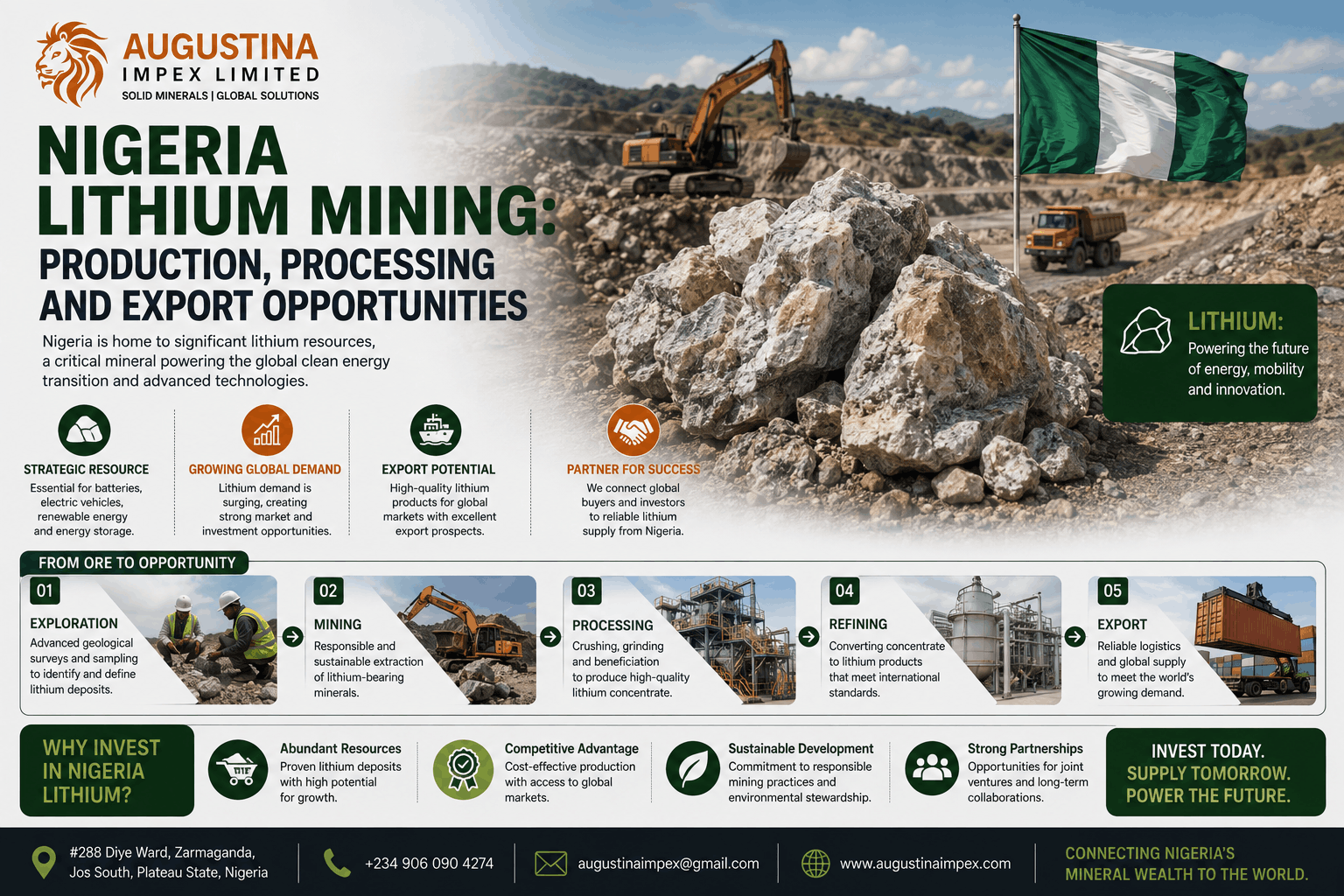
Nigeria Lithium Mining: Production, Processing & Export
Nigeria Lithium Mining: Production, Processing and Export Opportunities By Kolawole King, CEO — Augustina Impex…
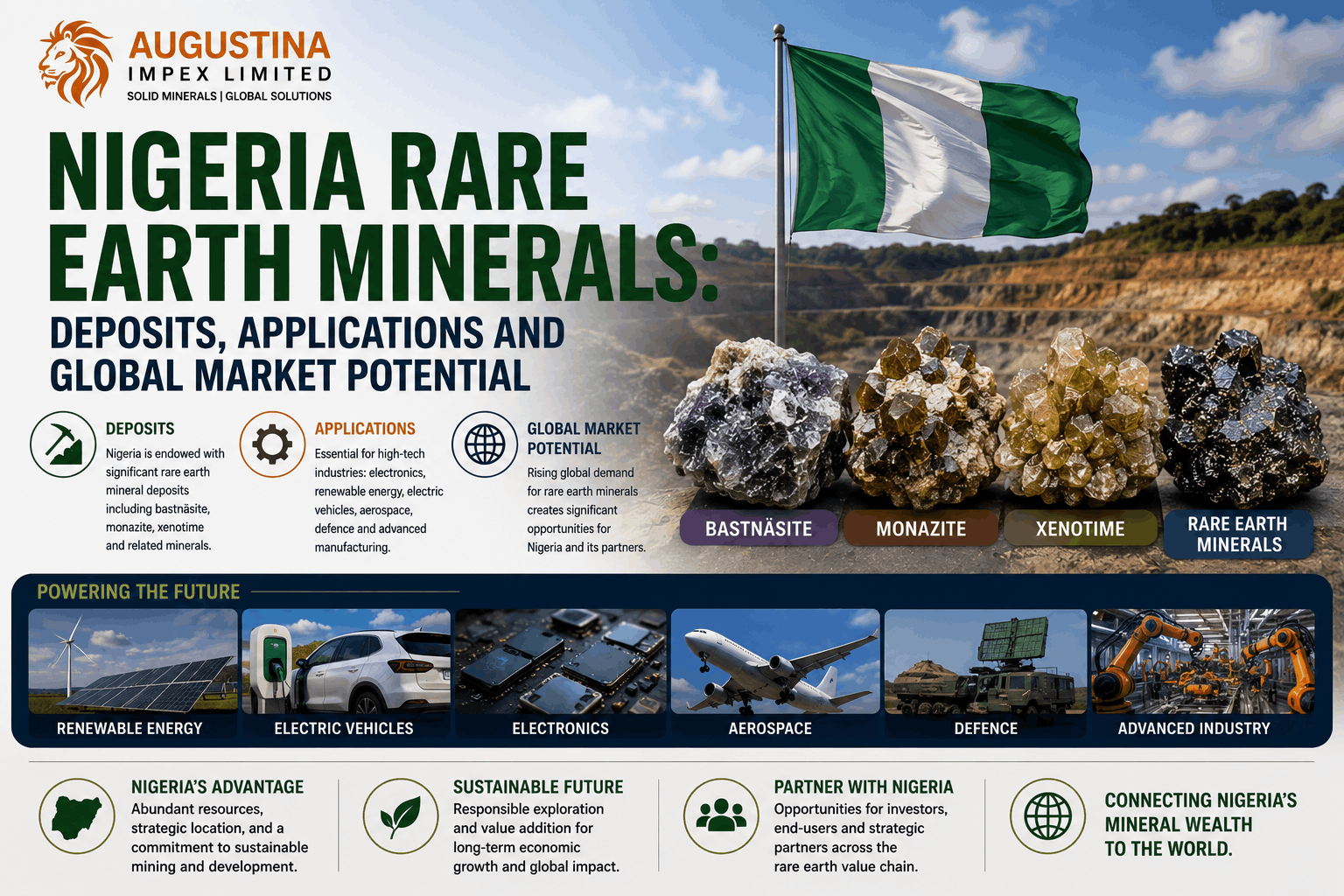
Nigeria Rare Earth Minerals: Deposits & Market Potential
Nigeria Rare Earth Minerals: Deposits, Applications and Global Market Potential By Kolawole King, CEO —…
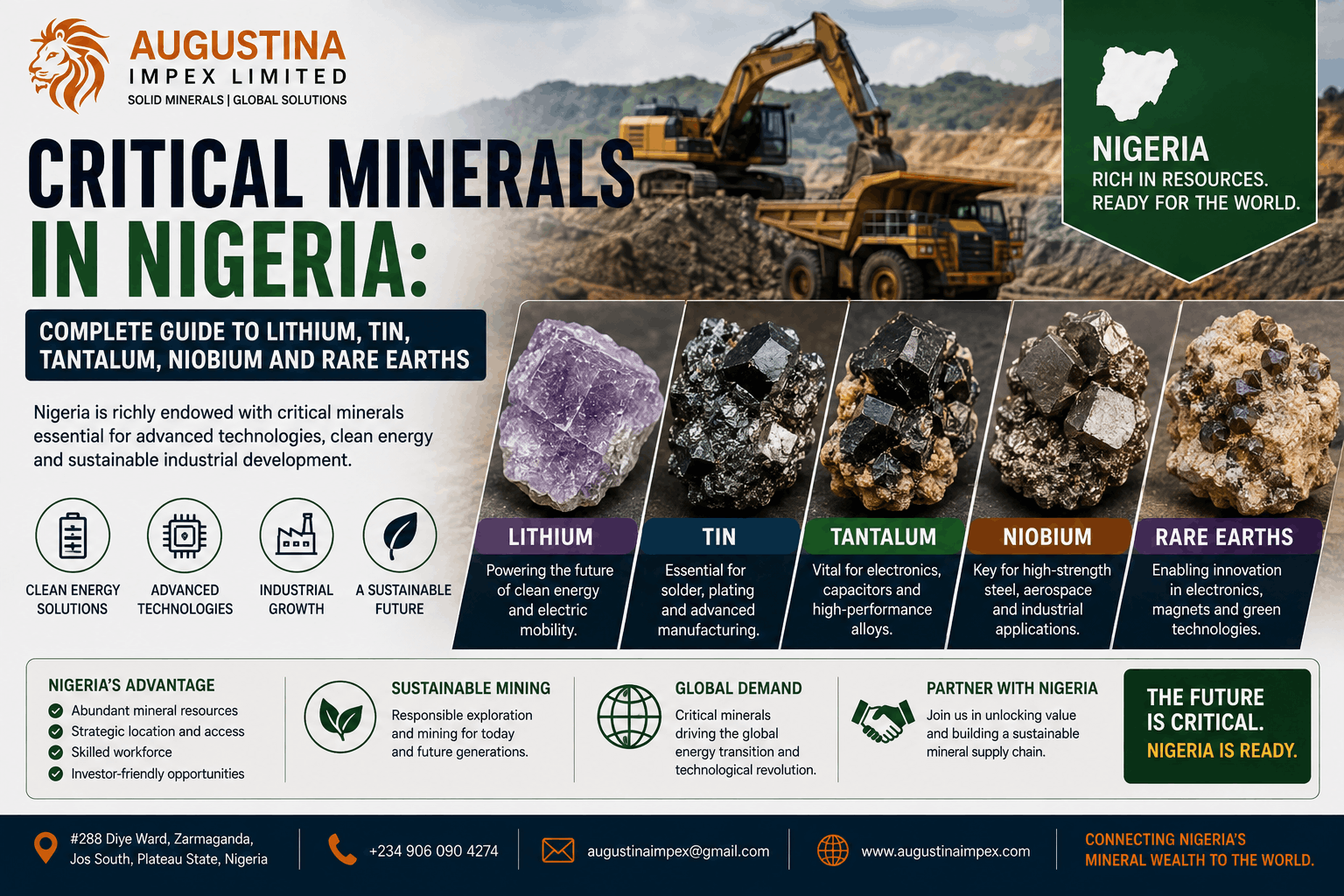
Nigeria Critical Minerals Guide: Lithium, Tin & Rare Earths
Critical Minerals in Nigeria: Complete Guide to Lithium, Tin, Tantalum, Niobium and Rare Earths By…
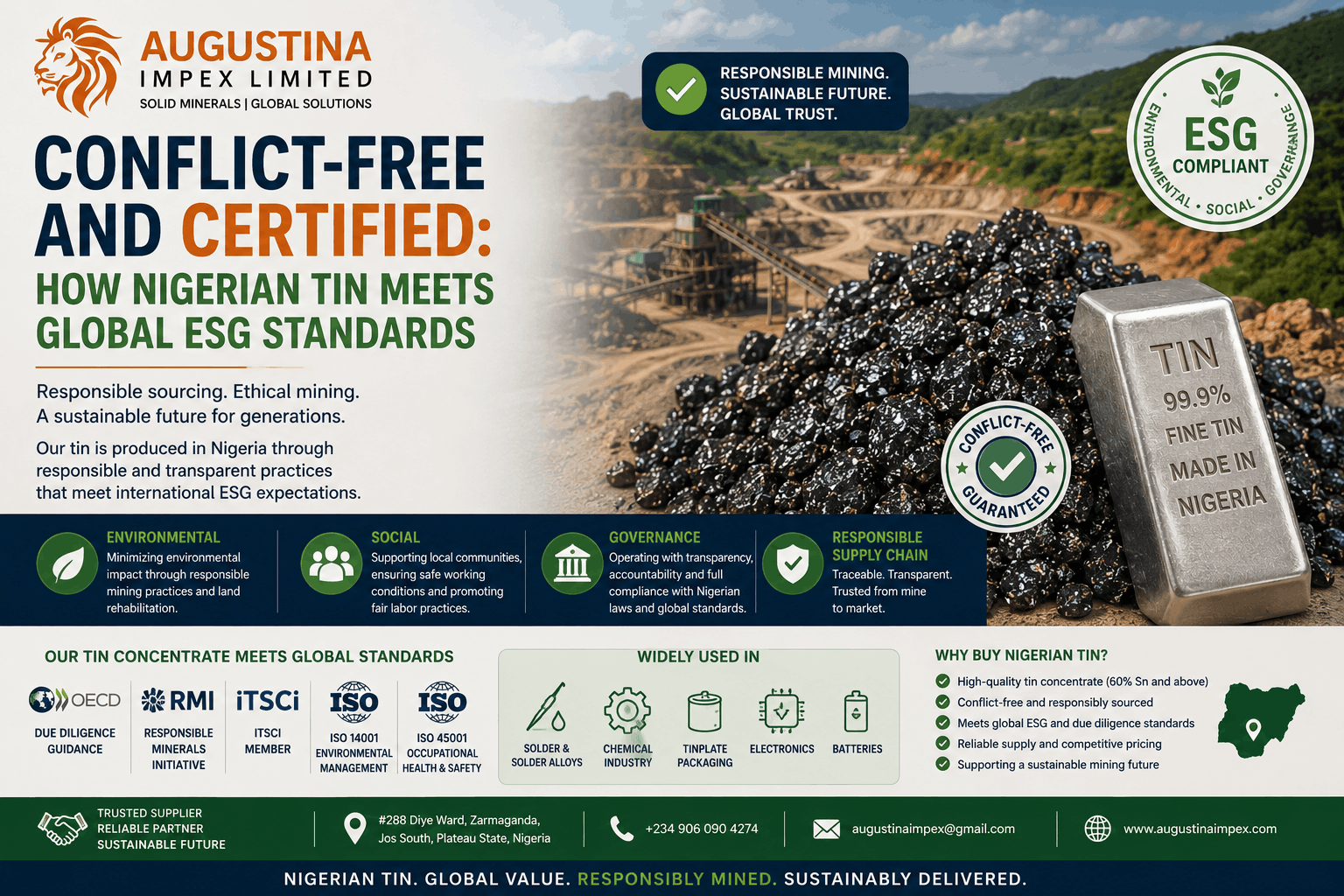
Conflict-Free Nigerian Tin Meets Global ESG Standards
Conflict-Free and Certified: How Nigerian Tin Meets Global ESG Standards By Kolawole King, CEO —…