
How to Export Solid Minerals from Nigeria: A Complete Step-by-Step Guide (2026)
By Kolawole King, CEO — Augustina Impex Limited | Published: August 2026 | Corporate Blog
Nigeria sits on one of the most mineral-rich landmasses on the African continent, yet much of its vast solid mineral wealth remains underutilised and under-exported. From the tin-rich plains of Plateau State to the lithium-laden pegmatites of Kwara and Nasarawa, from the lead-zinc belts of Benue to the rare earth deposits scattered across the Middle Belt — Nigeria’s mineral estate offers staggering commercial opportunity for those who know how to navigate it.
But here is the reality: the majority of would-be mineral exporters in Nigeria — whether Nigerian entrepreneurs, diaspora investors, or foreign buyers attempting to source directly — often get stuck at the regulatory, logistical, or commercial stage. The process seems complex, even opaque, from the outside.
This guide breaks it all down. Written by Kolawole King, CEO of Augustina Impex Limited — a fully licensed Nigerian solid minerals export company based in Jos, Plateau State — this is the most comprehensive, accurate, and practical guide available online for anyone who wants to understand how to export solid minerals from Nigeria in 2026 and beyond.
1. Nigeria’s Solid Minerals Landscape
2. Who Can Export Solid Minerals from Nigeria?
3. Key Regulatory Bodies You Must Know
4. Step-by-Step Export Process (10 Steps)
5. Required Export Documents
6. Understanding Incoterms for Nigerian Mineral Exports
7. Payment Terms in Nigerian Solid Minerals Export
8. Top Solid Minerals Available for Export
9. State-by-State Mineral Opportunities (GEO)
10. Common Mistakes to Avoid
11. How to Find International Buyers
12. How Augustina Impex Limited Can Help
13. Frequently Asked Questions
14. Conclusion
1. Nigeria’s Solid Minerals Landscape: A World of Opportunity
Nigeria is endowed with over 40 different solid mineral types, spanning 34 of its 36 states plus the Federal Capital Territory. The country’s geological diversity — a product of ancient cratons, Precambrian basement complexes, and sedimentary basins — produces everything from battery-critical lithium and coltan to construction minerals like granite and limestone, rare earth elements, precious metals, and industrial minerals.
For decades, Nigeria’s mineral potential was overshadowed by petroleum — the country’s dominant export. But with the global energy transition accelerating demand for battery metals, rare earths, and specialty minerals, and with oil revenues increasingly volatile, the Nigerian government has made diversification of exports through solid minerals a national economic priority.
Nigeria’s Ministry of Mines and Steel Development estimates the solid minerals sector could contribute up to $27 billion annually to the Nigerian economy if properly harnessed — compared to current actual export revenues that represent only a fraction of this potential. The opportunity for first-mover mineral exporters is enormous.
The Nigerian government, under the Federal Ministry of Mines and Steel Development (FMMSD), has progressively liberalised the mining and export regulatory framework over the past decade. New electronic licensing systems, reduced permit processing times, and active NEPC buyer facilitation programmes have made Nigerian mineral exports more accessible — though the landscape still demands expert navigation.
International buyers — from smelting companies in Shandong Province, China, to battery manufacturers in South Korea, to European rare earth processors — are increasingly sourcing from Nigeria as supply diversification from dominant producers like China and the DRC becomes a strategic priority. Nigeria’s moment in the global mineral supply chain has arrived.
2. Who Can Export Solid Minerals from Nigeria?
Before we walk through the export process, it is important to clarify who is legally permitted to export solid minerals from Nigeria. Under the Nigerian Minerals and Mining Act 2007 and its subsidiary regulations, the following categories of persons and entities may participate in solid minerals export:
| Category | Eligibility Requirement |
|---|---|
| Nigerian-Incorporated Company | Registered with CAC; holds a valid mineral trading or export licence |
| Licensed Mine Operator | Holds a valid Mining Lease (ML), Small-Scale Mining Lease (SSML), or Quarry Lease |
| Mineral Trading Licence Holder | Authorised to buy and sell; must export through a licensed export company |
| NEPC-Registered Exporter | Holds a current NEPC Export Registration Certificate (RE Number) |
In practice, most solid mineral exports from Nigeria are executed by registered export trading companies that aggregate minerals from mine owners, artisanal miners, and mineral trading licence holders — then handle all regulatory, documentation, and logistics aspects. This is the model operated by Augustina Impex Limited.
Foreign nationals cannot export directly in their own name — they must operate through a Nigerian-incorporated entity or appoint a licensed Nigerian export company as their agent. This is not a barrier; it is simply a feature of the Nigerian regulatory landscape that experienced export partners navigate daily on behalf of international clients.
3. Key Regulatory Bodies You Must Know
Navigating the Nigerian solid minerals export landscape requires understanding the roles of several key government agencies. Each has jurisdiction over different aspects of the export process — and engagement with the wrong agency for the wrong purpose is a common source of delay.
| Agency | Role in Mineral Export |
|---|---|
| FMMSD | Federal Ministry of Mines & Steel Development — oversees all mining; issues export permits |
| NEPC | Nigerian Export Promotion Council — registers non-oil exporters; issues RE Numbers; administers EEG |
| NESS | Nigerian Export Supervision Scheme — governs pre-shipment inspection and certification of exports |
| Nigeria Customs Service | Controls import/export at all ports and borders; processes export declarations (Form NXP) |
| Central Bank of Nigeria | Governs forex transactions, domiciliary accounts, and repatriation of export proceeds |
| CAC | Corporate Affairs Commission — company registration and incorporation |
| NNRA | Nigerian Nuclear & Radiological Regulatory Authority — regulates NORM minerals (Monazite, Zircon) |
4. Step-by-Step: How to Export Solid Minerals from Nigeria
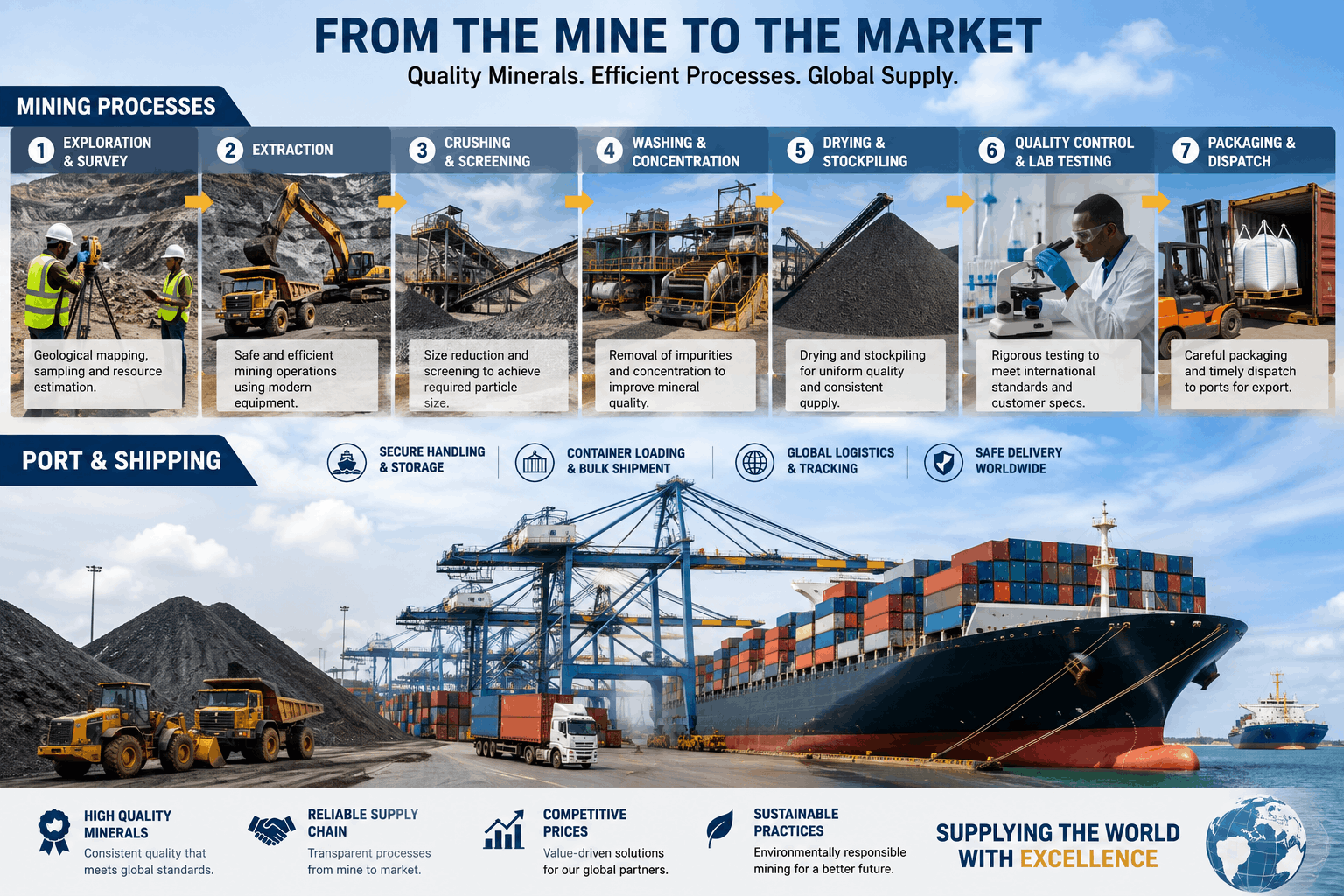
This is the heart of this guide. Below is the complete, professionally accurate, 10-step process for exporting solid minerals from Nigeria — drawn from active commercial experience in the Nigerian mineral export space. Follow these steps in sequence and you will navigate the process with confidence.
The very first step is securing your mineral supply from a legitimate, licensed source. Nigeria’s minerals must originate from licenced operations under the authority of the FMMSD. Exporting illegally mined minerals exposes you to serious legal penalties, including confiscation and prosecution.
Verify that your supplier holds one of the following: a Mining Lease (ML), Small-Scale Mining Lease (SSML), Quarry Lease, or a valid Mineral Trading Licence. Request certified copies of these documents before any commercial commitment. In Nigeria’s mineral supply chain, due diligence at this stage prevents enormous headaches downstream. When in doubt, verify directly with the Mining Cadastre Office in Abuja.
To export solid minerals from Nigeria as a legal entity, your company must be registered with the Corporate Affairs Commission (CAC). Foreign nationals cannot export directly — they must either partner with or acquire a Nigerian-registered entity. The company’s Memorandum and Articles of Association (MEMART) must include mineral trading and export in its stated objectives.
CAC registration typically takes 2–5 business days for online applications in 2026. You will receive a Certificate of Incorporation and a CAC Registration Number — both required for all subsequent export licensing. Note that CAC registration alone does not authorise mineral export; it is only the first prerequisite for the licences that follow.
The Federal Ministry of Mines and Steel Development (FMMSD) issues Mineral Export Permits to qualified entities. Application is made at the Mining Cadastre Office in Abuja or through the ministry’s online portal. Required documents typically include your CAC certificate, MEMART, Tax Identification Number (TIN), passport photographs of directors, and a description of the minerals to be exported.
Processing time varies from 2 to 6 weeks depending on the mineral type and the current workload at the ministry. For NORM-classified minerals (Naturally Occurring Radioactive Material) — such as Monazite Sand, Zircon Sand, Ilmenite, and Rutile — you will additionally need a dedicated export permit from the Nigerian Nuclear and Radiological Regulatory Authority (NNRA), which runs its own separate application and compliance review process.
Every company that exports from Nigeria — whether goods, commodities, or services — must register with the Nigerian Export Promotion Council (NEPC). NEPC issues an Export Registration Certificate (RE Number), which is mandatory for all export transactions at Nigerian ports and borders. Without your NEPC RE Number, your export will not clear Nigerian Customs.
NEPC registration is conducted online and requires CAC documents, TIN, bank details, and product/commodity information. The RE Number is issued for a specific validity period and must be renewed. NEPC registration also opens access to the Export Expansion Grant (EEG) — a government rebate programme that rewards exporters for contributing to Nigeria’s non-oil foreign exchange earnings. Augustina Impex Limited’s NEPC RE Number is 0039421, valid through July 2027.
Before any commercial shipment, an independent laboratory assay of the mineral’s chemical composition and grade is essential. This is the bedrock of trust in the Nigerian mineral trade. Disputes about grade and composition are the single most common source of transaction failure in this industry — and an assay certificate is your first line of defence.
In Nigeria, reputable ISO/IEC 17025-accredited laboratories include Zirconex Mining and Metal Laboratory (Abuja), ALS Minerals (Lagos), and several FMMSD-recognised labs. For international transactions, the buyer may also commission an independent assay upon receipt of samples. Always ensure your pre-shipment sample is drawn representatively from the full cargo — not cherry-picked — and properly sealed to maintain chain of custody integrity.
Pre-shipment inspection (PSI) is both a Nigerian regulatory requirement under the Nigerian Export Supervision Scheme (NESS) and a commercial necessity. International buyers — especially in China, India, and Europe — will routinely insist on inspection by a globally recognised inspection company before releasing payment.
The three internationally recognised inspection companies most commonly used in Nigerian mineral exports are: SGS Nigeria, CCIC Nigeria (China Certification and Inspection Corporation), and Bureau Veritas Nigeria. Inspection typically covers quantity verification (weight/tonnage), sampling, visual inspection, and — depending on the contract — grade analysis. It occurs at the loading point (mine, processing plant, or designated warehouse) or at the port. The resulting Inspection Certificate is one of the most critical documents in the export file and will be demanded by the buyer before any funds are released.
Export documentation is the paper trail that legitimises your shipment and enables it to cross borders legally. Missing or incorrect documentation is a leading cause of shipment delays, port detention, and buyer disputes in Nigerian mineral exports. The complete set of required documents is listed in Section 5 of this guide. At this stage, begin compiling and cross-checking every document — ensuring names, quantities, weights, HS codes, and declared values are consistent across all documents before submission to Customs.
Your licensed freight forwarder will assist with the preparation of the Single Goods Declaration (SGD) in the Nigeria Customs Service electronic system (eTrade), and will ensure your cargo is correctly declared with the appropriate HS Code for the mineral being exported. Different minerals carry different HS Codes — and incorrect classification can result in delays, fines, or cargo examination.
The Nigerian Export Supervision Scheme (NESS) is administered by the Federal Ministry of Finance through approved inspection companies (SGS, CCIC, Bureau Veritas). It mandates that all Nigerian exports above a threshold value undergo pre-shipment verification. The resulting Combined Certificate of Value and Origin (CCVO) — commonly called the NESS Certificate — is the document that grants your shipment clearance to leave Nigerian territory.
The NESS certificate confirms the FOB value of the goods and the country of origin. Without it, your cargo will be held at the port of exit. The process is initiated by the exporter applying to one of the approved inspection companies, who schedule the on-site inspection, collect their fee, and issue the certificate upon satisfactory completion. This step runs in parallel with Step 6 — they are usually done by the same inspection company in a combined engagement.
Shipping solid minerals from Nigeria involves selecting the right mode of transport, the right port, and the right Incoterm. The most commonly used ports for Nigerian solid mineral exports are Tin Can Island Port and Apapa Port, both in Lagos. Onne Port (Rivers State) and Warri Port (Delta State) are also used for some mineral exports originating from southern Nigeria.
Most mineral exports move in 20-foot dry containers (approximately 25–28 MT per container) or 40-foot containers. For very large volumes exceeding 5,000 MT, bulk vessels may be chartered. For exporters in northern Nigeria (Plateau, Nasarawa, Kwara, Kaduna States), road haulage to Lagos is the standard inland movement route — typically 8–15 hours depending on origin. Engage a reputable, licensed freight forwarder with solid mineral export experience to handle container booking, port formalities, and Bill of Lading documentation.
Payment is the final — and most critical — step. In the Nigerian solid minerals export trade, the standard payment term is 100% advance Telegraphic Transfer (T/T) prior to shipment, particularly for first-time transactions with new buyers. This is not a sign of bad faith — it is the commercial reality of a market where trust is built over time.
For established relationships, structures such as 50% advance / 50% upon Bill of Lading or payment against a Letter of Credit (LC) may be negotiated. Export proceeds must be repatriated to Nigeria through a CBN-licensed bank within the timeframe specified in CBN regulations — typically 90 days of shipment. This is enforced through Form NXP, which your bank will use for proceeds reconciliation.
5. Required Export Documents: Quick Reference
| # | Document | Issued By | Required For |
|---|---|---|---|
| 1 | Commercial Invoice | Exporter | All exports |
| 2 | Packing List | Exporter | All exports |
| 3 | Certificate of Origin | NACCIMA / NEPC | All exports |
| 4 | NESS / CCVO Certificate | SGS / CCIC / BV | All exports |
| 5 | Bill of Lading | Shipping Line | All sea exports |
| 6 | Mineral Export Permit | FMMSD | All mineral exports |
| 7 | NEPC RE Certificate | NEPC | All exports |
| 8 | Form NXP | Exporter’s Bank / CBN | All exports |
| 9 | Lab Assay Certificate | Accredited Laboratory | All mineral exports |
| 10 | NNRA Export Permit | NNRA | NORM minerals only |
| 11 | Material Safety Data Sheet (MSDS) | Exporter / Lab | NORM minerals & DG cargo |
6. Understanding Incoterms for Nigerian Mineral Exports
Incoterms — International Commercial Terms published by the International Chamber of Commerce — define the responsibilities of buyers and sellers in international trade. In Nigerian solid mineral exports, three Incoterms dominate:
| Incoterm | Meaning | Seller’s Risk Ends | Freight Paid By |
|---|---|---|---|
| EXW (Ex-Works) | Goods available at seller’s premises or mine | At mine/warehouse gate | Buyer pays all freight |
| FCA (Free Carrier) | Goods delivered to buyer’s carrier at named location | At named handover point | Buyer pays ocean freight |
| FOB (Free on Board) | Goods loaded on vessel at Nigerian port | On board the vessel | Buyer pays ocean freight |
At Augustina Impex Limited, we default to EXW (Ex-Works, Nigeria) or FCA (Nigerian Export Port) as our standard terms. This protects the seller and places freight, insurance, and ocean carriage responsibility squarely on the buyer. In the Nigerian mineral trade, this is the industry standard — and buyers from China, India, and Europe are entirely accustomed to it. Do not allow a buyer to pressure you into CIF pricing on a first transaction unless you have substantial experience in international freight management and the margin to absorb the associated risk.
7. Payment Terms in Nigerian Solid Minerals Export
Payment in international mineral trade is a subject that cannot be glossed over. The history of the Nigerian mineral export market includes transactions that failed — and exporters who were defrauded — due to poorly structured payment terms. Here is how the professional landscape looks in 2026:
| Payment Term | Description | Best For |
|---|---|---|
| 100% Advance T/T | Full payment wired before shipment begins | First-time buyers; small-to-mid transactions |
| 50% Advance / 50% B/L | 50% before shipment; 50% upon Bill of Lading | Established buyer relationships |
| Letter of Credit (LC) | Bank guarantees payment on presentation of compliant documents | Large contracts; institutional buyers |
| Port Payment | Buyer’s inspector tests at port; payment on acceptance of results | Buyers with agent presence in Nigeria |
The Nigerian mineral export space attracts fraudulent actors on both sides. Buyers posing as legitimate importers have defrauded exporters; “exporters” posing as licensed suppliers have defrauded international buyers. Protect yourself: always verify company registration, check NEPC RE numbers independently, demand CCIC/SGS inspection, and never release goods before your bank confirms cleared funds — not merely a payment notification or SWIFT copy.
8. Top Solid Minerals Available for Export from Nigeria
Nigeria’s mineral portfolio is genuinely impressive. The following table shows key minerals currently in active international demand from Nigeria’s mining sector, along with typical grade specifications and major buyer markets:
| Mineral | Key Specification | Key States | Main Buyer Markets |
|---|---|---|---|
| Lithium Ore (Spodumene) | Li₂O: 1%–5.5%+ | Kwara, Nasarawa, Oyo | China, India, Europe |
| Lepidolite | Li₂O: 1.2%–2.5% | Edo (Auchi) | China, South Korea |
| Bastnasite (Rare Earth) | REO: Ce, La, Pr, Nd | Plateau, Lagos | China, Japan, Europe |
| Fluorite Ore (Fluorspar) | CaF₂: 60%–85% | Benue, Cross River, Kogi | China, USA, Europe |
| Coltan / Tantalite | Nb₂O₅ + Ta₂O₅: 35%–55%+ | Plateau, Nasarawa, Zamfara | China, Germany, USA |
| Tin Concentrate (Cassiterite) | Sn: 60%+ | Plateau State (Jos) | China, Malaysia, Indonesia |
| Lead Ore (Galena) | Pb: 40%–70% | Plateau (Kanam LGA), Benue | China, India |
| Copper Ore | Cu: 3%–11% | Nasarawa, Plateau, Zamfara | China, India, Europe |
| Zircon Sand | ZrO₂: 40%–66.5% | Plateau, Kaduna | China, Europe |
| Monazite Sand | TREO 52.2%, NdPr 12.0% | Plateau, Kaduna | Europe, USA, Japan |
| Graphite Ore | TGC: 80%–95% | Cross River, Ogun | China, USA, India |
| Wolframite (Tungsten) | WO₃: 30%–50% | Plateau, Nasarawa | China, Austria, Germany |
9. State-by-State Mineral Opportunities in Nigeria
One of the most frequently searched questions in the Nigerian mineral export space is: “Where exactly in Nigeria are these minerals found?” Here is a practical geographic overview — covering the states that matter most for international buyers and exporters seeking specific mineral supply origins.
Plateau State is widely regarded as the historic epicentre of Nigerian mining. Jos, the state capital, hosts the largest concentration of solid mineral exporters, HMS processing plants, and mineral buying agents in the country. Key minerals include: Tin (Cassiterite), Coltan, Zircon, Monazite, Bastnasite, Lithium Ore, Lead Ore (Kanam LGA), Copper Ore, and heavy mineral sands. The Jos Plateau hosts Nigeria’s most active artisanal and small-scale mining (ASM) sector, with major active zones in Bukuru, Barkin Ladi, Shen, Ropp, Rayfield, and Kanam Local Government Areas.
Nasarawa State is increasingly prominent in Nigerian solid minerals export, particularly for Copper Ore from the Akiri Mine (Keana LGA — one of Nigeria’s most significant known copper deposits), Lithium Ore (Bina-Binnde district), and Coltan. The state’s proximity to Abuja (Nigeria’s capital) facilitates direct regulatory engagement with the FMMSD Mining Cadastre Office. Nasarawa is expected to become a major player in Nigeria’s copper and lithium export growth trajectory over the next decade.
Kwara State contains significant spodumene-kunzite lithium pegmatite deposits, particularly in the Oke-Oyi and surrounding areas. These deposits have attracted Chinese, Indian, and European buyer interest as global demand for battery-grade lithium surges. Kwara lithium ore typically assays at Li₂O 1%–5.5% depending on the specific location and processing stage. The state is also known for Coltan and Feldspar deposits.
Edo State, particularly the Auchi and environs area, hosts Nigeria’s most commercially active Lepidolite deposits — a lithium-rich mica mineral with Li₂O content ranging from 1.2% to 2.5%. Lepidolite from Auchi has been confirmed by multiple international buyers as a commercially viable source. Production is primarily through artisanal and small-scale mining, with aggregation and export facilitated by licensed trading companies.
Benue and Cross River States host commercially significant fluorite deposits with CaF₂ grades ranging from 60% to 85%. Fluorspar is in high global demand for aluminium smelting, steel production, and hydrofluoric acid manufacturing. Chinese buyers — particularly from Shandong and Fujian Provinces — have historically been major importers of Nigerian fluorspar. Kogi State also hosts growing fluorspar deposits.
Zamfara State contains rich deposits of Coltan, Copper Ore, and Gold. While artisanal gold mining in Zamfara has attracted significant security and regulatory attention, the state’s coltan and copper deposits represent growing commercial opportunities for properly licensed and fully compliant exporters.
Taraba and Adamawa States in northeastern Nigeria host significant Manganese Ore deposits (Mn: 35%–48%), Graphite, and construction minerals. These states represent an emerging frontier for Nigerian mineral exports — less developed than Plateau or Nasarawa, but with substantial untapped potential for exporters willing to build supply chains in the region.
10. Common Mistakes to Avoid When Exporting Minerals from Nigeria
Years of active experience in the Nigerian mineral export space have shown that certain mistakes are made repeatedly by first-time exporters and inexperienced middlemen. Avoiding these will save you money, time, and potentially your entire transaction.
① Quoting Prices Without a Buyer Specification
Every mineral deal begins with a specification. Grade, quantity, form (ore, concentrate, etc.), moisture content, and required incoterm must be confirmed by the buyer before any price is quoted. Pricing without specs leads to disputes, rejected shipments, and damaged commercial relationships.
② Dealing with Unlicensed Mineral Suppliers
Purchasing minerals from unlicensed or unverified sources exposes you to regulatory liability and potential seizure at the port. Always demand sight of the supplier’s mining licence or mineral trading licence — and verify it with FMMSD if in doubt.
③ Bypassing Pre-Shipment Inspection
Skipping CCIC/SGS/Bureau Veritas pre-shipment inspection — whether to save time or cost — is one of the most dangerous shortcuts in this business. Buyers will reject shipments without an inspection certificate, and you will have no legal protection in the event of a grade dispute.
④ Accepting Unverified Payment Instruments
Fraudulent Letters of Credit, fake SWIFT messages, and counterfeit bank guarantees are unfortunately common in the African commodity trade. Only accept payment through your bank’s verified channels and confirm receipt of cleared funds directly with your bank before releasing any shipment.
⑤ Under-Declaring Export Value
Some exporters attempt to under-declare the FOB value of mineral exports to reduce NESS inspection fees or tax liability. This constitutes a criminal offence under Nigerian law and subjects the exporter to prosecution, fines, and licence revocation. The NESS system cross-checks declared values against prevailing international market prices.
11. How to Find International Buyers for Nigerian Solid Minerals
Finding verified, serious international buyers is perhaps the most challenging aspect of the Nigerian mineral export business. Here are the most effective channels currently used by experienced Nigerian mineral exporters:
NEPC regularly organises international trade missions, online buyer-seller forums, and commodity exhibitions where Nigerian exporters connect directly with verified international buyers. Participation is strongly recommended for new exporters — and access is largely free or subsidised for NEPC-registered companies.
Platforms such as Alibaba, Global Sources, Made-in-China, IndiaMART, and specialised mineral trading exchanges host registered buyers from China, India, South Korea, Japan, and Europe who actively source African minerals. A professionally presented company profile with verified certifications is essential to attract serious enquiries.
LinkedIn remains one of the most effective platforms for connecting with mineral procurement managers, commodity traders, and industrial buyers across Asia and Europe. A well-maintained company LinkedIn page with regular content about your minerals, licences, and export capabilities generates consistent inbound buyer enquiries over time.
Attendance at international mining conferences — including the Mining Indaba (Cape Town), Investing in African Mining (London), and sector-specific exhibitions in Shanghai and Mumbai — provides direct access to mining executives, commodity traders, and institutional buyers. The cost of attendance is justified by the quality of buyer contacts available.
For mine owners and mineral producers who prefer to focus on production rather than export logistics and buyer development, partnering with a licensed, experienced mineral export company provides immediate access to an established international buyer network — without the time and cost of building market presence independently.
12. How Augustina Impex Limited Can Help You
Augustina Impex Limited is a fully registered and licensed Nigerian solid minerals export company, headquartered in Jos, Plateau State — Nigeria’s mineral heartland. Founded and led by Kolawole King (CEO), Augustina Impex operates as the critical bridge between Nigeria’s vast mineral wealth and the global industrial minerals market, connecting verified Nigerian mineral supply with qualified international buyers across Asia, Europe, the Middle East, and beyond.
Mineral Supply and Export — Aggregation, quality control, full export documentation, and shipment of Nigerian solid minerals to qualified international buyers.
HMS Toll Processing — Third-party ore processing through our partner Heavy Mineral Sands plant in Jos, using gravity, magnetic, electrostatic separation, and spiral concentrator technology.
Buyer-Seller Facilitation — Connecting verified Nigerian mineral producers with qualified international buyers on a structured commission basis.
Pre-Shipment Inspection Coordination — Full coordination of SGS, CCIC, and Bureau Veritas inspections at origin.
Sample Procurement and Dispatch — Representative mineral samples drawn, packaged, and dispatched to international buyers via DHL and specialist couriers.
Export Documentation — Complete preparation of all export documents: NESS certification, NEPC certificates, commercial invoices, packing lists, Certificates of Origin, and more.
Augustina Impex Limited is fully compliant with the FMMSD, NEPC (RE No. 0039421 — valid July 2027), and NNRA for NORM-classified minerals. Export operations are conducted under Jase Odus Nigeria Limited (RC 2022462). Our multi-state production network spans Plateau, Nasarawa, Taraba, Zamfara, Cross River, Kogi, Adamawa, Kwara, and Edo States.
13. Frequently Asked Questions (FAQ)
A: Not directly. Foreign nationals must operate through a Nigerian-incorporated company, or appoint a licensed Nigerian export company as their agent. Many international buyers partner with licensed Nigerian export companies — like Augustina Impex — who handle the export process end-to-end while the foreign buyer handles the import and onward processing in their country.
A: For an already-licensed exporter with minerals ready at the loading point, the export process — from inspection engagement to shipping — typically takes 2 to 6 weeks. The first-time licensing and registration steps (CAC, FMMSD, NEPC) add 4–10 weeks. Working with an experienced export facilitator like Augustina Impex compresses this timeline significantly, as the licensing and regulatory infrastructure is already in place.
A: There is no legally mandated minimum export quantity. Practically, most containerised mineral shipments start at one 20-foot container (approximately 25 MT). For air-shipped evaluation samples, even 10–500 kg are possible. Commercial scale contracts typically start at 100–500 MT per month and scale upward to thousands of MT for established supply relationships.
A: The majority of Nigerian solid mineral exports move through Tin Can Island Port and Apapa Port, both in Lagos — the busiest container port complex in West Africa. Shipping lines serving China, India, Europe, and beyond all call at Lagos regularly. For exporters in northern Nigeria (Plateau, Nasarawa, Kwara States), road transport to Lagos is the standard inland route — typically 8–15 hours by haulage truck.
A: Nigeria does not impose export duty on most solid minerals. However, exporters pay NESS inspection fees (a percentage of the declared FOB value), NEPC registration fees, FMMSD permit fees, and standard port handling charges. Mining royalties are payable to the state government under certain mining lease structures. NEPC-registered exporters may qualify for the Export Expansion Grant (EEG) rebate — a significant financial incentive for volume exporters.
14. Conclusion: Nigeria’s Mineral Wealth Is Ready for the World
Exporting solid minerals from Nigeria is neither as complicated as the uninitiated fear, nor as simple as opportunists would have you believe. It requires knowledge, regulatory compliance, the right partnerships, and a commitment to doing business with integrity and professionalism.
Nigeria stands at a pivotal moment in its minerals export story. The global energy transition — driven by electric vehicles, renewable energy storage, and the semiconductor revolution — is creating unprecedented demand for precisely the minerals Nigeria has in abundance: lithium, coltan, rare earths, tin, graphite, fluorite, and more. The world is actively seeking supply diversification beyond China and Australia. Nigeria is ready to step forward as a major, reliable, and compliant source.
Whether you are a Nigerian mine owner seeking a reliable export partner, a foreign buyer looking to source directly from Nigeria, or an entrepreneur exploring the solid mineral export business — the path is open. Follow the steps outlined in this guide, work with licensed and reputable partners, and the commercial opportunity is genuinely transformative.
Nigeria’s mineral wealth has waited long enough. It is time to connect it to the world — with transparency, reliability, and professionalism.
Augustina Impex Limited is your trusted partner for compliant, professional, and transparent Nigerian solid mineral export. We handle everything — from source verification and pre-shipment inspection to full export documentation and international shipment.
📧 augustinaimpex@gmail.com | 📞 WhatsApp: +234 906 090 4274
Kolawole King is the Chief Executive Officer of Augustina Impex Limited (RC 750691), a fully licensed Nigerian solid minerals export company headquartered in Jos, Plateau State, Nigeria. With active export operations across multiple mineral categories and buyer relationships in China, India, Belgium, South Africa, Japan, and beyond, Kolawole writes from direct commercial experience in the Nigerian mining and mineral export industry. Follow the company blog at augustinaimpexng.blogspot.com for regular market intelligence and export guides. Visit: www.augustinaimpex.com
-
Previous Post
Nigerian Monazite Sand Supplier
Post a comment
Related Posts
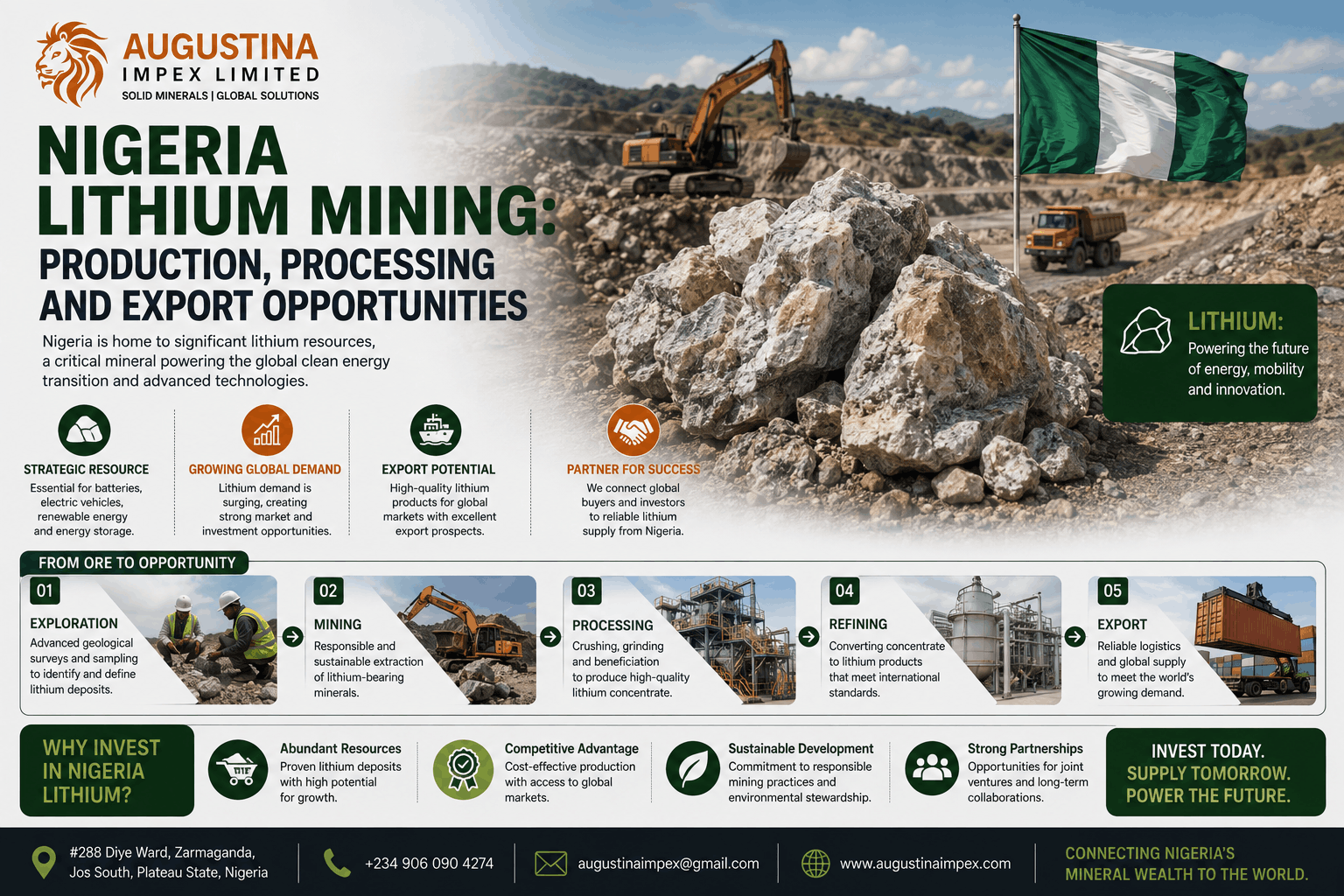
Nigeria Lithium Mining: Production, Processing & Export
Nigeria Lithium Mining: Production, Processing and Export Opportunities By Kolawole King, CEO — Augustina Impex…
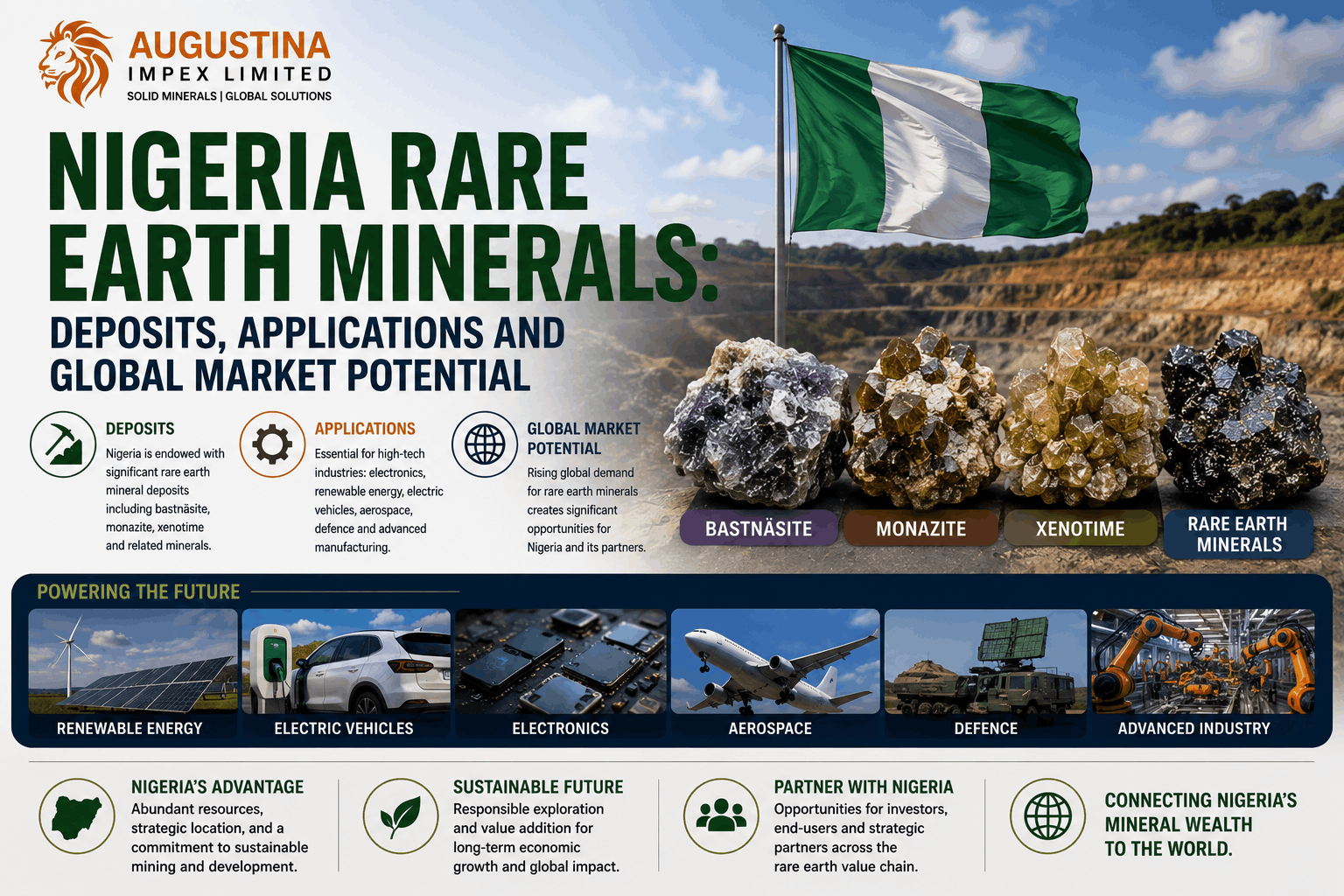
Nigeria Rare Earth Minerals: Deposits & Market Potential
Nigeria Rare Earth Minerals: Deposits, Applications and Global Market Potential By Kolawole King, CEO —…
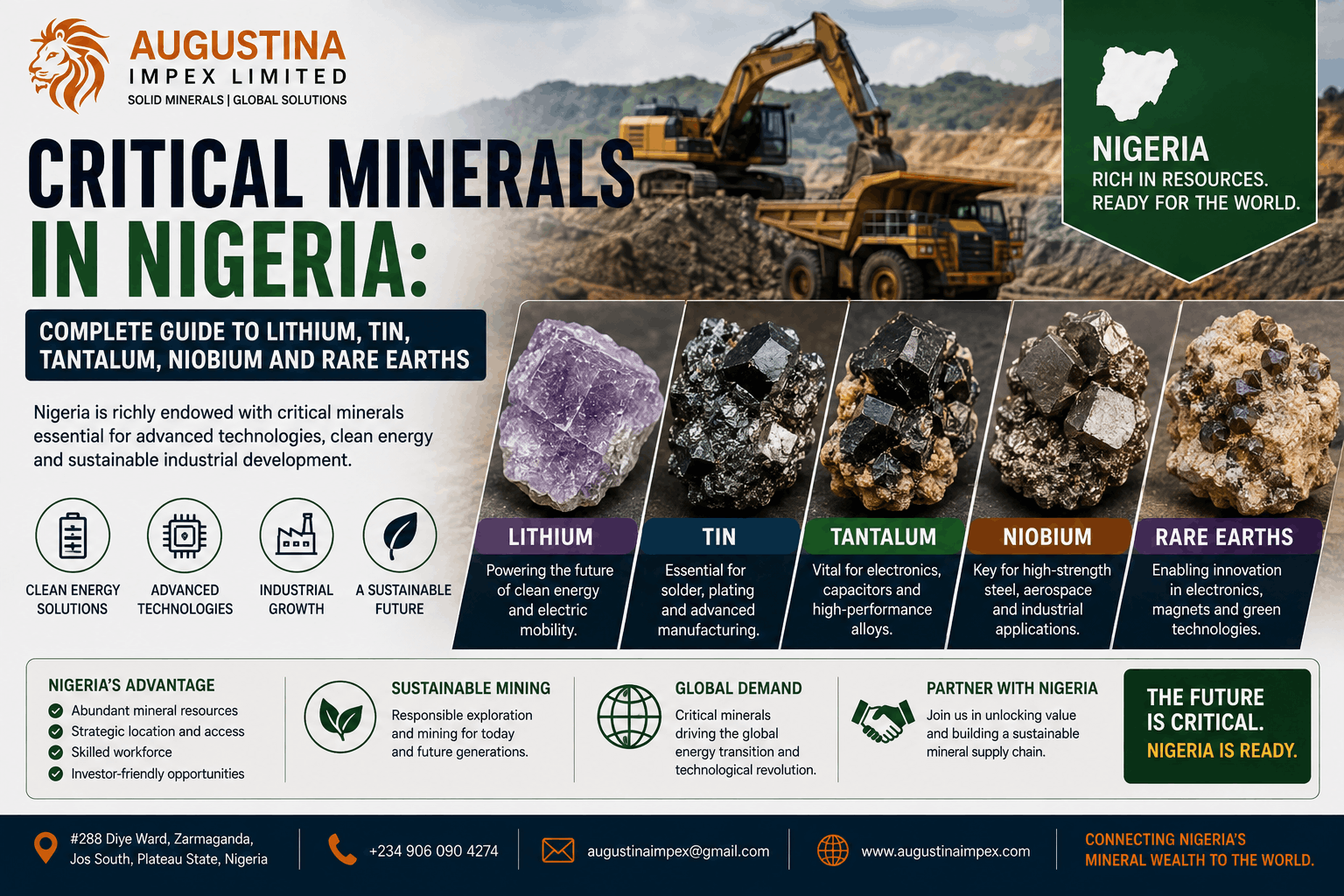
Nigeria Critical Minerals Guide: Lithium, Tin & Rare Earths
Critical Minerals in Nigeria: Complete Guide to Lithium, Tin, Tantalum, Niobium and Rare Earths By…
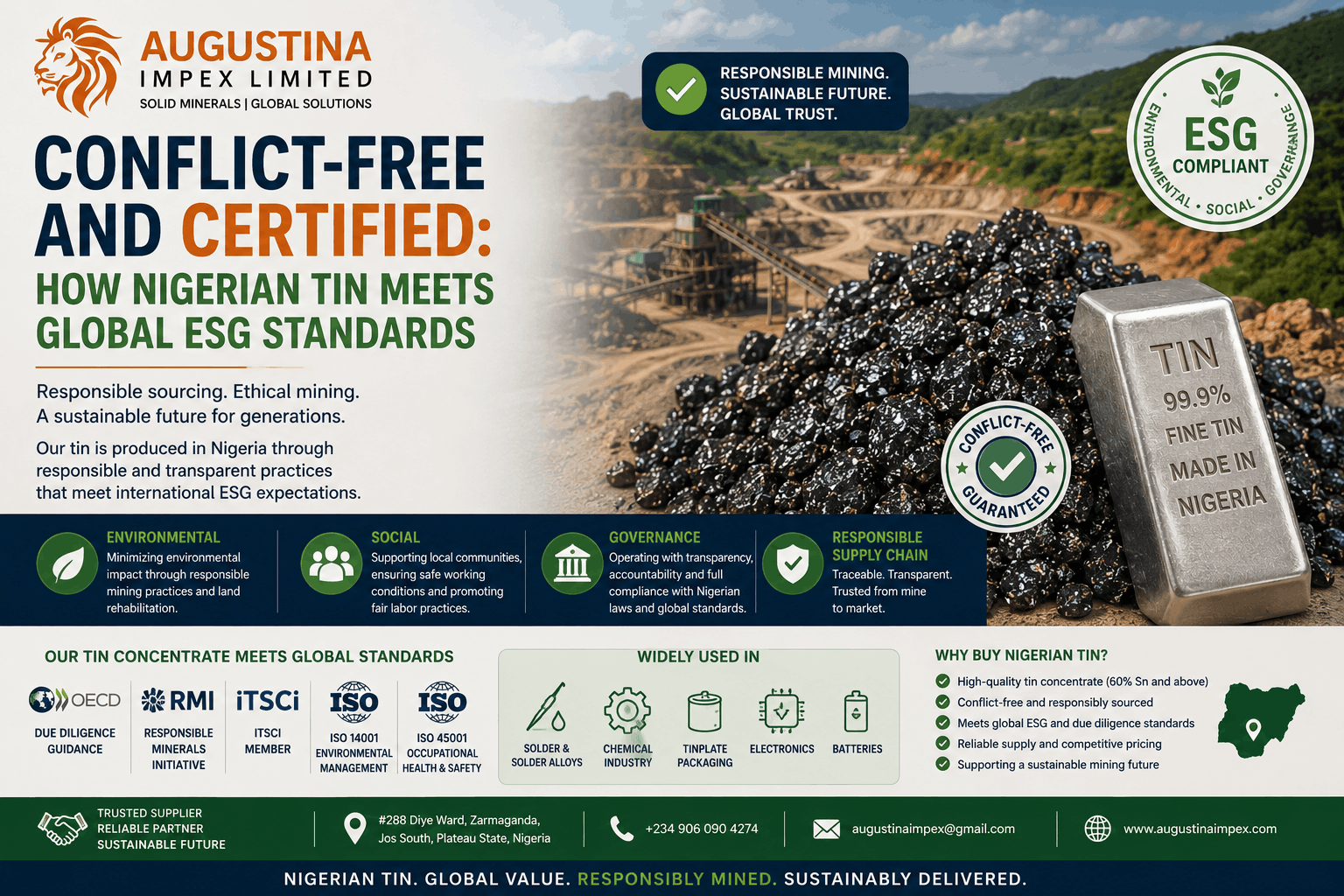
Conflict-Free Nigerian Tin Meets Global ESG Standards
Conflict-Free and Certified: How Nigerian Tin Meets Global ESG Standards By Kolawole King, CEO —…