

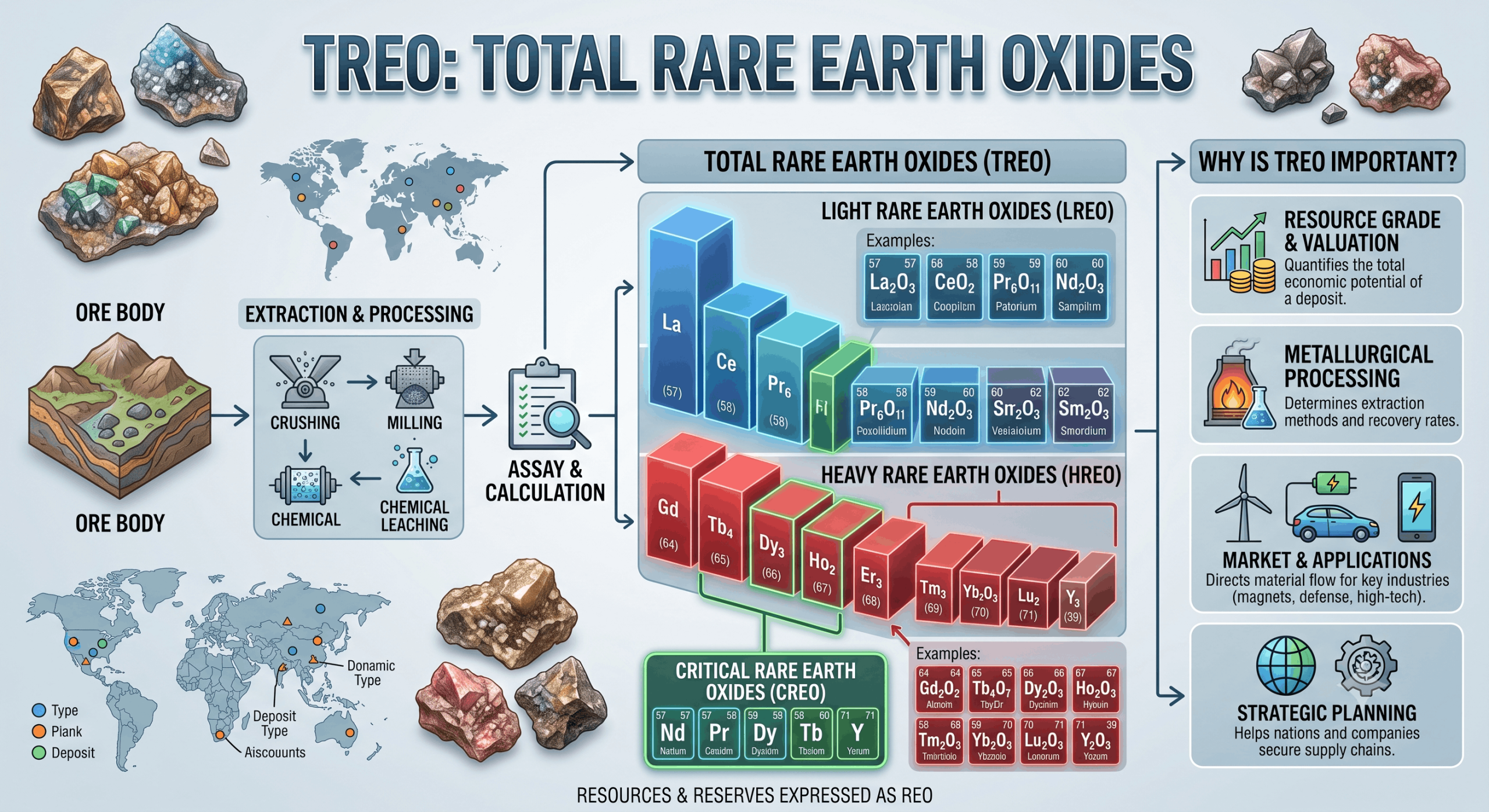
What Is TREO in Rare Earth Minerals? A Complete Guide
If you have ever looked at a rare earth mineral assay report or a supplier’s product specification sheet, you have almost certainly come across the acronym TREO. It appears alongside percentages, chemical symbols, and technical jargon that can feel overwhelming at first glance. But here is the truth: TREO is one of the most important numbers in the entire rare earth minerals industry — and once you understand what it means and why it matters, you will never look at a rare earth assay report the same way again.
Whether you are a mineral buyer, a procurement officer, a refinery operator, a commodities trader, or simply someone who wants to understand what makes one rare earth deposit commercially valuable while another sits untouched, this guide is written for you. We will break down exactly what TREO means, how it is measured, what constitutes a good TREO grade, and why the rare earth market — and the global clean energy economy — revolves around this single figure.
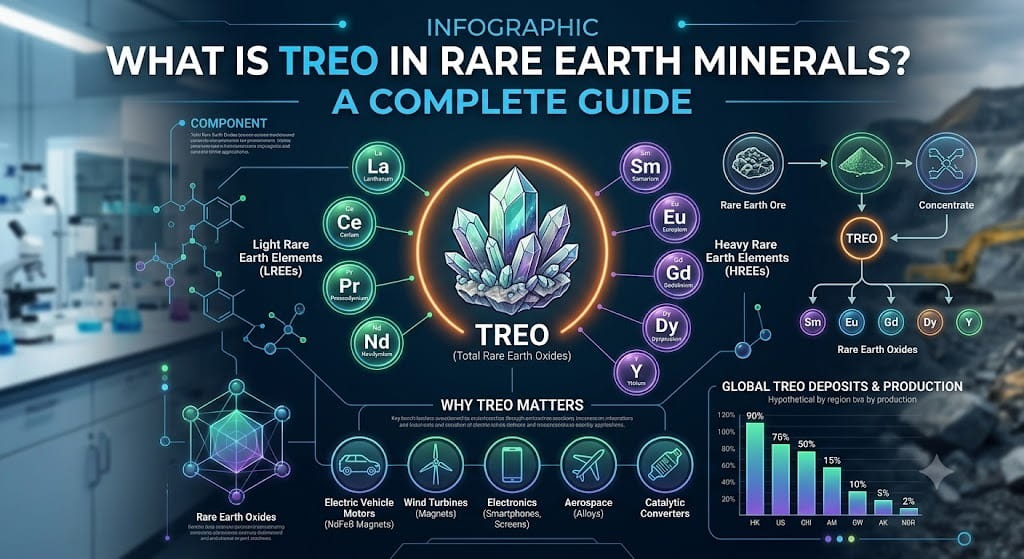
What Does TREO Stand For?
TREO stands for Total Rare Earth Oxide. It is a measurement — typically expressed as a percentage — of the total combined content of all rare earth element oxides present in a given mineral sample or concentrate. When a supplier says their bastnasite concentrate has a TREO of 70%, they are stating that 70% of the material by weight consists of rare earth oxides in their combined form.
To put it simply: TREO tells you how much rare earth content is actually in the material you are buying or selling. It is the single most important grade indicator in the rare earth minerals trade, functioning much like the gold grade (grams per tonne) in the gold market, or the iron content percentage in iron ore.
The term “oxide” is used because rare earth elements are almost always measured and reported after conversion to their oxide form. When a laboratory analyses a rare earth sample, it measures each element and reports the result as an equivalent oxide percentage. These individual oxide percentages are then added together to produce the TREO figure.
What Are Rare Earth Elements (REEs)?
Before going deeper into TREO, it helps to understand what rare earth elements actually are. Rare earth elements — also known as rare earth metals or REEs — are a group of 17 metallic elements that share similar chemical properties. They consist of the 15 lanthanides (elements 57 to 71 on the periodic table) plus Scandium (Sc) and Yttrium (Y), which are chemically similar and typically found in the same ore deposits.
The 15 lanthanide elements are:
- Lanthanum (La)
- Cerium (Ce)
- Praseodymium (Pr)
- Neodymium (Nd)
- Promethium (Pm)
- Samarium (Sm)
- Europium (Eu)
- Gadolinium (Gd)
- Terbium (Tb)
- Dysprosium (Dy)
- Holmium (Ho)
- Erbium (Er)
- Thulium (Tm)
- Ytterbium (Yb)
- Lutetium (Lu)
Despite the name “rare,” most rare earth elements are actually relatively abundant in the Earth’s crust. The “rare” refers to the difficulty of finding them in high enough concentrations to make mining economically viable, and the complexity involved in separating and processing them once mined. This is precisely why TREO grade matters so much — a higher TREO means a more economically concentrated deposit, and a more valuable product.
How Is TREO Calculated?
TREO is calculated by adding together the individual oxide percentages of all rare earth elements detected in a laboratory assay of the mineral sample. Each rare earth element is converted to its oxide equivalent and expressed as a percentage of the total sample weight. The sum of all these individual oxide percentages equals the TREO.
The individual rare earth oxides that are typically reported include:
- La₂O₃ — Lanthanum Oxide
- CeO₂ — Cerium Oxide
- Pr₆O₁₁ — Praseodymium Oxide
- Nd₂O₃ — Neodymium Oxide
- Sm₂O₃ — Samarium Oxide
- Eu₂O₃ — Europium Oxide
- Gd₂O₃ — Gadolinium Oxide
- Tb₄O₇ — Terbium Oxide
- Dy₂O₃ — Dysprosium Oxide
- Ho₂O₃ — Holmium Oxide
- Er₂O₃ — Erbium Oxide
- Tm₂O₃ — Thulium Oxide
- Yb₂O₃ — Ytterbium Oxide
- Lu₂O₃ — Lutetium Oxide
- Y₂O₃ — Yttrium Oxide
A complete assay report will list each of these individually before presenting the TREO total. In practice, not all rare earth oxides will be present in significant quantities in every deposit — the distribution varies considerably depending on the ore type and geological formation.
TREO vs. REO — What Is the Difference?
You will sometimes see both TREO (Total Rare Earth Oxide) and REO (Rare Earth Oxide) used in industry documentation. While the two terms are often used interchangeably in informal contexts, there is a technical distinction that experienced buyers and geologists observe.
TREO refers to the total combined percentage of all rare earth oxides in the sample — it is the sum figure.
REO, when used on its own without the “T” (Total), can refer to either the same total figure or to an individual rare earth oxide (for example, “Ce REO” meaning the cerium oxide content specifically). In formal assay reports, TREO is the unambiguous term that refers to the total combined rare earth oxide content.
In commodity trading and pricing, when a buyer asks for the “REO grade,” they are almost always asking for the TREO figure — the total rare earth content. Understanding this distinction prevents costly miscommunications in commercial negotiations.
What Is a Good TREO Grade?
This is one of the most frequently asked questions in the rare earth minerals market, and the honest answer is: it depends on the ore type. Different rare earth-bearing minerals naturally concentrate at very different TREO levels. Here is a practical reference guide.
Bastnasite (Bastnaesite) Concentrate
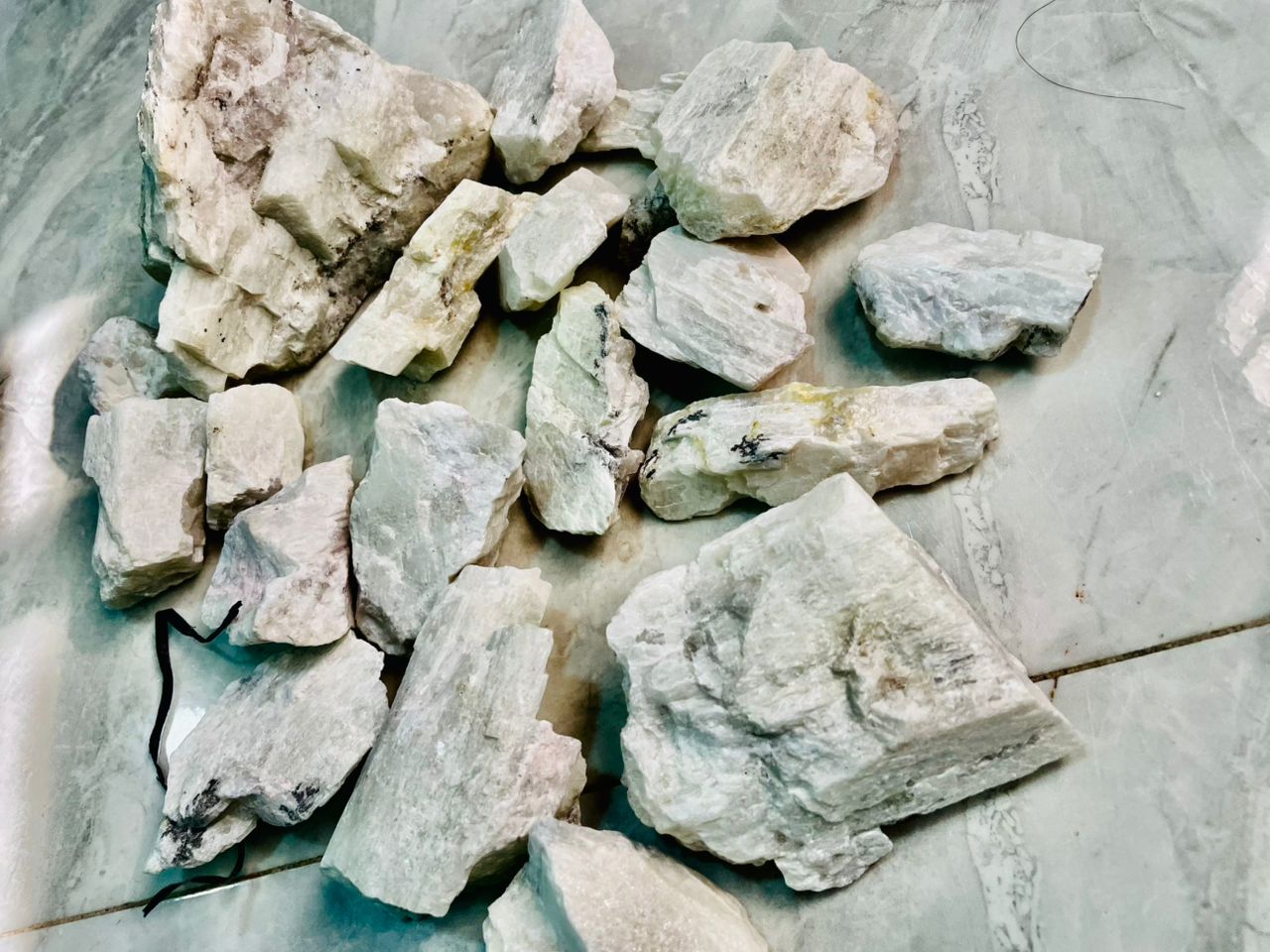
Bastnasite is a rare earth fluorocarbonate mineral and one of the primary commercial sources of light rare earth elements. In raw ore form, bastnasite typically carries a TREO of 0.5% to 10%. After beneficiation and concentration, commercially traded bastnasite concentrate ranges from 40% TREO on the lower end up to 72%+ TREO for premium-grade material. A TREO of 65% to 72% is widely considered high-grade and commands premium pricing in the international market.
Monazite
Monazite is a phosphate mineral rich in light rare earth elements. It typically carries 55% to 70% TREO. However, monazite also contains naturally occurring radioactive materials (NORM), specifically Thorium and Uranium, which adds regulatory complexity to its trade and transport.
Xenotime
Xenotime is a heavy rare earth-bearing phosphate mineral. Its TREO typically ranges from 54% to 67%.
Laterite and Ion Adsorption Clay Deposits
These deposits — common in Southern China — typically carry very low TREO grades, often between 0.05% and 0.2% in situ. However, they are particularly valued because they are disproportionately rich in heavy rare earth elements (HREEs), which are far scarcer and more valuable than light rare earths.
Loparite
A complex oxide mineral carrying TREO between 30% and 40%.
The takeaway is clear: when evaluating a rare earth product, always ask for the TREO figure and the ore type together. A 60% TREO bastnasite concentrate and a 60% TREO monazite concentrate are very different commercial propositions — with different chemistries, different processing requirements, and different regulatory frameworks.
Why TREO Matters So Much in the Rare Earth Trade
TREO is not just an academic measurement. In the commercial rare earth minerals market, it directly determines pricing, logistics economics, processing viability, and the strategic value of a deposit or product. Here is why every stakeholder in the rare earth supply chain pays close attention to this figure.
1. TREO Determines Price Per Tonne
Rare earth concentrates are priced primarily based on their TREO content. A supplier offering bastnasite at 65% TREO will command a significantly higher price per metric tonne than a supplier offering 45% TREO material, because the buyer is getting more actual rare earth content per tonne shipped, processed, and handled. In essence, TREO is a measure of value density.
2. TREO Affects Processing and Refinery Economics
Rare earth refineries and separation plants process concentrate to extract individual rare earth elements. The higher the TREO, the more productive the refinery run — fewer tonnes of raw material need to be handled, transported, and processed to produce the same output of separated rare earth products. A refinery running on 70% TREO bastnasite is significantly more efficient than one running on 40% TREO material.
3. TREO Affects Freight Efficiency
In international bulk mineral trade, you pay freight per tonne shipped — not per tonne of contained rare earth. If you are shipping 100 tonnes of 35% TREO material, you are effectively shipping 65 tonnes of gangue (non-valuable material) along with 35 tonnes of rare earth oxides. Ship 100 tonnes of 70% TREO material instead, and you are moving twice as much rare earth value for the same freight cost. This is why high-TREO concentrates trade at a premium that often exceeds the proportional TREO difference.
4. TREO Is the Foundation of Offtake Agreement Pricing
In formal supply contracts and offtake agreements, pricing formulas almost always reference TREO as the base unit. Penalty clauses for below-specification material and bonus clauses for above-specification material are typically structured around TREO thresholds. Understanding TREO is therefore not optional for any party entering a rare earth supply contract.
Understanding the REE Distribution Within the TREO
Here is something critical that many newcomers to the rare earth market overlook: not all TREO is equal. The distribution of individual rare earth elements within the TREO total can be as important as the TREO figure itself — sometimes even more so.
The rare earth elements are broadly divided into two groups.
Light Rare Earth Elements (LREEs)
These include Lanthanum (La), Cerium (Ce), Praseodymium (Pr), Neodymium (Nd), Samarium (Sm), and sometimes Europium (Eu). LREEs are generally more abundant and less expensive than HREEs. Most bastnasite deposits are LREE-dominant.
Heavy Rare Earth Elements (HREEs)
These include Gadolinium (Gd), Terbium (Tb), Dysprosium (Dy), Holmium (Ho), Erbium (Er), Thulium (Tm), Ytterbium (Yb), Lutetium (Lu), and Yttrium (Y). HREEs are far scarcer in nature, more difficult to process, and considerably more valuable per kilogram. A deposit with the same overall TREO but enriched in HREEs can be worth ten times more than an LREE-dominant deposit.
The Critical Importance of NdPr
Within the LREE group, two elements have emerged as uniquely critical for the modern economy: Neodymium (Nd) and Praseodymium (Pr), collectively referred to as NdPr.
NdPr is the primary feedstock for the manufacture of NdFeB (Neodymium-Iron-Boron) permanent magnets — the most powerful permanent magnets known to science. These magnets are indispensable components in:
- Electric vehicle (EV) traction motors
- Wind turbine generators
- Industrial servo motors
- Hard disk drives
- MRI machines
- Consumer electronics
The surge in global EV production and renewable energy investment has driven NdPr demand — and pricing — to historically elevated levels. As a result, the NdPr content as a percentage of the total TREO has become one of the most scrutinised figures in any rare earth assay report.
A bastnasite concentrate with a TREO of 70% where NdPr represents approximately 21% of that TREO is considered commercially excellent. This is because NdPr accounts for around 70 to 80% of the total value of a typical light rare earth concentrate, even though it represents a minority of the TREO by volume.
Reading a Rare Earth Assay Report: A Practical Example
To make this concrete, here is an illustrative example of how TREO appears in a typical rare earth assay report for a bastnasite concentrate:
| Element | Oxide Form | Content (% of Total Sample) |
|---|---|---|
| Cerium (Ce) | CeO₂ | 43.2% |
| Lanthanum (La) | La₂O₃ | 22.8% |
| Neodymium (Nd) | Nd₂O₃ | 15.4% |
| Praseodymium (Pr) | Pr₆O₁₁ | 5.6% |
| Samarium (Sm) | Sm₂O₃ | 1.8% |
| Gadolinium (Gd) | Gd₂O₃ | 0.7% |
| All Others Combined | Various | 0.5% |
| TREO (Total Rare Earth Oxide) | 70.0% | |
In this example, the NdPr content (Nd + Pr combined) is approximately 21% of the total TREO — a commercially attractive distribution for the NdFeB magnet supply chain. The TREO of 70% places this firmly in the high-grade category for bastnasite concentrate.
Radioactivity in Rare Earth Minerals: Thorium and Uranium
Any serious discussion of TREO and rare earth minerals must address the issue of naturally occurring radioactive materials (NORM), specifically Thorium (Th) and Uranium (U), which are commonly found in association with rare earth deposits.
This is a critical commercial and regulatory consideration. Many rare earth minerals — particularly monazite — contain significant levels of Thorium and Uranium, which classify the material as NORM and subject it to strict import, export, and processing regulations in most countries. Buyers in China, Europe, Japan, and the United States routinely specify maximum Th and U thresholds in their purchase specifications, and material exceeding those thresholds can be rejected, impounded, or incur significant regulatory penalties.
This is why any professional rare earth assay report should always include Thorium and Uranium readings alongside the TREO breakdown. A supplier who cannot provide Th and U data is a supplier you should approach with extreme caution.
From a commercial standpoint, zero Thorium and zero Uranium in a rare earth concentrate is an extraordinary advantage. It eliminates radioactivity-related shipping surcharges, simplifies export permitting, reduces port and customs risk, and makes the material accessible to a much wider range of refineries and end-users globally.
Nigerian Rare Earth Minerals and TREO: A Rising Global Source
Nigeria is rapidly emerging as one of the most significant rare earth mineral provinces in sub-Saharan Africa. The country’s geology — particularly in the Jos Plateau region and the North-Central and South-Eastern mining belts — hosts commercially significant deposits of bastnasite, monazite, xenotime, and associated heavy mineral sands.
What makes Nigerian rare earth deposits particularly noteworthy from a TREO perspective are several key characteristics.
High TREO Grades in Nigerian Bastnasite
Nigerian bastnasite concentrate — particularly material processed and beneficiated from the Jos Plateau and surrounding states — has consistently returned TREO grades in the range of 68% to 72% in independent third-party laboratory analysis. This places Nigerian bastnasite firmly in the premium-grade tier of the global market.
Confirmed NdPr Content
Independently certified assay results on Nigerian bastnasite concentrate have confirmed NdPr content in the range of approximately 21% of the total TREO — a commercially significant distribution that positions the material squarely within the NdFeB permanent magnet supply chain. For buyers sourcing material for magnet manufacturing, motor production, or wind turbine applications, this NdPr distribution is highly attractive.
Zero Thorium, Zero Uranium — A Decisive Advantage
Perhaps the most commercially decisive quality characteristic of Nigerian bastnasite from certified sources is the confirmed absence of Thorium and Uranium across multiple independently certified pit samples. In a global market where radioactivity concerns routinely complicate rare earth trade, a Nigerian bastnasite concentrate with confirmed zero Th and zero U offers a logistical and regulatory advantage that is genuinely rare and commercially powerful.
Regulatory Compliance and Supply Chain Transparency
Nigeria’s Federal Ministry of Mines and Steel Development (FMMSD), the Nigerian Export Promotion Council (NEPC), the Nigerian Export Supervision Scheme (NESS), and the Nigerian Nuclear and Radiological Regulatory Authority (NNRA) collectively provide a robust regulatory framework for rare earth mineral export. Licensed Nigerian exporters operating under these frameworks provide buyers with full documentation, third-party assay certificates, and internationally recognised pre-shipment inspection reports from agencies such as CCIC, SGS, and Bureau Veritas.
How Buyers and Refiners Evaluate TREO in Commercial Transactions
Understanding how professional buyers in China, Japan, Europe, and the United States evaluate TREO gives sellers a critical edge in commercial negotiations. Here is how the evaluation typically works in practice.
Step 1 — Request the Full Assay Report (Certificate of Analysis)
No serious buyer will make a purchase commitment on the basis of a headline TREO figure alone. They will always request the full certificate of analysis (CoA) showing the complete breakdown of individual rare earth oxides, together with Thorium and Uranium readings. The issuing laboratory’s ISO/IEC 17025 accreditation will also be scrutinised.
Step 2 — Evaluate the NdPr Content as a Value Driver
For most buyers in the current market, the NdPr fraction of the TREO is the primary economic value driver. A buyer supplying the magnet industry will calculate the contained NdPr per tonne shipped and price accordingly. NdPr represents the majority of the economic value of LREE-dominant bastnasite, even though it is a minority component by mass.
Step 3 — Assess the Radioactivity Profile
Thorium and Uranium levels are evaluated against the buyer’s regulatory requirements and import country thresholds. Material exceeding regulatory limits in the destination country is commercially worthless regardless of its TREO grade.
Step 4 — Verify the Product Form and Particle Size
Whether the concentrate is a granular product, a ball-milled fine powder, or unprocessed raw ore affects processing efficiency at the refinery. A buyer paying premium TREO prices expects a product that is ready for their processing flowsheet.
Step 5 — Confirm Supply Consistency Across Multiple Samples
Single assay results are rarely sufficient for establishing a long-term supply relationship. Serious buyers will request multiple assay reports from different pit samples or production batches to assess the consistency and reliability of the TREO grade across the supply chain.
TREO and the Global Clean Energy Revolution
It would be impossible to discuss TREO in rare earth minerals without acknowledging the macro-economic forces that have made this number more important than ever before in history.
The global transition to clean energy — driven by electric vehicles, offshore wind, grid-scale energy storage, and the electrification of industrial processes — has fundamentally restructured the demand landscape for rare earth elements. Consider these demand realities:
- A single electric vehicle contains approximately 1 to 2 kilograms of NdPr oxide in its traction motor.
- A single offshore wind turbine can contain 600 kilograms or more of rare earth magnets.
- Global EV sales are projected to exceed 40 million units annually by 2030.
- The International Energy Agency (IEA) projects that rare earth demand for clean energy applications alone could increase by more than 400% by 2040.
Against this demand backdrop, the supply side of the rare earth market faces mounting constraints. China currently controls the overwhelming majority of global rare earth refining capacity and has imposed export controls and production quotas in recent years. Western governments, Japanese corporations, and Korean manufacturers are actively diversifying their supply chains away from single-source dependency.
This supply-demand dynamic is precisely why African rare earth deposits — including Nigerian bastnasite with its high TREO, confirmed NdPr distribution, and zero radioactivity profile — are attracting serious commercial interest from international buyers who, just a few years ago, might not have considered a West African source.
TREO in Trade Documentation and Export Compliance
From an export documentation standpoint, TREO appears in several critical documents that any professional rare earth exporter must understand and manage correctly.
Certificate of Analysis (CoA)
The CoA, issued by an independent accredited laboratory, is the foundational document. It lists all individual rare earth oxide contents and the TREO total, along with Thorium, Uranium, and other relevant impurity readings. This document is reviewed by buyers, banks financing letters of credit, and customs authorities in the destination country.
Pre-Shipment Inspection Certificate
Issued by inspection agencies such as SGS, CCIC, or Bureau Veritas at the loading port, the pre-shipment inspection certificate confirms that the material being loaded meets the specifications agreed in the sales contract — including the TREO grade. Any discrepancy between the pre-shipment inspection result and the CoA can trigger payment disputes and contractual penalties.
NESS Certificate (Nigeria)
For Nigerian rare earth mineral exports, the Nigerian Export Supervision Scheme (NESS) certificate is a mandatory export document. It confirms the export value and quantity, and is required for the repatriation of export proceeds through the Nigerian banking system.
NEPC Export Certificate
The Nigerian Export Promotion Council (NEPC) registration and export certificate confirms that the exporter is duly licensed and that the goods meet export eligibility requirements under Nigerian law.
Common Misconceptions About TREO
Before we conclude, let us address some of the most common misconceptions about TREO that circulate — particularly among new entrants to the rare earth minerals trade.
Misconception 1: Higher TREO Always Means a Better Product
TREO is the primary grade indicator, but it does not tell the whole story. A 72% TREO concentrate with unfavourable NdPr distribution, high Thorium content, or inconsistent supply may be less commercially attractive than a 65% TREO product with excellent NdPr distribution, zero radioactivity, and a verified, consistent supply chain. Always evaluate the full picture.
Misconception 2: TREO and Purity Are the Same Thing
TREO is a measure of grade (concentration), not purity. A 70% TREO concentrate still contains 30% of other materials — gangue minerals, silica, iron oxides, and other non-rare-earth components. Purity refers to the degree to which individual rare earth elements have been separated from each other, which happens at the refinery stage after the concentrate has been processed.
Misconception 3: All TREO Figures Are Reported in the Same Way
Different laboratories and different reporting standards can sometimes result in slightly different TREO figures for the same material, depending on which elements are included in the summation and the analytical methods used. Always specify which laboratory conducted the analysis and request the detailed methodology alongside the results.
Frequently Asked Questions About TREO in Rare Earth Minerals
What does TREO stand for in rare earth minerals?
TREO stands for Total Rare Earth Oxide. It is the combined percentage of all rare earth element oxides present in a mineral sample or concentrate, and it is the primary grade indicator used in the rare earth minerals trade worldwide.
What is a good TREO percentage for bastnasite concentrate?
For bastnasite concentrate, a TREO of 65% to 72% is considered high-grade and commercially premium. Material below 50% TREO is generally considered lower grade and will command a lower price per tonne shipped.
Why is NdPr important within the TREO?
Neodymium (Nd) and Praseodymium (Pr) — collectively known as NdPr — are the primary feedstock for NdFeB permanent magnets used in electric vehicle motors, wind turbines, and clean energy technologies. Despite typically representing 18 to 25% of the TREO in bastnasite concentrates, NdPr accounts for the majority of the economic value of the product, making it the most commercially important component of any light rare earth concentrate.
Does high TREO mean the concentrate contains no Thorium or Uranium?
No. TREO grade and radioactivity (Thorium and Uranium content) are completely separate characteristics. Some high-TREO minerals — particularly monazite — can contain significant levels of Thorium and Uranium. Always request Th and U readings alongside the TREO in any assay report before making a commercial commitment.
Is Nigerian bastnasite high quality?
Yes. Independently certified Nigerian bastnasite concentrate from licensed producers has returned TREO grades of 68% to 72%, NdPr content of approximately 21% of TREO, and confirmed zero Thorium and zero Uranium — placing it among the most commercially attractive rare earth concentrates available on the international market today.
How is TREO different from the content of individual rare earth elements?
TREO is the sum total of all individual rare earth oxide percentages combined into a single figure. Individual rare earth element content refers to the specific percentage of each separate element within that total — for example, 43% CeO2, 22% La2O3, 15% Nd2O3, and so on. Both the total TREO figure and the distribution of individual elements within it matter critically in commercial evaluation.
Can TREO be independently verified before purchase?
Yes, and it should always be verified. Reputable suppliers will provide independent laboratory certificates of analysis (CoA) from ISO/IEC 17025-accredited laboratories. Buyers can also insist on pre-shipment inspection by internationally recognised agencies — SGS, CCIC, or Bureau Veritas — at the loading port as a contractual condition of purchase. This is standard practice in professional rare earth mineral trade.
What is the difference between LREE and HREE, and does it affect TREO evaluation?
Light Rare Earth Elements (LREEs) — such as Cerium, Lanthanum, Neodymium, and Praseodymium — are more abundant and less expensive per kilogram than Heavy Rare Earth Elements (HREEs) such as Dysprosium, Terbium, and Holmium. A TREO-bearing deposit enriched in HREEs can be dramatically more valuable per tonne than an LREE-dominant deposit with the same headline TREO figure. Always review the full elemental distribution, not just the TREO total.
Conclusion: TREO Is the Language of the Rare Earth Market
If the rare earth minerals industry has one universal language, it is TREO. Whether you are a Chinese refinery buyer, a Japanese magnet manufacturer, a European trading house, a West African mineral producer, or an investor evaluating the economics of a rare earth project, TREO is the number that sits at the centre of every conversation, every contract, and every commercial decision.
Understanding TREO — what it means, how it is measured, what constitutes a good grade, how radioactivity interacts with it, and how individual element distribution within the TREO affects value — gives you the foundation you need to participate confidently and professionally in the global rare earth minerals market.
At Augustina Impex Limited, we specialise in the aggregation, quality assurance, and international export of high-grade Nigerian solid minerals, including certified Nigerian Bastnaesite-Ce Rare Earth Concentrate with independently verified TREO grades of 68 to 72%, confirmed NdPr content of approximately 21% of TREO, and certified zero Thorium and zero Uranium across all tested pit samples.
Our operations are fully compliant with the Nigerian Minerals and Mining Act, the Nigerian Export Promotion Council (NEPC), the Nigerian Export Supervision Scheme (NESS), and the Nigerian Nuclear and Radiological Regulatory Authority (NNRA). All our mineral products are accompanied by third-party laboratory certificates from ISO/IEC 17025-accredited laboratories, pre-shipment inspection reports, and a full suite of internationally recognised export documentation.
If you are a qualified buyer or refinery operator looking for a reliable, transparent, and professionally managed supply of high-grade Nigerian bastnasite concentrate or other Nigerian rare earth minerals, we welcome your enquiry. Reach us through our website at www.augustinaimpex.com, send us an email at augustinaimpex@gmail.com, or contact us directly on WhatsApp at +234 906 090 4274.
Connecting Nigeria’s Mineral Wealth to the World — with Transparency, Reliability, and Professionalism.
-
Previous Post
Nigerian Mineral Export Process Explained
Post a comment
Related Posts
Nigeria Lithium Mining: Production, Processing & Export
Nigeria Lithium Mining: Production, Processing and Export Opportunities By Kolawole King, CEO — Augustina Impex…

Nigeria Rare Earth Minerals: Deposits & Market Potential
Nigeria Rare Earth Minerals: Deposits, Applications and Global Market Potential By Kolawole King, CEO —…
Nigeria Critical Minerals Guide: Lithium, Tin & Rare Earths
Critical Minerals in Nigeria: Complete Guide to Lithium, Tin, Tantalum, Niobium and Rare Earths By…
Conflict-Free Nigerian Tin Meets Global ESG Standards
Conflict-Free and Certified: How Nigerian Tin Meets Global ESG Standards By Kolawole King, CEO —…