


Introduction
Rare Earth Elements (REEs) have become some of the most strategically important minerals within the modern global economy. As industries worldwide continue transitioning toward:
- Electric vehicles
- Renewable energy systems
- Advanced electronics
- Aerospace technologies
- Defense applications
- High-performance manufacturing
the demand for rare earth minerals continues increasing significantly.
Rare earth elements are essential for producing:
- Permanent magnets
- Electric motors
- Wind turbines
- Industrial automation systems
- Advanced electronics
- Military technologies
As international competition for strategic mineral supply chains intensifies, rare earth pricing trends have become increasingly important for:
- Mining companies
- Mineral processors
- Commodity traders
- Industrial consumers
- Investors
- Governments
This article explores:
- Global rare earth pricing trends
- Market drivers affecting REE prices
- Monazite and Bastnasite market dynamics
- Supply chain diversification
- Nigeria’s opportunities within the rare earth market
- The future outlook for critical mineral pricing

Understanding Rare Earth Elements (REEs)
Rare Earth Elements are a group of strategically important metallic elements widely used in advanced technologies.
Important rare earth elements include:
- Neodymium (Nd)
- Praseodymium (Pr)
- Cerium (Ce)
- Lanthanum (La)
- Dysprosium (Dy)
- Samarium (Sm)
These elements are essential for:
- Electric vehicle motors
- Renewable energy systems
- Defense technologies
- Aerospace engineering
- Electronics manufacturing
As global industries modernize, rare earth demand continues increasing rapidly.
Why Rare Earth Prices Matter
Rare earth pricing is important because these minerals support industries critical to:
- Economic growth
- National security
- Clean energy transition
- Technological development
Price movements affect:
- Mining investment decisions
- Industrial production costs
- Strategic mineral trade
- Supply chain planning
Because REEs are essential for several advanced industries, pricing trends are closely monitored globally.
Major Factors Affecting Rare Earth Prices
Several factors influence global rare earth pricing trends.
1. Electric Vehicle Demand
The EV industry remains one of the largest drivers of rare earth demand.
Electric vehicles require:
- Permanent magnets
- Electric motors
- Battery technologies
Important rare earth elements such as:
- Neodymium
- Praseodymium
- Dysprosium
play critical roles in EV motor systems.
As global EV adoption increases, demand for rare earth feedstock continues growing.
2. Renewable Energy Expansion
Renewable energy technologies such as:
- Wind turbines
- Energy storage systems
- Grid infrastructure
depend heavily on rare earth materials.
Wind turbines, in particular, require high-performance permanent magnets containing rare earth elements.
This contributes to growing long-term demand.
3. Supply Chain Concentration
One of the major factors affecting rare earth pricing involves:
Supply chain concentration
Global rare earth production and processing remain concentrated within limited regions.
This concentration creates concerns related to:
- Supply security
- Geopolitical tensions
- Export restrictions
- Industrial dependency
As countries seek diversified supply chains, pricing volatility may increase.
4. Strategic Mineral Competition
Rare earth minerals are increasingly viewed as:
Strategic resources
Several governments worldwide are investing heavily in:
- Critical mineral supply chains
- Domestic processing
- Strategic reserves
- Alternative sourcing
This growing competition affects:
- Investment flows
- Market demand
- Long-term pricing trends
Monazite and Rare Earth Pricing
Monazite remains one of the world’s most important rare earth-bearing minerals.
It commonly contains:
- Cerium
- Lanthanum
- Neodymium
- Praseodymium
Monazite pricing is influenced by:
- TREO concentration
- Mineral purity
- Radioactivity considerations
- Particle sizing
- Rare earth market demand
Higher-grade monazite concentrates generally attract stronger commercial interest.
Understanding TREO in Rare Earth Markets
TREO stands for:
Total Rare Earth Oxides
TREO measures the total concentration of rare earth oxides contained within a mineral sample or concentrate.
Higher TREO levels generally indicate:
- Better concentrate quality
- Greater commercial attractiveness
- Stronger refining potential
TREO is one of the most important commercial indicators affecting rare earth pricing.
Bastnasite and Low-Radioactivity Rare Earth Feedstock
Bastnasite is another important rare earth-bearing mineral increasingly attracting global attention.
Bastnasite is commercially attractive because it generally contains:
- Lower thorium content
- Lower radioactive characteristics
- Easier refining potential compared to some monazite materials
As industries increasingly seek lower-radioactivity rare earth feedstock, Bastnasite demand may continue increasing.
Rare Earth Processing and Pricing
Rare earth pricing is also affected by:
- Beneficiation quality
- Processing technology
- Concentrate upgrading
- Export-grade preparation
Higher-quality processed concentrates generally command:
- Better pricing
- Greater buyer interest
- Improved export competitiveness
Countries capable of producing export-grade rare earth concentrates may strengthen their position within international supply chains.
Global Demand for Rare Earth Elements
Several industries continue driving long-term rare earth demand including:
- Electric vehicles
- Renewable energy
- Defense systems
- Aerospace engineering
- Industrial automation
- Consumer electronics
As the energy transition accelerates globally, rare earth demand may continue increasing significantly over the coming decades.
Africa’s Growing Role in Rare Earth Markets
Africa is increasingly attracting international attention because the continent possesses substantial deposits of:
- Rare earth minerals
- Lithium
- Battery minerals
- Strategic industrial minerals
Countries seeking diversified rare earth sourcing are increasingly exploring opportunities within Africa.
Nigeria is gradually becoming part of these discussions because of:
- Heavy mineral sands
- Monazite occurrences
- Strategic mineral potential
Nigeria’s Rare Earth Opportunities
Nigeria possesses substantial rare earth opportunities associated with:
- Heavy mineral sands
- Tin mining environments
- Monazite-bearing deposits
- Strategic mineral systems
Several Nigerian states are associated with rare earth potential including:
- Plateau State
- Nasarawa State
- Kaduna State
- Niger State
As global demand for strategic minerals increases, Nigeria’s role within future rare earth supply chains may continue expanding.
Rare Earth Pricing Volatility
Rare earth markets are often characterized by:
- Supply chain sensitivity
- Geopolitical influences
- Industrial demand fluctuations
- Strategic trade policies
This can result in:
- Price volatility
- Supply uncertainty
- Investment fluctuations
Market participants increasingly monitor:
- Industrial demand
- Government policies
- Export restrictions
- Energy transition trends
Investment Opportunities in Rare Earth Markets
The rare earth sector presents opportunities in:
- Mineral exploration
- Beneficiation
- Processing
- Export operations
- Strategic mineral trade
- Industrial partnerships
As global industries continue seeking:
- Diversified supply chains
- Export-grade concentrates
- Strategic mineral security
investment opportunities within rare earth markets may continue expanding significantly.
Challenges Facing the Rare Earth Industry
Despite strong opportunities, several challenges remain.
1. Processing Complexity
Rare earth beneficiation and refining often require:
- Specialized technology
- Technical expertise
- Processing systems
- Environmental management
2. Environmental and ESG Requirements
Responsible mining and processing practices are becoming increasingly important globally.
International buyers increasingly emphasize:
- ESG compliance
- Sustainable sourcing
- Responsible beneficiation
3. Infrastructure and Investment
Large-scale rare earth operations often require:
- Industrial infrastructure
- Logistics systems
- Processing facilities
- Long-term capital investment
The Future Outlook for Rare Earth Pricing
Several long-term trends may continue influencing rare earth pricing including:
- EV industry expansion
- Renewable energy growth
- Strategic mineral competition
- Supply chain diversification
- Industrial modernization
As industries continue prioritizing:
- Critical minerals
- Battery materials
- Rare earth feedstock
global rare earth markets may remain strategically important for decades.
About Augustina Impex Limited
Augustina Impex Limited is a Nigerian mineral sourcing, export facilitation, and mining consultancy company with over two decades of industry experience.
We specialize in:
- Rare earth minerals
- Monazite sand
- Bastnasite
- Ilmenite concentrate
- Zircon sand
- Lithium ore
- Mineral beneficiation
- Export facilitation
- Strategic mineral trade
Our company works closely with mineral producers and processing partners across Nigeria.
Partnership with Mineral Processing Operations in Jos
Augustina Impex Limited maintains operational relationships with mineral processing facilities situated in Jos, Plateau State, Nigeria.
These operations support:
- Heavy mineral sands processing
- Gravity separation
- Magnetic separation
- Concentrate upgrading
- Export preparation
- Bulk aggregation
Products handled include:
- Monazite concentrate
- Ilmenite concentrate
- Zircon sand
- Tin-bearing concentrates
- Strategic mineral products
Conclusion
Rare earth pricing trends are increasingly shaping the future of:
- Strategic mineral markets
- Clean energy industries
- Electric vehicle supply chains
- Advanced manufacturing systems
As industries worldwide continue demanding:
- Rare earth elements
- Battery minerals
- Strategic industrial materials
global rare earth markets may remain highly important within the evolving critical minerals economy.
Nigeria possesses growing opportunities within:
- Rare earth beneficiation
- Heavy mineral sands processing
- Strategic mineral exports
- International supply chains
With continued investment in processing, beneficiation, and sustainable mining, Nigeria may gradually strengthen its role within the future global rare earth market.
Contact Information
Kolawole King
Chief Executive Officer
Augustina Impex Limited
📧 augustinaimpex@gmail.com
🌐 https://augustinaimpex.com
📝 https://augustinaimpexng.blogspot.com/
📱 WhatsApp: +234 906 090 4274
🎥 https://www.youtube.com/watch?v=Izg0t7By6co
-
Previous Post
The Future of Rare Earth Processing in Nigeria
Post a comment
Related Posts
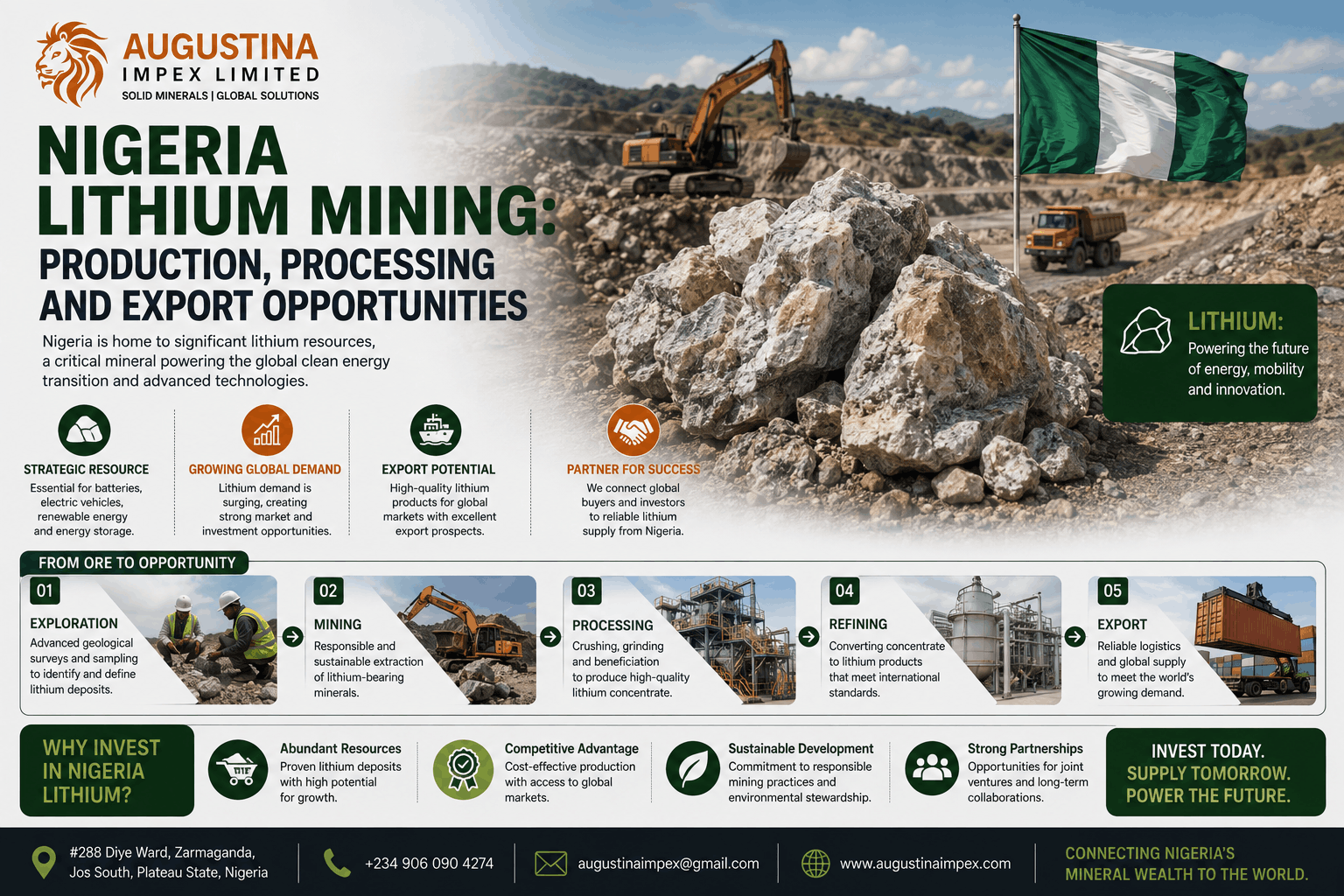
Nigeria Lithium Mining: Production, Processing & Export
Nigeria Lithium Mining: Production, Processing and Export Opportunities By Kolawole King, CEO — Augustina Impex…

Nigeria Rare Earth Minerals: Deposits & Market Potential
Nigeria Rare Earth Minerals: Deposits, Applications and Global Market Potential By Kolawole King, CEO —…
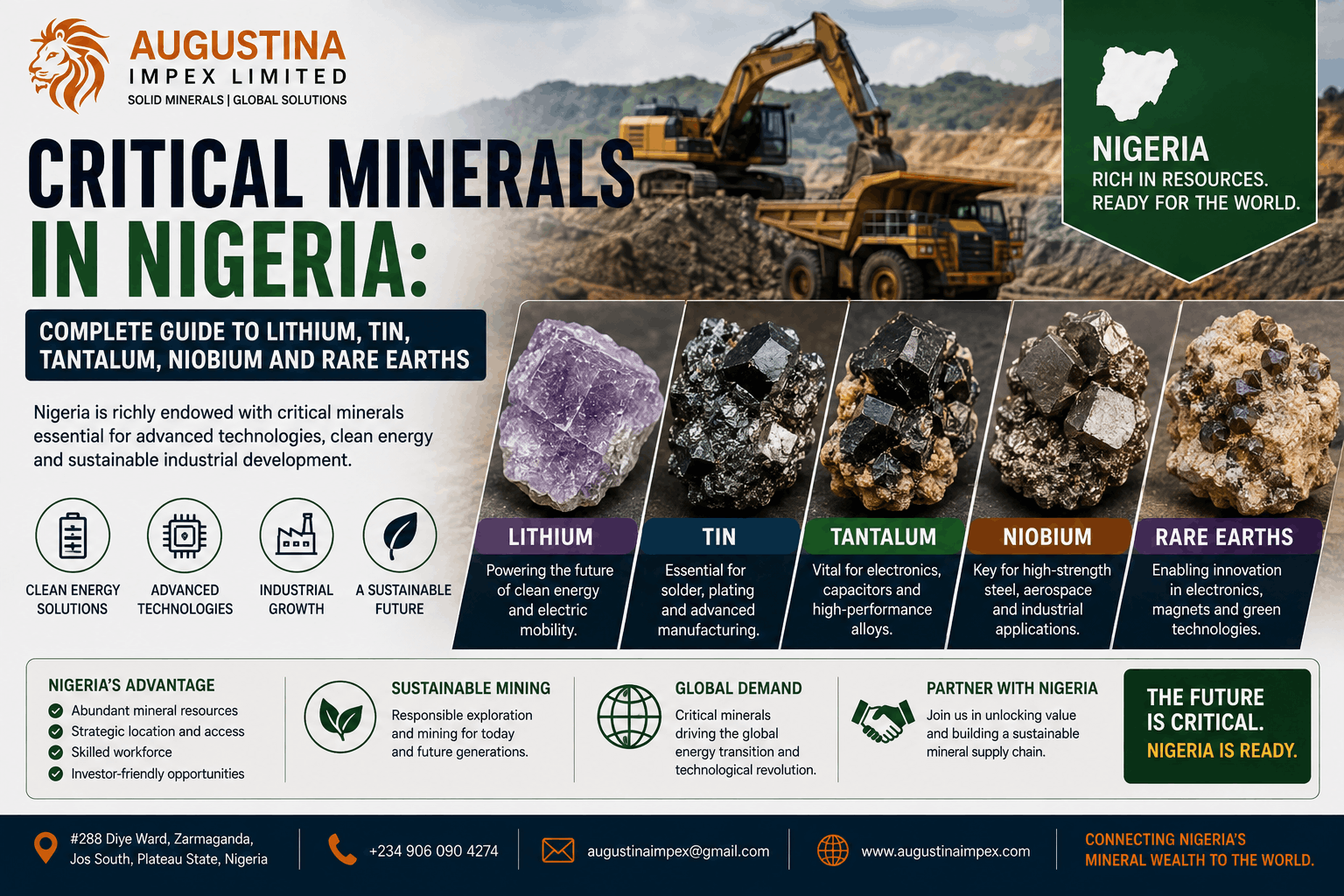
Nigeria Critical Minerals Guide: Lithium, Tin & Rare Earths
Critical Minerals in Nigeria: Complete Guide to Lithium, Tin, Tantalum, Niobium and Rare Earths By…
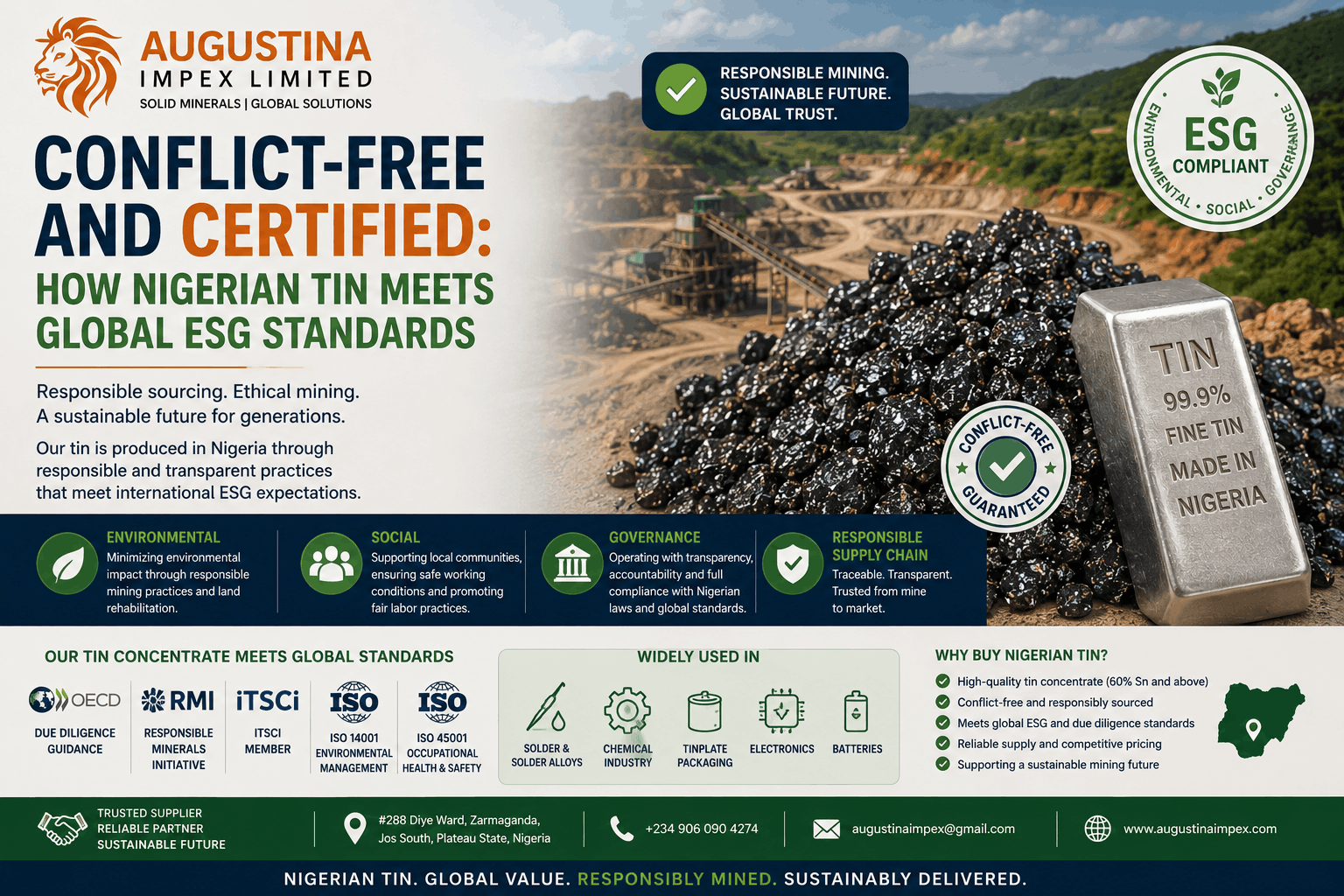
Conflict-Free Nigerian Tin Meets Global ESG Standards
Conflict-Free and Certified: How Nigerian Tin Meets Global ESG Standards By Kolawole King, CEO —…