
Ilmenite vs Rutile: What’s the Difference?
If you have spent any time in the titanium minerals industry — whether as a buyer, a metallurgist, an investor, or a mining professional — you have almost certainly encountered both ilmenite and rutile. You have seen them appear in the same export documentation, the same geology reports, the same heavy mineral sands (HMS) processing plant output summaries, and the same commodity market pricing tables. And you may have wondered: what exactly is the difference between these two minerals, why does the distinction matter so much commercially, and which one should you be looking for when you are sourcing Nigerian titanium feedstock?
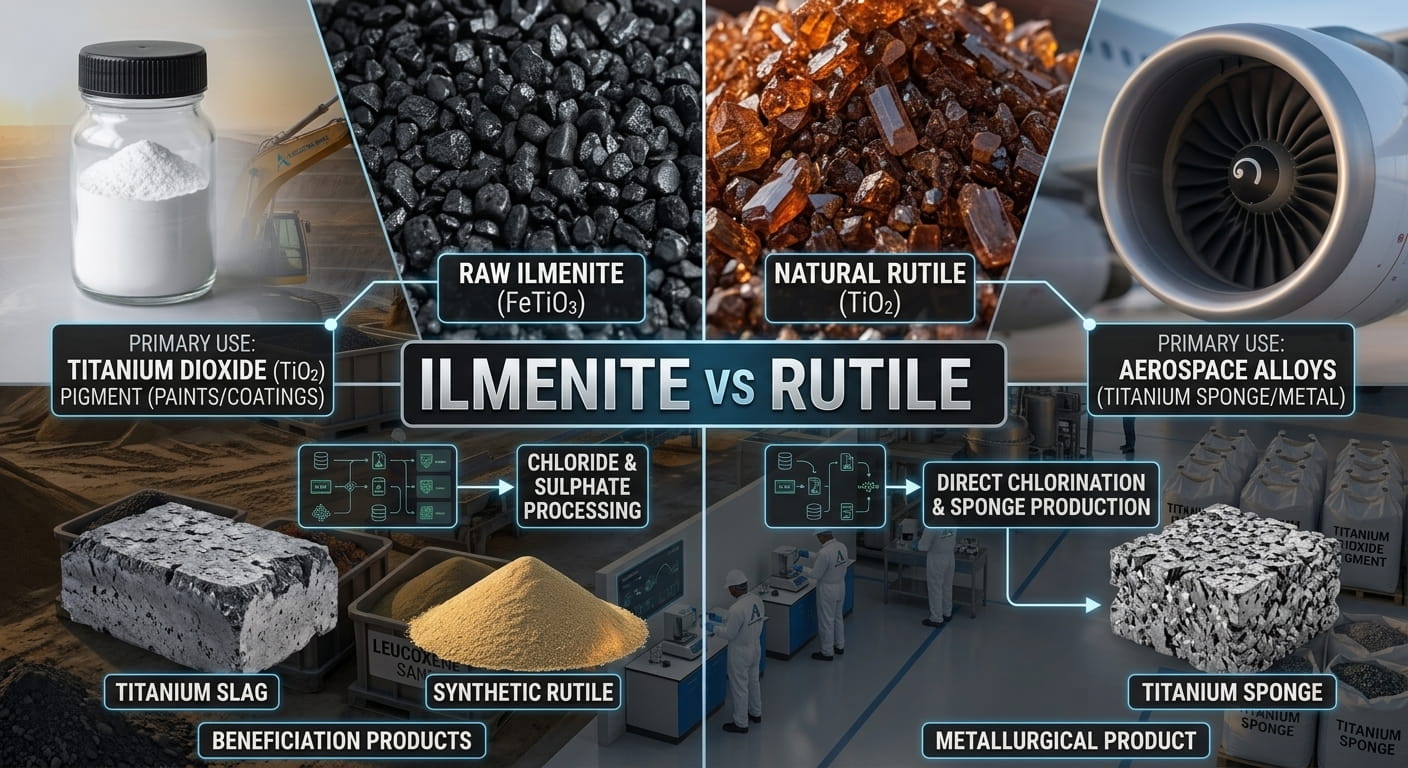
The short answer is this: both ilmenite and rutile are titanium minerals — titanium-bearing oxide minerals that serve as the primary raw material feedstocks for the global titanium dioxide (TiO₂) pigment industry and the titanium metal industry. But they are chemically distinct, physically different, commercially separated by a significant price gap, and processed through different industrial routes to produce the TiO₂ or titanium metal products that the world’s paint, plastics, welding, aerospace, and specialty chemicals industries depend on. Understanding the differences between ilmenite and rutile — in depth, not just at the headline level — is essential knowledge for anyone operating in the titanium minerals space.
This article provides exactly that understanding. It covers the mineralogy, geology, physical properties, TiO₂ content, processing routes, market applications, pricing dynamics, and Nigerian supply context for both ilmenite and rutile — side by side, in depth, and with a level of practical commercial detail that goes beyond the generic mineral encyclopaedia entry. Whether you are a TiO₂ pigment manufacturer sourcing feedstock, an HMS processing plant operator assessing product quality, or a trader navigating the Nigerian titanium minerals export market, this is the comparison you need.
What Is Ilmenite? — Mineralogy, Chemistry, and Physical Properties
Ilmenite is an iron-titanium oxide mineral with the chemical formula FeTiO₃ — iron(II) titanate. The name comes from the Ilmen Mountains of the South Urals in Russia, where it was first described in 1827. In its ideal, stoichiometric form, ilmenite contains approximately 52.7% TiO₂ and 47.3% FeO by weight. In practice, natural ilmenites are rarely stoichiometrically perfect — they contain varying amounts of additional iron oxides (both FeO and Fe₂O₃), manganese, magnesium, and trace elements that affect their processing behaviour and market value.
The TiO₂ content of commercial ilmenite concentrates ranges from approximately 44% to 65% TiO₂, depending on the deposit type, the degree of weathering and oxidation in the ore, and the efficiency of the beneficiation process used to produce the concentrate. Heavily weathered ilmenite — often referred to as “leucoxene” when alteration is extreme — can reach TiO₂ contents of 65%–90%+ as iron is progressively leached and oxidised out of the crystal structure over geological time.
| Property | Value / Description |
|---|---|
| Chemical Formula | FeTiO₃ (iron titanate) |
| Mineral Group | Oxide minerals — ilmenite group |
| Crystal System | Trigonal (rhombohedral) |
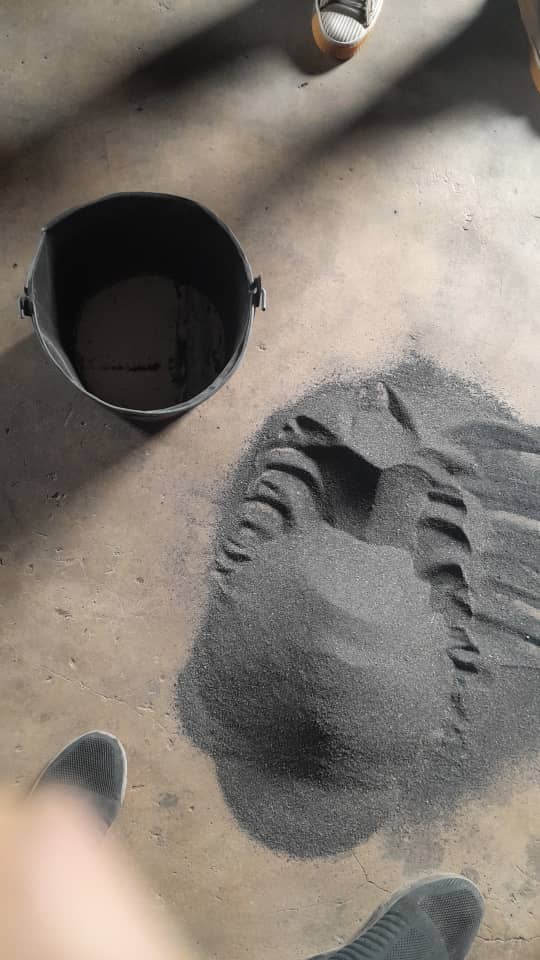
| Colour | Iron-black to dark steel-grey; sometimes brownish-black |
| Lustre | Submetallic to metallic |
| Specific Gravity | 4.5 – 5.0 g/cm³ |
| Hardness (Mohs) | 5 – 6 |
| Magnetic Properties | Weakly magnetic (paramagnetic); separable by WHIMS |
| Typical TiO₂ Content (commercial concentrate) | 44% – 65% TiO₂ |
| Primary Processing Route | Sulfate process; smelting to titanium slag; synthetic rutile production |
Ilmenite is by far the most abundant of the commercially important titanium minerals — it accounts for approximately 90% of global titanium mineral production by weight. It occurs in two principal geological settings: in primary hard-rock deposits, typically associated with anorthosite intrusions or mafic/ultramafic igneous rocks; and in secondary placer (alluvial and coastal) deposits, where it has been liberated from primary rock by weathering and concentrated by water and wind transport into economically mineable accumulations.
What Is Rutile? — Mineralogy, Chemistry, and Physical Properties
Rutile is a titanium dioxide mineral with the chemical formula TiO₂ — in its pure form, it is simply titanium dioxide in its most stable polymorph. The name derives from the Latin rutilus, meaning reddish, reflecting the characteristic reddish-brown to deep red colour of many natural rutile crystals. Rutile is the highest-TiO₂-content naturally occurring titanium mineral — in its pure form it contains approximately 100% TiO₂, and commercial rutile concentrates typically grade at 90%–98% TiO₂.
This high TiO₂ content is the single most important commercial attribute of rutile. It is what makes rutile the preferred feedstock for the chloride process of TiO₂ pigment production — the dominant processing technology used by leading pigment manufacturers globally — and the preferred feedstock for titanium metal sponge production via the Kroll process. In these applications, the higher the TiO₂ content of the feedstock, the lower the processing cost, the lower the waste generation, and the higher the product quality — and rutile’s 90%+ TiO₂ content gives it a decisive advantage over unupgraded ilmenite in both dimensions.
| Property | Value / Description |
|---|---|
| Chemical Formula | TiO₂ (titanium dioxide) |
| Mineral Group | Oxide minerals — rutile group (TiO₂ polymorphs) |
| Crystal System | Tetragonal |
| Colour | Red-brown to black; sometimes yellowish, golden, or rarely blue |
| Lustre | Adamantine (diamond-like) to submetallic |
| Specific Gravity | 4.2 – 4.3 g/cm³ |
| Hardness (Mohs) | 6 – 6.5 |
| Magnetic Properties | Non-magnetic; separable from ilmenite by magnetic separation |
| Typical TiO₂ Content (commercial concentrate) | 90% – 98% TiO₂ |
| Primary Processing Route | Chloride process TiO₂ pigment; Kroll process titanium metal sponge |
Rutile is considerably rarer than ilmenite in the Earth’s crust and in economically mineable deposits. Commercial natural rutile deposits occur primarily in coastal heavy mineral sands accumulations — often in association with ilmenite, zircon, leucoxene, and monazite in the same heavy mineral suite — and in certain metamorphic rock types (eclogites, kyanite-bearing schists) where it forms as a stable high-pressure polymorph. Australia, Sierra Leone, Kenya, Madagascar, and Nigeria are among the world’s significant rutile-producing nations.
Ilmenite vs Rutile — The Definitive Side-by-Side Comparison
The following comparison table sets out the key differences between ilmenite and rutile across the dimensions that matter most to miners, processors, traders, and buyers in the titanium minerals supply chain.
| Parameter | Ilmenite | Rutile |
|---|---|---|
| Chemical formula | FeTiO₃ | TiO₂ |
| TiO₂ content (commercial) | 44% – 65% | 90% – 98% |
| Iron content | High (up to 36% Fe) | Very low (<2% Fe in natural rutile) |
| Colour | Iron-black to dark grey | Red-brown to black |
| Specific gravity | 4.5 – 5.0 | 4.2 – 4.3 |
| Magnetic response | Weakly magnetic (paramagnetic) | Non-magnetic |
| Abundance / availability | Abundant (90% of Ti mineral production) | Scarce (5% of Ti mineral production) |
| Primary processing route | Sulfate process; slag smelting; SR production | Chloride process; Kroll process (Ti metal) |
| Upgrade requirement | Requires upgrading (slag/SR) for chloride process | Suitable for chloride process as mined |
| Price premium | Lower — base market price | Higher — 2x to 4x ilmenite FOB price |
| Separation from other HMS minerals | By gravity + WHIMS (magnetic separation) | By gravity + electrostatic separation (HTR) |
| Key applications | Pigment (sulfate), welding electrodes, slag feed | Pigment (chloride), Ti metal, speciality coatings |
TiO₂ Content — The Commercial Heart of the Ilmenite vs Rutile Debate
If there is a single number that explains the entire commercial relationship between ilmenite and rutile, it is the TiO₂ content percentage. Everything else — the price difference, the processing route choice, the upgrade economics, the supply chain complexity — flows from this one fundamental chemical distinction.
A typical commercial ilmenite concentrate from a West African HMS deposit grades at approximately 48%–56% TiO₂. The balance is primarily iron oxides (FeO and Fe₂O₃), with smaller amounts of manganese oxide, magnesium oxide, aluminium oxide, and silica. A typical commercial natural rutile concentrate from the same region grades at approximately 94%–97% TiO₂ — roughly double the TiO₂ content of ilmenite.
This doubling of TiO₂ content has profound economic consequences across the entire titanium minerals processing chain. The chloride process for TiO₂ pigment production — which is the preferred technology of virtually all leading pigment producers, including Tronox, Chemours, Kronos, and Venator — requires a high-TiO₂ feedstock (typically >85% TiO₂) because the chlorine reagent used in the process reacts indiscriminately with all metals present in the feedstock, producing metal chloride by-products (including ferrous chloride from the iron in ilmenite) that must be managed, treated, and disposed of at significant cost and environmental compliance expense. High-iron ilmenite fed directly into a chloride process reactor generates excessive ferrous chloride waste — a commercially and environmentally untenable situation.
This is precisely why natural rutile — with its 90%+ TiO₂ content and very low iron content — commands a substantial price premium over ilmenite, and why the intermediate products of ilmenite upgrading (titanium slag and synthetic rutile) have developed as important market segments: they are the economic bridge between the abundance of ilmenite and the chloride-process world’s demand for high-TiO₂ feedstock.
The Geological Formation of Ilmenite and Rutile
Understanding where ilmenite and rutile come from geologically — how they form and how they end up in economically mineable concentrations — helps explain why they co-occur in certain deposit types, why their grades and ratios vary so significantly between deposits, and why Nigerian HMS deposits have the specific mineral assemblage characteristics they do.
① Primary Hard-Rock Deposits — Ilmenite: Ilmenite crystallises as an accessory mineral in a wide range of igneous and metamorphic rock types — particularly in mafic and ultramafic igneous rocks (gabbros, norites, anorthosites) and in certain granitic and pegmatitic rocks. Large-tonnage primary ilmenite deposits occur where ilmenite has concentrated by magmatic differentiation or through metamorphic processes into ore-grade accumulations. Tellnes (Norway), Lac Tio (Canada), and Panzhihua (China) are classic primary hard-rock ilmenite deposits. Nigerian primary ilmenite in Jos Plateau granites and Jos Plateau gneisses is typically a minor accessory mineral rather than an ore-grade accumulation — the commercially significant Nigerian titanium minerals are predominantly in secondary alluvial/placer concentrations.
② Primary Hard-Rock Deposits — Rutile: Rutile forms in metamorphic rocks (particularly high-grade schists, gneisses, and eclogites) under conditions of elevated pressure and temperature that favour the stability of TiO₂ rather than the iron-titanium oxide ilmenite. Primary hard-rock rutile deposits are rare but significant — the Dahomeyide metamorphic belt in Nigeria and Benin Republic hosts rutile-bearing metamorphic rocks that contribute to alluvial rutile accumulations in the drainage systems of central and southwestern Nigeria.
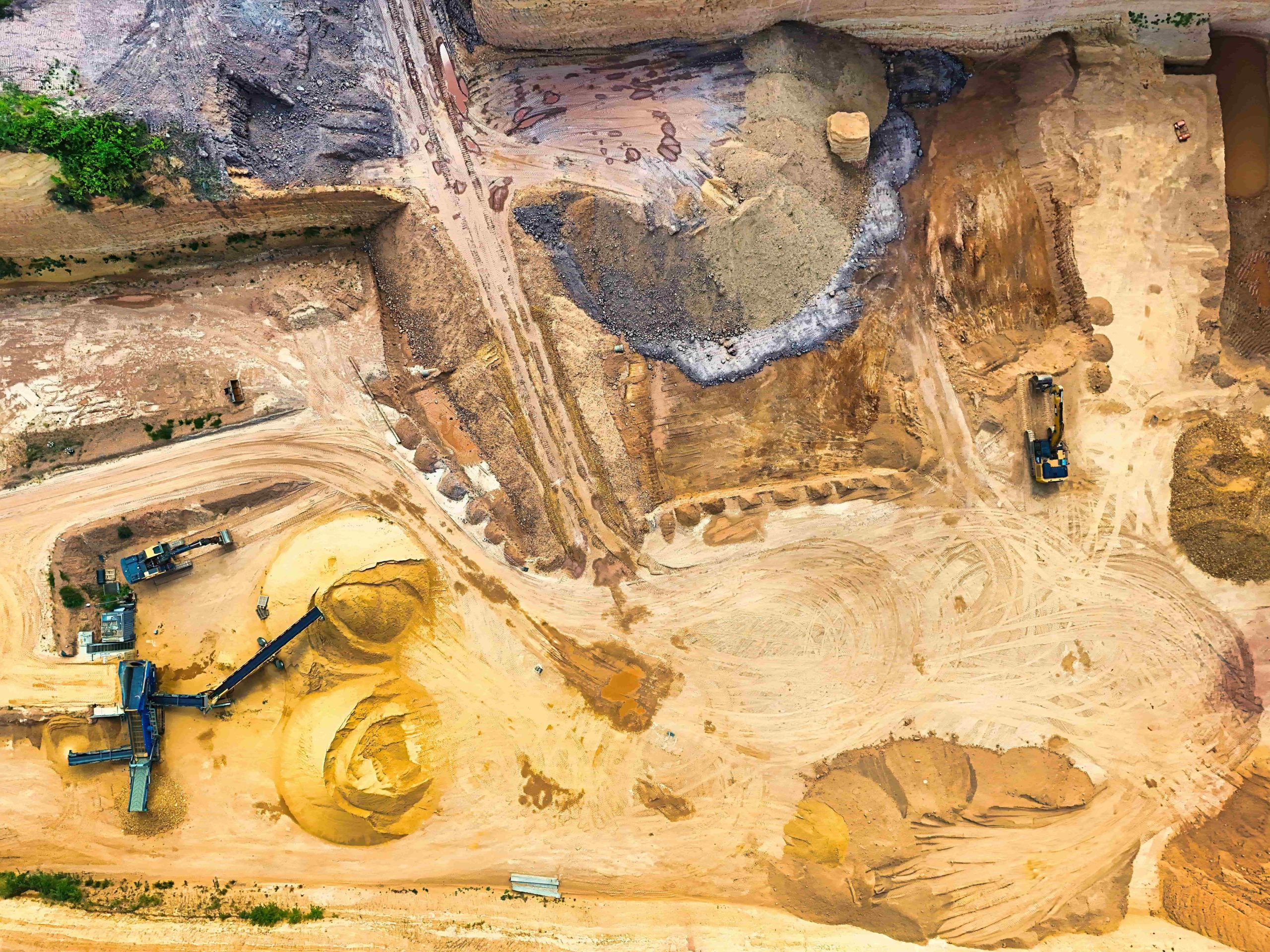
③ Coastal and Alluvial Heavy Mineral Sands (Placer Deposits) — Both Ilmenite and Rutile: The commercially most important source of both ilmenite and rutile globally is coastal and alluvial heavy mineral sands deposits — ancient and modern beach sands, river channel sands, and aeolian (wind-blown) sand accumulations where the high specific gravity of ilmenite (SG 4.5–5.0) and rutile (SG 4.2–4.3) has caused them to concentrate relative to the lighter quartz and feldspar matrix (SG ~2.65). Wave action, longshore drift, and aeolian sorting have concentrated these heavy minerals into distinct layers and beds over tens of thousands to millions of years. Australian east coast HMS deposits (Iluka, Murray Basin), Sierra Leone’s placer rutile deposits, and Nigeria’s coastal and riverine HMS accumulations are all formed by this process. In these deposits, ilmenite, rutile, zircon, leucoxene, and monazite co-occur in the same heavy mineral suite, separated and individually recovered during HMS processing.
How Ilmenite and Rutile Are Separated — The HMS Beneficiation Process
In an HMS processing plant, ilmenite and rutile arrive together in the raw ore feed — mixed with each other and with zircon, leucoxene, monazite, quartz, and other minerals — and must be progressively separated into individual product streams through a sequence of physical separation steps. The complete separation of the ilmenite product from the rutile product is one of the key process engineering challenges of HMS mineral processing, and understanding how it is achieved illuminates one of the key physical differences between the two minerals.
The separation sequence in a Nigerian HMS processing plant (such as the facility operated by Augustina Impex’s partner plant in Jos, Plateau State) typically proceeds as follows:
① Gravity Separation (Spirals and Shaking Tables): The ore feed is first processed by spiral concentrators or shaking tables, which separate the heavy mineral fraction (HMC — heavy mineral concentrate, containing both ilmenite and rutile together with zircon and leucoxene) from the light mineral fraction (primarily quartz sand, which is discarded). Both ilmenite and rutile are recovered together in the HMC at this stage — gravity alone cannot separate them from each other because their specific gravities are similar.
② Magnetic Separation (WHIMS — Wet High Intensity Magnetic Separator): The HMC is then processed through a Wet High Intensity Magnetic Separator. Ilmenite is weakly paramagnetic — it is attracted to a strong magnetic field — while rutile is non-magnetic. WHIMS exploits this difference to pull ilmenite particles out of the HMC stream into the magnetic product fraction, leaving a non-magnetic fraction that is enriched in rutile, zircon, and leucoxene. The ilmenite concentrate product is essentially complete at this stage. The non-magnetic fraction continues to further processing.
③ Electrostatic Separation (HTR — High Tension Roll Separator): The non-magnetic fraction is then processed through a High Tension Roll (HTR) electrostatic separator, which separates conductive minerals (rutile is conducting) from non-conductive minerals (zircon and leucoxene are non-conducting). The rutile is recovered in the conductive product fraction; zircon and leucoxene report to the non-conductive fraction for further separation. The rutile product stream is now essentially pure.
This separation sequence is efficient but sensitive — product quality depends critically on feed preparation (particle size, moisture content, mineral liberation) and on operating conditions in each separation stage. Augustina Impex’s HMS processing plant partnership in Jos operates gravity, magnetic, and electrostatic separation circuits, enabling production of individual ilmenite and rutile concentrate products from Nigerian heavy mineral sand feeds.
Processing Routes: The Chloride Process vs The Sulfate Process
The ultimate end use of both ilmenite and rutile is the production of TiO₂ — primarily as a white pigment used in paints, coatings, plastics, paper, and a vast range of other products, but also as a feedstock for titanium metal production, titanium chemicals, and speciality ceramics. The two primary industrial processes for converting titanium mineral feedstocks into TiO₂ — the sulfate process and the chloride process — have very different feedstock requirements, which is a primary driver of the distinct commercial markets for ilmenite and rutile.
The sulfate process dissolves the titanium mineral feedstock in concentrated sulfuric acid, producing a titanyl sulfate solution from which TiO₂ is then hydrolysed, filtered, calcined, and finished into pigment-grade product. The sulfate process can tolerate higher iron content in the feedstock than the chloride process — it is specifically designed to process ilmenite and iron-rich titanium slags, generating ferrous sulfate as a co-product (which must be managed and disposed of). The sulfate process produces both anatase and rutile TiO₂ polymorphs, depending on the processing conditions and seed crystals used. Most sulfate process plants operate in China, Central Europe, and parts of India. Primary feedstock: Ilmenite (44%–65% TiO₂) or low-grade titanium slag.
The chloride process reacts titanium mineral feedstock with chlorine gas at high temperature in a fluidised bed reactor (chlorinator), producing titanium tetrachloride (TiCl₄, also known as “tickle”) which is then oxidised back to TiO₂ of very high purity and controlled particle size in a high-temperature oxidation reactor. The chloride process produces exclusively rutile-form TiO₂, which is the preferred crystal structure for the highest-performance pigment applications (maximum brightness, opacity, durability). The process is highly sensitive to iron content in the feedstock — iron produces ferrous chloride (FeCl₂) in the chlorinator, which corrodes the equipment and must be removed. This requires that chloride-process feedstocks meet a minimum TiO₂ threshold of approximately 85%–90%+, making natural rutile the preferred feedstock and making high-iron ilmenite incompatible with direct chloride-process use. Primary feedstock: Natural rutile (90%–98% TiO₂), synthetic rutile (92%–95% TiO₂), or high-grade titanium slag (85%–95% TiO₂).
Upgrading Ilmenite — Titanium Slag and Synthetic Rutile
Because the global TiO₂ industry is dominated by chloride-process producers who cannot use raw ilmenite directly, a significant portion of the world’s ilmenite production goes through upgrading processes that convert iron-rich ilmenite into high-TiO₂ upgraded products suitable for the chloride process. The two principal upgrading routes are:
① Smelting to Titanium Slag: Ilmenite is smelted in an electric arc furnace with carbon (coal) as a reducing agent. The iron in ilmenite is selectively reduced to metallic iron, which is tapped as a pig iron or ferrochrome co-product. The titanium-enriched slag remains as the primary product, typically grading at 80%–95% TiO₂ depending on the ilmenite feed grade and smelting conditions. Major titanium slag producers include Richards Bay Minerals (South Africa), QIT Madagascar Minerals, and Tronox (multiple locations). Titanium slag of sufficient TiO₂ grade (>85%) is a direct substitute for natural rutile in chloride-process TiO₂ plants.
② Synthetic Rutile (SR) Production: Ilmenite is leached with acid (hydrochloric acid in the Becher/chlorination process, or sulfuric acid in other routes) to selectively dissolve and remove the iron, leaving behind a porous, iron-depleted titanium dioxide product known as synthetic rutile, typically grading at 91%–94% TiO₂. SR is directly equivalent to natural rutile as a chloride-process feedstock. Major SR producers are located in Australia (Iluka Resources, Tronox) and India. SR production from Nigerian ilmenite is not yet practised at commercial scale but represents a significant future value-addition opportunity for the Nigerian titanium minerals industry.
Market Applications — Where Ilmenite and Rutile Are Used
| Application | Ilmenite | Rutile |
|---|---|---|
| TiO₂ Pigment (sulfate process) | Primary feedstock ✔ | Suitable but rarely used (too expensive) |
| TiO₂ Pigment (chloride process) | Not directly suitable (unless upgraded) | Primary feedstock ✔ |
| Titanium Metal (Kroll process) | Via slag upgrading only | Primary feedstock ✔ |
| Welding Electrode Coatings | Primary feedstock ✔ (rutile-type electrodes) | Premium feedstock ✔ |
| Titanium Slag Feedstock | Primary feedstock ✔ (electric arc smelting) | Not used |
| Speciality Ceramics and Refractory | Minor use | Significant use ✔ |
| UV-Absorbing Coatings and Sunscreens | Indirectly (via pigment production) | High-purity rutile TiO₂ used directly ✔ |
| Aerospace-grade Titanium Alloys | Via slag → TiCl₄ → metal (indirect) | Primary feedstock for Kroll process ✔ |
Ilmenite vs Rutile — Pricing Dynamics and Market Value
The price gap between ilmenite and rutile is one of the most persistent and commercially significant features of the titanium minerals market. This gap reflects the fundamental difference in TiO₂ content, processing flexibility, and market utility between the two minerals — and it is a gap that has persisted through multiple commodity cycles despite repeated efforts by the industry to close it through upgrading technologies.
As a general market principle (noting that prices fluctuate with supply/demand conditions and should be confirmed against current market data for any specific commercial purpose): natural rutile typically trades at 2x to 4x the FOB price of equivalent-grade ilmenite. When ilmenite concentrate (52% TiO₂) trades at USD 200–300/MT FOB West African port, natural rutile (95% TiO₂) from the same region typically trades at USD 700–1,200/MT FOB. This premium reflects rutile’s scarcity relative to ilmenite, its chloride-process compatibility without upgrading, and its suitability for titanium metal production.
Pricing for both minerals is strongly influenced by: the TiO₂ content of the specific concentrate being traded (higher TiO₂ = higher price within each mineral category); the level of impurities (chromium, in particular, is penalised sharply in rutile destined for chloride-process plants, as chromium contamination in the TiCl₄ is very difficult and expensive to remove); the form (bulk versus bagged); the origin and logistics costs; and the overall health of the TiO₂ pigment industry (paint and coatings demand is the dominant driver of titanium mineral demand globally).
Nigerian Ilmenite and Rutile — GEO Guide by State
Nigeria is an emerging but significant producer of both ilmenite and rutile within the context of the West African HMS mineral belt. Nigerian titanium mineral production is currently at an early commercial stage — with the majority of output coming from small-scale and artisanal HMS operations rather than large mechanised mining companies — but the country’s geological endowment supports the development of a commercially significant titanium minerals export sector. The following state-by-state guide sets out the known and emerging Nigerian ilmenite and rutile production zones for the benefit of buyers, investors, and industry professionals.
| State | Key Zone / LGA | Mineral | Notes |
|---|---|---|---|
| Plateau State | Jos North, Jos South, Bassa LGA; Bukuru; Rayfield | Ilmenite, Rutile, Zircon, Leucoxene | Jos–Bukuru Pegmatite Field; long HMS mining tradition; active artisanal and small-scale HMS operations |
| Cross River State | Akpabuyo, Calabar environs; Biase LGA | Rutile, Ilmenite, Zircon | Coastal and near-coastal alluvial HMS accumulations; proximity to Cameroon border rutile occurrences |
| Ekiti State | Ado-Ekiti environs; Emure LGA; Ikere | Ilmenite, Rutile | Associated with Precambrian basement complex gneisses; minor but documented HMS occurrences |
| Ondo State | Ore, Ifon, Owo area; Ose LGA | Ilmenite, Rutile, Zircon | Ore city is Nigeria’s documented rutile production centre; alluvial accumulations in Ose River basin |
| Ogun State | Ijebu Ode environs; Odeda LGA | Ilmenite, Zircon (minor Rutile) | Basement complex alluvial accumulations; sporadic small-scale HMS activity |
| Kogi State | Okene area; Ajaokuta environs | Ilmenite, Rutile (associated with iron ore belt) | Itakpe Iron Ore belt hosts minor ilmenite; under-explored for HMS specifically |
| Nasarawa State | Nasarawa–Eggon; Obi LGA | Ilmenite (with coltan, lithium) | HMS minerals occur as associated minerals in artisanal coltan and lithium mining zones; under-developed as standalone HMS |
| Edo State | Auchi (Etsako West); Akoko-Edo | Ilmenite (minor; associated with lepidolite zones) | Minor HMS recovery possible as by-product of lepidolite mining; not primary HMS production zone |
Augustina Impex Limited, through its HMS Processing Plant partnership in Jos, Plateau State, offers Nigerian ilmenite and rutile concentrates to qualified international buyers. Our processing plant partner uses gravity separation (spirals), Wet High Intensity Magnetic Separation (WHIMS), and High Tension Roll (HTR) electrostatic separation to produce individual ilmenite concentrate and rutile concentrate product streams from Nigerian HMS feeds. We coordinate pre-shipment inspection by CCIC, SGS, or Bureau Veritas at origin, and manage the complete export documentation package under the NEPC-registered export entity Jase Odus Nigeria Limited (RC 2022462, NEPC RE No. 0039421). Contact us to discuss your titanium mineral sourcing requirements.
Which Should You Choose — Ilmenite or Rutile?
The question of which titanium mineral to source — ilmenite or rutile — is ultimately a question about your processing technology and your product specification requirements. The answer is determined by the chemistry of your downstream process, not by a general preference for one mineral over the other.
① You operate a sulfate-process TiO₂ pigment plant — ilmenite is your primary feedstock. The sulfate process is designed around ilmenite chemistry and can handle the iron content economically.
② You produce welding electrodes — ilmenite is a standard component of rutile-type welding electrode coatings and is the major constituent of many electrode coating formulations.
③ You are a titanium slag smelter or a synthetic rutile producer — ilmenite is your feed material, which you upgrade into a chloride-process-compatible product.
④ Budget is a constraint — ilmenite is significantly cheaper than rutile on a per-tonne basis, and if your process can handle it, the economics strongly favour ilmenite.
① You operate a chloride-process TiO₂ pigment plant — natural rutile, synthetic rutile, or high-grade slag are your feedstock options. Raw ilmenite is incompatible with your process without extensive upgrading.
② You produce titanium metal sponge via the Kroll process — high-TiO₂ feedstock is essential. Natural rutile and high-grade synthetic rutile are the standard Kroll process feeds.
③ You need high-purity TiO₂ for speciality applications — optical coatings, advanced ceramics, photocatalysis, high-performance pigments — where iron contamination in the feed translates to unacceptable product quality constraints.
④ You are a premium welding electrode manufacturer targeting the highest-specification electrode grades — pure rutile electrode coatings command higher prices and are produced with natural rutile, not ilmenite.
Frequently Asked Questions — Ilmenite vs Rutile
In pure crystal form, yes — experienced mineralogists and mining professionals can often distinguish them by colour (ilmenite is iron-black, rutile tends towards red-brown to black with a distinctive adamantine lustre on fresh crystal faces), crystal habit (rutile forms distinctive prismatic crystals, often striated along the long axis; ilmenite forms tabular or platy crystals), and magnetic response (ilmenite is weakly attracted to a strong magnet; rutile is not). In a mixed heavy mineral concentrate — where both minerals occur as fine grains mixed with zircon, leucoxene, and other minerals — visual distinction is not reliably possible and laboratory analysis or pilot-scale separation testing is required.
No — leucoxene is not a separate mineral species but rather a general field term for fine-grained, altered ilmenite in which the original FeTiO₃ has been partially or extensively converted to higher-TiO₂ compositions by the weathering-related removal of iron from the crystal structure. Leucoxene grades in TiO₂ content from approximately 65% (lightly altered ilmenite) to 90%+ (extensively altered, approaching rutile composition). Commercial leucoxene concentrates typically grade at 65%–88% TiO₂ — intermediate between ilmenite and rutile — and command an intermediate price. In HMS mineral processing and export, leucoxene is typically reported as a separate product stream from both ilmenite and rutile.
Nigerian rutile has historically been less prominent in the international titanium minerals market than Australian rutile primarily because the scale of production and the degree of commercial organisation of the Nigerian HMS sector has been much smaller than Australia’s large, mechanised HMS mining industry. Nigeria’s rutile production comes predominantly from small-scale artisanal and semi-mechanised operations rather than from the large HMS projects that dominate Australian supply. However, Nigeria’s geological endowment of rutile is significant — particularly in the Ondo State (Ore area) and Cross River State — and the commercialisation of this endowment through structured aggregation and export companies like Augustina Impex is a developing opportunity that the international market is increasingly interested in.
Chromium is the most critical impurity in rutile destined for chloride-process TiO₂ pigment plants. Chromium in the feedstock is converted to chromyl chloride (CrO₂Cl₂) in the chlorinator — a volatile, toxic, and extremely difficult-to-separate contaminant that passes through into the TiCl₄ product and ultimately degrades the quality of the TiO₂ pigment product. Most chloride-process operators specify a maximum Cr₂O₃ content of approximately 0.05%–0.15% (500–1,500 ppm) in rutile feedstock, with the strictest specifications below 0.03%. Nigerian rutile from HMS alluvial deposits typically has low chromium content — this is one of the commercial advantages of West African coastal HMS rutile compared to certain hard-rock rutile sources.
Contact Augustina Impex Limited directly via email at augustinaimpex@gmail.com or WhatsApp at +234 906 090 4274. We require buyers to provide their volume requirement, TiO₂ grade specification, preferred incoterm (EXW or FCA), and intended end use before we issue a Soft Corporate Offer (SCO). Representative samples of Nigerian ilmenite and rutile concentrate are available for independent laboratory assay. Pre-shipment inspection by CCIC, SGS, or Bureau Veritas is coordinated at origin, at the buyer’s or shared expense as agreed. Our minimum order quantity, pricing, and logistics information will be provided in our SCO upon receipt of your specifications.
Augustina Impex Limited is a NEPC-registered Nigerian solid minerals export company with an HMS processing plant partnership in Jos, Plateau State. We supply ilmenite concentrate, rutile concentrate, zircon, and leucoxene from verified Nigerian HMS sources, with pre-shipment inspection by CCIC/SGS/Bureau Veritas and full export documentation.
📧 augustinaimpex@gmail.com | 📞 WhatsApp: +234 906 090 4274
Kolawole King is the Chief Executive Officer of Augustina Impex Limited (RC 750691), a NEPC-registered Nigerian solid minerals export company headquartered in Jos, Plateau State. With an operational HMS processing plant partnership in Jos and a supply network spanning multiple Nigerian states, Augustina Impex sources and exports ilmenite, rutile, zircon, and a broad portfolio of Nigerian solid minerals to qualified international buyers. Visit www.augustinaimpex.com or the corporate blog at augustinaimpexng.blogspot.com for more.
-
Previous Post
Nigerian Lithium Ore Miner | Augustina Impex Limited
Post a comment
Related Posts
Nigeria Lithium Mining: Production, Processing & Export
Nigeria Lithium Mining: Production, Processing and Export Opportunities By Kolawole King, CEO — Augustina Impex…

Nigeria Rare Earth Minerals: Deposits & Market Potential
Nigeria Rare Earth Minerals: Deposits, Applications and Global Market Potential By Kolawole King, CEO —…
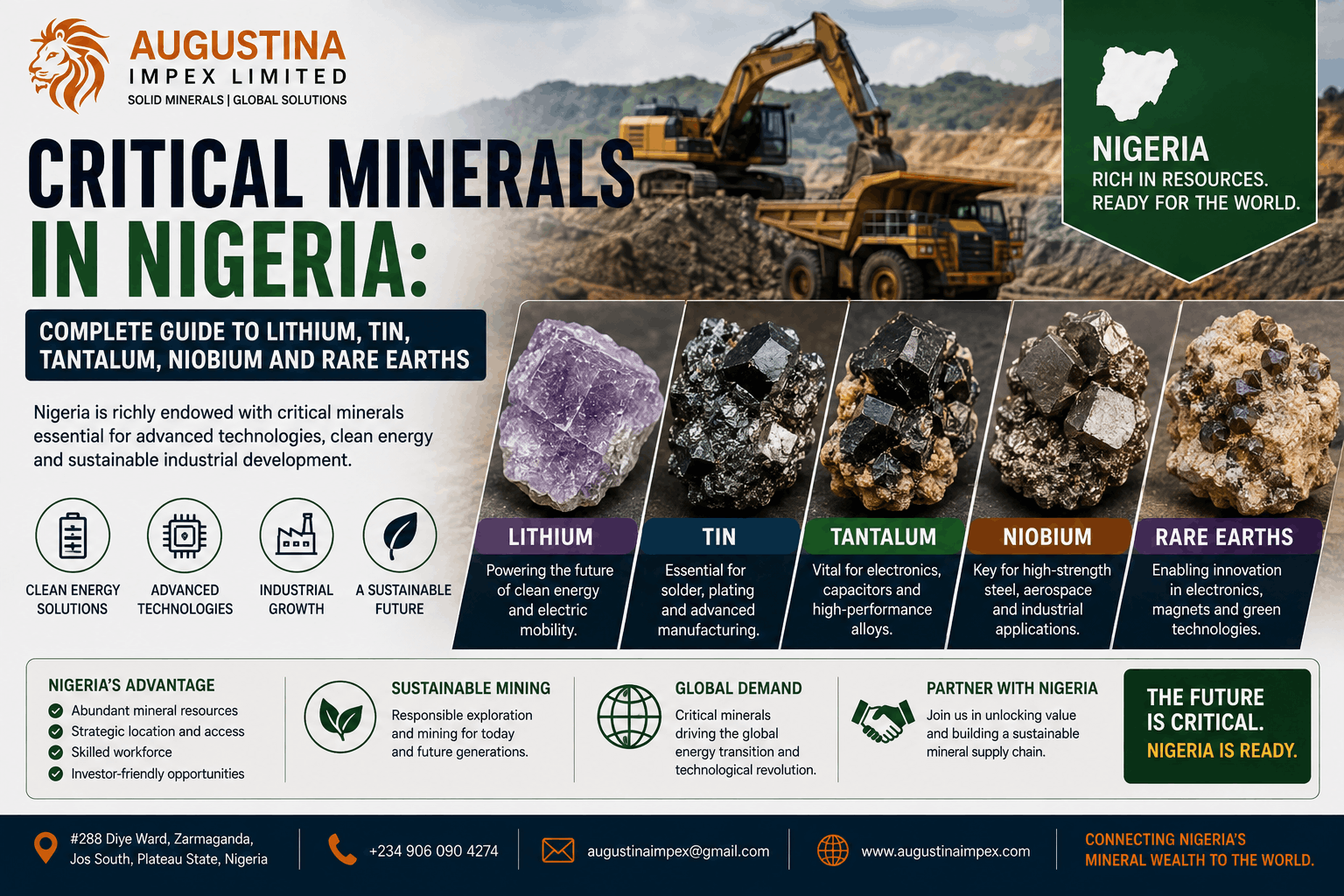
Nigeria Critical Minerals Guide: Lithium, Tin & Rare Earths
Critical Minerals in Nigeria: Complete Guide to Lithium, Tin, Tantalum, Niobium and Rare Earths By…
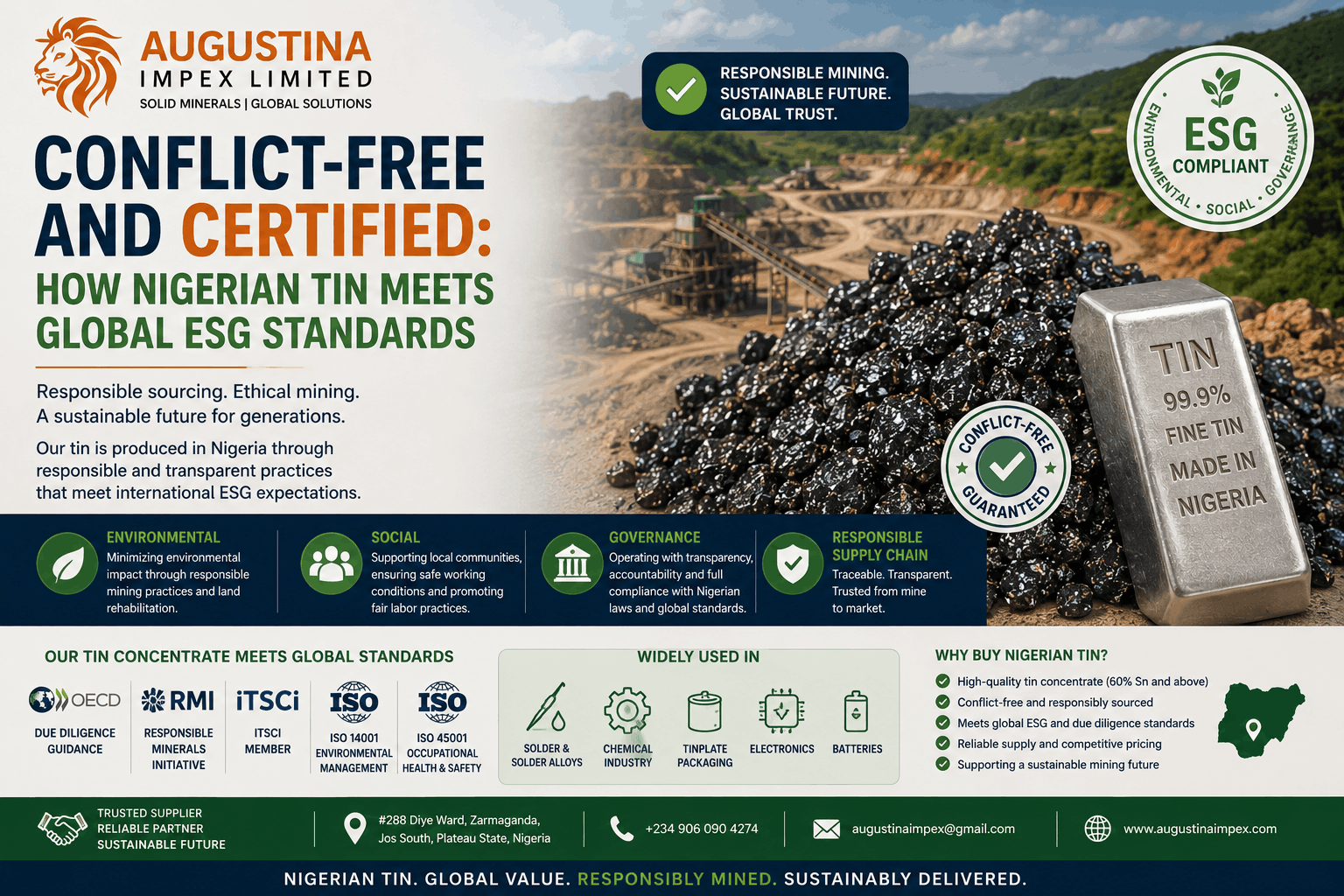
Conflict-Free Nigerian Tin Meets Global ESG Standards
Conflict-Free and Certified: How Nigerian Tin Meets Global ESG Standards By Kolawole King, CEO —…