
Every serious buyer of Nigerian monazite sand eventually arrives at the same crossroads. They have done their research on the mineral. They understand the rare earth oxide content, they know what TREO means and why it matters, and they have a processing facility — in China, India, Malaysia, Japan, or Europe — that is ready and waiting to receive material. The question they cannot answer from a desk in another country is the one that matters most at this stage: who exactly is on the Nigerian side of this transaction, are they genuinely capable of performing, and can they be trusted?
That question — who is my monazite sand exporter in Nigeria, and are they the real thing — is what this article addresses from every meaningful angle.
We are Augustina Impex Limited, a mineral trading and export company incorporated in Nigeria since 2008 with RC Number 750691, headquartered in Jos, Plateau State, in the heart of Nigeria’s monazite-bearing heavy mineral sand region. We have been exporting Nigerian solid minerals for over 17 years, and we have navigated every aspect of the Nigerian mineral export environment — the regulatory agencies, the documentation chain, the port logistics, the pre-shipment inspection process, and the commercial structures that give international buyers confidence. In this article, we share that knowledge openly, because we believe that informed buyers make better trading partners, and because we want every person reading this to understand exactly what professional monazite export from Nigeria looks like — and what it does not look like.
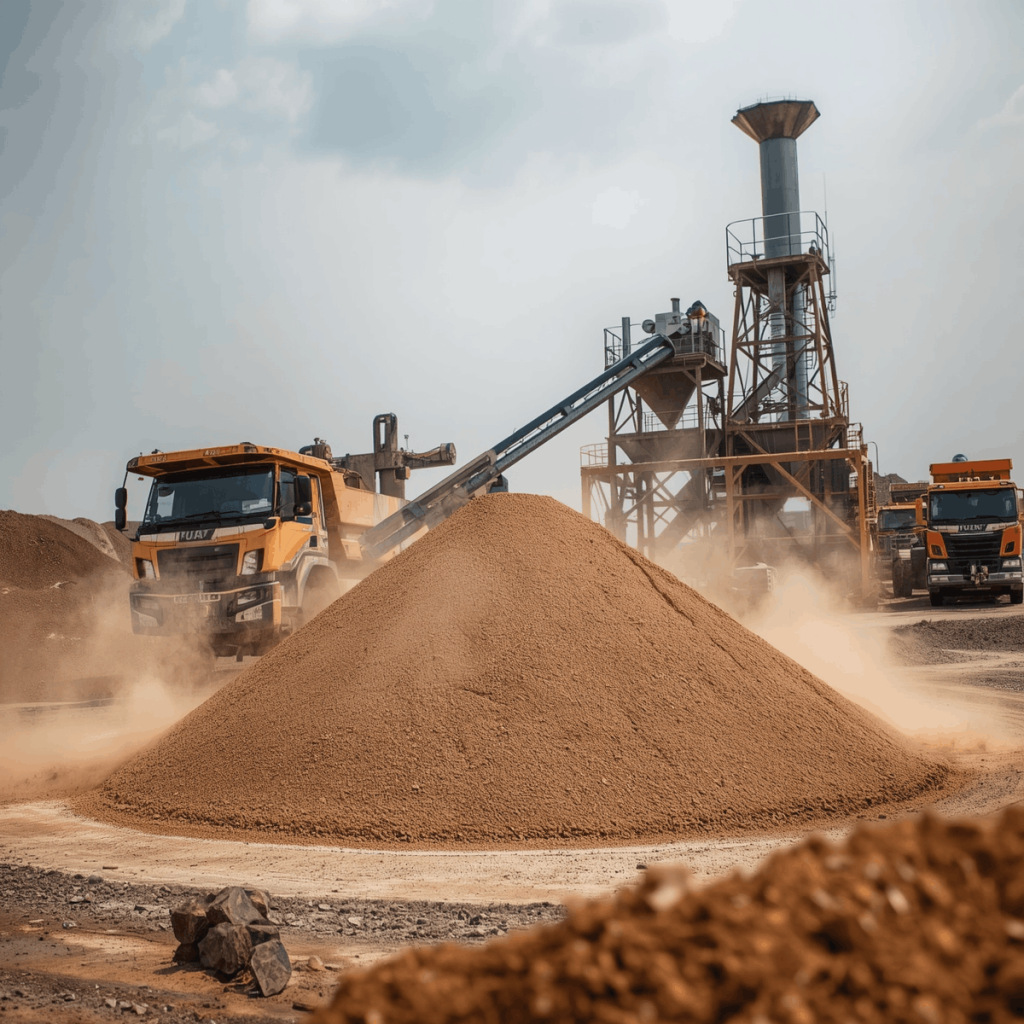
The Nigerian Monazite Export Sector: Promise, Progress, and Pitfalls
Nigeria’s monazite export sector is at an inflection point. The country holds genuinely significant deposits of monazite sand — particularly in the heavy mineral sand formations of the Jos Plateau in Plateau State and the adjacent alluvial systems of Nasarawa State — with total rare earth oxide (TREO) grades typically ranging from 50% to 68%. The international rare earth market, driven by the electric vehicle revolution, the clean energy transition, and the strategic push by the United States, European Union, Japan, and South Korea to diversify rare earth supply chains away from China, has created unprecedented demand for sources exactly like Nigeria’s.
At the same time, the Nigerian monazite export sector faces the challenges that are common across many African mineral-exporting economies: a significant informal economy operating alongside the formal, regulated sector; inconsistent enforcement of export regulations that creates confusion for both buyers and legitimate exporters; and a small but damaging population of fraudulent or non-performing intermediaries who present themselves as exporters but lack the compliance infrastructure, mineral access, or operational capability to actually perform.
For international buyers, this landscape creates a genuine due diligence challenge. Nigerian monazite is real, the commercial opportunity is genuine, and there are credible, professional exporters in the market who can deliver. But the process of identifying those credible exporters, distinguishing them from non-performers, and structuring transactions that protect the buyer’s interests requires specific knowledge that most first-time buyers of Nigerian monazite simply do not have.
This article gives you that knowledge.
What a Professional Monazite Sand Exporter in Nigeria Actually Does
The term “exporter” is used loosely in commodity trade, sometimes referring to anyone who sends minerals across a border and sometimes referring to a specific licensed category of commercial entity. In the context of Nigerian monazite, a genuine professional exporter is a company that performs a defined and comprehensive set of functions — not just physically moving product from one country to another, but managing the complete chain of activities that makes a legal, commercial, and compliant international monazite transaction possible.
Here is what a real monazite sand exporter in Nigeria should be doing on your behalf.
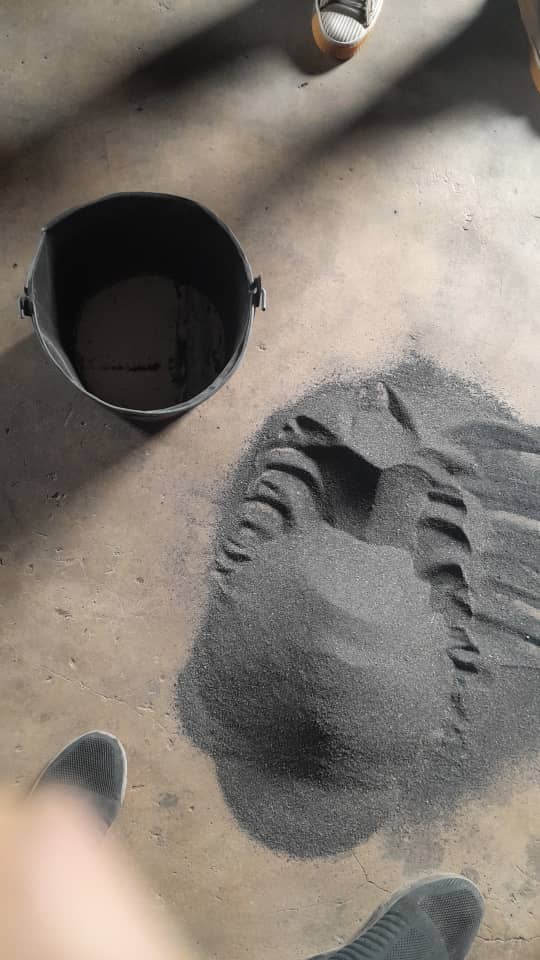
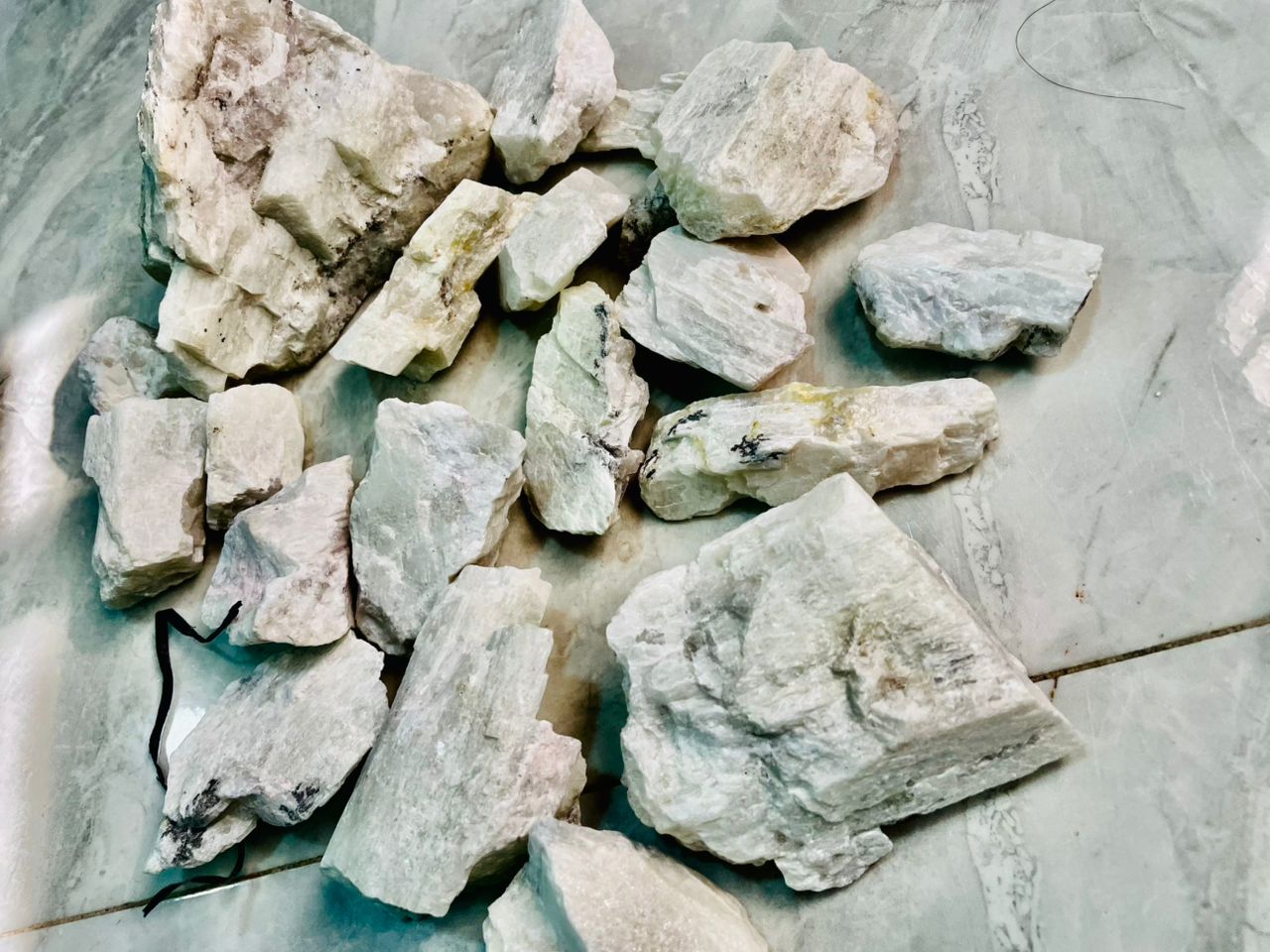
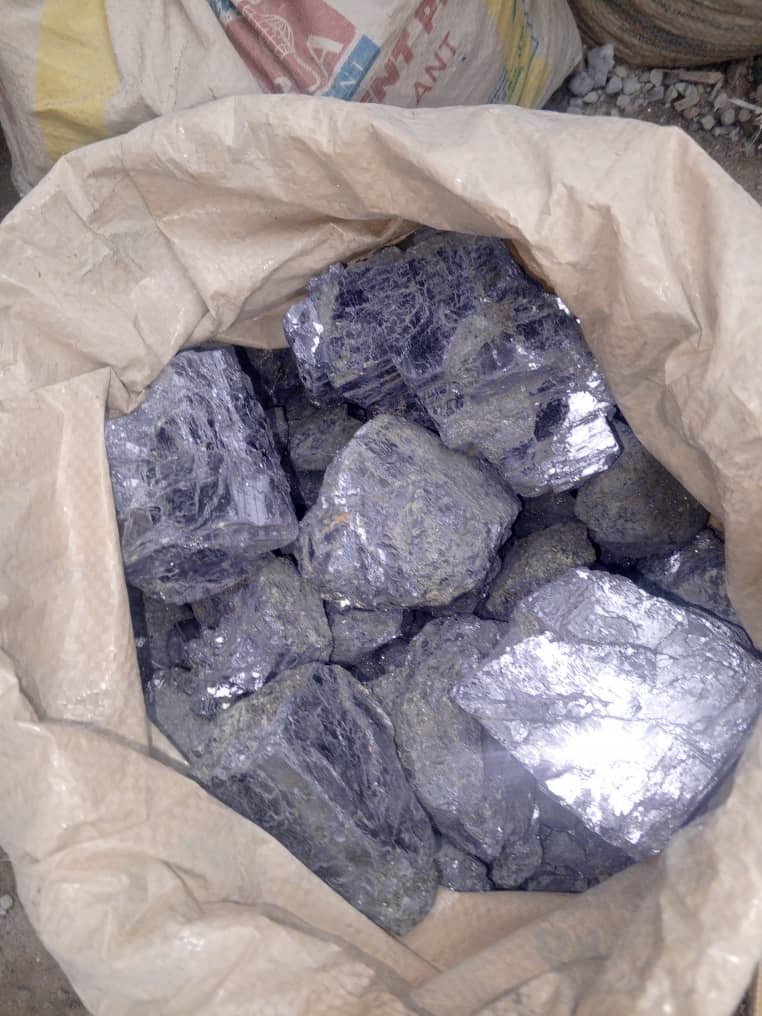
A genuine exporter maintains active sourcing relationships with artisanal and small-scale mining communities and aggregation networks in the mineral-producing regions. This means they have physical access to real monazite material — not hypothetical or future supply, but actual stockpiles they can demonstrate and sample. One of the most reliable ways to distinguish a legitimate exporter from an intermediary or fraudster is to ask: can you show me the material? A genuine exporter can arrange a sample shipment and a verifiable assay. A non-performer cannot.
A genuine exporter holds all required regulatory registrations and permits. In Nigeria’s context, this means active registration with the Nigerian Export Promotion Council (NEPC), a valid export permit from the Ministry of Mines and Steel Development (MMSD), and — critically for monazite — an established working relationship with the Nigerian Nuclear Regulatory Authority (NNRA) that enables the exporter to obtain NNRA clearance certificates within commercially reasonable timeframes. These registrations are not theoretical — they are documented, verifiable credentials that a genuine exporter can produce on request.
A genuine exporter has established relationships with internationally recognized pre-shipment inspection agencies — CCIC (China Certification and Inspection Group), Bureau Veritas, SGS, Intertek, or others — and has practical experience managing the logistics of third-party inspection at Nigerian ports. Pre-shipment inspection is not an administrative formality; it is the mechanism by which the buyer verifies the quality and quantity of material before payment is released, and an exporter who cannot competently coordinate this process is an exporter who cannot actually protect the buyer’s interests.
A genuine exporter understands international commercial terms (INCOTERMS 2020), Letters of Credit mechanics under UCP 600, and the documentation requirements of major importing countries. They can prepare and submit a complete documentary package — Bill of Lading, Commercial Invoice, Certificate of Origin, Packing List, NNRA Clearance Certificate, Pre-Shipment Inspection Certificate, Assay Report, NEPC Non-Oil Export Certificate, and MMSD Export Permit — that satisfies the buyer’s import requirements without missing documents that hold up customs clearance at the destination port.
At Augustina Impex Limited, every one of these capabilities is operational and documented. We are not describing what an exporter should theoretically do — we are describing what we actually do on every shipment we execute.
The Complete Export Documentation Chain for Nigerian Monazite
One of the areas where buyers most commonly encounter difficulty when working with inexperienced or informal Nigerian mineral exporters is documentation. The export documentation chain for Nigerian monazite is more complex than that for most other minerals precisely because of monazite’s NORM (Naturally Occurring Radioactive Material) classification arising from its thorium content. Getting the documentation right — in the correct sequence, from the correct issuing authorities, with the correct content — is the difference between a cargo that clears customs smoothly and one that is detained, returned, or confiscated.
Let us walk through the complete documentation chain that accompanies every legitimate Nigerian monazite export shipment.
The process begins with the Mineral Export Permit issued by the Federal Ministry of Mines and Steel Development (MMSD). This permit is the foundational authorization for the export of solid minerals from Nigeria and must be obtained before the physical movement of any mineral consignment to a port. The application requires documentation of the exporter’s business registration, their mineral sourcing agreements with licensed miners, royalty payment receipts, and a declaration of the specific mineral, quantity, and destination country.
Simultaneously, the NEPC Non-Oil Export Certificate must be obtained from the Nigerian Export Promotion Council. This certificate confirms that the exporter is registered with NEPC as a non-oil export entity and that the specific consignment is authorized for export under Nigeria’s non-oil export promotion framework. The NEPC certificate is required by Nigerian port customs and cannot be substituted or bypassed.
The NNRA Clearance Certificate is the document unique to monazite and other NORM mineral exports. This certificate is issued by the Nigerian Nuclear Regulatory Authority following a formal application that includes the specific activity measurement of the consignment (in Becquerels per kilogram, or Bq/kg), the thorium and uranium concentrations as determined by chemical analysis, and a declaration of the intended disposal or processing route for the radioactive material in the destination country. The NNRA evaluates the application against its regulatory thresholds and, if the consignment meets the conditions for authorized export, issues a clearance certificate valid for that specific shipment. This certificate must be presented to port customs before loading and must accompany the Bill of Lading.
The Quality Assay Certificate is issued by an ISO/IEC 17025-accredited testing laboratory and confirms the mineral composition of the consignment — specifically the TREO content, the distribution of individual rare earth oxides, the thorium and uranium concentrations, the moisture content, and any other parameters specified in the sales contract. For international buyers, the assay certificate is arguably the most commercially important document in the package, because it is the primary basis on which the final payment calculation is made.
The Pre-Shipment Inspection Certificate is issued by the buyer’s designated internationally recognized inspection agency — typically CCIC, Bureau Veritas, SGS, or Intertek — following physical inspection of the consignment at the loading port. The inspection covers quantity verification (using calibrated weighing equipment), visual quality assessment, sampling for confirmatory analysis, and packaging compliance check. The inspection certificate gives the buyer documentary assurance that what is described in the contract is what was actually loaded onto the vessel.
The Certificate of Origin is issued by the Nigerian Export Promotion Council or, in some cases, by the Nigerian Association of Chambers of Commerce, Industry, Mines and Agriculture (NACCIMA). This document confirms that the mineral is of Nigerian origin and is required by customs authorities in virtually all importing countries for tariff classification purposes.
The Commercial Invoice, Packing List, and Clean On-Board Bill of Lading complete the standard shipping document package. The Bill of Lading for monazite must correctly reflect the IMDG dangerous goods classification for radioactive material (UN 2912, Class 7, Packing Group III for typical LSA-I monazite) and must include the shipper’s and consignee’s radiation safety declarations as required by the applicable transport regulations.
At Augustina Impex Limited, we manage the preparation and coordination of every document in this chain. Buyers who work with us receive a complete, organized document package that meets the import requirements of all major destination countries, and we provide advance copies of all documents by email before the originals are dispatched, giving buyers the opportunity to review and confirm correctness before the shipment departs.
Understanding NNRA Clearance: The Regulatory Step That Separates Legitimate from Illegal Monazite Export
Among all the regulatory requirements for Nigerian monazite export, the NNRA clearance step is the one that most clearly separates legitimate, compliant exporters from those operating outside the law. And it is the step that international buyers most frequently overlook when conducting due diligence on Nigerian monazite suppliers.
The Nigerian Nuclear Regulatory Authority was established under the Nuclear Safety and Radiation Protection Act to regulate all activities involving radioactive materials in Nigeria, including the import, export, transport, and processing of NORM minerals. Under NNRA regulations, any mineral that contains naturally occurring radioactive materials above specified activity concentrations — a category that unambiguously includes monazite due to its thorium content — cannot be exported from Nigeria without NNRA authorization.
This means that any monazite that leaves Nigeria without an NNRA clearance certificate is being exported illegally. The consequences of this for the international buyer are serious. Depending on the import regulations of the destination country, a monazite consignment arriving without proper radioactive material documentation may be detained by customs, subjected to radiation surveys, required to be returned to the country of origin at the importer’s expense, or in some jurisdictions confiscated entirely. Several countries have strict regulations governing the import of NORM minerals, and buyers who discover — after the Letter of Credit has been drawn down — that their monazite consignment lacks valid NNRA clearance face a genuinely difficult commercial and regulatory situation.
The practical implication for buyers is straightforward: before committing to any Nigerian monazite transaction, verify that your exporter has an established relationship with the NNRA and can demonstrate experience in obtaining NNRA clearance certificates. Ask for copies of previous NNRA clearances on past shipments. Ask your exporter to explain the NNRA application process and the typical timeline. A genuine, experienced Nigerian monazite exporter will be able to answer these questions fluently and provide documentary evidence without hesitation. One who cannot is not yet ready to execute a compliant monazite export transaction.
Nigeria’s Export Port Infrastructure: What Monazite Buyers Need to Know
The logistics of getting monazite sand from the production areas of the Jos Plateau to a vessel at a Nigerian port involves a supply chain that buyers rarely see but that profoundly affects transaction timelines, cost structures, and risk profiles. Understanding this supply chain helps buyers set realistic expectations and ask the right questions when evaluating an exporter’s capabilities.
Monazite and other heavy mineral sands from the Jos Plateau region are typically transported by road from production and aggregation points in Plateau State to one of Nigeria’s major ports. The two principal ports used for mineral export consignments are the Apapa Port Complex in Lagos (the largest and most developed port in West Africa, handling the majority of Nigeria’s import and export volume) and the Onne Port Complex in Rivers State (a dedicated oil and gas and dry cargo port that has increasingly been used for solid mineral exports given its proximity to certain production regions and its somewhat less congested operational environment).
Road transport from Jos to Lagos covers approximately 300 kilometres and typically takes between 6 and 12 hours under normal conditions, though this can extend significantly in the rainy season when road conditions deteriorate. The road journey from Jos to Port Harcourt (for Onne Port) is approximately 450 kilometres. These logistics distances are manageable and do not represent a significant cost component for a bulk mineral consignment, but they do need to be factored into the overall export timeline.
At Apapa Port, the Nigerian Ports Authority (NPA) manages port operations, while multiple terminal operators handle specific berths and cargo types. Dry bulk mineral exports are typically handled through the conventional cargo terminals. Container shipments — which are increasingly used for monazite given the NORM classification and the preference of many buyers for containerized delivery — are handled through the container terminals operated by companies including APM Terminals and Ports and Cargo Handling Services Limited.
Port congestion at Apapa has historically been a concern for exporters. The port serves the largest economy in Africa, and demand for port services has consistently outpaced available capacity. Experienced Nigerian mineral exporters know how to navigate Apapa’s congestion realities — including working with well-connected freight forwarding and shipping agents, scheduling shipments during lower-demand periods, and maintaining flexible laycan arrangements in contracts that allow for reasonable port delay without triggering contract penalties.
Onne Port, while smaller than Apapa, offers certain operational advantages for mineral exporters — particularly in terms of operational efficiency and the availability of specialized heavy-lift and bulk handling equipment. Some experienced Nigerian mineral exporters use Onne as their preferred loading port, particularly for larger bulk consignments.
At Augustina Impex Limited, we have established relationships with freight forwarding companies, customs clearing agents, and shipping line agents at both Apapa and Onne ports. These relationships allow us to efficiently coordinate the port-side logistics of monazite export — from container procurement and stuffing to customs clearance and vessel booking — and to give buyers accurate and realistic shipment schedules that we can actually meet.
How to Vet a Nigerian Monazite Sand Exporter: A Practical Checklist
Given the importance of choosing the right exporter, we want to provide international buyers with a practical, actionable checklist for due diligence. Use these questions as a framework when evaluating any Nigerian monazite sand exporter — including us.
Start with business registration verification. Any legitimate Nigerian export company should be registered with the Corporate Affairs Commission (CAC) and should be able to provide their Certificate of Incorporation, their RC number, and their Memorandum and Articles of Association. These documents can be independently verified through the CAC’s public database at cacsonline.gov.ng. An exporter who cannot or will not provide these documents is operating without formal legal standing.
Next, verify NEPC registration. The Nigerian Export Promotion Council maintains records of all registered non-oil exporters. An exporter should be able to provide their NEPC registration certificate and their exporter code. If they are claiming to be an active mineral exporter but cannot demonstrate current NEPC registration, that is a significant concern.
Ask for evidence of previous NNRA clearance. This is the single most effective filter for distinguishing genuine, compliant monazite exporters from those who are not yet capable of executing a legal monazite shipment. Ask to see copies of NNRA clearance certificates issued to the exporter for previous monazite consignments. These certificates will show the date, the quantity cleared, the specific activity measurements, and the authorization number. The existence of multiple such certificates over time demonstrates an established relationship with the NNRA and operational experience with the clearance process.
Request assay certificates from recent transactions. A genuine exporter who is actively sourcing and trading monazite will have recent assay data from material they have handled. Ask for assay certificates from an internationally recognized, ISO/IEC 17025-accredited laboratory for material of similar grade and origin to what they are offering you. This verifies both that they have genuine access to mineral material and that the quality parameters they are quoting are grounded in real analytical data rather than assumptions.
Ask for references from previous international buyers. This is a standard business due diligence step that is often skipped in commodity trade but should not be. A Nigerian monazite exporter who has successfully completed international transactions should be willing to provide buyer references — companies or individuals who can confirm that shipments were completed, documents were correct, and the commercial relationship was professionally managed.
Verify inspection agency relationships. Ask which internationally recognized inspection agencies your prospective exporter works with, and ask how they coordinate the pre-shipment inspection process. A genuine, experienced exporter will name specific agencies, name specific contact people or offices within those agencies, and be able to describe the inspection process in practical detail. Vague or evasive answers about inspection should raise concerns.
Finally, evaluate their knowledge of INCOTERMS and LC mechanics. A professional exporter should be fluent in the commercial terms of international mineral trade — they should be able to discuss FOB vs CIF pricing, explain the structure of a Letter of Credit under UCP 600, identify the specific shipping documents that must be presented to trigger LC payment, and flag any issues with the buyer’s proposed payment structure that could create problems at the execution stage. Exporters who cannot engage substantively with these topics are unlikely to successfully execute complex international transactions.
Common Mistakes International Buyers Make When Sourcing Monazite from Nigeria
Experience in the Nigerian mineral export sector gives you a particular vantage point — you see the same mistakes repeated by international buyers, often first-time buyers of Nigerian minerals, that could have been avoided with better knowledge. We share these not to embarrass anyone but because preventing these mistakes is genuinely in the interest of building a healthy and trustworthy Nigerian mineral export market.
The most common and costly mistake is proceeding to contract and payment without verifiable evidence of the mineral. Many international buyers, particularly those who are accustomed to commodity markets where spot availability is assumed, make the mistake of issuing a Letter of Credit based on a specification sheet and a proposed price without first demanding proof that the mineral physically exists in the quantity and quality described. In Nigerian mineral trade, proof of product — a verifiable sample with a genuine assay certificate from an accredited laboratory — should always precede any financial commitment. This is non-negotiable.
A related mistake is relying on assay certificates provided by the seller without independent verification. Assay manipulation — deliberately or inadvertently misrepresenting the mineral grade — is a risk in any mineral market. The buyer’s protection against this risk is to require that pre-shipment inspection be conducted by an inspection agency of their own choosing, and to require that the final payment calculation be based on the results of that buyer-designated inspection rather than on the seller’s own assay.
Another common mistake is failing to account for NNRA compliance in the transaction timeline. Buyers who are used to sourcing non-radioactive minerals often build commercial timelines that do not include the NNRA clearance process, and then find themselves facing delays when the clearance takes longer than anticipated or when documentation issues require re-submission. Working with an exporter who has established NNRA relationships and knows the clearance timeline realistically is the most effective way to avoid this problem.
Finally, many buyers underestimate the importance of the freight forwarding and customs brokerage relationships in Nigeria. Port logistics at Apapa in particular can be affected by congestion, documentation delays, or unexpected customs queries. Working with an exporter who has well-established port-side relationships — who knows the customs officers, who works with experienced shipping agents, who has contingency plans for common port-side issues — can mean the difference between a shipment that departs on schedule and one that misses its vessel booking and causes costly delays.
Incoterms for Nigerian Monazite Export: FOB vs CIF
International buyers of Nigerian monazite need to make a fundamental commercial decision when structuring each transaction: under which Incoterm will the trade be conducted? The two most common options in Nigerian mineral export are Free On Board (FOB) and Cost, Insurance, and Freight (CIF), and the choice between them has significant implications for cost, risk, and logistics management.
Under FOB (Free On Board) terms, the seller’s responsibility ends when the goods are loaded onto the vessel at the named Nigerian port. All ocean freight charges, marine insurance, and destination port charges are for the buyer’s account. FOB pricing is typically lower than CIF pricing because it excludes these freight and insurance components. For large, experienced commodity buyers who have established relationships with freight forwarders and shipping lines, FOB terms often provide better overall cost control because the buyer can leverage their freight volumes to negotiate competitive ocean freight rates.
Under CIF (Cost, Insurance, and Freight) terms, the seller is responsible for the ocean freight and marine insurance costs to the named destination port. The seller arranges and pays for the vessel booking, freight, and insurance, and the buyer’s cost is a single all-inclusive landed price per tonne to their destination port. CIF terms are often preferred by smaller or less experienced buyers who do not have established shipping relationships and prefer the simplicity of a single delivered price.
At Augustina Impex Limited, we offer both FOB and CIF terms for Nigerian monazite export, with pricing adjusted appropriately to reflect the logistics costs included or excluded. We can also accommodate DAP (Delivered at Place) terms in some circumstances for buyers with specific logistics requirements. Regardless of the Incoterm chosen, the quality assurance and documentation package remains the same — what changes is only who arranges and pays for the ocean freight and insurance leg.
The Role of Pre-Shipment Inspection in Protecting the Buyer
We have mentioned pre-shipment inspection several times in this article, and with good reason — it is one of the most important protections available to the international buyer of Nigerian monazite, and it is the mechanism that makes Letter of Credit payment a genuinely secure instrument for both parties.
Pre-shipment inspection of monazite in Nigeria involves an internationally accredited inspection agency attending the loading port at the time of shipment to carry out a formal assessment of the consignment. The inspection typically covers the following activities.
Quantity verification is performed using calibrated weighing equipment at the loading point — either at the container stuffing location or at the port. The inspector confirms that the weight of material being shipped matches the quantity declared in the sales contract and invoice.
Quality sampling involves the inspector drawing representative samples from the bulk material in accordance with internationally recognized sampling standards (typically ISO or ASTM protocols) and submitting those samples to an accredited laboratory for chemical analysis. The resulting assay certificate from the inspector’s chosen laboratory constitutes the independent quality verification of the shipment.
Packaging inspection confirms that the material has been packed in accordance with the contractual specifications and applicable transport regulations, including proper labelling for radioactive materials under IMDG regulations.
The pre-shipment inspection certificate issued at the conclusion of this process is one of the core documents presented to the issuing bank to trigger payment under the Letter of Credit. It gives the buyer confidence that what was shipped was what was contracted, and it provides a basis for any quality or quantity claims that may arise after arrival at the destination port.
The choice of inspection agency matters. CCIC (China Certification and Inspection Group) is the preferred and most commonly used inspection agency for Nigerian mineral exports destined for Chinese buyers, and CCIC maintains offices and operational capacity in Nigeria. Bureau Veritas, SGS, and Intertek are all internationally recognized options for buyers in other markets. At Augustina Impex Limited, we work seamlessly with all of these agencies and accommodate the buyer’s preference without restriction.
Augustina Impex Limited: A Nigerian Monazite Sand Exporter You Can Verify
We have described at length what a professional Nigerian monazite sand exporter looks like and how to verify one. It would be inappropriate for us to make that case without applying the same standards to ourselves.
Augustina Impex Limited was incorporated in Nigeria on 3rd June 2008 under the Companies and Allied Matters Act (CAMA), RC Number 750691. Our Corporate Affairs Commission registration is publicly verifiable. We are registered with the Nigerian Export Promotion Council as a non-oil exporter and hold active mineral export permits from the Ministry of Mines and Steel Development for our standard mineral categories. We have an established relationship with the Nigerian Nuclear Regulatory Authority and have obtained NNRA clearance certificates for monazite consignments on multiple occasions. We work with CCIC, Bureau Veritas, and SGS for pre-shipment inspection, and we can provide buyers with contact details for our inspection agency representatives in Nigeria.
Our headquarters in Jos, Plateau State places us within the primary production region for Nigerian heavy mineral sands, including monazite. This proximity gives us direct access to the mining communities and aggregation networks from which monazite is sourced, and it means our quality assessments are based on first-hand knowledge of the material rather than remote assumptions.
We maintain detailed transaction records for all mineral export consignments we have handled, and we are willing to provide documentary evidence of our export history to serious prospective buyers who require it as part of their due diligence process. We welcome independent verification of our credentials, we support site visits and factory inspections for buyers who want to visit Nigeria and assess our operations directly, and we are available for video conference meetings to discuss technical and commercial details before any transaction is initiated.
Our standard mineral export portfolio includes monazite sand concentrate (50–68% TREO, NNRA cleared), ilmenite concentrate (40–65% TiO₂), zircon sand concentrate (60–66% ZrO₂), fluorite ore (60–85% CaF₂), coltan (20–40%+ Ta₂O₅), lithium ore (1–3% Li₂O), tin ore, copper ore, and lead-zinc ore. This breadth of portfolio means that buyers who come to us for monazite often discover additional sourcing opportunities for other Nigerian minerals that complement their procurement requirements.
Beginning Your Journey: How to Request a Monazite Sand Export Quote from Nigeria
If you have read this far, you now have a comprehensive understanding of what the Nigerian monazite export process involves, what a professional exporter looks like, and what questions to ask before committing to a transaction. The natural next step is to open a conversation.
When you contact us, it helps to have the following information ready: the grade of monazite you are seeking (in terms of minimum TREO content), the quantity for a trial order and for ongoing monthly supply, your preferred loading port and destination port, your preferred payment terms and inspection agency, and any specific chemical parameters — thorium content thresholds, individual REO minimum grades, moisture limits — that your processing facility requires.
With this information, we can provide you with a Soft Corporate Offer within a short timeframe. The SCO will set out the available material specifications, the FOB pricing, the proposed commercial terms, and the timeline from contract execution to shipment. If the SCO meets your requirements, we move to a Full Corporate Offer, coordinate pre-shipment sampling and assay, and progress to the contract and Letter of Credit stage.
Throughout this process, our team is available by email, video call, and WhatsApp to answer questions, address concerns, and keep you informed of progress. We understand that international buyers who are sourcing from Nigeria for the first time have legitimate concerns about transaction risk, and we take those concerns seriously. Our entire transaction management approach is designed to make the process as transparent, verifiable, and commercially secure as possible.
Conclusion: Choose Your Nigerian Monazite Sand Exporter with Your Eyes Open
The Nigerian monazite export sector offers genuine value for international buyers who approach it with the right knowledge and the right partner. The mineral is real, the quality is competitive, the supply potential is significant, and the demand drivers from the global rare earth and clean energy transition are as strong as they have ever been.
But the value of Nigerian monazite is only accessible through an exporter who can actually deliver — one who holds the right regulatory credentials, manages the documentation chain competently, coordinates pre-shipment inspection professionally, and executes transactions with the kind of transparency and reliability that builds long-term commercial relationships.
At Augustina Impex Limited, that is what we do. It is what we have been doing for more than 17 years, and it is what we will continue doing as Nigeria’s role in the global rare earth supply chain grows.
We invite you to reach out to us at augustinaimpex@gmail.com to begin the conversation. Tell us what you need, let us show you what we have, and together we will determine whether a monazite supply relationship between your organization and Augustina Impex Limited makes commercial sense. We look forward to hearing from you.
Post a comment
Related Posts
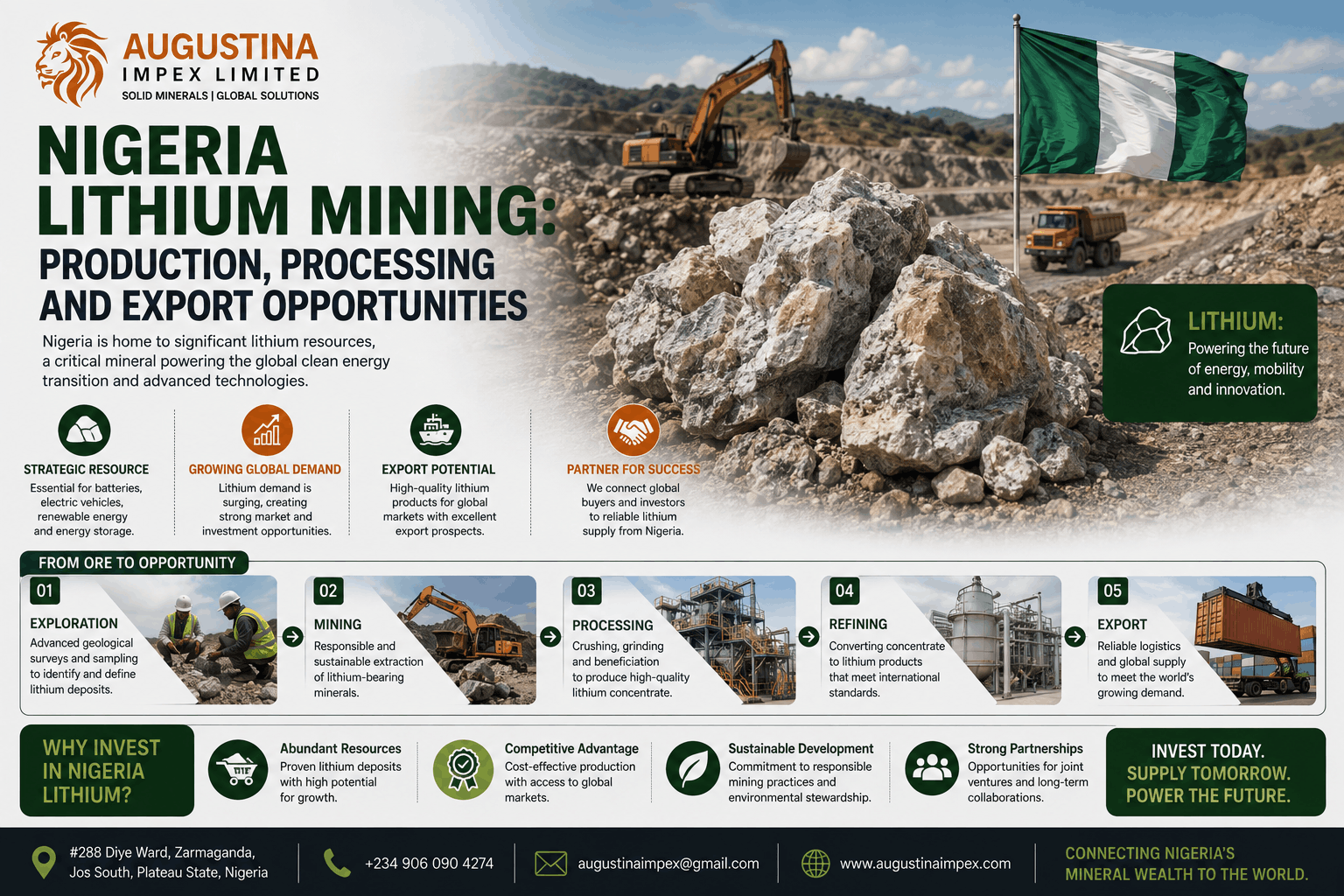
Nigeria Lithium Mining: Production, Processing & Export
Nigeria Lithium Mining: Production, Processing and Export Opportunities By Kolawole King, CEO — Augustina Impex…

Nigeria Rare Earth Minerals: Deposits & Market Potential
Nigeria Rare Earth Minerals: Deposits, Applications and Global Market Potential By Kolawole King, CEO —…
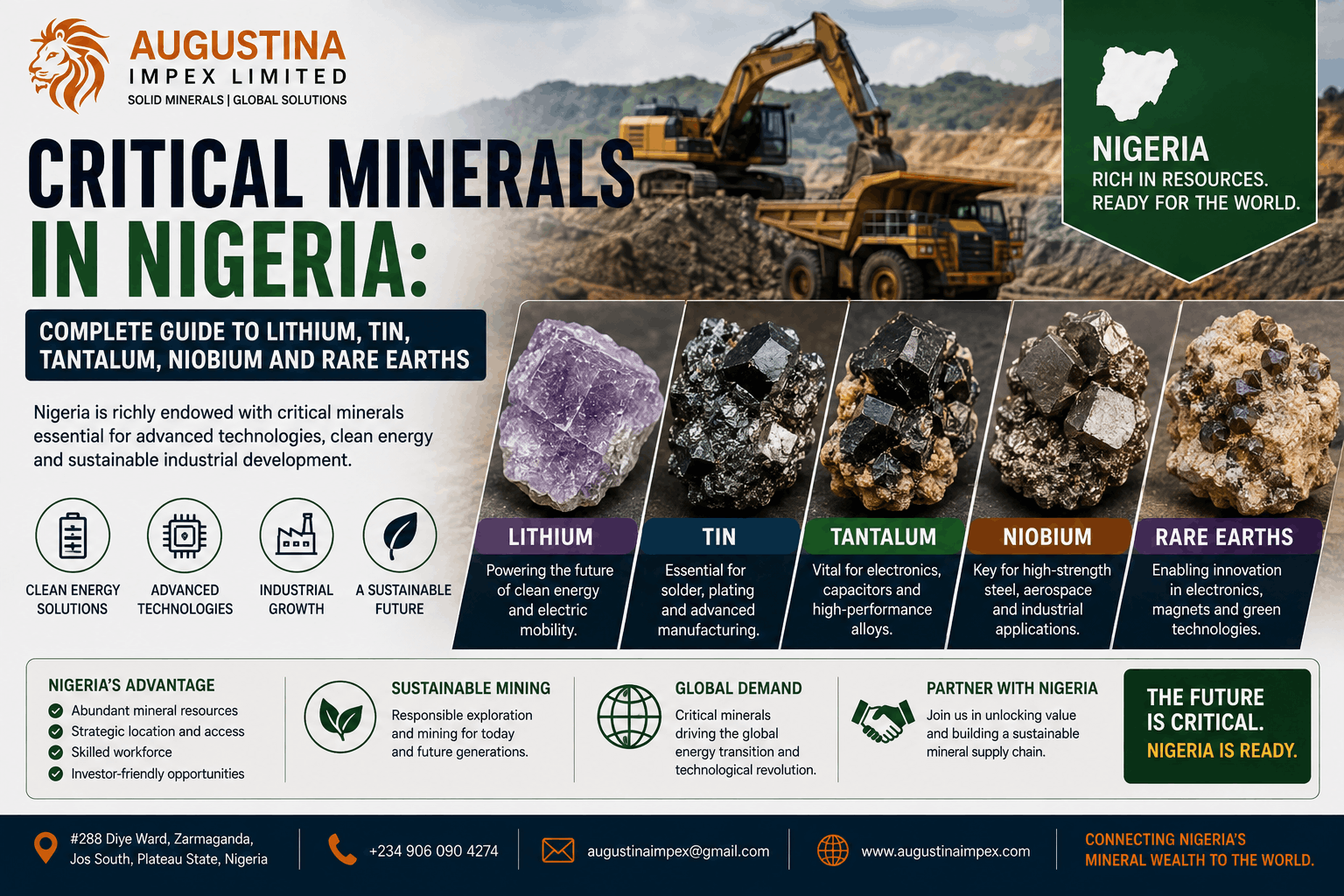
Nigeria Critical Minerals Guide: Lithium, Tin & Rare Earths
Critical Minerals in Nigeria: Complete Guide to Lithium, Tin, Tantalum, Niobium and Rare Earths By…
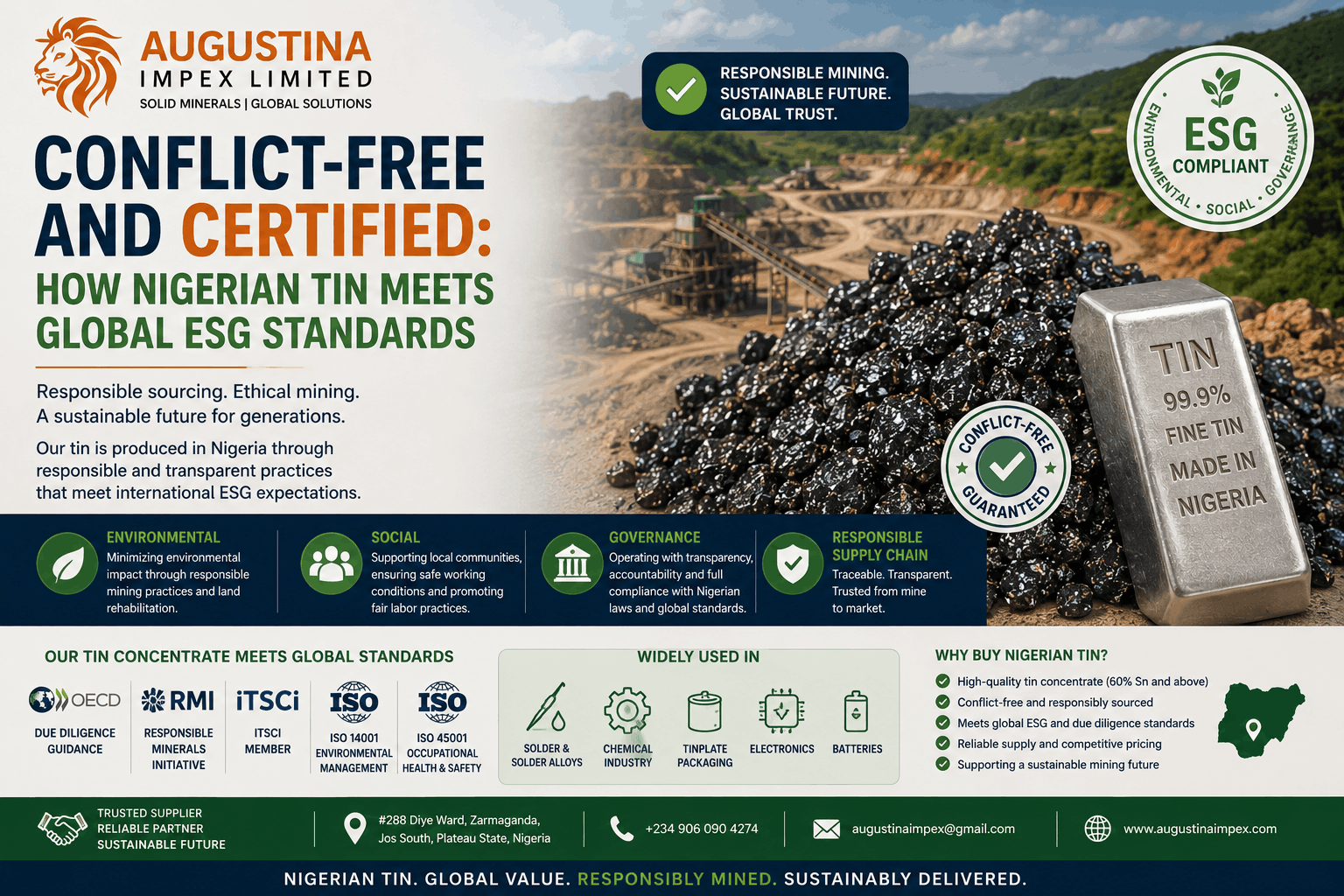
Conflict-Free Nigerian Tin Meets Global ESG Standards
Conflict-Free and Certified: How Nigerian Tin Meets Global ESG Standards By Kolawole King, CEO —…