
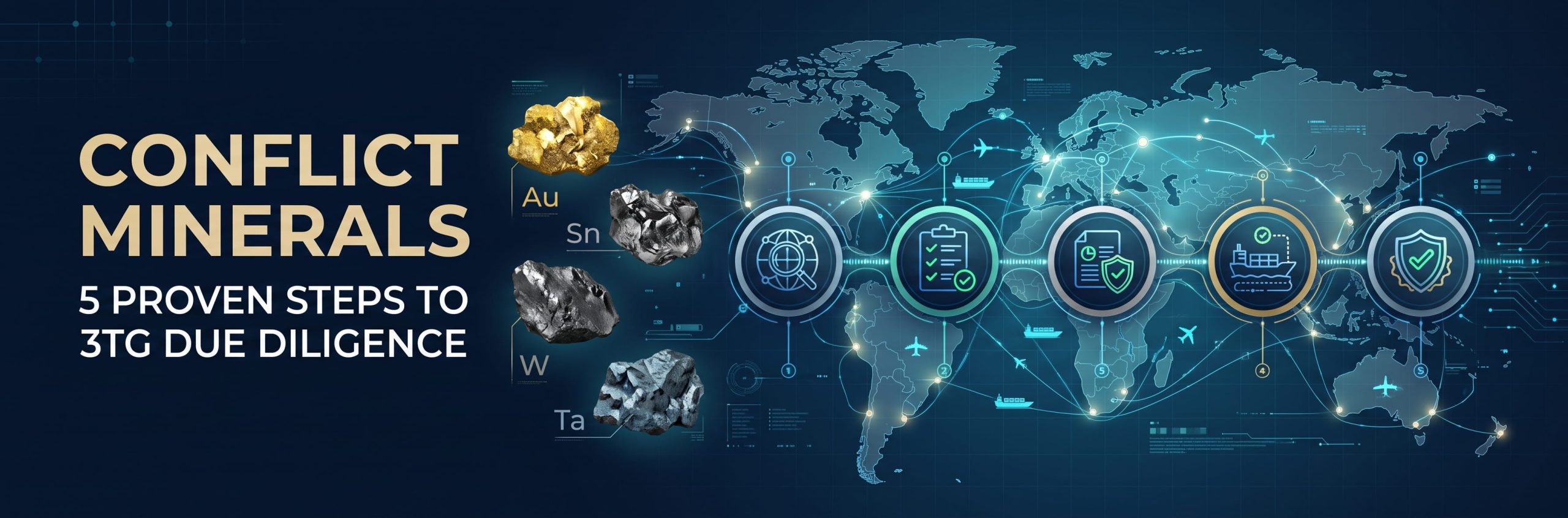
Conflict Minerals and Responsible Sourcing: A Practical Guide to 3TG and the OECD Due Diligence Rules
By Kolawole King, CEO — Augustina Impex Limited | Published: October 2026 | 22 min read
Conflict minerals are minerals whose mining, trade or transport helps to finance armed groups, fuels violence or is linked to serious human rights abuses. In international law and business practice, the term usually refers to the four 3TG metals: tin, tantalum, tungsten and gold. Today, almost every smelter, refiner and electronics manufacturer in the world expects its suppliers to prove that their 3TG minerals were sourced responsibly, using the framework set out in the OECD Due Diligence Guidance.
I run a mineral sourcing and export company in Jos, Plateau State, the historic heart of Nigeria’s tin and columbite trade. Over the years I have watched the questions from buyers change. Ten years ago, most buyers asked about grade, price and shipping date. Today, the first questions are often different: Which mine did this come from? Who handled it on the way to the port? Were royalties paid? Is any armed group or child labour linked to this cargo? An exporter who cannot answer these questions clearly is quietly dropped, however good the grade.
This guide explains, in plain language, what conflict minerals are, why the rules exist, how the OECD five-step due diligence framework works, what the major laws require, which industry programmes your buyers rely on, and how a small or medium exporter in Nigeria or anywhere in Africa can build a credible responsible sourcing system. At the end, I introduce my new 150-page ebook, which covers every part of this subject in much greater depth.
1. Conflict minerals rules focus on the 3TG metals: tin, tantalum, tungsten and gold.
2. The OECD Due Diligence Guidance is the global reference. Its five steps are: management systems, risk identification, risk response, independent audit and annual reporting.
3. Annex II of the OECD Guidance sets “red lines”. Support to non-state armed groups and serious abuses such as the worst forms of child labour require immediate suspension of a supplier.
4. US Dodd-Frank Section 1502, EU Regulation 2017/821 and China’s CCCMC guidelines all build on the OECD framework.
5. For exporters, responsible sourcing is not just compliance. It is a sales tool that wins buyers, speeds up approvals and protects prices.
What Are Conflict Minerals?
The phrase “conflict minerals” became widely known through the wars in the eastern Democratic Republic of the Congo (DRC). United Nations investigators documented how armed groups controlled mine sites, taxed miners and traders at roadblocks, and sold minerals into international supply chains to buy weapons and pay fighters. The minerals most closely linked to this trade were cassiterite (tin ore), coltan (the source of tantalum), wolframite (a tungsten ore) and gold. These four became known as the 3TG.
It is important to understand that a mineral is not a “conflict mineral” because of its chemistry or the country it comes from. Tin from a well-governed, licensed mine is not a conflict mineral. Tin taxed by a militia at a roadblock is. The label depends on the circumstances of extraction, transport and trade, which is why the rules focus on due diligence: a continuous process of finding out where minerals come from and what risks are attached to them.
| Metal | Main ores traded upstream | Main uses | Why buyers care |
|---|---|---|---|
| Tin (Sn) | Cassiterite (SnO₂) | Solder for electronics, tinplate, chemicals | Every circuit board uses tin solder |
| Tantalum (Ta) | Coltan, columbite-tantalite, tantalite | Capacitors, superalloys, sputtering targets | Africa is the leading source of mined tantalum |
| Tungsten (W) | Wolframite, scheelite | Hard metal tools, alloys, electronics | Critical for industry and defence |
| Gold (Au) | Alluvial and hard-rock gold, doré | Jewellery, investment, electronics | High value, easy to smuggle, large artisanal sector |
Because conflict minerals end up in phones, laptops, cars, medical devices and aircraft, the responsibility for how they are sourced runs through the entire supply chain, from the artisanal miner with a shovel to the global brand on the shelf.
Why Conflict Minerals Rules Exist: A Short History
Through the late 1990s and 2000s, reports on conflict minerals by the UN Group of Experts on the DRC and by civil society organisations showed a direct link between the trade in conflict minerals and the financing of armed groups in the Great Lakes region. Consumers and investors began to ask electronics companies where the metals in their products came from. Most could not answer.
Three responses followed. First, the OECD developed its Due Diligence Guidance for Responsible Supply Chains of Minerals from Conflict-Affected and High-Risk Areas, adopted as an OECD Council Recommendation in 2011 and now in its third edition. Second, the United States passed the Dodd-Frank Act in 2010, whose Section 1502 required listed companies to disclose whether their products contained 3TG from the DRC or its neighbours. Third, industry created programmes to audit smelters and refiners, because these processing plants are the narrow “chokepoint” through which almost all 3TG must pass.
When the first conflict minerals rules arrived, many buyers simply stopped buying from the Great Lakes region. This “de facto embargo” hurt thousands of legitimate artisanal miners while smuggling continued. The OECD approach was designed to avoid repeating that mistake. Its message to companies is clear: engage, assess, improve, and disengage only when necessary. Responsible sourcing is meant to keep legitimate African supply in the market, not push it out.
The OECD Due Diligence Guidance Explained
The OECD Due Diligence Guidance for Responsible Supply Chains of Minerals is the most important document in this field. It is not a law in itself, but it has become the global reference for conflict minerals and 3TG due diligence. The US, EU and Chinese rules, industry audit standards and the expectations of nearly all large buyers are built on it.
① It applies to all minerals and all high-risk areas
Although it is best known for 3TG, the Guidance applies to all minerals. It focuses on conflict-affected and high-risk areas (CAHRAs): places with armed conflict, widespread violence, weak or collapsed governance, or serious human rights abuses. A CAHRA is not necessarily a whole country. It may be a single region, district or trade route.
② It divides the supply chain into upstream and downstream
Upstream companies include miners, local traders, processors, exporters, international concentrate traders and the smelter or refiner itself. Downstream companies include metal traders, component makers, manufacturers and retailers. Upstream companies are expected to trace minerals back to the mine and assess risks on the ground. Downstream companies rely largely on the due diligence of the smelters and refiners in their supply chain.
③ It is risk-based and progressive
The Guidance does not demand perfection on day one. It expects companies to identify their risks, respond in proportion to those risks, and improve over time. A small exporter is not expected to run the same system as a multinational, but it is expected to know its suppliers, know its sources and act when it finds problems.
The OECD Five-Step Framework for Responsible Sourcing
At the heart of the Guidance is a simple five-step framework for 3TG due diligence and for responsible sourcing of other minerals. Every conflict minerals and responsible sourcing programme, from a small Nigerian buying centre to a global smelter, follows these steps.
① Step 1: Establish strong company management systems
Adopt a written supply chain policy consistent with Annex II of the Guidance. Appoint a senior person responsible for due diligence. Build a system of controls and records, including know-your-supplier files and chain-of-custody records. Communicate the policy to suppliers and include it in contracts. Set up a grievance mechanism so that miners, communities or staff can raise concerns.
② Step 2: Identify and assess risks in the supply chain
Map the supply chain from mine to export. Identify any “red flags”, such as minerals from or through a CAHRA, unexplained volumes, or suppliers who will not disclose the mine of origin. Where red flags exist, carry out enhanced due diligence, including on-the-ground assessments of mine sites and transport routes.
③ Step 3: Design and implement a strategy to respond to identified risks
Report the findings to senior management. Decide on the response: continue trading while mitigating the risk, temporarily suspend trade while mitigation is pursued, or disengage from the supplier. Write a risk management plan with measurable objectives and timelines, and monitor progress.
④ Step 4: Carry out an independent third-party audit
This step applies to smelters and refiners. Independent auditors check that the smelter’s due diligence practices meet the standard. In practice, this is done through industry programmes such as the RMI’s Responsible Minerals Assurance Process (RMAP) and the LBMA Responsible Gold programme.
⑤ Step 5: Report annually on supply chain due diligence
Publish an annual report describing the management system, the risks identified and the steps taken to manage them. Reports should be honest about problems as well as progress. Buyers increasingly read these reports before approving a new supplier.
You do not need expensive software to carry out 3TG due diligence. A written policy, a responsible person, a supplier register, a site register, a lot register, a shipment register, regular site visits and an honest annual report already put you ahead of many competitors. What matters is that every record connects: any shipment should be traceable back to its mine sites in minutes.
Annex II: The Red Lines Every Buyer Watches
Annex II of the OECD Guidance is a model supply chain policy for conflict minerals and other high-risk minerals. It lists the risks that companies must not tolerate and tells them how to respond. Some risks require immediate action. Others can be managed through mitigation while trade continues. Knowing the difference is essential for both buyers and sellers.
| Risk category | Examples | Required response |
|---|---|---|
| Serious abuses | Torture, forced labour, worst forms of child labour, war crimes, widespread sexual violence | Immediately suspend or end engagement |
| Direct or indirect support to non-state armed groups | Armed groups controlling mine sites or routes, illegal taxation or extortion | Immediately suspend or end engagement |
| Public or private security forces | Illegal control of sites, illegal taxation, abuses by security personnel | Mitigate; suspend if mitigation fails |
| Bribery and fraudulent misrepresentation | Bribes to hide origin, falsified documents, misdeclared weights or grades | Mitigate; suspend if mitigation fails |
| Money laundering | Mineral trade used to launder illicit funds | Mitigate; suspend if mitigation fails |
| Payments to governments | Unpaid taxes, fees and royalties; lack of transparency | Mitigate; suspend if mitigation fails |
For Nigerian exporters, the most common practical issues fall into the last three categories: missing royalty receipts, undocumented lots mixed into a cargo, and informal payments along transport routes. These are exactly the issues that a good due diligence system is designed to catch and fix.
The 3T Supplement and the Gold Supplement
For conflict minerals, the OECD Guidance has two supplements that apply the five steps to specific supply chains.
The Supplement on Tin, Tantalum and Tungsten sets detailed expectations for each type of company, from local exporters to smelters. Upstream companies are expected to collect and share information such as the mine of origin, quantities, dates of extraction, taxes and royalties paid, and the identity of all intermediaries. This information travels with the mineral down the supply chain.
The Supplement on Gold reflects gold’s special risks: it is high in value, easy to transport and smuggle, and produced on a large scale by artisanal and small-scale miners. It sets specific rules for refiners, recycled gold and the formalisation of artisanal mining. Refiners on the London Bullion Market Association (LBMA) Good Delivery List must follow the LBMA Responsible Gold Guidance, which is aligned with the OECD standard.
Conflict Minerals Laws: Dodd-Frank, the EU Regulation and China’s Guidelines
Several governments have turned the OECD standard into binding or semi-binding conflict minerals rules. An exporter does not need to be a lawyer, but should know which rules its buyers must follow, because those rules decide what information the buyer will ask for.
① United States: Dodd-Frank Section 1502
Section 1502 of the Dodd-Frank Act, implemented by the US Securities and Exchange Commission, requires US-listed companies that use 3TG in their products to carry out a reasonable country of origin inquiry and file an annual Form SD. Where 3TG may come from the DRC or an adjoining country, the company must carry out due diligence, for which the OECD Guidance is the accepted framework, and may need to file a Conflict Minerals Report.
② European Union: Regulation (EU) 2017/821
The EU Conflict Minerals Regulation has applied since 1 January 2021. It requires EU importers of tin, tantalum, tungsten and gold ores, concentrates and metals above set volume thresholds to carry out supply chain due diligence in line with the OECD Guidance, obtain third-party audits and report publicly. Unlike Dodd-Frank, it is not limited to the Great Lakes region. It applies to minerals from any conflict-affected or high-risk area worldwide.
③ China: CCCMC due diligence guidelines
The China Chamber of Commerce of Metals, Minerals and Chemicals Importers and Exporters (CCCMC) has issued guidelines for responsible mineral supply chains, built on the OECD framework. Chinese smelters and traders that sell to international customers increasingly apply them, which means Nigerian and African exporters selling to China should expect the same questions as those selling to Europe.
| Instrument | Type | Who it binds | Core demand |
|---|---|---|---|
| OECD Due Diligence Guidance | International guidance | Governments commit to promote it; companies use it voluntarily or because laws refer to it | Five-step risk-based due diligence; Annex II policy |
| Dodd-Frank Section 1502 | US federal law | US-listed companies using 3TG | Annual Form SD; Conflict Minerals Report where needed |
| Regulation (EU) 2017/821 | EU law | EU importers of 3TG above volume thresholds | OECD-based due diligence, third-party audit, annual disclosure |
| CCCMC guidelines | Chinese industry guidelines | Chinese companies in mineral supply chains | OECD-aligned risk-based due diligence |
| ICGLR Regional Certification Mechanism | Regional mechanism | Mineral exporters in Great Lakes member states | Mine inspection, chain of custody, regional certificate |
Industry Programmes: RMI, RMAP, CMRT, ITSCI and LBMA
Conflict minerals laws set the expectations, but industry programmes do much of the practical work. These are the names your buyers will mention, so it pays to know what they mean.
- Responsible Minerals Initiative (RMI): an industry body whose members include many of the world’s largest electronics, automotive and industrial companies. See the Responsible Minerals Initiative.
- Responsible Minerals Assurance Process (RMAP): RMI’s independent audit of smelters and refiners. Smelters that pass are listed as “conformant”. Many manufacturers buy only from conformant smelters, so the smelter, in turn, asks its suppliers for detailed origin information.
- Conflict Minerals Reporting Template (CMRT): a free standard spreadsheet that companies use to pass information about their 3TG smelters up and down the supply chain. The Extended Minerals Reporting Template (EMRT) does the same for other minerals such as cobalt and mica.
- ITSCI: an upstream traceability and due diligence programme for tin, tantalum and tungsten, operating in several Central African countries, which tags and records minerals from mine to export.
- ICGLR Regional Certification Mechanism: a certification system for 3TG exports from member states of the International Conference on the Great Lakes Region.
- LBMA Responsible Gold Guidance: the mandatory due diligence standard for refiners on the London Good Delivery List.
For exporters of conflict minerals in countries where no upstream scheme operates, as is currently the case for most 3TG in Nigeria, credibility comes from your own documented due diligence, independent verification of key sites where possible, and transparency with buyers.
Conflict Minerals Red Flags: Warning Signs in a 3TG Supply Chain
In 3TG due diligence, a red flag is a fact or circumstance that suggests a higher risk. It does not prove wrongdoing, but it does require enhanced due diligence before you buy or ship. Based on the OECD Guidance and my own experience in the field, these are the warning signs buyers and exporters must watch for:
- The mineral originates from, or has passed through, a known or suspected conflict-affected or high-risk area.
- The volume offered is larger than the declared source could plausibly produce.
- The supplier is unable or unwilling to name the mine site or the licence holder.
- The mining licence is expired, suspended or issued for a different location.
- Armed persons are present at the mine site or along the transport route.
- There are reports of children working in hazardous conditions.
- Unofficial payments are being made to security forces or officials.
- Royalty and fee receipts are missing or inconsistent.
- Payment is requested in cash, to third parties or to offshore accounts.
- Documents show signs of alteration, or the grade does not match the declared deposit.
- The supplier or its owners appear on a sanctions list or in credible adverse media reports.
- The material has changed hands unusually many times before reaching you.
The most damaging mistake is not finding a red flag. It is finding one and doing nothing. Record every red flag, the questions you asked, the evidence you collected and the decision you made. If a buyer or auditor later asks, a documented response shows that your system works.
How to Build a Conflict Minerals Due Diligence System: 10 Practical Steps for Exporters
Many African exporters assume that conflict minerals due diligence is only for multinationals. That is a costly misunderstanding. A small company can build a credible system in a few months by following these steps.
- Adopt a written supply chain policy that reflects Annex II of the OECD Guidance, and have it approved by the managing director.
- Appoint a responsible person for due diligence, with the authority to stop a purchase.
- Open a know-your-supplier (KYS) file for every supplier, with registration documents, ownership, licences, mine sites and bank details.
- Keep a site register with licence details, GPS coordinates, photographs and a risk rating for every mine site.
- Keep a lot register recording every incoming lot: supplier, site, weight, grade, payment and royalty receipt.
- Keep a shipment register listing which lots went into each export, so any cargo can be traced back to its sites.
- Do a monthly mass balance to check that what you sold matches what you bought and held in stock.
- Visit your key sites at least twice a year and use a written site visit checklist.
- Set up a grievance mechanism: a phone number or email posted at buying points and sites, with a log of every concern received.
- Publish a short annual report and prepare a standing buyer information pack with your policy, procedures, sample lot file and latest report.
These steps cost far less than most exporters expect. In my experience, the cost of a basic system is a small fraction of the value of a single container of concentrate, and it is often recovered through better prices and faster buyer approvals.
Conflict Minerals and Responsible Sourcing in Nigeria and West Africa
Nigeria is not a war zone like eastern DRC, but conflict minerals rules and responsible sourcing still matter here, for three reasons. First, Nigeria is one of the world’s leading producers of tantalum concentrate, and its tin and columbite trade on the Jos Plateau is more than a century old. Every Nigerian 3TG cargo eventually reaches smelters that follow the OECD standard. Second, a large share of production is artisanal and informal, which makes traceability difficult. Third, some gold-producing areas, particularly in parts of the north-west, have experienced insecurity and illegal mining, which buyers treat as a high-risk factor.
The legal foundation is the Nigerian Minerals and Mining Act 2007. Mining titles are issued through the Mining Cadastre Office, royalties are paid to the federal government, and the Nigeria Extractive Industries Transparency Initiative (NEITI) promotes transparency in the sector. A buyer who sees a valid title, matching royalty receipts and a clear chain of custody from site to export is far more comfortable than one who sees only an invoice and an assay certificate.
Consider two Nigerian exporters offering the same cassiterite at the same grade. Exporter A provides an invoice, an assay certificate and an export permit. Exporter B provides the same documents plus the mine licence, a lot-by-lot record of purchases from named cooperatives, royalty receipts, transport records and a short risk assessment. A smelter that must pass an independent audit can buy from Exporter B immediately. It must either reject Exporter A or spend weeks asking for information Exporter A may not have. This, in one example, is the commercial case for responsible sourcing.
For foreign buyers sourcing from Nigeria, my earlier guides Buying Minerals from Nigeria and From Pit to Port explain how genuine Nigerian suppliers work and how a cargo moves from the mine to the vessel. Responsible sourcing is the layer of assurance that sits on top of that process.
Why Responsible Sourcing Pays: The Business Case
It is easy to see conflict minerals compliance as a cost. In practice, it is one of the best commercial investments an exporter can make.
- More buyers: conformant smelters and their customers can only buy from suppliers who provide origin information.
- Faster approvals: a complete 3TG due diligence file and a ready-made buyer information pack turns a ten-day questionnaire into a one-day task.
- Better prices: buyers pay more for material they can sell on without risk, and discount material they cannot trace.
- Fewer disputes: clear records protect you when a grade, weight or origin is questioned.
- Long-term relationships: buyers stay with suppliers who make their compliance work easier.
Beyond 3TG: Where Responsible Sourcing Is Heading
The principles developed for conflict minerals are now spreading to other minerals. Cobalt, mica, lithium, graphite and nickel are increasingly covered by industry reporting templates such as the EMRT and by new regulations. The EU Battery Regulation, for example, introduces supply chain due diligence obligations for key battery raw materials. Broader corporate due diligence laws in Europe and elsewhere are also raising expectations across all mineral supply chains.
For African exporters of lithium, rare earths and other critical minerals, the message is clear: the documentation habits learned from 3TG will soon be expected for almost every mineral you sell. Exporters who build these systems now will be ready when their buyers ask.
Introducing My New Ebook: Conflict Minerals and Responsible Sourcing
This article is a summary. If you want the complete, practical treatment of the subject, I have just published a new ebook through the Augustina Impex Mining Academy: Conflict Minerals and Responsible Sourcing: A Practical Guide to 3TG and the OECD Due Diligence Rules.
It is a 150-page A5 PDF with 32 chapters in seven parts and 14 appendices, written for mineral exporters, traders, mine owners, cooperatives, buyers, compliance teams, investors, consultants and students. It explains every conflict minerals rule in plain language and gives you the tools to apply it.
| Part | What it covers |
|---|---|
| Part 1: Understanding Conflict Minerals | Definitions, history and the four 3TG supply chains |
| Part 2: The OECD Due Diligence Guidance | Structure, Annex II and all five steps, plus the 3T and gold supplements |
| Part 3: The Law | Dodd-Frank Section 1502, EU Regulation 2017/821, China’s CCCMC guidelines and other rules |
| Part 4: Industry Programmes and Tools | RMI, RMAP, the CMRT and EMRT, ITSCI and the ICGLR certificate |
| Part 5: Building Your Due Diligence System | Policy, know-your-supplier, chain of custody, field risk assessment, mitigation and audit preparation |
| Part 6: Nigeria and West Africa | 3TG deposits and trade routes, the Nigerian legal framework and a roadmap for exporters |
| Part 7: Cases and the Road Ahead | Worked cases, what comes after 3TG and frequently asked questions |
| Appendices A to N | Model policy, supplier questionnaire, red-flag checklist, shipment file, CMRT guide, report and risk-plan templates, site visit checklist, eight training case studies and model contract clauses |
Price: US$12.53 · 150-page A5 PDF · instant download
Buy on Selar (card, bank transfer or USSD): selar.com/0043e0zn94
See sample pages and full contents: Conflict Minerals and Responsible Sourcing sales page
Pay with cryptocurrency: 12.53 USDT (ERC-20) or the Bitcoin equivalent. Wallet addresses are on the sales page.
Explore all eight titles: Augustina Impex Mining eBooks Library
If you work with tantalum in particular, the book pairs well with my market report Coltan in Africa, which analyses African tantalum and niobium supply, prices and outlook.
Frequently Asked Questions About Conflict Minerals
3TG stands for tin, tantalum, tungsten and gold. They are the four metals covered by the main conflict minerals rules, including Dodd-Frank Section 1502 and EU Regulation 2017/821. Their main ores are cassiterite (tin), coltan and tantalite (tantalum), and wolframite and scheelite (tungsten).
It is the OECD’s Due Diligence Guidance for Responsible Supply Chains of Minerals from Conflict-Affected and High-Risk Areas. It sets out a five-step, risk-based framework for companies: establish management systems, identify and assess risks, respond to risks, carry out independent audits of smelters and refiners, and report annually. It is the global reference for responsible mineral sourcing.
The Regulation applies directly to EU importers of 3TG above set volume thresholds, not to Nigerian exporters. However, those importers must carry out OECD-based due diligence on their supply chains, so a Nigerian exporter selling to them, or to smelters that supply them, will be asked for origin, chain-of-custody and risk information.
A conformant smelter or refiner is one that has passed an independent audit of its due diligence practices, such as the Responsible Minerals Initiative’s RMAP or the LBMA Responsible Gold programme. Many manufacturers buy 3TG only from conformant smelters.
No. Whether a mineral is a conflict mineral depends on how it was mined, traded and transported, not on the continent it comes from. Most African 3TG is produced legitimately. Due diligence exists to separate responsibly sourced material from material linked to armed groups or serious abuses, so that legitimate African producers can keep selling to global markets.
Yes. A basic system needs a written policy, a responsible person, supplier and site files, lot and shipment registers, regular site visits, a grievance channel and an annual report. The cost is modest compared with the value of a single shipment, and it often pays for itself through better buyer access and prices.
The OECD Due Diligence Guidance and the Responsible Minerals Initiative website are the primary references. For a practical, plain-language guide with templates, see Conflict Minerals and Responsible Sourcing: A Practical Guide to 3TG and the OECD Due Diligence Rules by Kolawole King, published by the Augustina Impex Mining Academy.
Conclusion: Responsible Sourcing Is the New Licence to Trade
Conflict minerals rules were born out of tragedy in the Great Lakes region, but their influence now reaches every mine, buying centre and port that handles tin, tantalum, tungsten or gold. The OECD five-step framework, Annex II red lines, the US and EU laws and the industry audit programmes all point in the same direction: buyers want to know where minerals come from, who handled them and whether anyone was harmed along the way.
For African exporters, this is not a threat. It is an opportunity. Those who can show clean, documented supply chains will win the buyers, the prices and the long-term contracts. Those who cannot will be left selling at a discount to whoever still asks no questions. The choice, and the advantage, belongs to the exporters who act first.
Conflict Minerals and Responsible Sourcing · 150 pages · 14 templates · US$12.53 · Selar, Bitcoin and USDT payment
📧 augustinaimpex@gmail.com
📞 WhatsApp: +234 906 090 4274
Kolawole King is the Chief Executive Officer of Augustina Impex Limited (RC 750691), a NEPC-licensed Nigerian solid mineral export company headquartered in Jos, Plateau State, and founder of the Augustina Impex Mining Academy. He is the author of Conflict Minerals and Responsible Sourcing, Africa’s Critical Minerals, Coltan in Africa, Lithium Ore in Nigeria, Monazite Sand in Nigeria, Bastnäsite in Nigeria, From Pit to Port and Buying Minerals from Nigeria. Contact: augustinaimpex@gmail.com | WhatsApp: +234 906 090 4274 | www.augustinaimpex.com | Corporate Blog | Advert Video
Post a comment
Related Posts
Nigerian Mining Ebook Library: 10 Practical Guides for Buyers, Exporters and Investors
Nigerian Mining Ebook Library: 10 Practical Guides for Buyers, Exporters and Investors By Kolawole King,…
Mining Ebooks: 6 Expert Guides to Nigerian Minerals (2026)
Mining Ebooks: 6 Expert Guides to Buying and Exporting Nigerian and African Minerals By Kolawole…
Nigeria Lithium Mining: Production, Processing & Export
Nigeria Lithium Mining: Production, Processing and Export Opportunities By Kolawole King, CEO — Augustina Impex…

Nigeria Rare Earth Minerals: Deposits & Market Potential
Nigeria Rare Earth Minerals: Deposits, Applications and Global Market Potential By Kolawole King, CEO —…