
Nigeria’s Solid Minerals Sector in 2026: Opportunities for International Buyers
By Kolawole King, CEO — Augustina Impex Limited | Published: August 2026 | 16 min read
There is a particular kind of excitement that comes from being early to a market that the rest of the world is just beginning to notice. Nigeria’s solid minerals sector in 2026 has that quality — a vast, geologically endowed country with proven deposits of more than forty commercially valuable minerals, a government genuinely committed to diversifying revenue away from oil, an improving export compliance infrastructure, and a growing community of professional, licensed mineral exporters who can navigate the supply chain on behalf of international buyers.
This is not a theoretical opportunity. Nigerian minerals are being shipped to China, Europe, India, and the Middle East today — lithium ore, coltan, cassiterite, zircon sand, copper ore, lead ore, steam coal, manganese, graphite, bastnasite, fluorite, and more. What has changed in 2025 and 2026 is the level of seriousness on both the supply and regulatory side. Pre-shipment inspection by CCIC, SGS, and Bureau Veritas is now standard practice. Export documentation through the Nigerian Export Promotion Council (NEPC) and the Nigerian Export Supervision Scheme (NESS) provides the paper trail that international buyers — particularly those in China, Japan, and the EU — require. And a new generation of Nigerian mineral export companies, led by professionally run operators like Augustina Impex Limited, is delivering a buyer experience that meets international commercial standards.
In this article, we walk international buyers through everything they need to understand about Nigeria’s solid minerals sector in 2026 — the regulatory framework, the mineral portfolio, the state-by-state geography, the commercial process, and the risks to manage. Whether you are sourcing lithium ore for a battery materials plant, coltan for a tantalum capacitor manufacturer, or steam coal for an industrial boiler facility, this guide is your starting point for accessing one of Africa’s most exciting mineral frontiers.
Nigeria’s Mineral Endowment: Why the World Is Paying Attention in 2026
Nigeria sits on the West African Craton — one of the oldest and most mineral-rich geological formations on Earth. The country’s Precambrian basement complex, spanning roughly 60% of the national land area, hosts a remarkable diversity of mineral deposits. The Jos Plateau in Plateau State is globally known for its tin (cassiterite) and coltan (columbite-tantalite) fields, which powered Nigeria’s first mining boom in the colonial era and now supply a new generation of technology metal buyers. The LCT pegmatite belt stretching from Plateau through Nasarawa, Kaduna, Kwara, and Ekiti states carries some of Africa’s most significant proven lithium mineralisation. Coastal and riverine sedimentary sequences in the south and south-south host heavy mineral sand (HMS) deposits of zircon, ilmenite, rutile, and monazite. Limestone, coal, iron ore, lead-zinc, manganese, and graphite deposits are distributed across the middle belt and south-east.
The Federal Ministry of Mines and Steel Development (FMMSD) estimates that Nigeria’s solid minerals sector contributes less than 1% of GDP — a figure that spectacularly understates the country’s actual mineral resource base and illustrates the scale of the opportunity for development. The Nigerian government’s Solid Minerals Development Fund (SMDF), the Nigeria Minerals and Mining Act 2007, the National Minerals and Metals Policy, and the ongoing effort to formalise artisanal and small-scale mining (ASM) all point toward a sector that is being systematically unlocked for serious commercial development.
Three forces are converging in 2026 to make Nigerian mineral exports more attractive and accessible than at any previous point in modern history: (1) Global critical minerals policies (EU Critical Raw Materials Act, US Inflation Reduction Act, Japan Critical Minerals Action Plan) are driving industrial buyers to actively diversify their supply chains away from China and the dominant Australian and South American producers. (2) Nigeria’s export compliance infrastructure has matured — NEPC registration, CCIC/SGS pre-shipment inspection, and NESS certification are now routine for serious exporters. (3) The commercial gap between Nigerian mineral prices and equivalent supply from established producers represents a meaningful cost advantage for buyers willing to work with a verified Nigerian supplier.
Nigeria’s Mineral Export Regulatory Framework: What International Buyers Need to Know
One of the most common concerns among international buyers approaching Nigeria for the first time is regulatory clarity — understanding who governs the sector, what documentation is required, and how to verify that a Nigerian mineral export is legally compliant. The answer is more structured than many buyers expect.
| Regulatory Body | Role | Relevance to Buyers |
|---|---|---|
| FMMSD | Federal Ministry of Mines and Steel Development — apex mining regulator | Issues mining licences (SSML, MSML, ML); administers the Nigerian Minerals and Mining Act 2007 |
| NEPC | Nigerian Export Promotion Council — export licensing body | All solid mineral exporters must hold NEPC Registration (RE Number). Verify your supplier’s RE number before transacting. |
| NESS | Nigerian Export Supervision Scheme — export inspection and certification | Every shipment requires a NESS certificate confirming compliance with quality and documentation standards |
| CCIC / SGS / Bureau Veritas | International pre-shipment inspection agencies | Conduct independent assay, weighing, and quality verification at the loading point before payment or shipment |
| NNRA | Nigerian Nuclear and Radiological Regulatory Authority | Regulates export of NORM-classified minerals (monazite sand, some bastnasite). Special licence required. |
| CBN / Commercial Banks | Central Bank of Nigeria — foreign exchange framework | International payments (T/T) processed through Nigerian commercial banks under CBN export proceeds rules |
For international buyers, the practical due diligence checklist when qualifying a Nigerian mineral supplier includes: verifying their NEPC Registration (RE) number, confirming that their export entity is registered with the Corporate Affairs Commission (CAC), reviewing their track record of pre-shipment inspections with CCIC/SGS/BV, and requesting sample documentation from prior shipments (NESS certificate, COO, commercial invoice, packing list). A professional Nigerian mineral exporter will provide all of this without hesitation.
Nigeria’s Solid Mineral Portfolio in 2026: The Full Commercial Inventory
Nigeria’s commercially viable mineral portfolio is broader and more diverse than most international buyers initially realise. The table below summarises the principal solid minerals available for export in 2026, with indicative grades and pricing where applicable:
| Mineral | Grade / Specification | Key Buyer Markets | Export Status |
|---|---|---|---|
| Lithium Ore (Spodumene) | Li₂O: 1%–5.5%+ | China, Australia, South Korea, Japan | Active — high demand, strong buyer interest |
| Lepidolite | Li₂O: 1.2%–2.5% (Edo State) | China, India, South Korea | Active — domestic pricing ₦150k–₦230k/MT by grade |
| Coltan (Columbite-Tantalite) | Grade 1: 30% (Nb 27%, Ta 3%) | Grade 2: 38% (Nb 35%, Ta 3%) | China, Germany, USA, Japan | Active — USD 27–44/kg FCA Lagos per grade |
| Tin Concentrate (Cassiterite) | Sn: 60%+ | China, Malaysia, Indonesia, EU | Active — Jos Plateau historic supply base |
| Copper Ore | Cu: 3%–11% (Grade A 8–11%, B 5–7%, C 3–4%) | China (Tongling, Qingdao), India | Active — multiple buyers engaged in 2026 |
| Zinc Ore (Sphalerite) | Zn: 30%–35% | China, Turkey, India, South Korea | Active — USD 1,390/MT FCA Lagos (35% Zn basis) |
| Lead Ore (Galena) | Pb: 40%–70% (Dengi Mine, Plateau State) | China, India, South Africa | Active — high-grade lead available from Kanam LGA |
| Zircon Sand | ZrO₂: 40%–66.5% | China, India, Spain, Italy, Turkey | Active — HMS processing in Jos operational |
| Bastnasite (Rare Earth) | REO-bearing; Ce, La, Pr, Nd — per assay | China, Japan, EU (REE supply diversification) | Active — DHL samples shipped to buyers in 2026 |
| Fluorite Ore (Fluorspar) | CaF₂: 60%–85% | China, India, EU (HF, aluminium smelting) | Active — large-volume inquiries from Chinese buyers |
| Steam Coal | GCV 6,383 kcal/kg; NAR 6,066 kcal/kg; S 0.53%; Ash 9.4% | China, India, SE Asia, Middle East | Active — USD 85/MT FOB Onne Port; 50,000 MT/month |
| Manganese Ore | Mn: 35%–48% | China, India (steel alloys) | Available via associate suppliers |
| Graphite Ore | TGC: 80%–95% | China, India, EU (battery anode materials) | Available — growing EV battery demand driver |
| Wolframite (Tungsten Ore) | WO₃: 30%–50% | China, Japan, USA (hard metals, electronics) | Available — Jos Plateau and Nasarawa sources |
| Monazite Sand | TREO 52.2%, NdPr 12.0%, ThO₂ ~0.05% | EU, Japan (REE supply; NdFeB magnet chain) | Active — NNRA-compliant; NORM-classified export |
The Five Most In-Demand Nigerian Minerals for International Buyers in 2026
① Lithium Ore — Nigeria’s Fastest-Growing Critical Mineral Export
Nigeria’s lithium story is one of the most compelling emerging supply narratives in the global critical minerals market. The country’s LCT (lithium-caesium-tantalum) pegmatite belt runs through Plateau, Nasarawa, Kaduna, Kwara, Ekiti, and Zamfara states, hosting significant deposits of spodumene (LiAlSi₂O₆) and lepidolite — the two primary lithium-bearing minerals of commercial interest to battery materials processors.
Nigerian spodumene with Li₂O grades between 1% and 5.5%+ is being actively purchased by Chinese, South Korean, and Australian processors as a blendable feedstock for lithium chemical production. Lepidolite from Edo State (particularly from the Auchi area) with Li₂O grades of 1.2%–2.5% represents a secondary lithium source that glass and ceramic manufacturers also find commercially interesting. The EV battery demand wave — projected to drive global lithium demand from approximately 700,000 tonnes LCE in 2023 to 3–4 million tonnes LCE by 2035 — makes Nigerian lithium not just interesting but strategically necessary for supply chain diversification.
Nigerian lithium ore is priced competitively below Australian spodumene concentrate on a per-unit Li₂O basis, and can be sourced as run-of-mine ore, beneficiated concentrate, or small trial parcels (100–250 kg) for independent assay before bulk commitment. Augustina Impex supplies both spodumene and lepidolite from its multi-state network, with independent assay at accredited laboratories and full NEPC export documentation.
② Coltan (Columbite-Tantalite) — Jos Plateau’s Historic Technology Metal
Nigeria was the world’s leading coltan producer for decades before the DR Congo (DRC) emerged as the dominant contemporary supplier. The Jos Plateau fields remain among the world’s highest-quality coltan deposits — particularly for columbite (niobium-rich) grades that serve the specialty steel, superalloy, and electronics capacitor markets. Nigeria’s coltan is notable for its relatively high niobium (Nb) content compared to DRC material, which is more tantalum-heavy, making Nigerian coltan particularly valuable to niobium-focused buyers.
In 2026, the global tantalum and niobium markets are being reshaped by two forces: the rapid growth of demand for tantalum capacitors in consumer electronics, electric vehicles, and defence systems; and the critical mineral designation of both metals by the EU, USA, and Japan, which is driving industrial supply chain managers to actively seek non-DRC, non-Russian sources. Nigeria — with a history of responsible mineral production, NEPC export licensing, and pre-shipment inspection infrastructure — is an increasingly attractive alternative.
Augustina Impex supplies two commercial grades of Nigerian coltan: Grade 1 (30% total, Nb 27%, Ta 3%) at USD 27/kg FCA Lagos, and Grade 2 (38% total, Nb 35%, Ta 3%) at USD 44/kg FCA Lagos. Supply capacity is 60 MT per month, with Bureau Veritas or CCIC pre-shipment inspection at Lekki Deep Sea Port, Lagos.
③ Steam Coal — West Africa’s Highest-Quality Industrial Coal
Nigeria’s Enugu State coal fields, centred on the Coal Camp Coal Mine, produce a high-volatile A (hvA) bituminous coal that combines an impressive calorific value (GCV 6,383 kcal/kg ar; NAR 6,066 kcal/kg) with ultra-low sulphur content (0.53% ar) and low ash (9.4% ar). The ash fusion temperature exceeds 1,500°C (all stages), making this coal suitable for boilers and industrial furnaces with strict slagging requirements. The Free Swelling Index (FSI) of 1 confirms it is non-caking — ideal for stoker and pulverised coal combustion systems.
For Asian, Middle Eastern, and South Asian industrial buyers, Nigerian steam coal offers a geographically diversified supply option with competitive FOB pricing (USD 85/MT FOB Onne Port; USD 135/MT CIF buyer’s nominated port) and available volume of 50,000 MT per month at ±5%. Export is through Onne Port (near Port Harcourt, Rivers State), with CCIC pre-shipment inspection and full SGS quality certification. Payment is by irrevocable LC at sight.
④ Copper Ore — Three Commercial Grades from Nasarawa and Beyond
Nigerian copper ore is perhaps the solid mineral that has seen the sharpest growth in international buyer interest in 2025–2026, driven by the global copper deficit — structural undercapacity in copper mining relative to projected demand from electrification, EVs, and renewable energy infrastructure. Nigeria’s copper deposits, most concentrated in Nasarawa State (including the Akiri mine area in Kanam LGA, Plateau State) and associated with the basement complex geology of the north-central region, offer three commercial grades: Grade A (Cu 8–11%), Grade B (Cu 5–7%), and Grade C (Cu 3–4%).
Chinese buyers from Tongling, Qingdao, and other copper smelting centres have been the primary market for Nigerian copper ore, purchasing both as direct smelter feed and as a blendable low-grade ore for heap leach or SX-EW processing. Indian buyers from Rajasthan and Gujarat copper smelting operations are increasingly engaged. The ability to supply trial parcels of 250 kg for independent assay before bulk orders is a key feature of Augustina Impex’s copper ore supply service.
⑤ Bastnasite and Rare Earth Minerals — Nigeria’s Emerging REE Frontier
For international buyers focused on rare earth element (REE) supply chain diversification, Nigeria’s bastnasite deposits represent one of the most exciting emerging opportunities outside the established Chinese, Australian, and Mountain Pass (USA) supply centres. Nigerian bastnasite, produced through Augustina Impex’s partnership with Tulay Africa (Khafe Dirisu, Victoria Island, Lagos), carries a verified REO content with meaningful concentrations of cerium (Ce), lanthanum (La), praseodymium (Pr), and neodymium (Nd) — the light rare earths that are most in demand for magnet alloys, catalysts, polishing compounds, and phosphors.
The geopolitical case for Nigerian REE sourcing is compelling. China currently controls approximately 85% of global REE processing capacity, and both the EU and USA are under regulatory pressure (CRMA and IRA respectively) to develop non-Chinese REE supply chains. Nigeria — with a functioning export infrastructure, NNRA compliance capacity for radioactive mineral supervision, and a professional supply chain through operators like Augustina Impex — is well positioned to serve this market. DHL sample shipments to buyers in China, India, Malaysia, New Zealand, Ukraine, Poland, South Korea, Japan, and Vietnam were completed in 2025–2026, with multiple SCOs outstanding.
Nigeria’s monazite sand (TREO 52.2%, NdPr 12.0%, ThO₂ ~0.05%) is a particularly interesting proposition for European REE buyers. The ultra-low thorium content (~0.05% ThO₂ vs the global monazite average of 3–8%) dramatically reduces the radioactive waste handling challenges associated with conventional monazite processing, potentially simplifying European FANC/NORM regulatory compliance. Export of Nigerian monazite requires NNRA licensing and specialised IATA dangerous goods air freight — both of which Augustina Impex is experienced in coordinating.
Nigeria vs Other African Mineral Exporters: A Buyer’s Comparison
International buyers frequently ask how Nigeria compares to other African mineral supply jurisdictions — particularly the DR Congo, Zimbabwe, South Africa, Ghana, and Zambia. The honest answer is that each country has specific competitive advantages and risks, and Nigeria’s position is genuinely distinctive in several important respects.
| Country | Key Minerals | Strengths vs Nigeria | Nigeria’s Advantage |
|---|---|---|---|
| DR Congo | Coltan, Cobalt, Copper, Gold | Very large coltan and cobalt volumes; established buyer relationships | Better governance; NEPC compliance; no conflict mineral designation; English-language trade |
| Zimbabwe | Lithium, Chrome, Platinum, Gold | Large-scale lithium projects; established chrome and PGM sectors | More diverse mineral portfolio; better port infrastructure (Lagos vs Beira); no lithium ore export ban risk |
| South Africa | PGMs, Chrome, Zircon, Manganese | World-class mining infrastructure; large-scale operations; established assay systems | Much lower prices; wider mineral variety; growing lithium supply; competitive coal and coltan |
| Ghana | Gold, Bauxite, Manganese | Stable governance; strong gold sector; good port (Tema) | Far broader mineral portfolio; lithium, coltan, coal, bastnasite not available from Ghana |
| Zambia | Copper, Cobalt, Emeralds | Large-scale copper; established cobalt supply chain | More diverse portfolio; direct Atlantic port access; competitive pricing on multiple minerals |
Nigeria’s distinctive competitive position in 2026 rests on three pillars: mineral diversity (no other single African country offers the same breadth of commercially available minerals from a single professional export operator); pricing competitiveness (Nigerian minerals are priced below established producers across virtually every category); and compliance maturity (the NEPC, NESS, and CCIC/SGS/BV inspection framework means Nigerian mineral exports are documentable, verifiable, and insurable in a way that informal West African supply cannot match).
Managing Risk as an International Buyer of Nigerian Minerals
No honest guide to sourcing Nigerian minerals would be complete without a frank discussion of risk. Nigeria’s mining sector does carry real risks for international buyers — and understanding them is the first step to managing them effectively. The three main categories of risk are supply quality risk, counterparty risk, and logistics risk.
① Supply Quality Risk — Nigerian mineral grades can vary significantly between different mines, artisanal groups, and processing facilities. The mitigation is straightforward: independent pre-shipment assay by CCIC, SGS, or Bureau Veritas at the loading point, with payment withheld until assay results are accepted. A professional Nigerian exporter will facilitate this inspection without resistance; any supplier who resists independent inspection is a counterparty to walk away from.
② Counterparty Risk — The Nigerian mineral export market, like all frontier mineral markets, includes both professional operators and opportunistic actors who misrepresent grade, volume, or capability. Mitigation: verify NEPC RE number independently on the NEPC portal; request CAC certificate of incorporation for the export company; check for references from prior international buyers; insist on a trial shipment or sample before committing to bulk supply contracts. Do not pay full advance for first-time orders without independent inspection coverage.
③ Logistics Risk — Port congestion, customs processing delays, and inland transport challenges are real features of the Nigerian logistics environment. Lagos (Apapa and Lekki Deep Sea Port), Onne Port (Rivers State), and Calabar Port each have different congestion profiles and commodity-specific advantages. A professional Nigerian exporter who works regularly with freight forwarders and shipping agents will have established logistics relationships that significantly reduce transit time and documentation risk.
Augustina Impex is aware that fraudulent operators impersonating legitimate Nigerian mineral exporters have caused significant losses to international buyers. Notable cases include operators collecting payment for minerals that are never delivered. Protect yourself: always verify the exporter’s NEPC registration independently, use escrow or inspection-contingent payment terms for first transactions, and engage CCIC/SGS/BV for independent pre-shipment verification. Augustina Impex Limited (RC 750691, NEPC RE 0039421) welcomes all buyer due diligence and will provide full corporate and regulatory documentation on request.
The Nigerian Mineral Export Process: From Inquiry to Shipment
International buyers frequently ask what the step-by-step process looks like when sourcing Nigerian minerals through a professional exporter like Augustina Impex. The process is more structured and internationally aligned than many buyers expect for the first time. Here is the standard workflow:
① Buyer Inquiry and Specification Confirmation — Buyer contacts Augustina Impex with mineral of interest, required grade, volume (trial and ongoing), preferred incoterms, and timeline. We confirm availability and request any additional specification details needed.
② Soft Corporate Offer (SCO) — Within 48 hours of confirmed specifications, Augustina Impex issues an SCO covering price, grade range, quantity, incoterms, payment terms, validity, and inspection arrangements. The SCO is not a binding contract but establishes the commercial framework for negotiation.
③ Sample Procurement and Testing — For new buyer relationships, we typically arrange a 100–500 kg sample shipment for independent assay at the buyer’s nominated laboratory. Sample cost and courier charges are the buyer’s responsibility. Independent assay results become the basis for grade and pricing confirmation.
④ Supply Contract / MOU Execution — Once sample results are accepted and commercial terms agreed, a Supply and Purchase Agreement (SPA) or Memorandum of Understanding is executed. For first-time buyers, we may require an MOU before proceeding to full SPA.
⑤ Production, Aggregation, and Pre-Shipment Inspection — Augustina Impex aggregates the contracted volume through its supplier network, processes through HMS or other beneficiation as required, and arranges CCIC/SGS/BV pre-shipment inspection at the loading point. The buyer is welcome to send a representative for the inspection.
⑥ Payment and Export Documentation — Upon buyer acceptance of inspection results, payment is processed (T/T advance or LC at sight). Augustina Impex then completes all export documentation through Jase Odus Nigeria Limited: NESS certificate, NEPC endorsement, certificate of origin, commercial invoice, packing list, and any additional mineral-specific permits (e.g. NNRA for monazite).
⑦ Shipment and Post-Shipment Support — Goods are loaded and shipped on the agreed incoterms. Augustina Impex provides all shipping documents to the buyer promptly and remains available for post-shipment queries, including liaison with the inspection agency for quality certificate issuance at the discharge port if required.
Nigeria Solid Minerals: State-by-State Geographic Guide for International Buyers
Nigeria’s mineral wealth is not evenly distributed — it is strongly tied to the underlying geology of each state. The following state-by-state GEO guide gives international buyers a clear picture of where to find each major mineral, the production context, and the commercial maturity of supply from each region. Augustina Impex operates across all of these states through its multi-state supplier network.
| State | Primary Minerals | Key Deposits / Areas | Export Readiness |
|---|---|---|---|
| Plateau State | Coltan, Cassiterite (Tin), Zircon, Lithium, Wolframite, Lead, Copper | Jos Plateau tin fields; Kanam LGA (Dengi Lead Mine); Akiri area (copper) | High — HMS plant operational; CCIC/SGS inspection available; Augustina Impex headquartered here |
| Nasarawa State | Copper Ore, Coltan, Lithium, Wolframite, Baryte | Akiri Mine (SSML 59148, copper); LCT pegmatite belt; Lafia area baryte | High — active mining operations; JV development in progress at Akiri |
| Taraba State | Lithium Ore, Coltan, Cassiterite, Gold | LCT pegmatite belt extension; alluvial coltan and tin in Gashaka LGA and surrounds | Medium — active artisanal mining; logistics to Jos for processing |
| Zamfara State | Gold, Lithium, Lead-Zinc | Maru-Birnin Gwari gold belt; lithium pegmatites emerging; Anka gold area | Medium — security conditions improving; ASM formalisation ongoing |
| Kaduna State | Lithium, Coltan, Zircon, Feldspar, Kaolin | Birnin Gwari LGA (lithium pegmatites); Zaria area (feldspar/kaolin); LCT belt | Medium-High — established industrial mineral sector; improving lithium production |
| Kwara State | Lithium, Coltan, Feldspar, Marble | Ilorin-Offa pegmatite belt; LCT mineralisation; marble quarries Igbaja area | Medium — artisanal lithium mining active; growing formal sector |
| Ekiti State | Lithium Ore, Feldspar, Kaolin, Granite | Ise-Orun LGA (spodumene pegmatites); Emure LGA granite; LCT belt southern extension | Medium — active lithium mining; government mineral development focus |
| Edo State | Lepidolite (Lithium), Bastnasite, Limestone, Marble | Auchi area (Rahim Momoh supply network — lepidolite Li₂O 1.2–2.5%); Ewekoro limestone | High — lepidolite actively supplied; domestic pricing ₦150k–₦230k/MT by grade |
| Kogi State | Iron Ore, Limestone, Coal, Dolomite | Itakpe Iron Ore (Ajaokuta); Koton Karfe limestone; Ankpa coal fields | Medium — large reserves; processing infrastructure development ongoing |
| Enugu State | Steam Coal, Limestone, Clay | Coal Camp Coal Mine (hvA bituminous, GCV 6,383 kcal/kg); Nkalagu limestone | High — 50,000 MT/month coal available; USD 85/MT FOB Onne Port |
| Adamawa State | Lithium, Coltan, Gypsum, Bentonite | Guyuk LGA coltan and lithium; Mubi gypsum; Madagali bentonite | Medium — remote logistics; artisanal mining active; growing formal interest |
| Cross River State | Baryte, Lead-Zinc, Zircon, Limestone | Obudu baryte; Ogoja lead-zinc; coastal HMS zircon; Calabar limestone | Medium — Calabar Port available; baryte well established; HMS early stage |
Augustina Impex Limited: Your Professional Gateway to Nigerian Minerals
Augustina Impex Limited (RC 750691) is a fully registered and NEPC-licensed Nigerian solid mineral export company headquartered in Jos, Plateau State — Nigeria’s mining heartland. Founded and led by Kolawole King (CEO), the company serves as the professional bridge between Nigeria’s verified mineral producers and qualified international buyers across Asia, Europe, the Middle East, and beyond. We operate a multi-state supplier network spanning Plateau, Nasarawa, Taraba, Adamawa, Kwara, Edo, and Ekiti states, with HMS processing infrastructure in Jos and export operations conducted through our licensed export entity Jase Odus Nigeria Limited (RC 2022462, NEPC RE 0039421 — valid through July 2027).
What distinguishes Augustina Impex from the general market of Nigerian mineral brokers is depth of supply network, regulatory compliance discipline, and the ability to manage the complete export transaction — from sample procurement and assay coordination through to NESS certification and shipping documentation. We have successfully shipped minerals to buyers in China, India, Belgium, South Africa, Australia, and across West Africa, building a track record that international buyers can verify and build upon.
Our commercial terms are structured to protect both parties: EXW or FCA incoterms as standard (with FCA at Lagos export port for buyers requiring a port delivery point), and advance T/T payment as the default payment structure — consistent with industry practice for independent mineral exporters across Sub-Saharan Africa, where advance payment and EXW/FCA terms are the norm among junior and independent operators. For established buyer relationships with track record, structured payment terms tied to inspection milestones are available for discussion.
Lithium Ore (Spodumene) | Lepidolite | Bastnasite (Rare Earth Carbonate) | Fluorite Ore (CaF₂ 60–85%) | Coltan / Tantalite (both grades) | Tin Concentrate (Cassiterite, Sn 60%+) | Zircon Sand (ZrO₂ 40–66.5%) | Ilmenite | Rutile | Monazite Sand (NNRA-compliant) | Lead Ore — Galena (Pb 40–70%) | Zinc Ore (Zn 30–35%) | Copper Ore (Cu 3–11%, three grades) | Wolframite (WO₃ 30–50%) | Manganese Ore (Mn 35–48%) | Graphite Ore (TGC 80–95%) | Steam Coal (GCV 6,383 kcal/kg ar — Enugu State)
Frequently Asked Questions: Nigerian Solid Minerals for International Buyers
For most minerals, Augustina Impex can arrange sample parcels from 10 kg (for speciality minerals like monazite, by DHL courier) to 250–500 kg (for copper ore, lithium, coltan, zinc by bulk courier or air freight). Sample orders are priced on a cost-recovery basis including collection, testing, packaging, and shipping. We recommend independent assay at an ISO/IEC 17025-accredited laboratory of the buyer’s choice as the basis for quality confirmation before bulk orders.
Request the following and verify independently: (1) CAC Certificate of Incorporation — searchable on the Corporate Affairs Commission portal (www.cac.gov.ng); (2) NEPC Export Registration certificate with RE number — verifiable through NEPC; (3) Evidence of prior CCIC/SGS/BV pre-shipment inspection reports; (4) Bank account confirmation in the company’s name (not a personal account); (5) References from prior international buyers. Augustina Impex provides all of this documentation proactively for any buyer conducting due diligence.
For spot and trial orders: 100% advance T/T before or upon loading, with independent CCIC/SGS/BV pre-shipment inspection providing quality assurance before payment is released. For established buyer relationships with track record, structured payment schedules (e.g. 40–60% advance after SPA signing, balance against inspection report) are available for discussion. Irrevocable LC at sight is the payment instrument for steam coal SCOs. Advance payment and EXW/FCA incoterms are standard commercial practice among independent Sub-Saharan African mineral exporters and are not unusual or unreasonable.
Nigerian minerals offer the most significant price competitiveness in: lithium ore (priced below Australian spodumene on per-unit Li₂O basis); coltan/columbite (competitive with DRC grades on Nb content per kg); steam coal (ultra-low sulphur at USD 85/MT FOB is highly competitive with Indonesian and South African equivalents); and bastnasite/REE minerals where non-Chinese, non-Australian supply is geopolitically scarce and buyers will pay a supply diversification premium. Zircon sand, copper ore, and lead ore also offer meaningful price advantages versus established producer pricing.
Nigeria’s solid mineral resource base is genuinely large — the country’s geological survey estimates over 40 commercially viable mineral types in proven quantities. Long-term supply reliability depends on three factors: the quality of the Nigerian supply partner (which is the buyer’s most important variable), the formalisation trajectory of Nigeria’s ASM sector (improving year on year under FMMSD policy), and the specific mineral and region in question. For minerals with established commercial production (Jos Plateau tin/coltan/lithium; Enugu coal; Edo lepidolite), supply continuity is well established. For emerging categories (coastal HMS zircon; graphite; manganese), supply is growing but may require longer lead times to reach consistent bulk capacity.
Augustina Impex Limited is Nigeria’s professionally managed gateway to the country’s solid mineral wealth — with NEPC licensing, CCIC/SGS/BV inspection coordination, and a proven track record of international mineral export across 15+ commodity categories.
📧 augustinaimpex@gmail.com
📞 WhatsApp: +234 906 090 4274
Kolawole King is the Chief Executive Officer of Augustina Impex Limited (RC 750691), a fully registered and NEPC-licensed Nigerian solid mineral export company headquartered in Jos, Plateau State. With hands-on experience across more than fifteen solid mineral commodities and an active buyer network spanning China, India, Europe, the Middle East, and beyond, Kolawole is one of Nigeria’s most commercially connected solid mineral export professionals. For inquiries, buyer introductions, or SCO requests, contact: augustinaimpex@gmail.com | WhatsApp: +234 906 090 4274 | www.augustinaimpex.com | Corporate Blog
Post a comment
Related Posts
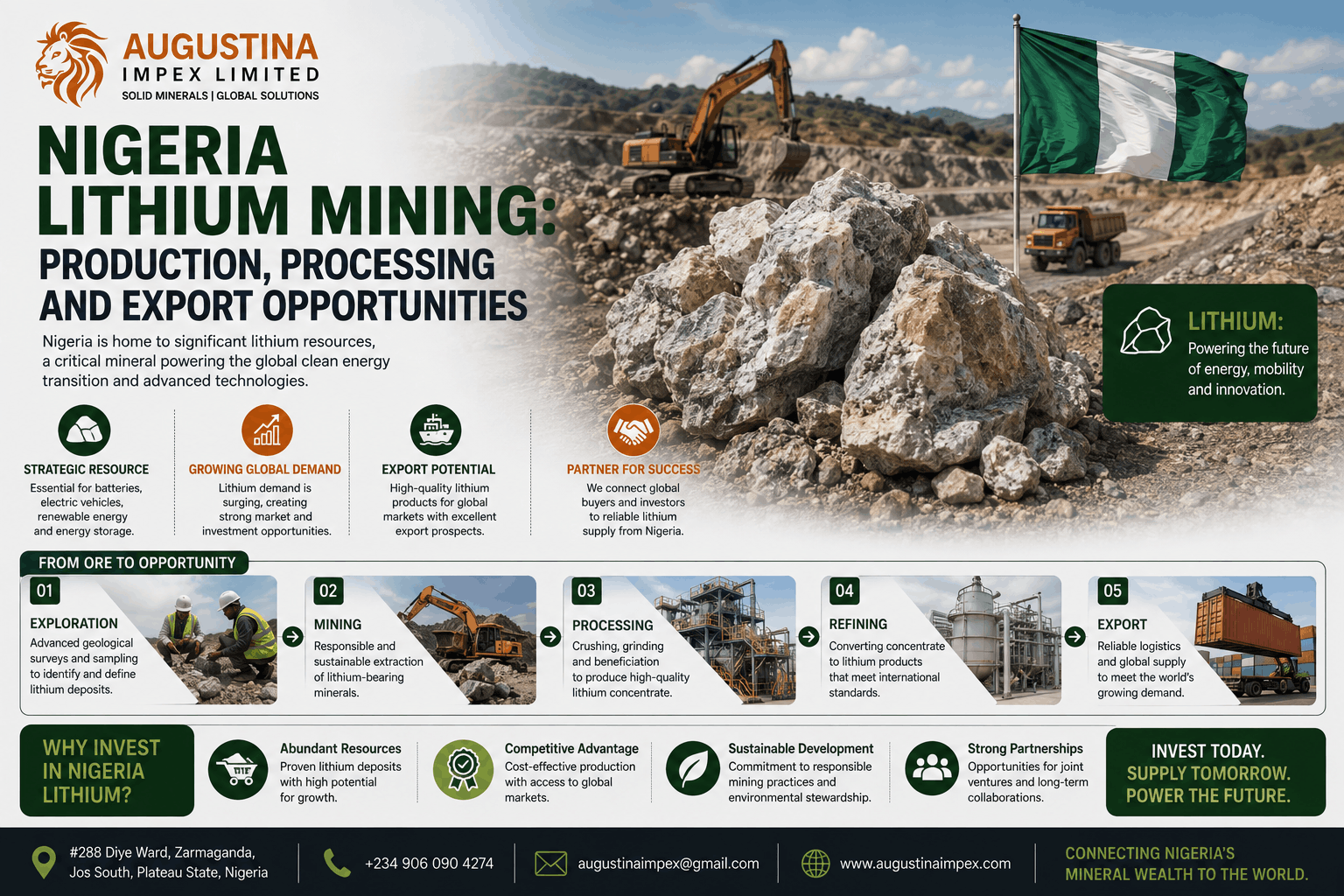
Nigeria Lithium Mining: Production, Processing & Export
Nigeria Lithium Mining: Production, Processing and Export Opportunities By Kolawole King, CEO — Augustina Impex…
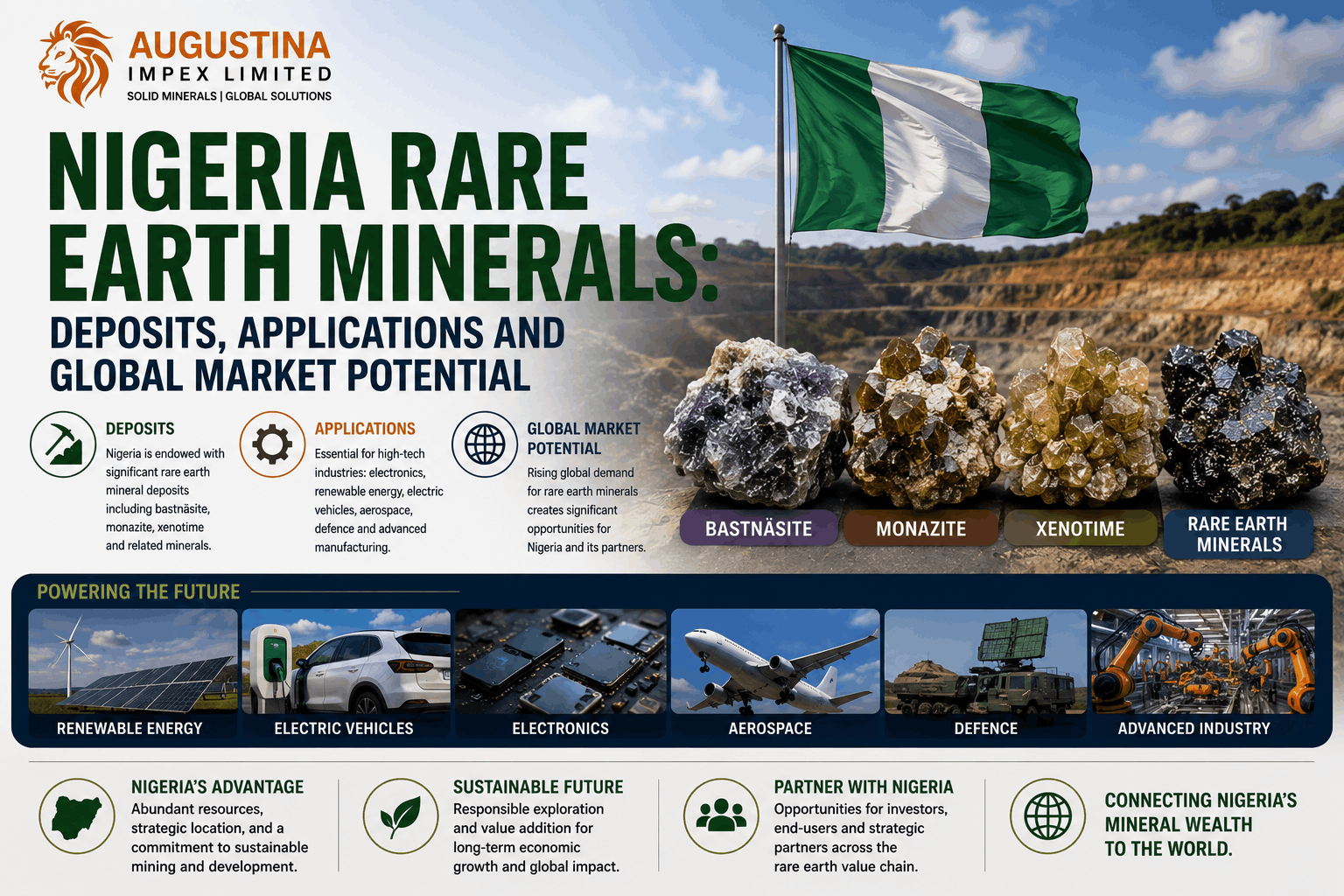
Nigeria Rare Earth Minerals: Deposits & Market Potential
Nigeria Rare Earth Minerals: Deposits, Applications and Global Market Potential By Kolawole King, CEO —…
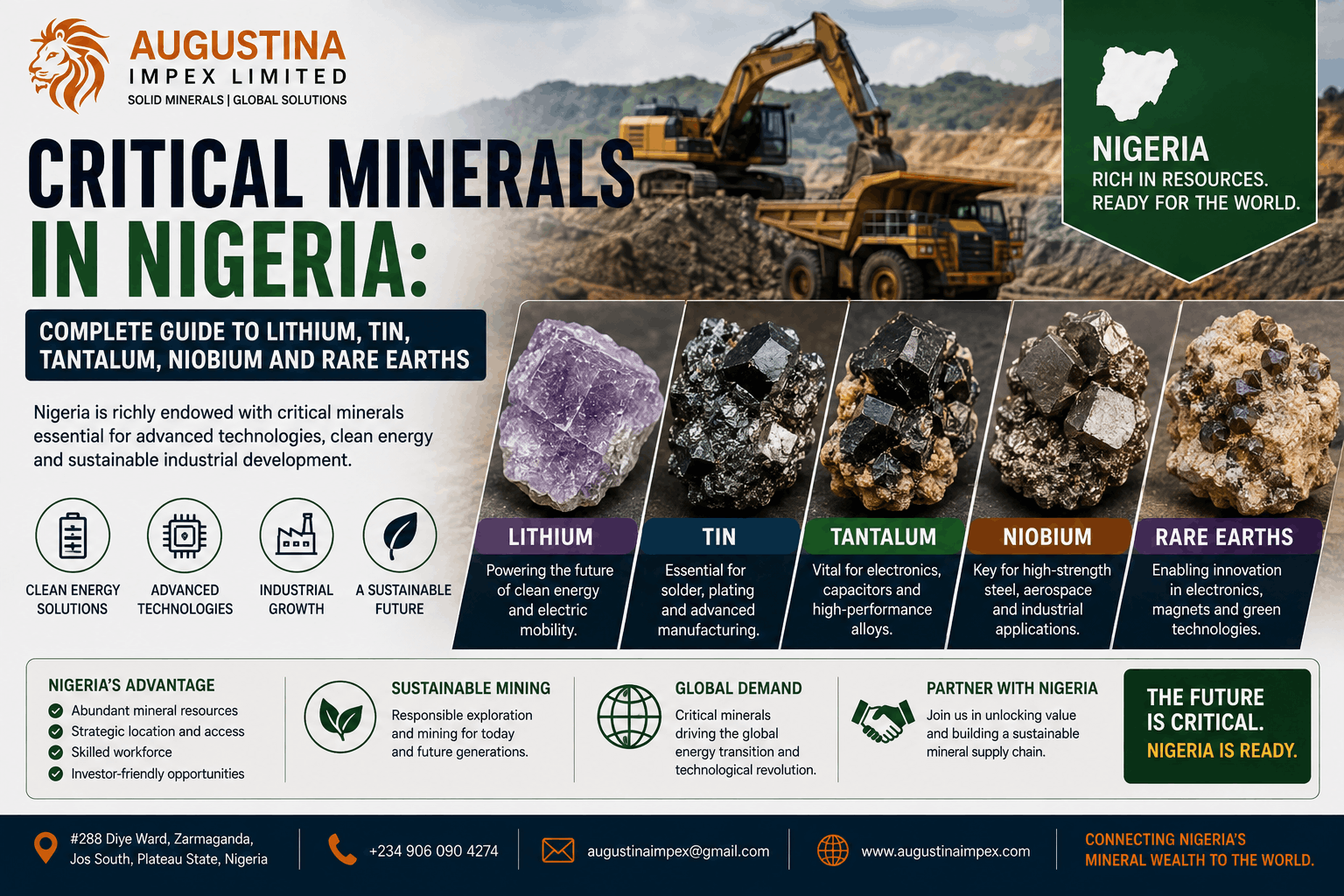
Nigeria Critical Minerals Guide: Lithium, Tin & Rare Earths
Critical Minerals in Nigeria: Complete Guide to Lithium, Tin, Tantalum, Niobium and Rare Earths By…
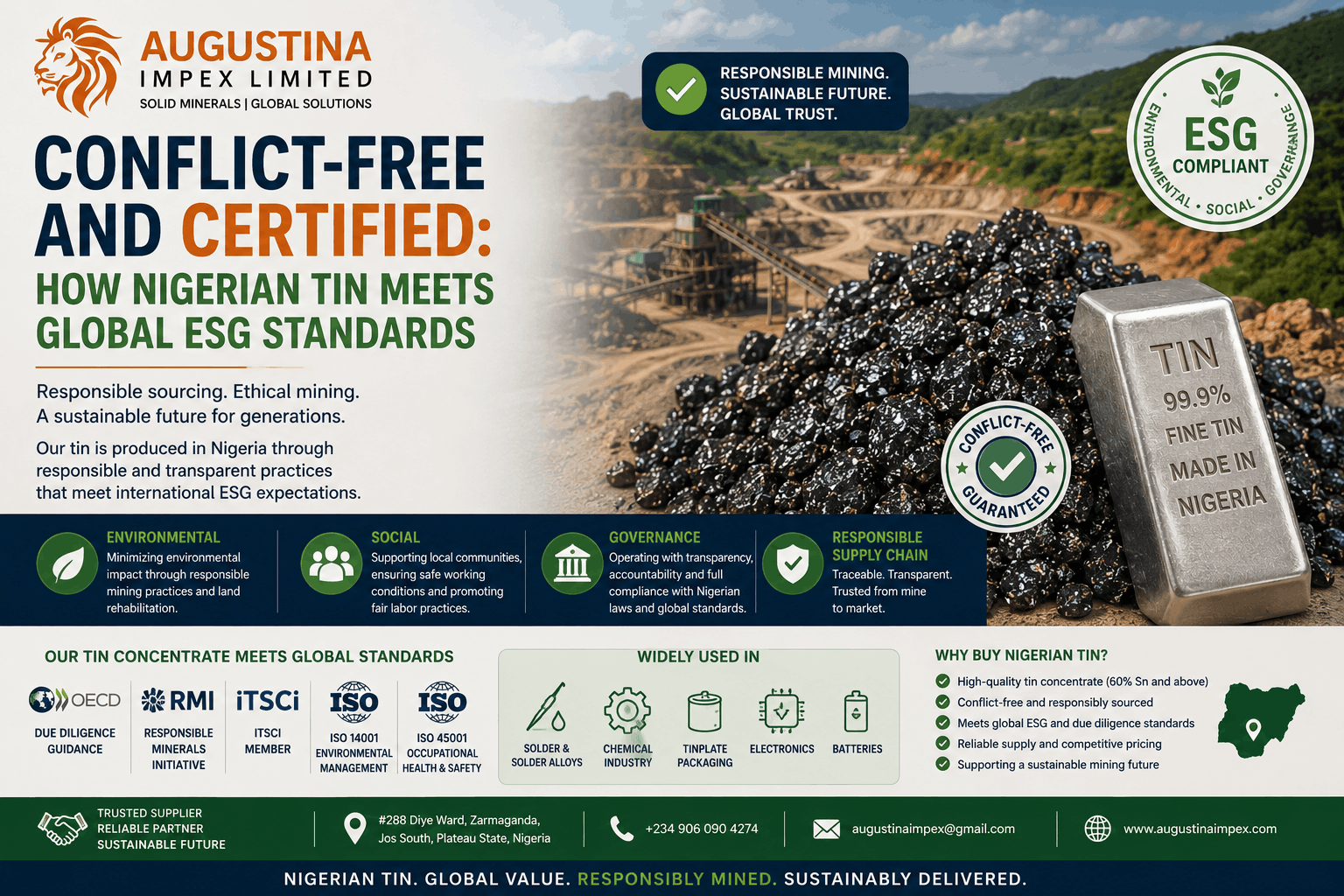
Conflict-Free Nigerian Tin Meets Global ESG Standards
Conflict-Free and Certified: How Nigerian Tin Meets Global ESG Standards By Kolawole King, CEO —…